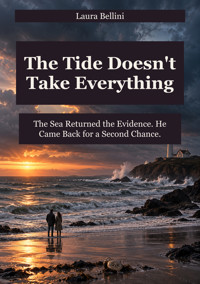
The Tide Doesn't Take Everything - The Sea Returned the Evidence. He Came Back for a Second Chance. ebook
Laura Bellini
Uzyskaj dostęp do tej i ponad 240000 książek od 14,99 zł miesięcznie
- Wydawca: ALL-IN Rafał Płonkowski
- Kategoria: Romanse i erotyka•Romanse
- Język: angielski
After a night storm on the Hel Peninsula, the sea returns something that should have disappeared years ago: a corroded aluminum tag marked 214. Ada, a museum conservator preparing an exhibition about the region’s maritime history, immediately recognizes the initials of Morska Rafa, the diving company once run by her father and Roman Krawiec.
The mark on the back is even harder to ignore. It belongs to Maks Krawiec, Roman’s son and the man Ada loved for six years before he left without giving her a real choice.
Now Maks is back.
Officially, he has returned to investigate unanswered questions surrounding his father’s death fifteen years earlier. But the tag leads to more than an old diving accident. A missing duplicate key, a damaged piece of the technical vessel Nereida, a yellow transport bag, forgotten photographs, hidden documents and a sealed archive begin to expose a history that several people worked hard to leave buried.
Ada cannot simply walk away. Morska Rafa is part of the exhibition she is responsible for, and her own father’s name appears throughout the surviving records. Every discovery forces her to separate the man she loves from the choices he made, and the father she trusts from the truths he refused to tell.
Working with Maks brings another problem. Their old rhythm returns far too easily. So does the attraction. But desire is not trust, and a kiss cannot erase five years of silence. Maks says he has changed. Ada has no intention of believing him simply because he wants her to.
If he wants a place in her life again, he will have to do more than apologize. He will have to stop deciding which truths she is strong enough to hear, accept the consequences of his own choices, and give her something he once denied her: the right to decide for herself.
As the investigation moves from museum archives and storm-damaged quays to underwater evidence and records preserved for fifteen years, Ada and Maks discover that the past is more complicated than any story about heroes and villains. Good intentions can still cause harm. Protection can become control. Love can survive separation while trust does not.
Set against cold water, working harbors, rain-soaked roads and the shifting coastline of northern Poland, The Tide Doesn't Take Everything is a contemporary second-chance romance woven tightly around a family mystery. It is a story about former lovers forced to work together, buried evidence returning at the worst possible moment, and two adults learning that rebuilding a relationship requires more than recovering what they once had.
Because some things return from the sea.
And some truths refuse to stay hidden.
This publication was prepared using tools that support the creative process, including artificial intelligence solutions. The final concept, structure and editing are the responsibility of the author.
Ebooka przeczytasz w aplikacjach Legimi na:
Liczba stron: 260
Rok wydania: 2026
Odsłuch ebooka (TTS) dostepny w abonamencie „ebooki+audiobooki bez limitu” w aplikacjach Legimi na:
Podobne




















Cover
The Tide Doesn't Take Everything
The Sea Returned the Evidence. He Came Back for a Second Chance.
Laura Bellini
ROMANS
Table of contents
Title page
INTRO
Chapter 1 - What Was Supposed to Disappear
Chapter 2 - Terms of Cooperation
Chapter 3 - The Place That Wasn’t Supposed to Exist
Chapter 4 - Things Kept Too Long
Chapter 5 - Truth in More Than One Version
Chapter 6 - The Boundary That Wasn’t on the Map
Chapter 7 - Photographs That Shouldn’t Exist
Chapter 8 - The Other Half
Chapter 9 - What Remained Underwater
Chapter 10 - The Price of Silence
Chapter 11 - The Letter That Waited Fifteen Years
Chapter 12 - Archive 4B
Chapter 13 - The Voice from That Day
Chapter 14 - Things That Cannot Be Undone
Chapter 15 - What He Couldn’t Have Known
Chapter 16 - When Protection Becomes a Lie
Chapter 17 - Roman’s Notebook
Chapter 18 - The Cost of Truth
Chapter 19 - Truth Without Heroes
Chapter 20 - The Tide Doesn’t Take Everything
Landmarks
Cover
Title page
Table of contents
Start of content
INTRO
After a night storm, the sea always looked innocent. Like someone who had wrecked another person’s life the evening before, then showed up the next morning in a clean shirt and asked whether there was anything they could do to help.
I stood on the wet sand a few hundred meters from the harbor in Kuźnica, looking at the line of branches, plastic bottles, scraps of netting, and dark seaweed the water had thrown ashore. The wind was still too strong for early October, but the sky was brightening in the west. Behind me, I could hear the metallic clatter of masts in the marina. In front of me, the waves moved more calmly, as though the madness of the night had had nothing to do with them.
I should have gone back to the workshop.
At nine, I had a call with the regional heritage conservator about funding for an exhibition I had been working on for nearly a year. At eleven, a shipment was due to arrive with wooden fragments of an old fishing boat recovered during harbor dredging. I had forty minutes to shower, drink coffee, and pretend to be a person who ran a small maritime museum, had the budget under control, and did not start her day rummaging through whatever the Baltic had tossed onto the beach.
And yet I kept walking.
I had been doing this after storms since I was a child. First with my father, later on my own. My father used to say the sea never gave things back by accident. I, as an adult woman with a conservation degree and considerably less patience for romantic theories, believed currents, wind, and buoyancy were explanation enough.
Even so, I always watched where I stepped.
I bent to pick up a piece of green glass smoothed by the water. I turned it between my fingers and slipped it into my jacket pocket. We could use it in a mosaic during one of the children’s workshops. A few meters farther on, I found a cracked float, then a plastic crate with Danish lettering on the side.
I did not see the metal until I reached the remains of an old net.
It was not shiny. It almost disappeared into the wet sand. Only a few centimeters protruded from the tangle of lines.
I pulled.
The net gave way reluctantly, revealing a small rectangular metal tag attached to a heavily corroded ring. I brushed the sand off it with my glove.
And stopped hearing the sea.
Three numbers were still legible on the metal.
214.
Below them were two letters.
MR.
I knew this object.
Not one like it.
This one.
Fifteen years earlier, tags like this had hung from the locker keys at my father’s old diving base. He had stamped the numbers himself, slightly crooked, into pieces of aluminum bought from a marine supply shop in Władysławowo. The letters MR stood for Morska Rafa, the company he had run with Roman Krawiec.
The company had ceased to exist after the accident.
Roman Krawiec had died.
Half the peninsula had decided his son was the man who should have prevented it.
And for six years, I had loved that son more than common sense should ever have allowed.
I tightened my fingers around the tag.
“Ada?”
I turned sharply.
A few meters away stood Mr. Leon, a retired fisherman who walked the beach every morning carrying a yellow bucket and searching for amber, even though over the past twenty years he had supposedly found less of it than the average tourist did in a single weekend.
“Everything all right?”
“Yes.”
The answer came too quickly.
I closed my hand around the tag.
“I just found a piece of scrap.”
Leon looked at me, then at my clenched fingers, but he did not ask. On the peninsula, people could refrain from asking questions with the same professionalism people elsewhere used to ask them.
“After a storm like that, it’ll keep throwing things up for a while,” he said.
“Probably.”
He walked on.
I stayed where I was.
Locker 214 had belonged to Roman.
I knew because the key had been found among his personal effects after his death. I even remembered the moment my father had taken it from the plastic evidence envelope the police handed over.
The problem was that this tag should not have been lying on the beach.
The key marked 214 had sat in my father’s desk drawer for years.
Or at least that was what I had believed.
I took out my phone.
For several seconds, I stared at my father’s name in my contacts. I could call him. Ask. Let him tell me I remembered it wrong, or that there had been more than one set of numbers. I could let one logical sentence close the matter.
Instead, I took a picture.
Then another.
I turned the tag over.
There was a scratch on the back.
No.
Not a scratch.
A carved mark.
A small letter K.
A chill passed through me that had nothing to do with the wind.
Maks did that to everything that belonged to him or had been repaired by him. K on the underside of his toolbox. K on the casing of an underwater camera. K on the metal mug he used for coffee at the base. K on the key ring he had once given me.
Roman did not mark things that way.
Maks did.
Behind me came the sound of a car pulling up near the beach access.
I would not have paid attention if a door had not slammed a moment later.
I turned.
First I saw a navy SUV.
Then the man walking toward me.
For five years, I had sometimes imagined our next meeting. In none of those versions did I have wet hair, muddy boots, and my father’s old storm jacket on. In most of them, I was indifferent. Calm. Polite in a way that made it perfectly clear that whatever had once existed between us had stopped mattering a long time ago.
Reality had no respect for my plans.
Maks Krawiec stopped a few steps away.
He was older, of course. Broader through the shoulders, more tired around the eyes. His hair was shorter. He had several days’ worth of stubble and the same deeply inconvenient ability to look at someone as if, during a conversation, the person standing in front of him was the only thing in the world that mattered.
For a moment, neither of us spoke.
Then his gaze dropped to my closed hand.
“What did you find?”
He did not say hello.
He did not ask how I was.
After five years, he started exactly where everything between us had ended - with the things he had not told me.
I opened my fingers.
The tag lay in my palm.
Maks’s face changed at once.
I did not need to ask whether he recognized it.
“Where did you get that?” he asked quietly.
“The sea gave it back.”
He took one step toward me, then stopped before he came too close. Once, he had never needed to think about distances like that.
“Ada, listen to me.”
I laughed without humor.
“Five years ago, I was supposed to listen to you too.”
“I know.”
“No, Maks. That’s exactly the problem. You never knew what I knew.”
I looked at the letter K.
Then at him.
“Why is your mark on your father’s key?”
He did not answer.
And that one second of silence was enough.
Not because it told me the truth.
Because it proved there was a truth to tell.
A wave broke behind me and surged high enough for the water to touch the toes of my boots.
Maks stared at the tag as though he had just seen something he had been afraid of for years.
“I thought it was gone,” he said.
Chapter 1 - What Was Supposed to Disappear
“I thought it was gone,” Maks said.
For several seconds I stared at him, waiting for whatever was supposed to come next.
Nothing did.
Instead of an answer, I got the same kind of silence I remembered far too well: the brief tightening of his jaw, his gaze slipping away for a second before returning to me, as if in that one second he had managed to assess every possible version of the truth and choose the one he believed would do the least damage.
Once, I had thought that quality was self-control.
Later I learned that Maks could keep quiet for many different reasons, and I never knew which one applied at any given moment.
“What exactly was supposed to disappear?” I asked.
The wind blew a strand of hair into my mouth. I pushed it aside without taking my eyes off him.
Maks looked at the tag marked 214.
“That tag.”
“A tag? A minute ago you looked as if the sea had washed a human hand onto the beach.”
“Because I know where it came from.”
“So do I.”
“Not everything.”
I almost smiled. Not because I found anything funny. The sentence was so completely him that for a second it felt as if the last five years had never happened.
“Great. Then this is the perfect opportunity to tell me everything.”
He rubbed a hand over the back of his neck. He used to do that when he did not have an answer.
Now, he probably had one.
What he lacked was the willingness to say it aloud.
“That tag wasn’t attached to the key the police returned after my father died.”
“I noticed. I saw that key.”
“That was the original.”
“And this?”
“A duplicate.”
I looked again at the letter K carved into the back. The lines were shallow but unmistakable.
“You made it.”
He nodded.
“Two days before the accident.”
It felt as though the air around us had suddenly thickened.
“Why?”
“My father asked me to.”
“Why did he need a second key to his own locker?”
“He didn’t tell me at the time.”
“And later?”
Maks did not answer immediately.
That was enough.
“You found out later.”
“Partly.”
“And of course you told no one.”
“Ada…”
“Don’t.”
I closed my fingers around the tag and started toward the beach access. Maks followed but kept several meters between us. He knew that if I wanted him to stop, I would say so plainly.
At least he had not forgotten that much about me.
“The duplicate was only supposed to be used for one night,” he said.
I did not turn around.
“Fascinating.”
“My father said he’d return it the next day.”
“He didn’t.”
“No.”
“Because he died.”
“Yes.”
The steps leading over the dune were wet and half-buried in sand. I grabbed the railing to keep from slipping on one of them. Maks came closer but did not touch me.
I noticed the absence of that gesture more than I wanted to.
Only his car and my old Toyota stood in the parking area. His navy SUV was parked crookedly, as though he had arrived in a hurry.
“How did you know I was here?” I asked.
“I didn’t.”
“So what were you doing on this beach at seven in the morning?”
“Looking for whatever the storm might have exposed.”
I stopped.
“What?”
Maks looked toward the sea.
“Remains of the old quay. Things from the base.”
“The base was demolished eleven years ago.”
“The buildings were.”
“Maks.”
He sighed.
“After storms, the current washes things in from around the old channel. It always did. No one was actively looking for them before.”
“You were.”
“Yes.”
“Why now?”
This time he held my gaze.
“Because that’s why I came back.”
A sharp, almost cleansing irritation cut through me. It made it easier not to notice everything else: that his voice was still the same, only slightly deeper; that when he stood with his hands in his pockets, his left shoulder dipped a little because he had broken his collarbone windsurfing years ago; that I still remembered details like that after five years of deliberately building a life without him.
“For bits of metal on the beach?”
“For answers.”
I gave a short laugh.
“A new hobby? You left five years ago without them.”
“Five years ago, I didn’t have enough to prove anything.”
“And now you do?”
He looked at my hand.
“Now the sea has just returned the first thing that shouldn’t exist.”
The words were too precise for me to ignore.
I leaned against the door of my Toyota.
“Start talking.”
Maks came closer but stopped on the other side of the car.
“When I made the duplicate, my father told me not to record it in the key log.”
“You had a key log?”
“Everything at the base was logged. Equipment, cylinders, gas mixes, keys, tools. Your father made sure of it.”
“I know.”
Jan Rosiński was capable of locking a man in the storeroom if he failed to sign out two screwdrivers. As a child, I had thought he was obsessively pedantic. Later, I learned that with diving equipment, pedantry could be a virtue.
“Roman didn’t want Dad to know about the duplicate?” I asked.
“That was how I understood it at the time.”
“And you made it anyway.”
“I was twenty-one. My father said he’d lost the spare and didn’t want an argument with Jan. I assumed it was something stupid.”
“And the K?”
“So I’d know which one was mine. I was supposed to take the tag back afterward and return the key to the locksmith.”
“You didn’t.”
“My father took the whole set.”
I looked at the number.
“For locker 214.”
“Yes.”
“What was inside?”
“That’s exactly what I don’t know.”
“You said you found out partly.”
Maks closed his eyes for a moment.
“Three days after the funeral, I checked the locker.”
“And?”
“It was empty.”
“Maybe it had always been empty.”
“No.”
“How do you know?”
“Because two weeks earlier, I helped my father open it after the lock jammed. There was a yellow transport bag inside and a metal case.”
“What was in the case?”
“I didn’t open it.”
“The bag?”
“That either.”
“Do you seriously never open anything?”
He looked at me with a trace of the old amusement, there and gone almost before I saw it.
“Not then.”
“Who emptied the locker?”
“I don’t know.”
“My father?”
“He said it was already empty by the time the police secured the base.”
“Do you believe him?”
That was the first question that made Maks visibly hesitate.
“I want to.”
Those three words hurt more than a simple no would have.
I opened the car door.
“I have to go to work.”
“Ada, don’t show that tag to anyone yet.”
I froze.
“Excuse me?”
“Not until we establish exactly where it washed up from.”
“We?”
“Yes.”
“Us?”
“If you let me.”
“You come back after five years, happen to find me on the beach, it turns out you’ve been looking for evidence connected to your father’s death, and then you inform me that we’re going to do this together?”
“I’m not informing you.”
“It sounded remarkably similar.”
Maks rested both hands on the roof of his SUV.
“You’re asking me to tell you the truth, so I am. I don’t know who emptied locker 214. I don’t know why my father needed a secret duplicate. I do know that duplicate was never found afterward, and for fifteen years I assumed it disappeared along with something Roman took from the base. Today you found its tag a few hundred meters from the place where pieces of equipment connected to Morska Rafa washed up after the storm. If there’s even a chance the sea uncovered something else, I want to find out.”
“Alone.”
“If that’s your condition.”
“It is.”
He accepted it without protest.
I should have felt relieved.
Instead, an irritating little sting of disappointment went through me.
“All right,” he said. “But I’m asking one thing. Don’t throw it away, and don’t clean it.”
“I’m a conservator. I wasn’t exactly planning to attack fifteen-year-old aluminum with a wire brush.”
“I know.”
“I see five years have taught you to trust my professional judgment.”
“I always trusted your professional judgment.”
I said nothing.
That was true too.
The problem with Maks had never been that he underestimated me. Quite the opposite. When I was twenty-seven and wondering whether to leave my job in Gdańsk to take over a small museum on the peninsula, everyone else asked about salary, prospects, and whether it was sensible.
Maks asked only one thing.
Would I be allowed to do there what no one let me do anywhere else?
I said yes.
“Then go,” he told me.
Three years later, he left himself without asking me anything.
I got into the car.
“Ada.”
I stopped the door before closing it.
“What?”
“Your father knows I’m here.”
I looked at him.
“How?”
“I spoke to him yesterday.”
Everything inside me hardened.
“You arrived yesterday?”
“In the evening.”
“And the first thing you did was go see my father.”
“I had to.”
“Of course.”
“It wasn’t about you.”
“Don’t worry. I’ve had five years to stop assuming anything you do is about me.”
This time it was his face that changed.
I shut the door.
I reached the museum nine minutes before my call with the heritage conservator. Kasia, who handled the administration, looked at me over the rim of her mug.
“You look like you lost a fight with the Baltic.”
“The Baltic cheated.”
“There’s coffee on your desk.”
“I love you.”
“Unlike the Baltic, I don’t use that against you.”
I stopped for a second.
“Why is everyone speaking to me in sentences with double meanings today?”
Kasia narrowed her eyes.
“Who else?”
“No one.”
“Ada.”
“My call is at nine.”
“So you’ll tell me at ten.”
I did not have time to argue.
The museum occupied an old fishing warehouse right beside the harbor. It was not large. Two exhibition rooms, a conservation workshop, storage, a small office, and a mezzanine where we held workshops. Over the past four years I had managed to secure funding for renovations, a humidity-control system, and the digitization of the collection.
Now I was fighting for the biggest project since I had taken over the institution: an exhibition about divers, rescuers, and the people who had worked underwater around the peninsula for decades.
Morska Rafa was supposed to be an important part of it.
That morning, the decision suddenly seemed like an exceptionally bad idea.
I went through the call almost on autopilot. I answered questions about display protection, the budget, and the schedule while an object belonging to the very history I planned to present in a few months as ordered, cataloged, and understood sat in the pocket of my jacket hanging over the chair.
After forty minutes, I was told the funding decision should be made within two weeks.
I thanked them.
Ended the call.
Kasia came into my office without knocking.
“Krawiec is back.”
I looked at her.
“How do you already know?”
“My brother works at the harbor. He saw his car.”
“A car isn’t proof that a person is here.”
“Are you suggesting Maks sent the car ahead of him?”
“I’m suggesting I have a lot of work.”
She sat down across from me.
“You saw him.”
I said nothing.
“Oh my God.”
“Don’t make it into an event.”
“For people who remember you as a couple, it is an event.”
“Don’t people have lives of their own?”
“They do. Yours was more interesting.”
“Thank you.”
I took a small ziplock bag from the drawer where I kept supplies for securing minor finds and placed the tag on my desk.
Kasia stopped smiling.
“What’s that?”
“I found it on the beach.”
“Is that a Morska Rafa number?”
I nodded.
Kasia had worked with me long enough to recognize the labeling system.
“Two fourteen,” she said. “We have two thirteen and two sixteen in the catalog.”
I looked at her.
“We do?”
“From your father’s donation. Remember? The box with metal tags and keys.”
I stood so quickly that my knee hit the desk.
The storage room was behind the workshop. I knew where the Morska Rafa collection was kept, though I had last gone through it several months earlier while preparing the first draft of the exhibition plan.
Box MR/17 sat on the second shelf.
Kasia brought it to the table.
I put on gloves.
Inside were identification tags, damaged pressure gauges, employees’ nameplates, an old company stamp, and eleven keys with aluminum tags.
201.
202.
203.
204.
205.
206.
The numbers did not form a complete sequence. Most of the equipment had been handed out, discarded, or kept by its owners when the base closed.
I took out the donation record.
Donor: Jan Rosiński.
Date: eight years earlier.
Description: administrative and storage equipment from Morska Rafa.
An attachment listed the items.
I ran my finger down the page.
Beside the entry marked “keys and locker tags,” there was a handwritten note in my father’s writing.
“Range 201-220, missing 204, 209, 214, 215, 218.”
Tension gathered between my shoulder blades.
Kasia looked at me.
“Fourteen was already listed as missing then.”
“Yes.”
“So finding this on the beach is…”
“Weird.”
“I was going to say damn weird.”
I did not answer.
There was another line beneath the entry, one I had never noticed before.
“214 - R.K. - private materials.”
R.K.
Roman Krawiec.
“Ada?”
I put the record down.
“I need to talk to my father.”
I did not call.
I drove there.
He lived a few kilometers away in a small house behind a belt of pine trees. After my mother died, he sold the larger house and moved here, claiming that a man over sixty did not need three bathrooms and a garden demanding more attention than most marriages.
I found him in the garage, repairing a lamp from an old boat.
“Ada?” He looked surprised. “I thought you were working.”
“I am.”
“Then why…”
I took out the bag.
My father fell silent.
He did not need to ask what it was.
It was the second time that day someone’s face told me more than their words.
“Where did you find that?” he asked.
“On the beach.”
“After the storm?”
“Yes.”
He took off his glasses.
“Throw it away.”
I stared at him, certain I had misheard.
“What?”
“It’s an old piece of metal. It means nothing.”
“On the donation record, you wrote that 214 belonged to Roman.”
“Because it did.”
“And that it was missing.”
“Because it was.”
“Maks says he made a duplicate two days before the accident.”
My father went still.
“You spoke to him?”
“This morning.”
“Ada…”
“Don’t change the subject.”
“I’m not. I just want to know what he told you.”
“Enough to bring me here.”
My father set down the screwdriver.
“Maks should never have gone back to this.”
“To Kuźnica or to the case?”
“Both.”
“Why?”
For a moment he looked much older than he had the day before.
“Because some things are over.”
I looked at the bag.
“Apparently the sea disagrees.”
My father shook his head.
“You don’t know what you’re saying.”
“Then explain it to me.”
He did not answer.
And for the first time that day, I was genuinely afraid.
Not of the object.
Not of Maks coming back.
Of the fact that the two men I knew best in the world had looked at the same metal tag and both reacted as though what they had seen was not a piece of the past.
But something that could still reach them.
Chapter 2 - Terms of Cooperation
My father poured coffee into two mugs even though I had never said I was staying. He always did that during difficult conversations. Coffee meant the problem could be contained at the table, divided into reasonable pieces, and solved without anyone raising their voice unnecessarily.
This time, I did not sit down.
I stood by the kitchen window and watched the pine trees bend in the wind. The tag marked 214 lay between us on the table inside its plastic bag.
“Tell me why I should throw it away.”
My father rested his elbows on the counter.
“Because nothing good will come of it.”
“That isn’t an answer.”
“Ada, it’s been fifteen years.”
“Exactly. That should make it easy to talk about.”
He looked at me wearily.
“Not everything gets easier just because it gets older.”
“Roman died. The base closed. Maks left. For years you’ve said the accident was explained. So what exactly can happen because one key has been found?”
“It isn’t a key.”
“You know what I mean.”
He pushed one of the mugs toward me.
I did not touch it.
“The duplicate wasn’t in the records,” he said.
“I know.”
“So it has no value.”
“Maybe not to the police. It has value to me.”
“Why?”
That question irritated me more than anything he had said so far.
“Because Maks made it for Roman without logging it. Because Roman took it two days before he died. Because it disappeared afterward. And because eight years ago, you listed 214 as missing.”
My father looked at the tag.
“I wrote down what I knew.”
“What was in the locker?”
“Roman’s things.”
“What things?”
“Documents. Personal odds and ends. Maybe some equipment.”
“Maks remembers a yellow bag and a metal case.”
My father’s eyes lifted immediately.
“He told you that?”
“Yes.”
“What else has he been filling your head with?”
“Stop talking about him as if he’s trying to sell me something.”
“He tried once before.”
“What?”
My father pressed his lips together.
“His version of what happened.”
“When?”
“A long time ago.”
“Never to me.”
“Maybe for once he did something sensible.”
Cold moved through me.
“You spoke to him about the accident after Roman died.”
“Of course.”
“I’m not talking about the investigation. I mean later.”
My father stood and went to the coffee machine even though his mug was full. He turned his back to me.
“Maks was looking for someone to blame.”
“People thought he was responsible.”
“People always need one person. Accidents are rarely that simple.”
“So you didn’t think it was his fault?”
“I said as much at the time.”
That part I remembered.
After Roman died and stories started circulating around the harbor that Maks should have called off the dive sooner, my father defended him publicly. He kept saying the decision belonged to the operation supervisor and to Roman himself.
I had always assumed he did it out of loyalty to his business partner and his son.
“And yet you don’t want him looking for answers.”
“I want him to start living.”
“He is living.”
“You don’t know that.”
“Apparently you know more about him than I do.”
My father turned around.
“You haven’t seen each other in five years.”
“That doesn’t give you the right to answer for him.”
“I’m not.”
“Then answer for yourself. What happened to the contents of locker 214?”
He said nothing.
My heart rose into my throat, not from fear but from the growing certainty that I had finally asked the exact question I was supposed to ask.
“Dad.”
“After the accident, the base was chaos.”
“I know.”
“The police secured documents. The insurer took copies. Some equipment was returned to families. Some was sold. I don’t remember every object.”
“But you remembered the number eight years later.”
“Because I was preparing an inventory.”
“And you wrote Roman’s initials next to it.”
“Yes.”
“Why?”
“Because the locker belonged to him.”
“How did you know that if, fifteen years later, you don’t remember what was inside?”
My father looked at me for a long moment.
“Are you interrogating me?”
“No. An interrogation is conducted by someone who assumes there’s a possibility you’re lying. I’m still trying to assume you’ll tell me the truth.”
That hurt him.
I could see it.
It hurt me too.
At last, he sat at the table.
“Ada, promise me one thing.”
“No.”
“You don’t even know what I’m asking.”
“You want me to leave this alone. I won’t promise that.”
“I want you not to give this to Maks.”
I looked at the plastic bag.
“Why?”
“Because if he really came back to dig into that story, he won’t stop at one metal tag.”
“Maybe he shouldn’t.”
“You don’t know where this leads.”
“Do you?”
My father ran his tongue along the inside of his cheek the way he always did when trying to buy himself a few seconds.
“I know my friend died fifteen years ago. I know his son was left carrying guilt no one could take away from him. I know we all made mistakes.”
“What mistakes?”
“I’m not digging all this up at the kitchen table.”
“Then choose another place.”
I stood.
My father stood too.
“Ada.”
I picked up the tag.
“I have to get back to the museum.”
“What are you going to do?”
“I don’t know yet.”
“Don’t do anything with Maks.”
I stopped at the door.
“That’s particularly interesting advice from a man who spoke to him yesterday before bothering to tell me he was back.”
My father did not answer.
I left.
On the way to the museum, I tried to organize the facts, but my thoughts kept returning to one detail.
My father had not asked how Maks knew about the duplicate.
He had not asked whether Maks might be mistaken.
He had not even asked whether I was sure the letter K belonged to him.
He knew.
My phone rang as I passed Jastarnia.
Kasia.
“Where are you?”
“On my way back.”
“Good. The shipment arrived.”
“At eleven.”
“It’s eleven twelve.”
I looked at the clock.
“Damn.”
“Relax. They’re already unloading. But we got a bonus.”
“How badly do I not want to know?”
“Depends. Remember the port ordered an additional review of things recovered during the dredging after the storm?”
“Yes.”
“They brought us something that wasn’t on the list.”
“What?”