
Uzyskaj dostęp do tej i ponad 240000 książek od 14,99 zł miesięcznie
- Wydawca: Kuba Niessner _
- Kategoria: Powieści przygodowe i historyczne
- Język: angielski
The Templar is a dark historical novel set during the final years of the Crusader kingdoms, when faith, war, and betrayal ruled the world.
Aldric de Fontaine is twenty-four years old, a Knight Templar, and the Order’s hidden weapon. Chosen by the Grand Master himself, he is sent where armies cannot go - into shadows, courts, fortresses, and enemy strongholds - to carry out missions that must never be spoken of. Traitors, spies, enemies of the Order... all are judged in silence, and Aldric is the blade that delivers that judgment.
As the Holy Land begins to crumble under the pressure of war, Aldric is pulled deeper into a world of bloodshed, politics, and secret loyalties. From Jerusalem and Tyre to Kerak, Constantinople, and the courts of Europe, he moves through a land divided by ambition, fear, and fanaticism. Every mission brings him closer to the truth behind the wars being fought around him - and to the darkness growing within himself.
While kingdoms fall, rulers scheme, and Saladin rises, Aldric must survive not only the enemies beyond the walls, but also the ones within his own world. In an age where men kill in the name of God and power hides behind holy vows, loyalty can be more dangerous than treason.
The Templar is a story of war, secrecy, sacrifice, and the brutal cost of devotion. It is a novel about a man shaped by violence, torn between faith and duty, and forced to walk a path from which there may be no return.
Ebooka przeczytasz w aplikacjach Legimi na:
Liczba stron: 338
Rok wydania: 2026
Odsłuch ebooka (TTS) dostepny w abonamencie „ebooki+audiobooki bez limitu” w aplikacjach Legimi na:
Podobne
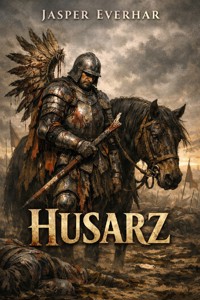


















THE TEMPLAR
THE BLEEDING CROSS
A Novel of the Knights Templar
Jasper Everhar
"Non nobis, Domine, non nobis, sed Nomini Tuo da gloriam."
(Not unto us, O Lord, not unto us, but to Thy Name give glory.)
— Psalm 115:1, Motto of the Knights Templar
"Every saint has a past, and every sinner has a future."
PROLOGUE
I remember the smell. That is what stays with me, even now, after all the blood and all the years. Not the sight of the Grand Master’s face, half-hidden in the candlelight. Not the sound of his voice, low and deliberate as a man reading last rites. But the smell — cold stone, tallow smoke, and something beneath it all, something older, like iron left too long in water. Like old blood that had seeped into the foundations of the world and refused to wash away.
It was the autumn of the Year of Our Lord 1185, and I was twenty-four years old. I had been a Knight of the Temple for three years, sworn in the usual way, with the usual vows — poverty, chastity, obedience. I had knelt in the chapel at Tortosa with my forehead pressed to cold marble and spoken the words that every Templar spoke, the words that were supposed to burn away the old man and forge something holy in his place. I believed them, then. Or I believed that I believed them, which is perhaps the same thing when you are young enough.
My name was Aldric de Fontaine, though I had not used that name with any pride in many years. The de Fontaines were minor nobility from the county of Champagne, which meant we had a name, a crumbling tower, and not much else. My father, Guillaume de Fontaine, had been a knight in the retinue of Count Henry I of Champagne — a position of some nominal honour and absolutely no wealth. He drank. He fought poorly and often. When I was six, he rode to a tournament at Troyes and was unhorsed so badly that his left leg never set right again. After that, he drank more. My mother, Isabelle, had died giving birth to me, which my father mentioned often enough that I understood it as an accusation rather than a fact. By the time I was ten, he had sold our last parcel of good land to pay his debts to a Lombard moneylender and was sleeping in the hall of our tower with three dogs and a barrel of sour wine.
The monks of Saint-Pierre-de-Lagny took me in when I was eleven. Not out of charity — my father gave them two silver marks and the right to harvest our orchard, which was about the only thing of value left on our land. I think he was glad to be rid of me. I know I was glad to be rid of him. At Saint-Pierre, I learned to read and write in Latin and French, to calculate figures, to sit still during the offices, and to endure boredom so profound it felt like a physical weight pressing on my skull. I also learned to fight, though the monks would not have called it that. Brother Matthieu, who had been a sergeant before taking orders, taught me the basics of the sword under the pretence of ‘physical instruction for the health of the body.’ I took to it the way a river takes to its bed — naturally, inevitably, and with a quiet violence that Brother Matthieu found troubling.
When I was fourteen, a Templar recruiter visited Saint-Pierre. He was a hard-faced man named Arnaud de Villiers, a sergeant of the Order, and he watched me spar with a wooden sword for perhaps three minutes before speaking to the abbot. Two weeks later, I was on a ship to the Holy Land. My father did not come to see me off. I was told he died three years later, drowned in a ditch after a night of drinking. I felt nothing when I heard the news, and I feel nothing about it now. I mention it only because you should understand what I was made of before the Temple ever got its hands on me. I was not innocent. I was not devout. I was a boy with a dead mother and a worthless father, a boy with quick hands and empty pockets and a talent for hurting people. The Templars did not corrupt me. They merely sharpened what was already there.
* * *
The fortress they brought me to that night was not the main Templar house in Jerusalem — not the great complex on the Temple Mount that the Saracens called the Al-Aqsa Mosque and we called the Templum Solomonis. Every pilgrim and merchant in the Kingdom of Jerusalem knew that place, with its stables vast enough for two thousand horses and its halls where white-mantled knights came and went like ghosts at all hours. No. This was somewhere else. Somewhere beneath.
Brother Gilles came for me after Compline, when the other knights had retired to the dormitory. He was a thin, silent man with a face like a hatchet blade — one of the Grand Master’s personal attendants, though I had never been sure of his exact title. He said nothing. He simply appeared at the door of my cell, held up a lantern, and gestured for me to follow. I pulled on my boots and went.
We walked through corridors I knew, and then through corridors I did not. The Templar precinct in Jerusalem was vast — a labyrinth of halls, chapels, storerooms, kitchens, armouries, and dormitories that sprawled across the southern end of the Temple Mount. The Order had occupied the site since 1120, when King Baldwin II of Jerusalem granted the original nine knights the use of the Al-Aqsa Mosque as their headquarters. In the sixty-five years since, generation after generation of Templars had expanded, excavated, built, and rebuilt until the precinct was less a building than a small city — one that extended as far below the surface as it did above it. The tunnels beneath the Temple Mount were ancient. Some dated to the time of Solomon. Some were older still. The Templars had explored them, mapped them, sealed some and opened others, and built new passages of their own between the old ones. It was into this underworld that Brother Gilles led me.
Down stairs. Through a doorway that looked like solid stone until Gilles pressed something I could not see and it swung inward on oiled hinges. Along a passage so narrow my shoulders brushed the walls on either side. The air grew colder as we descended, and the smell of tallow and old stone grew stronger. I could hear water somewhere — a slow, persistent drip, as though the rock itself were weeping. Finally, we emerged into a chamber.
It was not large — perhaps twenty paces across, with a vaulted ceiling that disappeared into shadow. The floor was smooth, worn stone. In the centre stood a table of dark wood, bare except for a single candle and a sealed letter. Behind the table, in a chair that was no more ornate than a common bench, sat Gérard de Ridefort, Grand Master of the Poor Fellow-Soldiers of Christ and of the Temple of Solomon.
I had seen de Ridefort before, of course. Every Templar in the Kingdom had. He was a tall man, lean and sharp-featured, with close-cropped grey hair and eyes that never seemed to rest on anything for long. He had been elected Grand Master in 1185, only months before this night, after the death of Arnold of Torroja. The older knights spoke of him with a respect that was laced, I noticed, with something else — not quite fear, but a kind of wariness, as one might feel around a dog that had bitten before. De Ridefort was ambitious, impatient, and utterly convinced of his own divine mandate. He had risen through the Order not through piety but through politics, and there were brothers who said quietly that he served his own glory more faithfully than God’s. I did not know, that night, how much truth was in those whispers. I would learn.
“Sit,” he said. There was no greeting, no preamble. A second chair had been placed before the table. I sat. Brother Gilles withdrew to the edge of the chamber and stood in the shadows like a piece of furniture.
De Ridefort studied me for a long moment. The candlelight carved his face into angles and hollows. “You are Aldric de Fontaine,” he said. It was not a question. “Twenty-four years of age. Born in Champagne. Taken into the Order at fourteen, made a full brother-knight at twenty-one. You have fought at Kerak, at Nablus, and in three engagements along the road to Jaffa. You killed your first man at seventeen — a Saracen raider, a lance through the throat. Your marshal reports that you are skilled with the sword, adequate with the lance, and exceptional with the dagger. You are literate in French, Latin, and passable Arabic. You drink less than most knights. You pray more than I expected.”
He paused. I said nothing. In the Temple, you did not speak to the Grand Master unless spoken to, and even then, brevity was a virtue.
“Your marshal also reports,” de Ridefort continued, “that you are difficult. That you obey orders precisely but without enthusiasm. That you have been disciplined twice for leaving the precinct without permission, and once for striking a sergeant who insulted your parentage. That you keep your own counsel, trust no one fully, and have a coldness about you that some of your brothers find unsettling.” He leaned forward slightly. “Do you dispute any of this?”
“No, my lord.”
“Good. A man who lies about his own nature is useless to me.” De Ridefort picked up the sealed letter from the table and held it between two fingers, turning it slowly. The seal was red wax, stamped with the Templar cross, but there was something else pressed into it — a second mark, smaller, that I could not make out in the dim light. “What I am about to tell you,” he said, “does not leave this room. Not in words, not in writing, not in confession, not in prayer. If you speak of it to any living soul, you will be killed. Not punished. Not expelled. Killed. Do you understand?”
“Yes, my lord.”
“The Order of the Temple,” de Ridefort said, setting down the letter, “was founded in 1119 by Hugues de Payns and eight other knights, for the protection of Christian pilgrims on the roads of the Holy Land. That is what the chronicles say. That is what the Pope says. That is what every brother in this Order believes, and it is true — as far as it goes.” He steepled his fingers. “But the Temple has always had another purpose. A purpose known only to the Grand Master, the Seneschal, and a very few brothers chosen for a very specific calling.”
I waited. My heart had begun to beat faster, though I kept my face as still as the stone walls around me.
“The roads of the Holy Land,” de Ridefort continued, “are not only threatened by bandits and Saracen raiders. The Kingdom of Jerusalem is surrounded by enemies — Saladin to the south and east, the Seljuks to the north, the Assassins in their mountain fortresses, the Byzantines with their endless intrigues. But the greatest threats to the Kingdom are not always external. Traitors. Spies. Men who sell Christian blood for Muslim gold. Men who would open gates, poison wells, betray troop movements, murder kings. These threats cannot be met on a battlefield. They cannot be defeated with a charge of heavy cavalry. They require a different kind of soldier.”
He fixed me with those restless eyes. “They require a shadow.”
* * *
What de Ridefort explained to me in that underground chamber — speaking slowly, precisely, as though each word were a stone being laid in a wall — was this: since the earliest days of the Order, there had existed within the Templar structure a hidden role. It had no official title in the Rule of the Order. It appeared in no charter, no papal bull, no record that any historian or inquisitor would ever find. The brothers who served in this capacity were known, among the very few who knew of their existence at all, by a single word: Umbra. Shadow.
The Umbra was the Grand Master’s personal instrument of secret violence. An assassin. A killer who operated alone, outside the chain of command, answerable to no one except the Grand Master himself. When a threat to the Order or to Christendom could not be addressed through open warfare or diplomacy — when a man needed to die quietly, without trial, without witnesses, without the knowledge of the Pope or the King of Jerusalem or even the Templar Seneschal — the Umbra was dispatched. He received his orders in sealed letters, stamped with the Grand Master’s personal mark. He chose his own methods. He reported his success with a single word, written on a scrap of parchment and left in a designated place. And then he returned to his ordinary life as a brother-knight, invisible, unremarkable, waiting for the next letter.
There had been an Umbra for as long as anyone could remember, de Ridefort told me. The first had served under Hugues de Payns himself. Each Grand Master selected the next, usually from among the younger knights — men who were skilled, discreet, and possessed of what de Ridefort delicately called ‘a certain moral flexibility.’ Not every Grand Master had used the Umbra frequently. Some had been men of genuine piety who found the role distasteful and employed it only in the direst circumstances. Others — and here de Ridefort’s thin lips curved into something that was not quite a smile — had been more pragmatic.
“I am pragmatic,” he said. “The Kingdom of Jerusalem is dying. Baldwin the Leper held it together through force of will, but Baldwin is dead. His nephew, the child Baldwin V, is sickly and will not last. When the boy dies, Guy de Lusignan will seize the throne — a fool, a vain and reckless fool, but a fool who serves my purposes for now. Meanwhile, Saladin grows stronger every year. He has united Egypt and Syria under his banner. He is patient, intelligent, and ruthless. The Kingdom has perhaps two years before he comes for Jerusalem. Perhaps less.”
De Ridefort leaned back. “In the time that remains, there is much work to be done. Work that requires a sharp blade and a quiet hand. I have watched you for two years, Aldric de Fontaine. I have read every report your marshals have written. I have spoken with the brothers who train beside you and the sergeants who have bled beside you. You are exactly what I need.”
He pushed the sealed letter across the table. “From this moment, you are the Umbra. You will continue to live and serve as a brother-knight. You will attend the offices, keep the Hours, obey the Rule in all things that are visible. But when a letter bearing this seal reaches you —” he tapped the wax with one finger, and I saw now the second mark pressed into it: a small cross with a single wing, the sign of a fallen angel — “you will read it, memorise its contents, burn it, and carry out its instructions. No questions. No hesitation. No mercy.”
I looked at the letter. I looked at de Ridefort. And I felt something move inside me — something that had been coiled there for years, waiting. Not horror. Not reluctance. Something darker and more honest than either of those things. Recognition. As though I had always known this was what I was for, and had merely been waiting for someone to say it aloud.
“Yes, my lord,” I said.
* * *
They gave me my equipment that same night. Not the standard-issue gear of a Templar knight — the longsword, the kite shield, the white surcoat with its red cross that made every brother a target on the battlefield. This was different. Specialised. The tools of a trade that no one was supposed to know existed.
The first was a sword — but not the heavy, cross-hilted longsword that was the standard Templar weapon. This was shorter, lighter, designed for close work in tight spaces. The blade was perhaps two and a half feet long, single-edged for most of its length with a double-edged point for thrusting. The steel had been folded and refolded in a way I had never seen before — the smith who made it, I was told, had learned his craft in Damascus before converting to Christianity and entering the Order’s service. The hilt was plain, wrapped in dark leather, with no crossguard to speak of — just a simple disc that would not catch on clothing when drawn in haste. The pommel was weighted for balance but could also serve as a bludgeon in extremity. I held it and it felt like an extension of my arm, natural and lethal.
The second was a dagger, though ‘dagger’ does not do it justice. The blade was narrow and triangular, designed for piercing mail and finding the gaps in armour. It came with a sheath that could be strapped to the inside of the forearm, hidden beneath a sleeve, and released with a flick of the wrist. I practised the motion a dozen times that night until it was smooth — a twitch of the arm, a flash of steel, and the blade was in my hand before the eye could follow.
The third was the mantle. Every Templar knight wore a white mantle — the manteum album, blessed by the Pope, symbol of purity and the Order’s divine mission. Mine was white on one side and very dark grey — almost black — on the other. Reversible. When I needed to be a Templar, I wore the white. When I needed to be no one, I turned it inside out and became just another figure in the shadows of whatever city or camp or fortress I found myself in. The fabric was finer than standard issue, closely woven to shed rain and resist tearing, and beneath the collar was a hidden pocket large enough to hold a folded letter or a small purse of coins.
There was also a suit of mail — a hauberk cut short at the waist instead of the knee-length hauberks worn by knights on horseback. Lighter, quieter, designed to be worn beneath a tunic or robe without showing its outline. Leather gloves lined with fine mail across the knuckles. A coif of mail that could be worn beneath a hood. Every piece was dark, oiled to prevent rust and to stop the telltale glint of metal in torchlight.
I laid it all out on the table after de Ridefort left and I was alone in that underground chamber. The sword, the dagger, the mantle, the armour. The tools of murder, sanctified by the seal of Christ’s own knights. I should have felt the weight of it. I should have knelt and prayed, as a true Templar would, and asked God to guide my hand and forgive what it was about to do. Instead, I felt a lightness — a terrible, exhilarating lightness, as though chains I had not known I wore had fallen away.
I strapped the dagger to my forearm. I drew it, fast. Drew it again. And again. The blade caught the candlelight and threw it back, sharp and cold and beautiful.
I smiled. God help me, I smiled.
* * *
I should tell you something about the Holy Land in 1185, because if you do not understand the world in which I moved, you will not understand what I did or why.
The Kingdom of Jerusalem was sixty-six years old, established by the warriors of the First Crusade after they stormed the city in July of 1099 and waded through blood up to their ankles in the streets. For six decades, a thin sliver of Christendom had clung to the eastern shore of the Mediterranean — a string of fortified cities and castles stretching from Beirut in the north to Ascalon in the south, with Jerusalem at its heart. It was a miracle that it had survived as long as it had. The Crusader states were always outnumbered, always short of men, always dependent on reinforcements from Europe that came too slowly and too rarely. They survived because they were fierce, because their fortresses were strong, because the Muslims were divided, and because the military orders — the Templars, the Hospitallers, the Teutonic Knights — provided a standing army of professional warriors in a land where most fighting men came and went with the seasons.
But by 1185, the division among the Muslims was ending. Salah ad-Din Yusuf ibn Ayyub — the man the Franks called Saladin — had spent twenty years building an empire. He had seized Egypt from the Fatimid caliphs. He had taken Damascus. He had conquered Aleppo, Mosul, and the cities of the Jazira. For the first time since the Crusaders arrived, the entire Muslim world from the Nile to the Tigris was united under a single, capable, determined commander. And that commander had sworn to take Jerusalem.
The Kingdom, meanwhile, was tearing itself apart from within. King Baldwin IV, the Leper King, had been a remarkable ruler — brilliant, courageous, and cursed from boyhood with the disease that would eventually kill him. He had fought Saladin to a standstill at the Battle of Montgisard in 1177, charging at the head of five hundred knights into an army of twenty-six thousand and winning one of the most astonishing victories in the history of the Crusades. But leprosy is patient. By 1185, Baldwin was dead at twenty-four, his body destroyed, and his nephew Baldwin V — a sickly child of eight — sat on the throne as a puppet, with Raymond III of Tripoli as regent. Everyone knew the child would not last. And everyone knew what would come next: a war of succession between Raymond and Guy de Lusignan, the ambitious, empty-headed husband of Baldwin IV’s sister Sibylla.
This was the world I stepped into as the Umbra. A world of decay and betrayal, of petty intrigues and vast armies, of men who prayed to God while sharpening their knives for each other’s backs. It was, I think now, the perfect world for a man like me. A world where shadows were needed.
I opened the letter that night. The wax cracked under my thumb, and I unfolded the parchment in the candlelight. The handwriting was not de Ridefort’s — it was written by a scribe, in a careful, anonymous hand. The message was brief.
Brother,
In the city of Tyre dwells a man named Marco Venier, a merchant of Venice who deals in silk, spices, and information. For three years he has served as an intermediary between the trading houses of the Republic and the court of the Kingdom. For two of those years, he has also served Saladin.
Venier has been selling knowledge of Frankish troop movements, garrison strengths, and supply routes to agents of the Sultan. The information passes through a chain of intermediaries in the merchant quarter of Tyre, but Venier is the source. His betrayal has already cost Christian lives. A convoy of pilgrims was ambushed on the road from Jaffa to Jerusalem in the spring. Forty-three men, women, and children were killed. The Saracens knew exactly where to strike, and when, because Marco Venier told them.
He must die. Quietly. In a way that does not implicate the Order or the Kingdom. Make it appear as a merchant’s misfortune — a robbery, a quarrel, a fall from a balcony. I do not care which.
Non nobis, Domine.
By the seal of the Master
I read the letter three times. Then I held it to the candle and watched it burn to grey ash in my fingers.
I had my first name. Marco Venier.
I had my first mission.
May God have mercy on us both.