


Uzyskaj dostęp do tej i ponad 240000 książek od 14,99 zł miesięcznie
- Wydawca: Mariusz Trynka
- Kategoria: Fantastyka•Sci-fi
- Język: angielski
Home is lost.
All that remains is the outline of a future – carried through time, space, and doubt. They knew it would end. But not what would begin after.
A society on the brink of collapse saves what can still be saved – memories, lives, responsibility. Across generations it prepared for the one moment that could change everything. Yet preparation is no guarantee. And whoever seeks answers must be ready to ask questions for which there are as yet no words.
INTERITUS is a novel about the end of certainty, about choices made under the pressure of time – and about the quiet question of whether understanding is possible in a universe that listens only to strength.
A story about those who press on, even though no one is waiting for them anymore.
———
Across generations, the ship becomes the only world its inhabitants will ever know. Systems age, old certainties crumble, and every decision weighs heavily on all those who come after. For survival demands more than engineering – it demands trust, sacrifice, and choices no one should ever have to make.
But the journey's destination is only the beginning. At the end of the long road waits not the longed-for peace, but a new trial. What was meant to be salvation suddenly calls into question everything they ever believed.
INTERITUS is the opening of an epic science-fiction trilogy that spans solar systems and generations – and asks what happens when understanding fails.
For readers of Liu Cixin's The Three-Body Problem, Arthur C. Clarke's Rendezvous with Rama, and Adrian Tchaikovsky's Children of Time.
Book 1 of 3. A self-contained arc with a breathtaking finale that redefines everything. The saga continues in INTERITUS 2 – Chronicles of Divided Worlds.
Includes: generation ship, interstellar journey, struggle for survival, social ethics, space colonization, philosophical science fiction, space opera, multi-perspective narrative.
Ebooka przeczytasz w aplikacjach Legimi na:
Liczba stron: 773
Rok wydania: 2025
Odsłuch ebooka (TTS) dostępny w abonamencie „ebooki+audiobooki bez limitu” w aplikacjach Legimi na:
Podobne








MARIUSZ TRYNKA
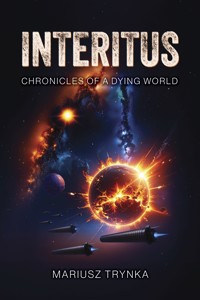
INTERITUS
CHRONICLES OF A DYING WORLD
Table of Contents
Prologue
Chapter 1
Chapter 2
Chapter 3
Chapter 4
Chapter 5
Chapter 6
Chapter 7
Chapter 8
Chapter 9
Chapter 10
Chapter 11
Chapter 12
Chapter 13
Chapter 14
Chapter 15
Chapter 16
Chapter 17
Chapter 18
Chapter 19
Chapter 20
Chapter 21
Chapter 22
Chapter 23
Chapter 24
Chapter 25
Chapter 26
Chapter 27
Chapter 28
Chapter 29
Chapter 30
Chapter 31
Chapter 32
Chapter 33
Chapter 34
Chapter 35
Chapter 36
Chapter 37
Chapter 38
Chapter 39
Chapter 40
Chapter 41
Chapter 42
Epilogue
Afterword
A Word to the Readers
Acknowledgements
About the Author
Other Books by the Author
Copyright © 2025 Mariusz Trynka
All rights reserved
No part of this publication may be copied, stored in information retrieval systems, or transmitted in any form or by any means—electronic, mechanical, photocopying, sound recording, microfilming, digitization, storage on electronic data carriers, or by any other technology—with the exception of short quotations in reviews, critical articles, or scientific papers in accordance with applicable law.
Second edition, Cracow 2025
Self-published by the author
Cover concept: Mariusz Trynka
Cover project: Łukasz Dziedzic
Original title: “INTERITUS - Chroniken einer untergehenden Welt”
Beta-Reader: Danilo Nenadović
Editing & proofreading: Gareth Clegg / Blacksails Publishing
Layout and design: Mariusz Trynka
ISBN: 978-83-976889-3-3
You can find more books by this author at:
www.mariusztrynka.com
For Danilo and Andi –
my brothers in spirit,
fellow explorers in distant galaxies of thought and imagination,
navigators between reality and the realm of ideas.
Together we have forged worlds, ignited theories,
and searched for truth within the nebulae of possibility.
You held the course with me when the starship of ideas began to overheat,
turned quanta of madness into inspiration,
and shaped the chaos of wild notions into new constellations.
Your insight, your humour, and your unshakable spirit of discovery
have not only expanded the universes of my books but made them come alive.
Without you, these journeys through time, space, and mind
might long ago have ended in a cosmic dead end.
May the coffee never run dry,
the warp drive of imagination never falter,
and may our next expeditions once again
lead us into the same delightfully mad quadrants of creativity.
INTERITUS (lat.)
Noun, masculine – downfall, destruction, decay, annihilation.
From the Latin interire – “to perish,” “to pass away.”
Describes the physical or moral collapse of a world, a culture, or a species.
In a figurative sense: the moment in which insight and downfall become one.
“Interitus is not only the end of a civilization –
but the mirror in which it recognizes its true face.”
PROLOGUE
Silence.
Not the peaceful, but the oppressive kind.
The one that pushes itself between you and the world like a slab of glass.
Tamira sat on a smooth bench made of light-colored composite material.
For hours.
Her legs were numb, her back ached, but she didn’t dare move—for fear of missing the moment. Above her, the enormous beams of the assembly hall stretched out like the skeleton of an ancient creature. She held her pad like a weapon. Like a talisman that could save the world.
Once again, the calculations.
Once again, the anomaly.
Once again, the certainty that no one would believe her.
The big council meeting was in full swing—access for members only.
For her, a young scientist in the second row, that meant waiting.
Waiting for the improbable.
Waiting for a person: Seren Atavaar.
Finally, the massive doors of the auditorium opened, and the council members stepped out into the foyer. Tamira recognized them by the silver embroidered insignia on their clothing, each indicating their respective disciplines. Quantum physics, astronomy, bioinformatics. Here, surrounded by the elite, she felt smaller than ever before and, at the same time, like the only one who understood how little time they had left. Then she saw her. Seren. Standing tall, alert, surrounded by aides. Tamira rose, stepped out of the shadow of a pillar, took a deep breath, and called out: “Chairwoman Seren! Please, just a moment!”
The woman stopped, turned halfway around, and looked her over with a gaze neither hostile nor friendly, but razor sharp.
“Who do I have the honor of speaking to?”
“I’m Tamira Sorellin. I need to talk to you. It’s about my message... about the anomalies in the solar corona.”
The words poured out, carried by the urgency of her conviction. Data, diagrams, calculations. She had everything with her. And none of it seemed to interest Seren. The council chair remained polite, but reserved. She spoke of procedures, technical reviews, and the risk of unnecessary panic.
“Follow the proper procedure. Submit your results via your mentor.”
Tamira’s heart was pounding in her throat. One more try. One more appeal.
“Please, listen to me. I’m sure we only have days left—“
The piercing sound of the council chamber’s sirens cut through the conversation like an alarm clock interrupting a peaceful dream world. Red light flickered across the high walls, and a calm, artificial voice spoke from the ceiling:
“Attention, urgent message. The three chairpersons of the Scientific Council are requested to report immediately to the assembly hall of the Planetary Government. Repeating: Chairpersons Atavaar, Drys, and Korr, your immediate presence is required. Reason: confirmed data on unusual solar flares. This is not a drill.”
A murmur rippled through the hall. Scientists paused, glancing at their instruments. Tamira saw Seren raise her handheld terminal, and her expression suddenly turn serious. Kaelan Drys and Yunavai Korr hurried over. Words were exchanged, orders given. Tamira stood there, her pulse pounding in her head, while the three council members were already on their way out of the foyer.
Then, unexpectedly, Seren stopped again. “Tamira?”
“Yes?”
The chairwoman looked at her, this time with an expression Tamira had never seen before on a member of this committee. Doubt. “Please come with us.”
“Excuse me?”
“You understood the corona better than many others, and if you turn out to be right, we may still need your expertise.”
Tamira didn’t hesitate for a second. Not because she had been invited, but because she knew in her heart that this was her last and only chance. The doors to the inner hall closed behind her. And somewhere beyond the artificial light, a star had begun to turn against its children.
Time had run out …
Chapter 1
The sound of children’s feet trampling on the floor snapped her out of her gloomy thoughts. Shortly afterwards, dozens of children entered the hall, and Tamira was already standing in front of the semicircular seating area. The comfortable seats nestled like shells against the curved back wall of the teaching dome. Her young listeners quickly hurried to their seats. Her gaze swept over the expectant faces of the ten- to twelve-year-old students who had signed up for the astronomy club today.
“Hello, everyone. It’s great to have you all here. Today we’re going to talk about our solar system. So let’s get started.” She paused briefly to make sure everyone was listening. She hadn’t chosen just any topic for today’s lesson, but one currently on her mind.
“You know what planet we live on, right?” she began with a slight smile that appeared on her lips but was not reflected in her eyes. Some children nodded euphorically, while some younger ones looked around questioningly.
“I know, I know! Home!” said a boy of about ten in the back row.
“Exactly,” confirmed Tamira. “Home, also known as P3. We astronomers say: We live on P3. There is now only one other planet between us and the sun, namely P2, but that wasn’t always the case.”
She activated the projection behind her with a hand gesture, without turning away from the children. As she moved her hand palm-up toward the ceiling, the front dome wall, to which she still had her back turned, began to flicker. Shortly thereafter, a vivid, three-dimensional model of their solar system appeared, and Tamira continued her explanation. “Over three thousand years ago, there was another planet between our sun and P3. Planet P1. It was small, but it was there. It existed for billions of years until one day it collided with a swarm of massive asteroids. These came from the inner asteroid belt. The collision did not destroy P1 immediately, but it changed it fundamentally. Above all, it changed its trajectory, its heliocentric orbit. Does anyone know what happened then?”
Tamira paused briefly, then slowly moved around the room with a searching gaze.
“He broke the sun,” replied an even younger girl in a sad voice.
“That’s right, Natea. But how did that happen? The wounded planet P1 drifted off its course. Over two millennia, it changed its orbit, and eventually became unstable. So unstable that it ended up too close to the much larger sun... and was swallowed up.” Tamira clapped her hands together. “We’ll talk about the effect of gravity from such large objects in the cosmos another time.”
A quiet murmur rippled through the rows. Some children stared spellbound at the projection. It showed how the tiny planet spiraled toward the sun, eventually breaking apart, then tearing apart, until it literally burned up in the glowing giant.
“But that wasn’t the end; it was just the start of much bigger problems,” Tamira continued, raising her eyebrows. “The asteroid impacts on its surface left deep scars. When the wounded P1 came too close to the sun, it tore a hole in its photosphere—the area below its corona and chromosphere—about a millennium ago—a process that no one could have foreseen. This hole and the intrusive matter caused our sun’s magnetic field to become unstable. The hole closed again, but P1’s ionized heavy elements remained in the photosphere. Since then, these have caused constant fluctuations—the magnetic field is repeatedly disturbed there and generates minor eruptions. Most of these are harmless, but we are constantly monitoring this weak point because the instability is increasing.”
She paused dramatically. The children stared in shock at the flare that suddenly lit up, shooting out of the sun’s surface in the projection.
“And one of these flares was enormous. In a gigantic eruption, the sun spewed out an unprecedented amount of its mass. The plasma wave was so large that it hit P3 head-on eight hundred years ago. An entire hemisphere was vaporized within seconds. Part of our home’s atmosphere burned up. More than ninety percent of the population died instantly.”
Silence. Tamira saw Natea’s eyes well up with tears.
“Our ancestors fled underground at that time. Or rather, those who remained. They lived there for around five hundred years—in darkness, in old bunker systems built for entirely different reasons. Over the centuries, these were then further expanded. A lot changed back then, not just our way of life. Incidentally, the bunkers still exist today, and you can even visit them.”
Tamira pointed to the star model again.
“The time spent in the protective bunkers was a difficult period for our ancestors. A test, and a time when many things were lost. Science, norms, even entire languages. Among other things, the names of the planets and other celestial bodies, because there was no room for astronomy underground. The old names, handed down over thousands of years, gradually disappeared. Only the most important technical basics were passed on—mostly only orally. When our ancestors returned to the surface, they only had basic knowledge. Not just in astronomy, but in all sciences.”
She paused briefly.
“That may seem cold. But it was the expression of a new way of thinking: sober, survival-oriented, rational. Nevertheless, over the centuries, P1 was never removed from the count. It remained as a reminder of the worst event that had ever befallen us. You are probably familiar with the saying: if someone betrays their friends, they are a P1. This saying also derives from P1, which brought disaster to the solar system.”
She was met with astonished looks from the audience. The little ones had probably not been aware of this. She played the projection, a detailed solar flare, in fast motion.
“Since then, our sun has been unstable. The scientific community believes it could happen again at any time.”
One girl timidly raised her hand. “And... do you think it will happen soon?”
Tamira hesitated. Then she shook her head.
“No. I don’t think it will happen soon. Definitely not.”
Secretly, she thought differently.
* * *
The lab was cool, permeated by that sterile coldness that goes hand in hand with neon lighting and smooth surfaces. Tamira stood at one of the analysis terminals. The latest data from the solar probes ran across the translucent screen like a fleeting stream. Ardon Veyran entered with slow, measured steps. His posture was upright, proud, as if he had to constantly remind everyone that he was in charge here. That he had the final say.
“You wanted to talk to me, Tamira,” he said without further ado. No greeting.
She turned to him and did the same. “Yes. It’s about the readings from our corona probe. Project Sunwatcher. The data from my colleagues in the spectral and radio wave range show no abnormalities, but my parameters show increased magnetic activity and unusual peaks in the X-ray range—values that cannot be explained in this form. The old weak spot in the photosphere—where P1 penetrated back then—is showing increasing fluctuations. The heavy elements are destabilizing the magnetic field at this point more and more. Something is not right there. The energy is constantly shifting, the balance is tipping, Ardon.”
He didn’t bat an eyelid. He stepped closer, glanced at the graphs and endless columns of figures. Then he frowned. “I’ve seen the data. There’s nothing there that isn’t within acceptable limits.”
“Within acceptable limits?” Tamira took a step toward him. “The fluctuations have doubled in the last six days. In just six days, Ardon. If this continues, we’re facing the biggest flare since the collision with P1. The dispersion will be much greater, the intensity stronger. This time it will hit us full force. Please, Ardon. We have to speed up the construction of the arks. What are eighteen ships?”
Ardon crossed his arms. “Tamira, you’re seeing things that aren’t there. Maybe because you want to see them. Maybe because you think this is your moment in the scientific community.”
Tamira’s throat tightened. “This has nothing to do with ego. You’re not a heliophysicist. You don’t understand the depth of these specific processes. Why don’t you trust my instincts?”
“I am an astronomer, my dear,” he replied sharply. “And I know we must not cause planetary panic because of the speculative fluctuations of a young aspirant. Your theory is neither substantiated nor verified. Follow the official route, Tamira. Submit it for review.”
“And until then? That will take weeks. Anything could happen. What if we run out of time?”
“Then it would already be too late.”
Silence. Then one last glance from Ardon, half tired, half condescending. “You’re a brilliant thinker, Tamira, but you let your emotions get the better of you. And that makes you and your predictions dangerous. Global panic can cause more damage than you can imagine.”
She said nothing more. She silently gathered her documents and turned away angrily. As she walked through the door, she heard him mutter after her.
“Emotions and science... rarely go together.”
* * *
The sky above the university town was bathed in the soft light of the afternoon sun as Tamira settled down with Thareena, her best friend, on the shaded terrace of a small bar. The air smelled of hot stone and fresh synth tea, brought to their table by a friendly, smiling serving robot. In the background, a spherical composition by Nonto, that newcomer to the music industry so popular at the academy, hummed softly. They had spent the first ten minutes making small talk. After the basics about family and friends had been said, they fell into a brief, shared silence. Then Thareena tilted her head slightly and looked at Tamira searchingly. “You seem tense. Did you have another one of your great conversations with Ardon?” She didn’t wait for an answer. “He really is the worst mentor you can imagine.”
Tamira nodded and stirred her tea mechanically. “He doesn’t take me seriously—he never does. Today I showed him the new data, the anomalies in the photosphere, but he... he doesn’t see anything. He’s ignorant and accuses me of not being professional enough.”
“Or he doesn’t want to see anything,” replied Thareena with a hint of bitterness. “At least nothing he hasn’t discovered himself.”
Tamira looked at her. “I have a feeling it’s really serious. The latest measurements... they no longer fit the model. If I’m right—and I believe with every fiber of my being that I am—then we only have a little time left. Days. Not weeks. Maybe a week or two, if we’re lucky. And nobody wants to hear it, Thareena.”
Thareena leaned back, her gaze becoming vacant. She pondered briefly, then became urgent. “Then you must find someone who will listen, and quickly. Even if it is the Science Council itself.”
Tamira shook her head vigorously. “I’m not allowed to speak there. Ardon has expressly forbidden me to do so. And without his consent—his mandate as my mentor—I can’t even get anywhere near the general meeting.”
“Damn it, then go without permission. This is too important, Tamira!”
“How? Just show up and hope someone believes me? That someone will even listen to me?”
Her friend leaned forward with tears in her eyes and took Tamira’s hands.
“Exactly. If you’re convinced a mega-flare is imminent that could destroy everything, then you have no other choice. You have to try, Tamira. If you’re wrong, you can apologize later and eventually iron out this wrinkle in your resume. But if you’re right and you do nothing...”
Tamira remained silent.
“Send them a message. Send it directly to the chairpersons. You have their contact details in the university register. Seren, Kaelan, Yunavai—any one of them. Make it official, without permission. Then get going. Look for them. Try to intercept them.”
Tamira stared alternately at her communicator, which she had placed next to her teacup, and at her best friend, who sat opposite her with a desperate look on her face. Her fingers moved slowly, almost hesitantly, across the surface as she opened the input form.
“And what do I write?”
“The truth, Tamira. Everything you know—and keep it brief so they don’t overlook the most important things.”
Tamira nodded slowly. “All right, I’ll do it.” She looked at her friend, whose moist eyes were filled with a mixture of concern and determination. “Thank you, Thareena.”
“I wish I could do more. Help you with this. But this... is much bigger than the two of us.”
They said goodbye with a hug. Tamira watched her for a long time. Then she reached for her communicator, took a deep breath, and typed into the form.
To: Chair of the Scientific Council - Seren Atavaar, Kaelan Drys, Yunavai Korr
From: Tamira Sorellin, Sunwatchers Research Group
Subject: Urgent notice regarding unstable magnetic field in the sun’s photosphere
Dear Chairwoman,
I am writing to you with the utmost concern. My analyses over the last few days show a significant destabilization of our sun’s magnetic field. The known models can no longer support the current data. I believe we are on the verge of a massive mega-flare that could endanger all life on our planet. My mentor has ignored my attempts to communicate this internally. I urge you to review the attached data and contact me before it is too late for all of us.
With respect,
Tamira Sorellin
With trembling fingers, she attached her report and clicked “Send.”
When she left the restaurant, dusk had already fallen. The main actor in the drama of her world—the star that both gave life and took life—had already set. In its place, the two moons had come to the fore. The larger one, of course, the second, much smaller one artificial. A huge space station. The central shipyard of her world’s fleet.
* * *
Three days had passed. Three long, grueling days of waiting. Tamira stood in one of the rear areas of the research lab, her gaze fixed on the terminal. The latest analysis results flashed in warm blue, overlaid with thin diagrams. Curves that trembled like nerve strands. The sun’s magnetic field values were no longer just unstable, they had become chaotic. She couldn’t bear to look anymore, so much fear did these results instill in her. She had sent the report to the chairpersons three days ago. No response. No sound. No sign that anyone had even read her message. She was being completely ignored.
She looked at the curves one last time, running her hand through her hair, then over her face and her burning eyes. She had hardly slept in the last few nights. The feeling of being alone with a truth that no one wanted to hear weighed on her shoulders like a lead coat. The last sentence of her message echoed in her mind.
“Before it’s too late for all of us.”
“I think it’s already too late,” she murmured quietly as a beep from the terminal startled her. New data. It had just arrived. The probe in the solar corona had sent further readings. Tamira scanned them with growing bewilderment and widened her eyes when she saw the peaks.
“No...” she whispered. “That can’t be...”
The curves shot skyward. The magnetic field was out of control. The hole in the photosphere enlarged dramatically. Radiation levels rose so high that even the system’s threshold protocols could no longer evaluate them. The sun was out of control. She closed her eyes as she rubbed them. If her calculations were correct—and they were—then it was no longer a matter of weeks. It could only be a matter of days. Maybe even less.
And no one heard her. No one believed her.
She took her communicator out of her pocket and dialed the one person who believed her. “Thareena, we need to meet. Urgently.”
A short time later, she met up with her best friend again—as she had done so often in recent weeks. They sat in a small café near the university, somewhere between her faculty and Thareena’s, who was an aspirant in behavioral research. The café windows opened onto the promenade, where people strolled along, unaware of their fate.
“How’s the situation?” Thareena asked as soon as they sat down. “Nothing?”
Tamira shook her head. “Nothing. No response. No questions. Nothing. They had three days to at least look at it.”
“And the current values? Better or worse?”
“Catastrophic. I’m sure the flare is coming. And soon.”
Thareena took a deep breath. Then she reached across the table and took Tamira’s hand, her voice firm. “That’s enough now. You have to go. To the capital. To the Scientific Council. In person, Tamira.”
“I don’t know if I can talk to them, they probably won’t even let me into the building.”
“Then you wait outside. And when they come out, you talk to them. I know it sounds absurd, but what if you’re right? What if this is our only chance?”
Tamira nodded silently. She felt fear in her stomach—fear of the sun and of the council—but in her heart she felt determination.
She knew she had to get through it.
A few minutes later, Tamira was sitting in the suspension railway. Almost all the seats were empty; only an elderly couple and a few students were on their way to the metropolis. To the heart of their civilization, or what was left of it. The lights shining through the train windows flickered across their faces as they raced through the countryside. She held a simple pad with the latest solar activity data in her lap. Her fingers clutched it like a talisman.
Outside the window, the vast, gently glowing fields of the outer suburbs passed by. Then came the capital’s glass towers. And in the distance, on the horizon, the shimmering complex of the central government—like a crown of light on the head of the metropolis.
She briefly closed her eyes. Breathe in. Breathe out.
“If I’m right and they’re not listening to me...” she whispered.
She didn’t finish the sentence. The train accelerated one last time as they glided into the heart of the world.
* * *
She had arrived at the capital’s central terminal during the Council’s afternoon session. Now Tamira had been sitting on the hard bench made of white composite material in the large assembly hall’s foyer for over two hours. The imitation wood beams that adorned the ceiling stretched above her like the ribs of a gigantic creature. They were interspersed with narrow windows that simulated the daily cycle, like veins of light. Each of the beams ended on both sides in floor-to-ceiling columns. Everything seemed calm, almost reverent. As if this were not the same world that was perhaps only days away from its demise. The meeting had been going on since noon. Of course, only authorized council members were allowed to attend. Tamira had come here on a whim—no access, no invitation, no hope. Just the simple name of an aspirant with a goal that was anything but easy to achieve, and that goal was a person named Seren Atavaar. One of the Scientific Council’s three chairpersons. One of those she had addressed directly in her message. And now she waited again. For a miracle.
Finally, the inner hall’s massive doors opened, and a stream of scientists poured into the wide, open foyer. Voices mingled with the echo of their footsteps. And there she was. Seren. Elegant as a living statue, surrounded by several aides, she walked briskly through the crowd. Tamira rose, stepped out of the shadow of one of the columns and walked straight up to her. “Chairwoman Seren! Please, just a moment!” she called out louder than she intended.
Seren paused, turned halfway around, and looked at her coolly. “To whom do I have the honor?”
“I’m Tamira Sorellin. I need to talk to you. It’s about my message. About an anomaly in the solar corona. I... I’m sure we’re on the verge of a mega-flare. The situation is more critical than assumed. Please, listen to me.”
Seren’s face remained impassive. Her voice was calm, almost polite, but clearly dismissive. “I know you tried to speak to the Council. Your mentor, Ardon Veyran, told us about it, but he is not convinced of the urgency. Furthermore, your data has not yet been sufficiently verified. The risk of false panic...”
Tamira took a step toward her. “But the data is clear. I have brand new evaluations with me. I’m sure we only have days left...”
“Please, Tamira.” Seren raised a hand, interrupting her gently but firmly. “Follow the proper procedure. Submit your findings via your mentor. If your analysis is deemed relevant by the expert committees, we will reevaluate it. Trust the system. At the moment, it does not appear to us to be... priority.”
Tamira swallowed hard. Her heart pounded in her throat with despair.
A piercing, mechanical sound cut through the silence. Soft at first, then growing louder. The council building’s sirens. Red warning lights flashed throughout the building, accompanied by a voice from the internal communication system.
“Attention, urgent message. The three chairpersons of the Scientific Council are requested to report immediately to the assembly hall of the Planetary Government. Repeating: Chairpersons Atavaar, Drys, and Korr, your immediate presence is required. Reason: confirmed data on unusual solar flares. This is not a drill.”
Those present in the hall froze. Then there was movement, a thunderous sound of footsteps, as if someone had shaken the foundations of the world. Seren had already raised her handheld device. The real-time data that the communication system’s artificial intelligence had mentioned flashed on the display. Her eyes widened ever so slightly.
“The corona...” she whispered almost inaudibly.
Kaelan Drys and Yunavai Korr hurried over to them, having also been notified. The three exchanged a few brief words Tamira couldn’t hear, then they turned to leave, and marched purposefully toward the exit without further delay.
Tamira was still standing there, her hands cold, her thoughts confused. She had told them.
Then, unexpectedly, Seren stopped. Turned to her. “Tamira?”
“Yes?”
Seren took a step toward her. Her gaze was serious, focused, and free of the professional coolness she had displayed earlier. “Please come with us.”
“What?”
“You understood the corona better than many others. And if you are right, we will need your expertise.”
Tamira blinked in disbelief, then nodded. As they left the large auditorium, the doors closed behind them.
Chapter 2
The Planetary Government’s assembly hall was a place where history was made. It was an oval room with over a hundred seats, arranged in concentric semicircles, each seat with its own display, its own data line; each delegate with a voice that could decide the fate of millions.
Tamira entered the hall with a mixture of bewilderment and awe. Just hours ago, she hadn’t even known if she would ever be heard—now she was walking down the center aisle next to Seren Atavaar, the chair of the scientific community. Kaelan Drys and Yunavai Korr followed close behind them. It was perhaps thirty meters from the entrance to the podium. Eyes met hers from all directions. Some were surprised and questioning, others dismissive, and some openly suspicious. Tamira understood there was no room for uncertainty here, and yet her fingers trembled as she clutched the pad with her latest data update more tightly to her chest. At the front of the hall, where an elevated podium towered above the rows of seats, the Planetary Executive was already waiting. Three members of the government stood there, dressed in deep purple robes—a symbol of the highest decision-making power in this world.
Seren stepped forward. Her voice was clear, without any tremor. She spoke distinctly, but quickly. “Dear representatives of the Planetary Government. A few minutes ago, we were informed by several corona probes of strong, unclassifiable solar activity. The situation is serious. Our analysis systems report values outside all known models. Unfortunately, our early warning systems have failed. We have consulted an advisor who recognized and documented these developments at an early stage, but unfortunately did not receive enough attention. Her name is Tamira Sorellin, a specialist in heliophysics. I request she be given the floor for a brief presentation.”
A murmur rippled through the ranks. The chairwoman had asserted her authority. A rare occurrence, but an unequivocal one. A member of the executive committee, an elderly man with a calm gaze, nodded briefly. “Ms. Sorellin, you have the floor.”
Tamira nervously stepped up to the podium. Her sweaty hands clutched her pad tightly, afraid it might slip out of her grasp. The microphone automatically calibrated to her voice. Her heart was beating like crazy. This was her moment. Perhaps the last one she would ever have. She took a deep breath and then began her presentation.
“Dear attendees, thank you for this opportunity. I won’t take up much of your time. I am not talking about probabilities here, but about a mathematically inevitable reality.”
She activated the pad with a gesture that moved the data onto the holodisplay in front of her. A three-dimensional representation of the sun in warm orange and red tones came to life in the center of the hall, overlaid with glowing data points and energy flow lines.
“The weak spot in the photosphere, a remnant of the P1 collision, has been destabilizing the magnetic field for centuries. The ionized heavy elements from P1 cause permanent fluctuations there, but for the past few days, we have been observing a critical accumulation of radiation. The magnetic field is fluctuating dramatically, and the instability at the old entry point is growing exponentially—everything is out of control. What we are seeing is the beginning of a mega-flare—an unprecedented, never-before-seen mass ejection.”
The animation showed how the magnetic field deformed at one point. Plasma from the chromosphere surged high into the photosphere, accelerated by the magnetic field lines, until it shot outward in a violent explosion.
“If my calculations are correct—and I firmly believe they are, because I predicted these values—we only have a few days left. If the timing is right, the eruption will completely burn up our planet’s atmosphere. Unlike the flare that hit our ancestors eight hundred years ago, this time no hemisphere will be spared.”
A heavy silence fell over the room. Tamira looked into the faces of those present. Some looked shocked, others doubtful, but no one spoke.
“I know this is hard to believe, but my models are based on current data from our active probe on site—the Sunwatcher. I’m not here to cause panic. I’m here because we need to act now. Not tomorrow, but now.”
A member of the government leaned forward. “What do you suggest, Ms. Sorellin?”
She hesitated, then calmly said, “That is neither my area of expertise nor my responsibility, but I would say: speed up the evacuation. Retrieve the plans for launching the arks. Activate the emergency program for the underground shelters. If we wait any longer, there will be no second chance.”
Silence.
Then Seren spoke up from the background, breaking the gloomy mood. “The emergency calculations are underway. We will do everything we can.”
As dozens of pairs of eyes turned to Tamira and decisions began that would change the fate of millions, she knew:
She had finally been heard.
* * *
Three days later, the world was no longer the same. The impending mega-flare had initially been kept secret, but by the following day, the first fragments of information had already found their way into the public domain. What followed was a conflagration of panic, anger, and hope. Above all, however, there was frantic activity everywhere.
Tamira sat in one of the Scientific Council’s high-ceilinged meeting rooms. The large, elliptical holotable was bathed in bright light, displaying the current resource distribution and construction progress of the ships. On the day of her presentation, she had been honorarily appointed as an official mentor. A position that normally required years of work, recognition, and publications. Her former mentor, Ardon Veyran, on the other hand, had been dismissed. Officially, the reason given was that he had failed at a critical stage and made a potentially tragic misjudgment. Unofficially, no one spoke of him anymore, and he had been relieved of his participation in the evacuation.
“The chair of the Fleet Commission has just confirmed,” said Kaelan Drys, pointing to one of the projections, “that the last two ships will be ready for service in four days. The shipyards are working flat out. Eighteen of the twenty generation ships have already been completed.”
The hologram above the table flickered briefly and now showed the orbital shipyards on the artificial moon—a massive, metallic-shimmering satellite in geostationary orbit.
“All crew quarters, engine rooms, and life support systems are installed. Only the stasis sections for the sleepers in ships nineteen and twenty are still missing. These will be added in parallel with the loading of the cargo and passenger modules.”
He paused briefly, then continued speaking—soberly, as if announcing a technical upgrade. “The ships developed under the code name New Hope were never intended to return. They were our species’ largest long-term project—generation ships for colonizing distant systems. Self-sufficient cities in space, built for a one-way trip. And now...” He looked at the data running across the table. “...overnight, they became the last resort. Not for the future, but for survival.”
“Kaelan, what’s the situation with the target planet? Has the Planetary Council made a final decision?” asked Seren, once everything was said about the ships themselves for the time being.
“Yes, the target system is A3X, a planet in the habitable zone of a stable sun. It is the most promising candidate. At eighty light-years, it is also within reach for us. All other options are either further away or closer, but not suitable for human life without major adjustments. We don’t have the resources for terraforming or dome construction at the destination.”
“What about the bunkers on the planet?” Tamira asked. “You only talk about the evacuees, but what about those left behind, given the potential impending disaster?”
Yunavai Korr replied, “All existing bunkers have been reactivated. The older facilities deep in the tectonically stable zones are already ready for occupancy. The new modules in the north of the capital and in the old agricultural belt are currently being equipped.”
“And how many...?” Tamira left the rest unsaid. She suspected the answer would not be satisfactory.
Seren Atavaar turned to her. Her voice was calm, but heavy. “Approximately fifteen percent. About fifteen million people can be accommodated there.” She glanced briefly at a data field next to her and continued, “The probability of survival is between three and seven percent, depending on the position relative to the sun at the time of the eruption. Perhaps slightly higher if the energy is released evenly with the flare.” There was a moment of silence, then she added quietly, “The solar magnetic field is now completely destabilized. The mantle streams break out cyclically from the equatorial zones. Our sensors are registering increasingly directed deflections. We now know pretty much exactly when the flare will occur. We just don’t know how sharply focused it will be. And everything depends on that—especially for those left behind.”
Tamira lowered her gaze. Then she murmured almost inaudibly, “So few... That’s tantamount to a banishment.”
Later that day, as she was walking through one of the administration building’s long corridors, a messenger intercepted her. “Mentor Sorellin? Chairwoman Seren requests your presence in consultation room D.”
Once there, she found Seren and a representative of the Planetary Executive. A middle-aged man with a stony expression, whom she knew only from the news feeds.
“Tamira,” Seren began without further ado, “we would like you to participate in the internal commission for the selected crew of the arks.”
“Me... why me?”
“Firstly, because you are now a mentor, and this falls within your remit. And secondly, because, after all the bad news of the last few days, you are one of the few who have remained professionally and ethically stable,” said the government representative.
Tamira nodded slowly. The words echoed inside her as if they had come from far away. Chosen. Without testing, without trembling, without the feverish wait for news that millions would experience. Just like that.
Part of her expected the worst—that she would lose her place in the lottery, that she would be left behind on the ground. Not because she considered herself insignificant, but because there were too many important people. And now...
It didn’t feel like security. More like a break in the rhythm of the world.
She wasn’t relieved. Not yet. Just off balance, as if gravity had shifted.
And now the Commission too. One step further into the eye of the storm.
“How many seats... are available to the public?” she asked quietly.
“One hundred thousand in the lottery,” replied Seren. “Another hundred thousand will be selected—executives, scientists, medical personnel, technical specialists. Most of them have yet to be chosen. You, Tamira, already belong to this hundred thousand.”
Seren and the executive left the room, and Tamira slumped down. The number felt hollow—one hundred thousand. A huge number, a hopeful one, but a terrible one at the same time. She closed her eyes as if she could escape the weight of this realization. Her parents. Her friend Thareena. People she loved.
She would live. Not through luck or chance, but through belonging. She felt neither relief nor gratitude. Only emptiness. Rescue was not a triumph. Not when it felt like a death sentence for everyone else. Someone had to survive to preserve the knowledge, to carry on. And yet... How could a decision be right when it excluded so many? One hundred thousand lives out of one hundred million.
And she—right in the middle of it all. Not because she had asked for it. Here, the system had decided she was important. More important than others. A realization that took root in her soul like a growth. What did it mean to be chosen when everyone else had to stay behind? What did it mean to move on when you knew you were doing so on the backs of those who had once given you the strength to walk? She saw Thareena’s smile in front of her. Her parents, who had held her in their arms as a child. Her teachers, her neighbors. All the nameless ones who would never have a voice. The ship would carry Tamira. To safety. To a future. But her heart would remain behind. It didn’t feel like salvation. A fine shiver ran down her spine, cold as the realization itself, because it felt like betrayal.
* * *
The large meeting room had been placed in a strictly controlled security mode. No cameras, no recorders, and no outside connections. Only Planetary Government representatives, the Scientific Council chairpersons, and a small circle of advisory experts had access—including Tamira.
A schematic model of the New Hope fleet rotated on a central holotable. Twenty enormous ships, each two hundred and forty meters long and with a diameter of eighty meters, formed a self-sufficient habitat. With over sixty-six decks, artificial gravity for gliding flight, and two redundantly connected central drive cores—they were flying cities.
“We don’t have time for lengthy ethical debates,” said one of the government representatives. “The technical capacity of the fleet is exactly two hundred thousand individuals. More is not possible—neither in terms of resources nor logistics. The protocols provide for a secure selection of key personnel. The rest is determined by a random system.”
A woman from the Biomedical Council shook her head. “But we’re talking about one hundred million individuals. The lottery means only one in a thousand gets a chance.”
“There is no other option,” Kaelan Drys replied soberly. “All other evacuation scenarios were rejected decades ago. It was never about saving everyone. It was only about ensuring the survival of the species. The arks are the tool for that. The only one we have.”
Tamira wanted to say something, but her throat suddenly felt dry. The numbers, the words—recited matter-of-factly like coordinates in a logbook entry—lay heavy in her stomach.
Nought point two percent saved. The rest remained behind.
She felt her fingers digging into the fabric of her pants. Not out of anger, but out of helplessness. Then she looked up. Her voice was clear, but she had to force it through the tightness in her chest.
“And what about the bunkers? Are there any developments here?”
“They are all operational, but the chances of survival are slim,” replied Seren. “They offer radiation shielding and long-term life support systems, but unfortunately that’s all we can offer those who aren’t selected, because we’re talking about survival. What happens after the disaster is uncertain.”
The projection screen switched to a new view. A grid of all twenty arks appeared. Each ship had exactly ten thousand plates on board. The upper rows were marked green. They stood for the assigned crew. Below them were the blue fields—the lottery spots still to be allocated.
“The selected individuals comprise one hundred thousand people,” explained Yunavai. “That is one per thousand of our total population. They will be selected manually—based on professional competence, physical fitness, and psychological resilience. Five thousand people per ship. Of these, 1,500 are preservers and 3,500 are sleepers.”
“And how should the lottery be organized?” asked Tamira.
“Anonymous. Algorithmic. No regional quotas, no political influence. All registered citizens between the ages of ten and sixty are included in the pool. The draw takes place exactly twenty hours before the start. After that, the shuttles begin picking people up. The names are only made public upon arrival at the loading stations.”
“Why so late?”
“So there is no more time for uprisings.”
Tamira’s stomach tightened—again. The coldness of this logic was brutal, but it wasn’t wrong.
* * *
After the meeting, Tamira set off for home. The city surrounded her, a geometric mosaic of light in the twilight. People moved between them. Cars. Life, in other words. How many of them would survive? Her thoughts wandered back to her loved ones. None of them were among the chosen ones. None of them had any guarantees. Tamira clenched her fists. She had hoped her warning would save lives. Now she had to watch as they were selected like seeds in a crisis. The system would select. Distribute. Save. But would her parents be among them? Thareena? With a hundred million people, what were the chances they would survive together?
She looked up at the sky and saw the artificial moon, the shipyard that would soon spew forth these colossal ships. Like the planet’s real moon, its natural satellite, which had been a faithful companion for millions of years, the artificial, much smaller moon also followed its orbit. She watched as hundreds of thousands of small engines repeatedly ignited on its surface to correct its trajectory.
And then she had an idea. Without giving the huge shipyard another glance, she turned around and quickened her pace. When she arrived at her makeshift office shortly thereafter, she immediately sat down at the terminal and began her calculations. She kept calling up sketches to make sure she had the layout right. As she calculated partly in her head and partly on the computer, she muttered quietly to herself. “One-eighth kF, three light hours, fifteen light hours... thrust of...”
She worked into the night, waiting for the results of the complex calculations. Then she analyzed a few more sketches and made her own. She was no mathematician, but after a few hours she was satisfied with the results of her calculations. She finally left the room in the middle of the night and made her way to Seren. It wasn’t a perfect solution, but it was a glimmer of hope.
* * *
The reports came steadily. In the outer sectors in the west, a supply depot had been destroyed. In the north, a group of young people had occupied an administrative building and destroyed its data lines in protest against the lottery. And in the center of the capital, civilians trying to get their children to safety had besieged the evacuation centers. The images ran in an endless loop on silent monitors in the administrative headquarters. There was turmoil, despair, and total disinhibition.
Tamira sat with other advisors from the Scientific Council in a secure meeting room and followed the news. She felt like a stranger in her own world. The voices of the others sounded distant, muffled, as if through water. Images of her city flickered on the screens—familiar places, overlaid with chaos. Her heart beat calmly, as if it were no longer part of her body. Everything seemed like a dream from which she could not wake up.
“We’ve lost track,” said an official from the internal security. “All systems are running at full capacity. The administration is overwhelmed. The lottery is already causing unrest, even though it has not even started yet.”
A young man from the psychological service leaned forward. “That’s no surprise. What’s happening out there isn’t just panic, it’s a psychological breakdown. A psychological breakdown par excellence. Citizens realize they are no longer part of a functioning system, and that completely destroys their inner stability.”
Kaelan Drys’s fingertips glided over a terminal. “The machines are running. The arks will be ready. But the sociological factor... that’s unpredictable.”
Then Seren spoke up. “We may have a solution that could solve two problems at once. Ms. Sorellin approached me last night. I must say, honestly, it was a very interesting concept. First, her idea would help us bring a much larger part of the population to safety, and second, the action would also distract from the current despair. Tamira, please present your proposal.”
With a swipe of her finger, Tamira projected the presentation she had been working on late into the night onto the screens in the meeting room. The animation showed the rotating shipyard in all its grandeur, and Tamira said, “Ladies and gentlemen, dear colleagues. As I already explained to Ms. Atavaar yesterday evening, the fact that we can only save so few people has been weighing heavily on my mind. So I considered what else could be done in this regard. I made calculations and sketches and came to the following conclusion: we can use the shipyard as a lifeboat. Although it could never travel to another world, it could at least rescue other fellow citizens.”
A murmur went through the room. Advisors muttered something to themselves. One said, “That’s impossible.”
“That’s not impossible, my dear colleague. I’ve already done the basic calculations,” Tamira corrected him.
The eyes of those present widened.
“If that were true, then it would indeed be a sensation,” Kaelan said.
“The ship’s correctors work with one-eighth of our planet’s gravitational acceleration. According to my calculations, we could bring the artificial satellite out of its planet-bound rotation and accelerate it to cosmic escape velocity by moving all correction engines to the side facing away from the planet. This would not be a problem overall, as each station is already a self-sufficient platform docked to the artificial moon. Here I have performed a simplified calculation of the installation points. It also showed a map of the artificial object with the propulsion positions. Experts must, of course, still check this. After that, we have to throw the shipyard off course, so to speak, by igniting all engines for a precise time interval. It will approach the planet and pass its orbit in a slingshot maneuver. The resulting acceleration and renewed activation of all engines at half load against the direction of escape would bring the ship up to cosmic escape velocity. With all engines at full throttle, this acceleration curve could be maintained.”
One of the less skeptical members spoke up. It was Kaelan again. “Do we have the resources to handle a project like this?”
Seren took over the response regarding logistics. “Absolutely. I think we’ll get more than enough qualified volunteers from the population. Tamira, compile a list of all the professionals you need.” She paused meaningfully.
“Ladies and gentlemen. The shipyard has space for two million more people. That’s two million more souls we can save. It also provides resources to live on for centuries. Hydroponic facilities, production plants, raw material storage, and all kinds of skilled personnel. It will be tight, but it is possible. This proposal must be implemented. I propose that we vote on this here and now. All those in favor, please raise your hands.”
And they all lifted them in unison.
Later that evening, Tamira had a brief phone call with Thareena. No long conversation, just a quiet, “Come over. Roof terrace.”
Now she stood there, on the flat roof of Thareena’s apartment building, surrounded by the silence above the roofs of the university campus. The view stretched far into the distance, all the way to the glittering domes of the capital city on the horizon, which opened up like steel buds in the night.
Thareena stepped beside her. “I saw them,” she said quietly. “The people. They’re crowding in front of the shuttle terminals, even though no one knows who will be selected yet.”
Tamira nodded. “They hope for a miracle, or that someone will recognize that they are important.”
“The world as we knew it—built on reason, balance, and trust—is falling apart. Not because of fire or violence, but because fear is eating away at everything from within.”
Tamira was silent for a moment. “I don’t know what I feel. I’m among the secure, but I feel like a thief.”
Thareena looked at her seriously. “You warned us. Without you, no one would have been saved. You are the last person who has anything to blame yourself for.”
“But what good is my salvation if you remain behind?”
Thareena placed a hand on her arm. “Perhaps... so that at least one of us can carry on what we were.”
Tamira lowered her head. “There’s been another new development.”
Chapter 3
New security measures were announced the following morning. They included curfews in several regions, increased controls at communication centers, monitoring of internal networks, and the lottery hadn’t even started yet.
The message was brief, impersonal, and automatically generated. Tamira had set up a query routine on her pad that filtered the lottery results.
Your relatives, Lira and Jonev Sorellin, were not selected for evacuation by the New Hope Fleet. Although they were eligible for the lottery under Code §34b, due to their age being under 60, they voluntarily withdrew from the lottery. Their assignment to underground shelter Sector 14-A is therefore confirmed. Your friend Thareena Vosk participated in the lottery, but was not selected.
Tamira read the lines over and over again, as if their meaning might change the fifth time around, but the words remained the same. They remained indifferent and cold.
The air was dry, thick with smoke from the burning camps in the south. She sat on the bench in front of her parents’ apartment building, a simple, well-kept complex in one of the quieter areas of the capital. They had moved here when Tamira started college. The lights in the entrance flickered irregularly. A minor defect that no one would bother to fix. The door opened and her mother stepped out.
“You found out,” Lira said quietly.
Tamira stood. “Why didn’t you tell me?”
“Because you can’t change it.”
Tamira looked into her mother’s eyes—and saw not only love, but farewell.
There was something in that look she didn’t understand: a silence, a determination that defied her logic. Her throat tightened. She wanted to say something, to interject, a “No,” a “Then I’ll stay too”—but the words wouldn’t come.
It wasn’t age that separated them—it was an entire generation. One that had learned to let go, and one that still hoped to save. Her parents had made their decision. With a calmness that took Tamira’s breath away. She, on the other hand, had grown up with the idea that you had to fight, that you didn’t give up.
Now she stood here, in front of the two people who had given her everything—and who had decided to stay. Not because they had to, but because they believed it was the right thing to do, and Tamira didn’t know how she could bear it.
“I’m staying with you,” Tamira said suddenly, her voice barely more than a whisper.
Her mother smiled sadly. “You won’t.”
“I can’t just leave. I can’t... leave you here. In a bunker. While I...” She broke off.
Jonev Sorellin now also stepped out of the building. His gaze was calm, his step firm, but Tamira knew the slight tremor in his hands. He was nervous. He was afraid. “Child,” he said with a gentleness she had only known from before. “We have already lived our lives. You still have most of yours ahead of you. If you stay with us now, it’s not just your future that will die. Your work, your insights—everything you are—will have been for nothing.”
“I don’t want to outlive what I love!”
Lira stepped closer, placing her hands on Tamira’s cheeks. “Then you carry it on inside you. Us. All of us who remain behind. You are our legacy, Tamira. And that of this world.”
“What kind of world is this that eats its parents?”
Her father replied, “One that may know love again in centuries to come, because someone took her to where you are going.”
“You are our daughter. And we will not hand you over to death. Go. And live. For us.”
Silence. They were beautiful words. But for her, it wasn’t decided yet.
Later, on the way to the return station, her gaze fixed on the ground, Tamira felt something in her coat pocket. Her mother had secretly put it there. An old photo. Printed out and yellowed. There were three people in it. A child laughing and two adults hugging it. And on the back was an inscription.
Never forget who you are, even if you forget where you came from. – Mom
Something inside her broke. Tears welled up in her eyes, quietly and without warning. She ran her thumb over the faded writing, as if she could touch her mother again by doing so. She would never forget that. And that was exactly why she set out to talk to Seren again. It was time for her to play another card.
She pressed the buzzer at the door to Seren’s office in the administration building. The building AI had assured her that she would still find her there despite the late hour. Seren released the door, and it slid to the side into a wall slot. Behind it stood a slightly confused Seren. “What can I do for you, Tamira?”
Tamira gathered herself. “I don’t want to overstep my newfound authority, Chairwoman Seren. But as the initiator of the shipyard plan, I would like to make a request.”
Seren nodded knowingly. “Come in, Tamira, and tell me who it’s about.”
Tamira was surprised at how transparent she apparently was, and stepped into the office.
“I don’t want to take up too much of your time, Chairwoman. Do you think it’s appropriate for me to name three people who could be given a secure position at the shipyard?”
Seren looked at her for a long time. Her gaze remained cool and unmoved. Then she said dryly, “I don’t believe in burdening the selection process with personal preferences. The situation is too serious for that—and too sensitive.”
A brief moment of silence followed. Then she continued in a slightly lowered voice, “But your performance over the last few days is undeniable. Without you, the shipyard option would not exist. That alone makes me consider it. Give me until noon tomorrow.”
* * *
The automated spacecraft vibrated imperceptibly as it lifted off from the planetary launch platform. Tamira sat strapped into one of the observation seats and looked out into space through the reinforced front window. The familiar shape of the artificial moon was rapidly approaching—a massive construction made of metallic segments, shimmering in the light of the battered sun. This was the main shipyard for the New Hope fleet—the port of departure for a journey with no return.
“Docking procedure begins,” said the shuttle’s artificial intelligence voice matter-of-factly. Tamira took a deep breath. Today, she had been sent as a mentor to the Scientific Council to review the redistribution of manpower on the artificial satellite and the astrophysical sensors on the last completed ship: New Hope Twenty—her ship.
Her first stop was the shipyard’s main engine room. There she met with the chief engineer of orbital propulsion technology. Surrounded by various technicians working at their workstations, he stood next to a large screen in the middle of the control center—the heart of this gigantic structure. The senior engineer greeted her with a bow.
“Mentor Sorellin. It is an honor to meet you in person. We owe you a great deal up here. My team is at your disposal.”
Tamira felt a little embarrassed under the gaze of the technicians present. She felt her cheeks flush red. “You’re welcome. I’m glad I could help. How is the relocation of the maneuvering platforms going?”
“Very well. It’s a big help that they are already self-sufficient and can be moved and repositioned by remote control. That saves on human resources.” He opened a graphic on the large status screen next to him. “According to forecasts, we should be finished with our preparations a few days after the evacuation fleet departs.”





