Uzyskaj dostęp do tej i ponad 240000 książek od 14,99 zł miesięcznie
- Wydawca: Mariusz Trynka
- Kategoria: Fantastyka•Sci-fi
- Język: angielski
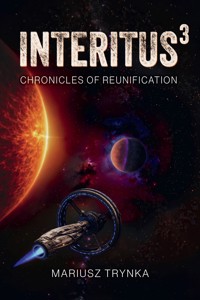
The wait is over. The INTERITUS trilogy reaches its finale.
Three books. Three generations. One story that pushes to the very edge of what two peoples can do to each other — and sacrifice for one another.
They lost their home. They found a new world. But peace was something they never reached. What began as a rescue mission became a journey through betrayal, sacrifice, and shattered truths. Between the two peoples lies more than the memory of dying worlds — a rift of guilt, fear, and competing versions of the past.
As new generations come of age who know the old world only from stories, everything built over centuries hangs in the balance. Power shifts. Loyalties break apart. And the question of what is true becomes more dangerous than any cosmic threat.
Because sometimes it is not stars that destroy worlds. Sometimes it is choices.
———
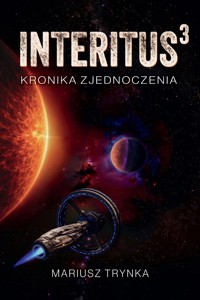
INTERITUS 3 – Chronicles of Reunification brings the saga to its climax: a story about memory and responsibility, about identity and reconciliation. Two peoples. One future. And the last chance to shape it together. Book 3 of 3 — readers are encouraged to begin with Book 1.
For readers of Liu Cixin (The Three-Body Problem), Adrian Tchaikovsky (Children of Time), and James S. A. Corey (The Expanse).
Includes: fragile coexistence, political intrigue, generational conflict, interstellar colonization, propaganda and the search for truth, space opera, philosophical science fiction, multi-perspective storytelling.
Ebooka przeczytasz w aplikacjach Legimi na:
Liczba stron: 668
Rok wydania: 2026
Odsłuch ebooka (TTS) dostępny w abonamencie „ebooki+audiobooki bez limitu” w aplikacjach Legimi na:
Podobne















MARIUSZ TRYNKA
CRACOW 2026
Table of Contents
The Story So Far...
Prologue
Chapter 1
Chapter 2
Chapter 3
Chapter 4
Chapter 5
Chapter 6
Chapter 7
Chapter 8
Chapter 9
Chapter 10
Chapter 11
Chapter 12
Chapter 13
Chapter 14
Chapter 15
Chapter 16
Chapter 17
Chapter 18
Chapter 19
Chapter 20
Chapter 21
Chapter 22
Chapter 23
Chapter 24
Chapter 25
Chapter 26
Chapter 27
Chapter 28
Chapter 29
Chapter 30
Chapter 31
Chapter 32
Epilogue
APPENDICES
Appendix 1
Appendix 2
Appendix 3
Appendix 4
Appendix 5
Appendix 6
Appendix 7
Appendix 8
Afterword
A Word to the Readers
Acknowledgements
About the Author
Other Books by the Author
Copyright © Mariusz Trynka, 2026
All rights reserved.
No part of this publication may be copied, stored in information retrieval systems, or transmitted in any form or by any means—electronic, mechanical, photocopy, sound recording, microfilm, digitization, storage on electronic media, or by any other technique—without the prior written permission of the author, except for brief quotations in reviews, critical articles, or scholarly works in accordance with applicable law.
First English edition, Cracow 2026
Self-published by the author
Cover design: Łukasz Dziedzic
Title: “INTERITUS 3 — Chronicles of Reunification”
Beta readers: Danilo Nenadovic, Tadeusz Dyduch, Joanna Trynka
Editorial work: Ef-Ef
Typesetting and layout: Mariusz Trynka
ISBN: 978-83-68784-35-0
More books by the author at: www.mariusztrynka.com
For Agnes, my favorite sister—
For reading my books—even the passages
where I’m no longer sure myself what I was thinking.
For passing on so many things in my childhood and explaining them to me,
things our parents never suspected I needed to know.
For always being there without my having to say so—
and still being there now.
And lastly, for being the best sister anyone could imagine—
and as a science fiction author, I have quite a lot of imagination.
They say you can’t choose your family.
With you, I would have done it anyway.
The Story So Far...
It began with a warning no one wanted to hear.
Tamira Sorellin, a young heliophysicist, was the first to recognize the deadly threat: her world’s sun stood on the brink of a catastrophic eruption. What followed was the largest exodus project in Thal-Venai history—her people’s history. Twenty generation ships of the New Hope Fleet became the last refuge for two hundred thousand chosen ones. The remaining hundred million stayed behind—in bunkers, on a shipyard in orbit, and on a dying planet.
Then the fleet departed. A three-hundred-year journey across eighty light-years brought them to planet A3X. Tamira found love in Zephir, a quiet ally in INTEGRA, the fleet’s artificial intelligence, and a new purpose in the years of the coast phase.
But the New Home was not empty. It was Earth. Inhabited, industrial, and civilized.
The encounter, meant as a bridge between two civilizations, became a fault line. Then came the discovery that changed everything: an interstellar asteroid was on a collision course with Earth. The Thal-Venai offered help and launched an evacuation mission to take more than four hundred thousand humans into the fleet. But their generosity bred suspicion. The Humans First movement under General James Vega struck. In a coordinated mutiny, human rebels seized eighteen of the nineteen remaining ships. INTEGRA answered with the mutiny protocol—and starved the rebel sectors of oxygen.
As silence settled over the fleet, the bridge between the worlds was broken. On Mars, Governor Maya Rodriguez watched the nineteen ships vanish into the darkness without a farewell. From a dying Earth, one last secret ship of the elites rose into the sky—the Phoenix, bound for Proxima Centauri. Behind them remained a handful of factions on Earth, surviving in the Bunker Enclaves, and the Martians, alone beneath a red sky.
But that was only the end of the beginning.
The fleet reached Gliese 1002c after eighty years. Tamira woke from stasis to find an alien world—tidally locked to its red star, habitable only in the narrow Terminator Zone between eternal light and eternal darkness. Under her leadership the first settlements rose. Thal-Venai and the humans who had traveled with them learned to build a civilization together. The colony grew, and with it grew hope.
On Mars, meanwhile, the lie metastasized. Vega’s heirs had rewritten history—branded the Thal-Venai traitors, recast the mutiny as a Liberation Strike. Under the authoritarian governments of President Caldwell and her successor President Foster, Mars lived inside a narrative of hatred and hero-myth.
Until Silvia Rodriguez came. A journalist at Mars Today, granddaughter of Maya Rodriguez, and for thirty years a seeker of truth. When the message from Gliese reached Mars—we have arrived, we are alive—Silvia used the shock to bring everything to light. Together with Tomás Cabrera, a young blogger whose platform The Red Truth ignited the underground, and with Saskia Vermeer as eyewitness, she shattered the edifice of lies. Marcus Vega, the general’s grandson, tried to save the old order with a military coup—but the population rose, soldiers refused orders, and the coup collapsed under its own weight. Marcus was convicted and fled. Foster resigned. Mars found its way to a new, democratic order—and Silvia Rodriguez became its President.
But the past was not buried.
On Earth, Marcus fled to the Vega enclave in the Andes. There he fulfilled the legacy of his dying father Nathan: three warships—the Nemesis, the Fury, and the Retribution—built in the depths of the Guiana Complex, crewed by nine hundred volunteers. And deep inside the enclave, behind a hidden steel door, lay the family’s greatest secret: James Vega himself, sixty years in stasis, protected and concealed by Nathan, waiting for the day he would wake and finish his war of vengeance.
Nathan died minutes after his father’s revival. He had waited sixty-one years for that moment. James Vega took command.
Then the Phoenix returned. Evan Mercer, the billionaire who had fled to Proxima Centauri before the asteroid, offered Vega a deal: his superior drive technology—able to cut the journey to Gliese from a hundred years to sixty—in exchange for control of Earth. Vega accepted. The Nemesis fleet was upgraded.
On Mars, Silvia intercepted the communication between the two ships. On a night that changed everything, she played Tamira the recording. Vega’s message echoed across sixteen light-years: We will destroy the aliens. Every last one of them.
Tamira and Zephir made one last decision. They would go into stasis on Ship Twenty and wait for Vega—ready when the enemy came, even if it meant waking in a future they would no longer recognize. Novaren took command of the colony.
Then, ninety days later, in the control center of Nova Gaia: Silvia watched Vega’s fleet ignite its engines. Course: Gliese. Sixty years’ travel. Half a lifetime to prepare.
But then the long-range sensors reported something unexpected. An object near Saturn. A ship that matched nothing—not human, not from the fleet. But with a hull geometry and drive signature that could mean only one thing: Thal-Venai.
Vega’s fleet changed course from Gliese to Mars.
Full acceleration.
Sixty hours.
Prologue
Emptiness.
Not the emptiness of space, immeasurable and indifferent. Silvia Rodriguez knew that emptiness.
The emptiness in her head was worse. A vacuum where thoughts formed and immediately fell apart, where every attempt to grasp a clear sentence shattered against exhaustion. She had not slept since Holt’s call at three in the morning. The monitors, the messages, the numbers. The certainty that the world she had built was racing toward a cliff. And she—the president of Nova Gaia and the united Mars—could do nothing but watch.
The council members came and left again. They saw the data, studied the trajectories, asked questions no one had answers to. Some went pale. Some grew angry. A few stayed silent, which was worse than either. Then they left the chamber, each with the same expression—that of people who understood sixty hours was not much time.
Now Silvia stood alone in the Communications Center. Just her and a handful of monitors on the wall. She had sent everyone on break. She had to make sense of this emptiness.
To the left: the alien ship halfway between Saturn and Mars. Still incomprehensible. The technicians were working on the signals, but so far no one could crack the code. A Thal-Venai ship that mastered no form of communication known to them. It made no sense. The fleet had departed for Gliese over ninety years ago. On the Thal-Venai homeworld no one remained. So where did this ship come from?
To the right: Vega’s fleet. Three points, unwavering, precise. Forty-six hours left. The acceleration had not slackened.
He isn’t coming for us. He’s coming for the ship. But he will go through us if we stand in his way.
She thought of her grandmother. Of Maya, who had stood in this same communications room when the Thal-Venai fleet set out. Back then Maya had been powerless—a governor watching nineteen ships vanish into the darkness without a farewell. Silvia had sworn never to be that powerless. She had fought for the truth for thirty years, survived a coup, rebuilt a democracy.
And now she stood here. In the same room. Before the same monitors. And was just as powerless as Maya had been.
No. She straightened. Not the same. Maya had no allies on Gliese. No quantum link that answered. No truth on her side.
But Maya also had no war fleet inbound.
The door behind her opened. It was Holt.
“The link to Gliese is ready, Ma’am.”
Silvia pressed her lips together. It was the only thing she could do now—warn them. Gliese lay far away, but thanks to the quantum communicator a signal needed not years but seconds. A tiny advantage in a situation that offered no others.
“And the alien ship?”
“Nothing new on communication. But our people say it’s decelerating.”
“Decelerating?”
“Yes, Ma’am. It seems ... it wants to arrive. Here. With us.”
Silvia closed her eyes. An unknown Thal-Venai ship arriving in the solar system. Three warships of a dead general racing toward Mars. And between them 1.3 million people who would learn within hours that their world had just changed.
She opened her eyes.
“Open the link to Gliese.”
Holt tapped his console. The display flickered. Then—a face at the other end of space. But not the one she had expected.
Novaren looked at her. He already knew something was wrong. You could see it in his eyes.
“Council Member Novaren,” Silvia said. “We have a problem. Two problems, to be exact.”
Outside, beyond the armored windows, the domes of Nova Gaia glowed in the red dust. In forty-six hours Vega would be here. And then it would be seen what Mars could endure.
The emptiness in her head did not lift. But through the static, thoughts formed. The same thoughts that had not let go of her for hours.
Who are you? What do you want? And why now, of all moments?
Chapter 1
Communications Center, shipyard,
Day 21,939 since departure of the New Hope Fleet
Her fingers hardly obeyed her over the keyboard. Thareena stared at the display, at the number blinking there—one per cent quantum integrity—and tried to find the words she had put off for more than fifty years.
The Last Words.
The Communications Center was silent. Half dead, like everything here. Most of the consoles were dark, shut down many days ago, some even cycles back. To save the last energy reserves for life support, they said, but in truth no one needed this room any more once the quantum communicator stopped running. Only it still worked, that one flickering light in the dark.
Not much longer.
Somewhere above her, water dripped onto metal—a monotonous, hollow tapping that echoed through the empty center like a slowed heartbeat. The air was cold and stale, saturated with the metallic taste of recycling filters that should have been replaced long ago. A light strip on the ceiling flickered, a nervous twitch, as if the shipyard itself knew it had little time left.
Thareena pulled her jacket collar tighter. The heating in this sector had failed two days ago. No one had repaired it. Plenty of people could have, but there were no spare parts and no more need.
She laid her hands in her lap and looked at them. The hands of an old woman—bony, dotted with age spots. The skin so thin the veins shone through bluish. These hands had once operated instruments, written reports, helped Thareena’s mother at her work. Now they trembled when they held a cup of tea.
When did I get so old?
The question was idle. She knew exactly when. Day by day, year by year, while the shipyard died around her. While the sectors failed, one after another. While the number of survivors shrank—from two million to one million, to five hundred thousand, to fifty thousand.
Fifty thousand. Crowded into the last functioning modules, like animals on a sinking ship.
She closed her eyes and thought of Tamira. Of her face, the way it had been fifty-five years ago—young, determined, full of hope. They had embraced then, before the fleet departed. Thareena had felt Tamira’s heartbeat against her chest and thought: We will see each other again. Sometime, somehow.
But they would not. She knew it now better than ever.
The tears came, quiet, without warning. They ran down her cheeks, dripped onto her hands, and Thareena let them. There was no one here to see her. No one any more.
After a while she opened her eyes again, wiped her face, and turned to the keyboard.
The Last Words. I have to find them.
Her fingers began to type, slow, deliberate.
Tamira,
this will be my last message.
The words stood on the screen, final and irrevocable. Thareena stared at them until they blurred.
The shipyard’s energy systems are failing. We had to shut down most subsystems to keep life support running. Communications will be the next to go.
Her fingers hesitated. What should she write? The truth? The whole, brutal truth about the slow dying, about the hopelessness, about the nights she lay awake wondering why she went on?
Or a lie? One last, merciful lie that would spare Tamira the pain?
No. No lies. Not now, not at the end.
The shipyard has become largely uninhabitable. Only fifty thousand of us are left. Crowded into the last functioning modules. We know what is coming. We have seen it coming for a long time.
The words flowed now, as if they had only been waiting to be released.
I have become an old woman. My hair is white, my skin thin as paper. I have lived a life I could never have imagined. In a flying city that is slowly dying.
She stopped, read what she had written. It sounded so final, so resigned. Is this really all I want to say to Tamira?
But what else? Hope I do not have? Promises I cannot keep?
But I regret nothing. We survived. We existed. We kept the memory alive.
The memory. Of P3, of the gardens, the animals and the cities, of the sky that had once been blue. Of Tamira, who had walked beside her through the streets, laughing, light-hearted, with no idea what was coming.
If you ever read these messages—if they have outlasted the centuries—then know that we thought of you to the end. Of you, who traveled on. Who would find a new world.
Thareena blinked. The tears were back, but she let them flow as she kept typing.
Do not mourn us. We had days and years. We had love and community. We had time we were not owed.
She thought of Jono Birell. Of his hands holding her when she woke at night from nightmares. Of his voice calming her. Of fifty years of marriage worth more than all the gold of the galaxy.
And in all that time you were with me. With every memory. With every thought.
The words blurred before her eyes. She blinked hard, forced herself to write the last lines.
Farewell, my dearest friend. May you find a sky kinder than the one we left behind.
Always,
your Thareena
She read the letter once more, from beginning to end. Every word a parting. Every sentence a gravestone.
Her finger hovered over the send key. So simple. One touch, and it was over. Six decades of friendship, ended with a keystroke.
She did not hesitate any longer.
The display flickered.
The data-integrity indicator dropped—one per cent, half a per cent, zero.
MESSAGE SENT. CONNECTION CLOSED.
The hum of the quantum entanglement unit died away. The lights on the console went out, one by one, until only the faint glimmer of the emergency lighting remained.
Silence.
Thareena sat motionless before the dead console. The tears had dried up, but the emptiness remained—an emptiness deeper than the darkness around her.
It is over. Everything is over.
She had said farewell to Tamira. She had accepted what was coming. Death, quiet and slow, like everything on this dying shipyard.
The silence after the console fell mute was unlike any silence before. Not the silence of a pause, not the silence between two words. It was the silence of a severed thread. Final. Irrevocable.
Thareena sat motionless. Her hands rested on the dead keyboard, as if by mere touch they could restore the connection. She listened—to the dripping above her, to the distant, barely perceptible hum of life support, to her own breath.
These were the sounds that remained. The sounds of a world that no longer tried to live, but was only busy not dying.
She thought of the first years after the fleet’s departure. Of the hope that had still been tangible then—that the shipyard could be repaired, that new resources would be found, that someone would find a solution. Someone has to find a solution.
No one had.
And she thought of Jono. Of the first great assembly after the fleet left, when the shipyard was still alive and full of voices. He had been thirty-three then—freshly named Chief Engineer, with dark eyes and a calm that did not match his age. He had stepped before the assembly of a hundred and called Tamira Sorellin a remarkable woman. One who had understood that hope isn’t hope, it’s work. Thareena had truly looked at him for the first time that day. It had taken five years for that first look to become a marriage.
At some point—she did not know whether minutes had passed or an hour—she stood up. Her bones protested, her joints ached, but she forced herself to her feet.
She still had duties. A council session she had to chair. Decisions she had to make. The Governor’s burden she carried, whether she wanted to or not.
She left the Communications Center without turning back. The door closed behind her with a soft hiss that sounded like a sigh.
The corridor beyond lay in half-darkness. The emergency lighting cast reddish shadows on the walls, on the spots where signs had once hung, long since removed and repurposed. Her footsteps echoed on the metal floor—a lonely, rhythmic clicking that ran ahead of her and came back from the walls, as if someone walked beside her.
But there was no one.
At the end of the corridor she turned into the main passage. It was warmer here, and the air carried the faint smell of cooked protein and bodies close together. Behind the doors of the adjoining modules lived Thal-Venai—sleeping, eating, arguing, comforting one another. Fifty thousand souls who did not yet know that the last link to the fleet had just gone dark.
This burden I carry now. Alone, until the council session.
Thareena squared her shoulders, as well as her body allowed, and walked on. Her steps grew firmer, more even. Not because the pain had eased, but because she could not show it. Not as Governor. Not now.
Death can wait. It has time.
* * *
Council Chamber, Sector 4, Shipyard
Day 21,939
The faces around the table blurred before her eyes. Thareena blinked, forced herself to concentrate, but the words she had just written to Tamira still echoed in her head.
We know what is coming. We have seen it coming for a long time.
She had accepted death. An hour ago, in the silent Communications Center, she had made her peace with it. And now she sat here, at the head of a table, surrounded by people who looked up to her as if she had answers.
The council table had once been built for twenty. Now five sat at it, and the empty chairs felt like an accusation. On the wall behind Thessan, a map of the shipyard had once hung—all forty-two sectors, color-coded by function. Someone had taken it down years ago. No one wanted to stare at thirty-five dead sectors.
She had no answers. She had only numbers.
“Current population,” she began, and her voice sounded foreign in her own ears. “Forty-nine thousand eight hundred and forty-seven.”
No one at the table moved. She had written “fifty thousand” in her letter to Tamira, rounded up because the exact number no longer mattered. But here, in the council, every single soul counted.
“Habitable sectors: seven of the former forty-two.”
Thessan lowered his gaze. His hands lay on the table, old and gnarled, dotted with spots like her own. He had lost three children in recent years, all to diseases that would once have been curable. Now he lived for his grandchildren.
“Hydroponics,” she went on, “shows critical failures in Sector 8. Remaining capacity: sixty per cent of need.”
Veris raised his head. “How long?”
The question no one wanted to ask. The question with only one answer.
“At current rations ... perhaps two years.”
Thareena saw the words sink in, saw them smother the last remnants of hope. She knew that look—she had seen it often enough in her own reflection.
“There is something else,” she said. The words scraped in her throat. “The quantum entanglement unit has failed. An hour ago. For good.”
The reaction was subtle—an indrawn breath, a lowering of shoulders, a closing of eyes. They had all known this day would come. But knowing and living it were two different things.
Korin spoke first. “What does that mean?”
“It means we are on our own,” she said. She spoke as a Governor speaks—not as a woman who had wept an hour ago. “No link to the outside. No more link to the fleet.”
Korin struck the table with the flat of his hand. “And that’s it? We sit here and wait for the end?”
“Korin—” Veris began.
“No.” Korin flared up, young and full of an anger Thareena almost envied. “There has to be something. Anything.”
Thareena looked at him. She knew that look—she had worn it herself, thirty years ago, twenty, perhaps even ten. Before the numbers had taken her hope, one decimal place at a time.
“If you have a proposal,” she said calmly, “I am ready to listen.”
Korin opened his mouth. Closed it again. The anger in his eyes flickered, looking for a hold and finding none.
She stood and went to the window. Outside, a broken piece of outer hull drifted past, rotating slowly, lit by the sun that from this distance was little more than a particularly bright star. She remembered what the view from this window had once looked like—bustling traffic, shuttles ferrying between sectors, the pulsing light of the docking stations. Now there was only blackness, scattered with stars so distant they might as well be imagined.
“We will have to discuss the next steps,” she said. “Rationing, energy distribution, the ...”
She broke off. The words rang hollow, meaningless. What was the point of speaking of rationing when the end was already certain?
No one spoke. Thareena waited—for an objection, an idea, anything. But nothing came. Only Veris nodded, slowly, as if confirming something he had long known.
“Then we adjourn,” said Thareena.
The council members rose and left the room, one after another, heads bowed, steps heavy.
Thareena remained at the window.
We survived. We existed.
But is that enough? Is mere existence enough?
The question stayed unanswered.
* * *
Private Quarters, Sector 4, Shipyard
Day 21,939 — at night
The door slid shut, and Thareena leaned against it, eyes closed, head pressed to the cool metal.
She was empty. Hollowed out. The tears she had shed in the Communications Center had taken everything with them—the pain, the fear, the hope. What remained was only this silence, this numb emptiness spreading inside her like frost on metal.
“Thareena?”
Jono’s voice, worried, from somewhere in the room. She did not open her eyes.
“I did it,” she said. “The last letter. To Tamira. I wrote her everything. The whole farewell.”
Footsteps coming closer. Then his hands on her shoulders, warm, firm.
“Come,” he said gently. “Sit down.”
She let him lead her through the small room that had been her home for fifty years. On the wall above the desk hung a faded photo of P3—a mountain range under a blue sky, taken before the evacuation. Beside it, on a narrow shelf, stood a clay bowl Tamira had shaped for her as a parting gift. The rim was chipped, the clay grown dull, but Thareena had never thrown it away. Some things you keep not because they are useful, but because they prove that something had been.
The mattress gave under her weight, familiar, worn from years. Jono sat beside her, but he did not touch her any more. He waited.
“I said goodbye to her,” Thareena whispered. Her voice broke. The emptiness in her filled with something else—with exhaustion, with a weariness that went deeper than bone and muscle. “And the worst of it is—I don’t even believe she will ever read it.”
A laugh, dry and bitter, that caught in her throat.
Jono was silent. His silence was not indifference—she knew him well enough to know that. It was the silence of a man who listened, who waited, who knew she had more to say.
“I wrote her that I regret nothing.” She raised her head, looked at him. His eyes in the faint light, dark and warm, so familiar after fifty years. “But that isn’t true, Jono. I do regret. I regret that I never saw her again. I regret that I am here, in this shell that grows a little smaller every day, while she may be finding a new world somewhere out there. I regret—”
The tears came, hot and uncontrollable. She had thought she had none left, but she was wrong. They poured, and with them came everything—the pain, the fear, the grief she had held down so long.
Jono drew her to him, held her tight, said nothing. His heartbeat under her ear, steady, calm. His warmth around her.
At some point, after minutes or hours, the tears stopped. Thareena lay still in his arms, exhausted, empty, but somehow lighter.
“I’m sorry,” she murmured.
“For what?”
“For being so ...” She searched for the right word. “weak.”
Jono snorted softly. “You are the strongest person I know. You have held this shipyard together since Maron died. You have kept fifty thousand Thal-Venai alive. That is not weakness.”
She sat up, looked at him. His face was serious, but in his eyes lay something else—something she could not place at once.
“Jono,” she said slowly. “What is it?”
He hesitated. His gaze drifted to the desk, where among old reports and diagrams something lay she did not recognize—a stack of handwritten notes, beside it a datapad with a dark screen. Then he looked back at her.
“There is something I want to show you.”
“Now?” Exhaustion pressed on her like a physical weight. “Can’t it wait until tomorrow—”
“No.” He sounded unusually firm. “It cannot wait until tomorrow.”
Something in his tone made her pause. She knew Jono, knew every nuance of his voice, every line around his eyes. And now—now she saw something she had not seen in years.
Excitement. Hope.
“What?” she whispered.
Jono stood, went to the desk, came back with the datapad. He sat down beside her again, holding it between them.
“You wrote to Tamira that you know what is coming,” he said quietly. “But what if we could change it?”
Thareena stared at him. The words made no sense, not after everything she had just been through, not after the farewell letter she had written.
“Change?” she repeated. “Jono, we can’t change anything. The shipyard is dying. Hydroponics is failing. In two years—”
“In two years we are dead, if we stay here,” he interrupted. “But what if we don’t stay?”
She looked at him a long time, in silence. Then she stood.
“Have you lost your mind?”
The words came harder than she had meant, but she couldn’t help it. Not after this day.
“Where are we supposed to go, Jono? The shuttles aren’t enough, the Arks are gone, we have nothing—”
“We have Hangar Seven.”
The words silenced her. She stood in the middle of the room, arms folded across her chest, and stared at him.
Hangar Seven. The old transport that had never been repaired. She had forgotten it, in all the years, in all the chaos. A relic from a time when the shipyard had still functioned, parked in a hangar that had long since gone unheated.
“The transport?” she asked, disbelieving. “It isn’t airworthy. It was never—”
“It could be.” Jono activated the datapad. Numbers and diagrams appeared, calculations, plans. “I have been working on it for the past cycles. In secret, because I wanted to be sure first. I didn’t want to give anyone false hope.”
“False hope.” Thareena laughed, but there was no joy in it. “Jono, that is exactly what this is. Hope we cannot deliver on.”
She turned away, went to the photo on the wall. The mountain range of P3, mute and unchanged behind its dulled glass. How often had she stared at that picture and wished to be there? How often had she learned that wishing changed nothing?
“Thareena.” Jono had risen and came to her. He set the datapad on the desk and stood beside her without touching her. “I am no dreamer. You know that. I was named Chief Engineer at thirty-two. A year before the catastrophe. And I have kept this shipyard’s energy systems running for fifty-six years. I don’t reckon with hope. I reckon with numbers.”
She turned to him. His face was calm, focused—the engineer’s face, not the husband’s.
“The numbers say it’s possible,” he said. “That is enough for me.”
Thareena was silent. She looked into his eyes, searching for self-deception, for the desperation that disguised itself as hope. But she found none of it. Only conviction. Calm, sober, unshakeable.
“Not all of us,” he said. “That’s impossible. But some. Enough to live on.”
Enough to live on.
An hour ago she had said farewell to Tamira. An hour ago she had made her peace with death.
And now Jono spoke of survival.
She went back to the bed, sat down, rubbed her eyes. Her mind fought itself—the part that had written the letter, that had accepted, that had let go, against another part, older and more stubborn, that refused to give up.
“Show me,” she said at last, and her voice trembled. “Show me everything.”
Jono sat beside her, activated the datapad, and began to explain.
* * *
Birell’s Office, Engineering Section, Shipyard
Day 21,939 — late at night
They had not spoken a word on the way here. Thareena had followed Jono through the half-dark corridors, past sealed sector doors and flickering emergency lights, and with every step the question had tightened inside her: What if he is right?
She did not want to believe it. Not yet.
Jono’s office in the Engineering Section was a room she had not entered in cycles. What she found there made her stop in the doorway.
Chaos. But not the chaos of neglect—the chaos of a man who had worked obsessed. Datapads lay stacked on the desk, on the floor, on the only chair. On the wall hung hand-drawn diagrams, covered in corrections, some crossed out, others ringed in red. Empty cups stood on every free surface, their rims stained from the same synthetic tea. In the corner lay a rolled-up blanket.
He had slept here. Nights, dozens of days perhaps. While she lay in their quarters and reconciled herself to dying, he had sat here and searched for a way out.
The realization struck her with a force she had not expected. Not anger—that was past. Something else. Shame, perhaps. Or gratitude. She could not tell them apart.
“Sorry for the mess,” said Jono, sliding a stack of papers off the chair. “Sit down.”
“I’d rather stand.”
He nodded, as if he had expected nothing else, and activated the holographic projector on the desk. The light flickered, stabilized, and then it hung before her in the air.
The ship.
It was ugly. That was Thareena’s first thought, involuntary and unrelenting. Bulky, unfinished, with sharp edges and visible weld seams that ran across the hull like scars. No elegant ark, no wonder of engineering. A workhorse, raw and unfinished, that looked as if someone had given up on it halfway.
Which was probably the truth.
“The transport from Hangar Seven,” said Jono. “Original capacity for the short flights it was designed for: five hundred passengers. But if we install stasis modules ...”
He tapped the projection. The ship’s interior changed, filled with rows of tanks—packed close, like coffins in a mass grave. Thareena pushed the thought aside.
“... we get to thirteen hundred or fifteen hundred.”
Fifteen hundred. Out of fifty thousand.
“That is three per cent,” she said tonelessly.
“I know.”
Thareena walked slowly around the projection, studied the ship from every side. From every angle it looked the same—inadequate. Too small, too raw, too makeshift for what Jono was proposing.
“The drive,” she said. “The transport has no drive for interstellar travel.”
“No. But Sector 19 does.” Jono swept the projection aside and called up a new one—technical drawings, cross-sections, energy calculations. “The antimatter drive for the twenty-first Ark. Seventy-eight per cent complete. The remaining components we can cannibalize from other systems.”
“Cannibalize.” She tasted the word. “You mean we take the shipyard apart.”
“The shipyard is dying anyway. We give it one last purpose.”
The logic was cruel and flawless. Thareena hated it for that.
“How long?” she asked. “Until the ship is flight-ready?”
“Ten to twelve cycles. Maybe more.” Jono hesitated. “With the full complement of remaining engineers.”
“So almost the entire remaining lifespan of the shipyard.”
“Yes.”
Thareena turned away. On the wall, between the diagrams, hung a small photo—her and Jono, years ago, in front of one of the observation windows. She did not remember when it had been taken. But she barely recognized the woman in the picture. That woman had still smiled.
“Three hundred and twenty years,” she said. “The journey. You mentioned it on the way here.”
“In stasis. We wouldn’t age, wouldn’t even know that time was passing.”
“And when we wake?”
“Then we are at A3X.” He pressed her hand. “With Tamira. Perhaps.”
She looked away. The thought was absurd, impossible, cruel in its hope. She had said farewell tonight. Had accepted that she would never see Tamira again.
And now—
She looked back at the projection. The ship. Fifteen hundred places.
“We would have to decide who comes,” she said. The Governor’s voice was back. “Who lives and who dies.”
“Yes.”
“Do you know what Tamira told me? About the lottery on P3?”
Jono shook his head.
Thareena sat down on the cleared chair. The memory came of itself, uninvited, painfully clear.
“She wrote me that she never forgot the faces. The faces of those who were not chosen. Not anger, she said. No despair. Something worse. Understanding. They understood what it meant, and they accepted it. And that understanding, that silent assent—that destroyed Tamira more than screams ever could.”
She looked at Jono. “And now I am to do the same. I am to stand before fifty thousand Thal-Venai and say: Fifteen hundred of you may live. The rest will die here.”
Jono returned her gaze, and she saw it: he had thought about it. He knew the weight of what he was proposing.
“Not you alone,” he said. “The council. Together.”
“The council.” A bitter smile. “Five council members deciding the fate of fifty thousand. That isn’t democracy, Jono. That is a death sentence.”
“Yes,” he said. “But the alternative is a death sentence for all.”
Thareena stared at the projection, at the ship that might—might—save fifteen hundred Thal-Venai.
Forty-eight thousand five hundred would die. One way or another. The only question was whether fifteen hundred died with them or not.
It is that simple. That cruel.
“I need everything,” she said at last. “Every calculation, every plan, every variable. Before I take this to the council, I have to be sure. Not seventy-eight per cent. Not ninety. Sure.”
“Absolute certainty doesn’t exist, Thareena. You know that.”
“Then as close as it gets.” She stood, brushed her hair from her face. “And not a word to anyone. Not until we know it works. I will give no one hope we cannot deliver on.”
“Agreed,” said Jono.
Thareena went to the door, stopped, turned once more. He stood before his projection, before his calculations, before cycles of work that might have been in vain—or might change everything.
“Jono.”
“Yes?”
“Thank you.”
It was only one word. But it carried everything in it—the evening, the tears, the anger, the letter to Tamira, and the fragile, dangerous possibility that perhaps it went on after all.
Jono smiled. Not triumphant, not relieved. The smile of a man who knew what lay before them.
Thareena left the office and started back through the dark corridors of the shipyard. In her head numbers turned, plans, faces.
Fifteen hundred. Forty-eight thousand five hundred.
And the question that overshadows everything else: Who decides who lives?
Chapter 2
Hangar 7, Shipyard
Day 21,952
The hangar lay dark, lit only by emergency lamps that threw long shadows across the floor. Thareena stood at the edge of the platform and looked down at the ship.
It was, above all, large. Larger than the projection on Birell’s datapad had led her to expect. A massive, squat shape of gray metal that filled half the hangar. The hull was mottled, studded with repairs from different decades—lighter plates beside darker ones, like patches on an old coat. From inside came a soft, rhythmic ticking—the life-support systems on standby, like the faint pulse of a sleeper.
And yet—and yet, it was their hope.
She felt Birell’s hand on her shoulder, warm and steadying.
“Captain Vorath is waiting,” he said quietly.
Thareena nodded, but she did not move at once. Thirteen days had passed since that night in Birell’s office. Thirteen days in which hope had slowly taken root, fragile as a seedling in barren soil.
Now they would see whether the venture was justified.
They walked down the gangway, into the hangar. As they drew closer, Thareena saw a figure standing beside the ship—tall, broad-shouldered, with the upright bearing of a man who had spent his life on bridges.
Kellan Vorath.
He was old, older than she was, with a face as if chiseled from stone. Once he had commanded the transports that shuttled between the shipyard and the Arks. When the Arks departed, he stayed behind—one of the few pilots who had chosen, of their own will, to remain with the shipyard.
“Governor Vosk.” He spoke roughly, but with respect. He nodded to her, then to Birell. “Engineer.”
“Captain.” Thareena stepped closer to the ship and laid a hand on the cold hull. The metal vibrated faintly beneath her fingers—the standby pulse she had heard from above was stronger here, tangible. “How long has it been since this ship last flew?”
Vorath snorted. “Forty-five years. At least. I’ve maintained her as best I could, but without spare parts...” He shrugged. “She’s not much more than a shell.”
“But she could fly?”
A pause. Vorath studied her, his gaze piercing.
“That depends on what you have in mind, Governor.”
Thareena exchanged a glance with Birell. They had spoken about how much to tell Vorath. He was loyal, they knew that. But this secret—it was too large, too dangerous, to share lightly.
Birell stepped forward. “Captain, what I’m about to tell you stays between us. No one outside this hangar may know. Not yet.”
Vorath’s eyebrows rose, but he did not object.
“We want to refit this ship,” Birell continued. “Fit her with an antimatter drive. Install stasis modules. And then...”
He broke off, looked to Thareena.
“And then we fly to A3X,” she finished. “To the planet the Fleet set out for.”
Silence. Vorath stared at her, his face unreadable.
Then, slowly, he began to laugh.
It was not a mocking laugh, not derisive. It was the laugh of a man who had just heard something absurd and did not know how to respond.
“A3X,” he repeated as the laughter faded. “Even with a matter-antimatter drive that’s what? Three hundred? Three hundred and twenty years of travel? In this...” He gestured at the ship. “In this thing.”
“Yes.”
Vorath shook his head. “You’re mad. Both of you.”
“Perhaps,” Thareena said. “But the alternative is certain death. In two years, when the hydroponics finally fail. Or sooner, if life support collapses.”
She stepped closer to Vorath, looked him in the eye.
“What do we have to lose, Captain? We’re dying here, slowly, day by day. You know that as well as I do. So yes—perhaps we are mad. But sometimes madness is the only sane option.”
Vorath held her gaze. The seconds stretched.
Then he lifted his chin. Agreed.
“To stand still is to die,” he said. “That’s what my father always said. He died when Sector 23 decompressed. Tried to fix the airlock until the last moment.”
He turned to the ship, laid a hand on the hull, just as Thareena had done.
“I’ve kept this ship alive for forty-five years. Maintained every valve, every circuit, every damned bolt.” His voice softened. “She deserves a flight. A real flight, not just standby and maintenance.”
He turned back, looked at Thareena.
“What do you need from me?”
Relief flowed through her like warm water.
“Everything,” she said. “We need everything you know. About the ship, about the systems, about the problems. And we need your discretion.”
Vorath nodded. “You have it.”
They came an hour later—Birell’s handpicked team. Three people, chosen over days, on skill and on trust.
Sevik saw the ship and whistled softly through his teeth. Vel Maros, Vorath’s nephew, threw his uncle a brief glance, then his gaze turned to the ship—methodical, square meter by square meter, as if reading a blueprint.
The last was Mira Toshan. She entered the hangar without haste, a worn notebook under her arm—handwritten, because datapads consumed energy and Mira Toshan wasted nothing. She stopped in front of the ship, regarded it in silence, and said, without turning, “The secondary seams on the port side are asymmetrical. Who patched those?”
Vorath cleared his throat. “I did. Twenty years ago. With what I had.”
Mira noted something and closed the book.
“What I’m about to tell you,” Thareena began once they were all assembled, “does not leave this hangar. Not until we are ready.”
Birell activated a portable projector and explained the plan—antimatter drive, stasis modules, A3X. Thareena watched the faces. Sevik’s eyes widened, his mouth closed, opened again. Vel Maros stood motionless, but his hands clenched into fists for an instant. Mira wrote.
“Questions,” Thareena said when Birell finished.
Sevik spoke first. “The drive—where does it come from?”
“Sector 19,” Birell answered. “The antimatter drive for the twenty-first Ark. Seventy-eight per cent complete.”
“Sector 19 is outside the habitable zone,” said Vel Maros. The first thing he had said. “The radiation there—”
“Is a problem,” Birell interrupted. “But a solvable one. With the right shielding we can run four-hour work shifts before exposure becomes critical.”
“Four hours,” Sevik repeated. “That’s not much.”
“It’s enough. If we plan well.”
Mira raised her eyes from the notebook. “Before we talk about the drive, we should talk about the hull.”
They all looked at her.
“I’ve examined the hull, as far as is possible from outside.” She opened her notebook, pointed to a sketch. “The secondary seams on port are cosmetic—they’ll hold. But here—” She tapped a point near the bow. “Here I saw a deformation. Minimal, barely visible. But if that’s a crack in the primary structure, we have a problem.”
Silence.
“How big a problem?” Thareena asked.
“Big enough that we shouldn’t launch before we’ve checked it.” Mira let no drama into her words. “On an interstellar voyage the hull is subjected to loads far beyond what it was built for. A crack in the primary structure—even a small one—could fail under drive load.”
Sevik swore under his breath.
“Can we repair it?” Birell asked.
“That depends on what we find.” Mira closed her notebook. “I propose we open the cladding at that point and look, before we talk about anything else. Everything else is theory without foundation.”
Thareena looked at Birell. His gaze said: go on.
“Then we start there,” Thareena said. “Mira, you lead the inspection. Sevik, Vel Maros—you assist. Captain Vorath, I need everything you know about this ship’s construction history. Every repair, every incident, all of it.”
“That’ll be a long list,” Vorath said.
“Then we’d better start at once.”
The engineers set to work. Mira’s calm voice directed, Sevik’s quick hands followed, Vel Maros checked everything twice.
It was the first time in days that Thareena felt something resembling hope. Not hope itself—it was too early for that, and Mira’s warning about the crack lay in her stomach like a stone.
But the readiness to hope. And that was enough.
For now, it was enough.
* * *
Hangar 7, Shipyard
Day 21,961
The datapad at her hip vibrated—three short, one long.
Thareena stopped. That was Vorath’s signal. Emergency in the hangar, but discreet, no fuss. They had agreed on it for the case that something went wrong—a silent alarm that raised no questions in the corridors.
She ran.
Chaos in the hangar. Two engineers knelt on the gangway, above them the open interior of the ship’s hull, sparks spraying and smoke billowing out. Vel was calling instructions, his usually calm voice sharp with tension. Mira Toshan stood at the console, fingers flying over the keys, trying to cut the power.
And on the floor, at the foot of the gangway, lay Sevik.
Thareena was at his side before she knew she had moved. He lay on his back, face contorted with pain, his left hand pressed to his chest. Blood seeped between his fingers and dripped onto the metal floor.
“What happened?” she asked, her hands trembling, but her tone holding.
“The cladding plate,” Sevik pressed out. His eyes were wide, but clear. “The mount gave way. The edge caught me as it fell.”
Thareena carefully drew his hand aside. The cut ran diagonally across his chest, from the left shoulder to the right side—long, but not deep. A lot of blood, but no organs hit, as far as she could tell.
“Mira!” she called over her shoulder. “Have you cut the power?”
“Done.” Mira’s voice came from the console, calm as ever, as if nothing had happened. Then she was beside them, kneeling, opening the first-aid kit she carried under her arm. “Let me see.”
Her hands worked quickly and precisely. She cleaned the wound, pressed a compress to the cut, fixed it with bandage. Not a wasted motion, not a superfluous word.
“You got lucky,” she said to Sevik, without looking up. “Two centimeters deeper, and we’d be having a very different conversation.”
“Doesn’t feel like luck,” Sevik said through clenched teeth.
“Luck rarely does.” Mira looked up at Thareena. “He needs the infirmary. The wound needs proper treatment, not field medicine.”
“Vel—take him there,” Thareena said.
Vel came, helped Sevik to his feet. The young man swayed, but he stood. His face was pale, but his gaze was defiant.
“It wasn’t the mount,” he said as Vel supported him. “It was the fastening bolts. They were corroded. I should have checked them before I loosened the plate.”
“Yes,” Mira said. “You should have.”
Sevik opened his mouth, closed it again, and let Vel lead him out of the hangar.
Silence settled in. The other engineers cleared the debris, secured the opening in the hull. Thareena stood at the edge of the gangway and stared at the bloodstains on the floor that no one had wiped away.
Jono came, out of breath. Vorath had alerted him too.
“How bad?” he asked.
“Sevik. Laceration, not life-threatening. A corroded mount gave way.”
Jono closed his eyes for a moment. “I should have had the bolts checked. That’s my fault.”
“It’s no one’s fault. It’s this shipyard.” Thareena turned to him. “Everything here is old, corroded, at the end. And we send people in to work under these conditions.”
She looked at her hands. Sevik’s blood was still on her fingers, dark, almost black in the emergency light.
“What if next time someone dies, Jono? What if a plate hits not the chest but the throat? What if a gangway breaks? What if the radiation in Sector 19 is stronger than we think?”
“Then—”
“Then I will have killed those people.” The words came out before she could stop them. “I. With my hope. With my plan. I send them into a wreck and tell them to build a starship out of it, and if they die doing it, then that’s my responsibility.”
Jono was silent for a long moment. Then he said, “Yes.”
Thareena stared at him.
“Yes, it’s your responsibility,” he said calmly. “Just as it’s mine. Just as it’s Vorath’s, and Mira’s, and every single person working on this project. We all carry that risk. Together.”
“But I’m the one who authorized it.”
“And Sevik is the one who volunteered. No one was forced, Thareena. No one.”
She turned away, walked to the edge of the gangway, looked down at the ship. It lay there, open, vulnerable, with the gaping opening at the bow where the cladding had been removed. In the faint light it looked like a wounded animal.
“Mira found the crack,” Jono said behind her. “Yesterday. In the primary structure, exactly where she suspected it.”
Thareena turned. “And?”
“It’s repairable. Mira says, with the right materials and fourteen days of work, we can weld it. The ship will fly.”
The ship will fly.
Five words that change everything and make nothing easier.
“Good,” Thareena said. “Then we go on.”
She looked once more at the bloodstains on the floor. Then she walked to the hangar exit.
“And get those damned bolts checked,” she said over her shoulder. “All of them. Every single one.”
* * *
Council Chamber, Sector 4, Shipyard
Day 21,978
Six faces looked at her. The same faces as so many days ago, when she had told them of the end of the communications. But this time something was different.
This time, she had something to offer.
The council chamber was unchanged—the oversized table, the empty chairs, the bare wall where the sector map had once hung. But Thareena had had a portable display set up, and when she activated it, the room filled with light.
The ship. Technical data. Calculations.
“A ship?” Thessan repeated, his voice incredulous. “You want to build a ship?”
“We are already building it,” Thareena corrected. “For twenty-six days. The work is under way.”
The council members exchanged glances. Thareena saw the disbelief, the confusion, the hope they tried to suppress.
“Why are we only hearing about this now?” Veris asked, a trace of reproach in his voice.
“Because I wanted to be sure it was possible. I didn’t want to give you false hope. Not after everything we’ve been through.”
“And now you’re sure?”
“Sure enough to tell you. The hull is intact, a structural flaw was found and is being repaired. The antimatter drive in Sector 19 is seventy-eight per cent complete. The stasis production appears to be functional.” She went on with the details, the schedule, the risks. “Capacity with stasis modules: one thousand three hundred to one thousand five hundred persons. Travel time to A3X: three hundred and twenty years.”
“Three hundred and twenty years,” Korin murmured. His eyes were wide, but not incredulous. Something else lay in them—something watchful.
“In stasis,” Thareena added. “We would not age. Not even know time was passing.”
Thessan shook his head slowly. “One thousand five hundred out of fifty thousand.”
“Yes.” Thareena swallowed. “That is the reality. We cannot save them all. We can save only some.”
“And the others?” Thessan asked quietly, but his eyes bored into hers. “What happens to the others?”
“They remain behind. Here, on the shipyard.”
Silence. It lasted three breaths, four, five.
Then Korin stood up.
“No.”
A single word, but it cut through the silence like a blade. Every gaze turned to him.
“No?” Thareena repeated.
“No.” Korin braced himself on the table, hands flat, fingers spread. “If we cannot save them all, we save no one. We die together. That is more honorable than a selection.”
“Honor?” Veris looked at him. “What has honor to do with survival?”
“Everything.” Korin spoke with passion—a young man who still believed in principles. “Who decides who lives? Who decides who dies? You, Governor? I? A lottery?” He ran a hand through his hair. “We’ve all heard the stories—of P3, of the selection there. What it did to the people. The guilt that never passed. Do we want to repeat that here?”
“The alternative,” Thareena said calmly, “is that all die. Every single one. Including you, Korin.”
“Then I die.” He looked her straight in the eye. “I’d rather die with everyone than decide who among us gets to live. I don’t want that on my conscience. And I don’t believe anyone in this room should.”
The words struck. Thareena saw it in the faces of the others—Veris, who lowered his gaze, the two silent council members, who looked at each other. Korin spoke aloud what they all thought. The question that tormented them all.
“Thessan,” Thareena said. “What do you think?”
Thessan looked at his hands resting on the table. Then he raised his eyes.
“My grandchildren,” he said softly. “They are eight and eleven.”
Korin opened his mouth, but Thessan raised his hand.
“Let me finish, son.” He spoke gently, but firmly. “I am old. Too old for such a voyage. But my grandchildren—they still have a life ahead of them. A life they will not have here.”
He looked at Korin. “You speak of honor. Of dignity in death. Those are fine words, Korin. But my granddaughter Lia is eight years old. She doesn’t understand what honor is. She only understands that she is hungry, and that it is cold, and that her friends are disappearing. Will you seriously tell me it is more honorable to let her die here than to give her a chance?”
Korin did not look away, but Thareena saw something in him waver.
“The children,” Thessan said, and now his voice was firmer. “All the children should go on the ship. That is not negotiable.”
“How many children are there on the shipyard?” Veris asked.
Thareena had the number ready. “Three thousand two hundred under eighteen.”
The number sank into the silence like a stone into water. Thareena watched the council members calculate, watched the realization spread across their faces.
“Three thousand two hundred,” Veris repeated slowly. “With one thousand five hundred places.”
“More than twice as many as the ship can hold,” Korin said, and for the first time his voice sounded not angry but shaken. “Even if we took only the children, they wouldn’t all fit.”
“And who crews the ship?” Veris added. “Who maintains the systems? Who responds when something goes wrong? Children can’t do that. We need engineers, pilots, medics. Adults with the right knowledge.”
“So we take the places from the children?” Thessan asked, sharper now.
“We take nothing from anyone,” Thareena said. “We try to save as many as possible. And for that we need a plan that works—not one that feels good.”
Thessan looked at her, and the resignation in his face gave way to something else. Not resistance—something in between. The realization that even his sacrifice would not be enough. That the equation, no matter how you set it up, did not balance.
“There’s another question,” Veris said into the silence. “The population. When do we tell them?”
Thareena had been waiting for it. “Not yet.”
“Not yet?” Veris’s eyebrows rose. “We’ve been building a ship for weeks that most of us will never set foot on, and you want to keep it secret?”
“Until we have a plan for the selection. Yes.” Thareena stood up, walked to the display. “Imagine what happens when fifty thousand Thal-Venai learn that there are one thousand five hundred places. Without rules, without procedure, without structure. There will be panic. Violence. Perhaps sabotage.”
“Or hope,” Korin said. “Perhaps there will be hope.”
“Hope without a plan is chaos,” Thareena replied. “And chaos we cannot afford. Not now, not with what is at stake.”
Korin raised his hands. “You’re speaking of fifty thousand Thal-Venai whom you would deny the right to decide their own future. That is not leadership, Governor. That is paternalism.”
“And what do you propose?” Thareena asked.
“Transparency. At once. We tell the population the truth, and then we decide together how to handle it.”
“And if the truth leads someone to destroy the ship? Because they think it is better if no one flies than only a few?” She paused. “Just as you were preaching just now, Korin. Better no one than only the chosen—wasn’t that your position?”
Korin flinched. The realization struck visibly—that his moral conviction, taken to its conclusion, was exactly that: an argument for sabotage.
Korin pressed his lips together.
“That is not the same,” he said, quieter now.
“Are you sure?”
Silence.
“I propose a compromise,” Veris said. “We keep the project secret until the council has decided on a selection procedure. Then we go public—with the ship and the procedure together. That gives people structure instead of chaos.”
Thareena looked around the circle. Thessan nodded slowly. The two silent council members assented. Korin said nothing.
“Korin?” Thareena asked.
He looked at her, long, with a gaze that was at once reproach and respect.
“I consider it wrong,” he said. “But I will go along with it. For now.”
Not consent. A truce.
“Then we are agreed,” Thareena said. “For now.”
She deactivated the display. The projection of the ship went dark, and the council chamber lay again in half-light.
But as the council members rose and left the room, Thareena saw that Thessan remained seated. He stared at the spot where the ship had been, and on his face lay an expression she could not read.
Something between hope and despair.
Something in between, that has no name.
Chapter 3
Outer Hull, Sector 19, Shipyard
Day 21,990