Uzyskaj dostęp do tej i ponad 240000 książek od 14,99 zł miesięcznie
- Wydawca: Mariusz Trynka
- Kategoria: Fantastyka•Sci-fi
- Język: angielski
“The past is 34 million years old. And it lives inside his head.”
Ben Foster carries a legacy that was never meant for him. With every passing day, it gets harder to tell which of his thoughts are still his own. And he isn't the only one who knows.
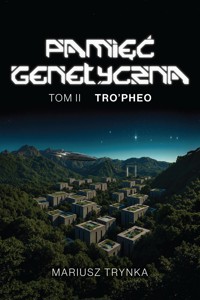
Somewhere beyond the known stars lies a city that has been silent for eons: Tro'Pheo. There, he might find his freedom.
Or the reason it fell silent.
A novel about memory, identity, and the question of how much of what we are truly belongs to us.
The second book in the Genetic Memory trilogy reaches farther out into space and, at the same time, far back into the past. Among ancient ships, hidden factions, and traces older than humanity itself, cosmic scale meets deeply personal choices. What remains of a person when their memory can no longer reliably tell them apart from someone else?
Mariusz Trynka writes with scientific curiosity and a keen eye for the human: gripping, vivid, and full of characters you won't soon forget. If you love science fiction that asks big questions without losing sight of its characters' heartbeat, you're aboard the right ship.
With a bonus appendix: a tongue-in-cheek tour along the seam between science and fantasy, covering genetic memory, zero-point energy, warp solitons, and wormholes.
Reading order: Book 2 continues the story of Book 1. For the full experience, start with the first book.
For readers who love science fiction full of big mysteries, are fascinated by the origins of humanity and the secrets of lost civilizations, and enjoy stories where science and adventure go hand in hand.
For readers of Frank Schätzing's The Swarm, Andy Weir's Project Hail Mary, or Frank Herbert's Dune, and for fans of Stargate, Mass Effect, and Assassin's Creed.
Ebooka przeczytasz w aplikacjach Legimi na:
Liczba stron: 673
Rok wydania: 2026
Odsłuch ebooka (TTS) dostępny w abonamencie „ebooki+audiobooki bez limitu” w aplikacjach Legimi na:
Podobne






MARIUSZ TRYNKA
GENETIC
MEMORY
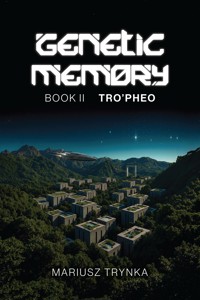
BOOK II TRO’PHEO
KRAKÓW 2026
Table of Contents
The Story So Far
Prologue
Chapter 1
Chapter 2
Chapter 3
Chapter 4
Chapter 5
Chapter 6
Chapter 7
Chapter 8
Chapter 9
Chapter 10
Chapter 11
Chapter 12
Chapter 13
Chapter 14
Chapter 15
Chapter 16
Chapter 17
Chapter 18
Chapter 19
Chapter 20
Epilogue 1
Epilogue 2
Appendix
Acknowledgments
A Word to My Readers
About the Author
Books by the Author – Coming Soon
Books by the Author – Available Now
Copyright © Mariusz Trynka, 2026
All rights reserved.
No part of this publication may be copied, stored in a retrieval system, or transmitted in any form or by any means—electronic, mechanical, photocopying, audio recording, microfilming, digitization, storage on electronic media, or any other technique—without the prior written permission of the author, except for brief quotations in reviews, critical articles, or scholarly works as permitted by applicable law.
First edition, Kraków 2026
Published by the author (self-publishing)
Cover design: Mariusz Trynka
Title: “GENETIC MEMORY — BOOK II — TRO’PHEO”
A Note on the Use of Artificial Intelligence
This book was written by the author. The story, its characters, its ideas, and every line of the original text are his own. No artificial intelligence was used for the actual writing or the creative work.
AI-assisted tools were used only for research and in the final editing stage, where they helped correct and refine spelling and grammar and check the typography. They smoothed the text; they did not write it.
This English edition was translated from the German original with the help of AI tools under the author’s direction, and then reviewed and revised by him.
Parts of the cover design were created with generative AI and then extensively reworked by hand.
More books by the author at:
www.mariusztrynka.com
For Joanna,
who had lunch with me at home every single day,
even when my thoughts were mostly far away,
aboard the Sark Benon or somewhere in Tro’Pheo.
The Story So Far
Ben Foster is a successful IT entrepreneur from Vancouver, burned out on the inside. A journey through South America is meant to give him back the clarity his life no longer offers. On the Nazca plateau, the ground gives way beneath him. He tumbles into a narrow crevice, and there, buried for millions of years, he finds an object caked in earth. It feels too light, and its lines are too straight, for it to be the work of nature. Ben takes it with him.
Before he grasps what he is carrying, Ben photographs the find and sends the picture to Emily Sinclair, an archaeologist at the Canadian Museum of History in Ottawa, hoping for an expert opinion. Only afterward, back in Lima, does the artifact wake. It is a semi-autonomous communication module, a SACM. Reading the night sky, it calculates that some 34 million years have passed since its last activation, and after a DNA match it recognizes Ben as a legitimate descendant. Ben names it Omnis. What Omnis reveals turns his world upside down. Thirty-four million years ago, there was a First Humanity, Homo primus, which possessed a genetic memory and passed its knowledge down through the generations. An asteroid impact forced this civilization to flee into space. Much later, a research mission stranded on Earth interbred with early Homo sapiens 350,000 years ago. Ben himself carries the genetic markers of this line, dormant until Omnis offers to awaken them.
In Ottawa, Emily finds a disturbing match between the photo and the Moravice Tablet, which is more than 350,000 years old. No sooner has she read the message than it vanishes without a trace, and her computer crashes. They are not the only ones who know about the find. A secret CIA unit, run by the all-seeing surveillance AI AEGIS, has intercepted Ben’s email and sends agents Alexandra Mitchell and Marco Alvarez after him. Emily, alarmed and curious in equal measure, travels to Lima herself and finds Ben. From that moment on, their paths are bound together.
What follows is a flight across four continents. Omnis gets them forged identities, hacks systems, and conceals their hideouts. Again and again, Ben and Emily escape by a hair. In Vancouver, Ben has his genetic memory activated through a risky gene therapy. From then on, he is haunted by the knowledge of a man named Asfar Degolian, a scientist of the First Humanity, in images, nightmares, and entire memories. Emily later undergoes the treatment as well, but her memory reaches back only into the more recent history of Homo sapiens. From this, they both conclude that present-day humanity also carries a genetic inheritance. During a brutal CIA raid, the geneticist who performed the treatment is killed. Ben and Emily fall into the agents’ hands, until Alexandra Mitchell switches sides, rescues them, and from then on is one of them.
Omnis is in contact with the High Council of the First Humanity, a galactic body that follows Ben’s progress with growing mistrust. The First Humanity is torn apart. The Progressives, led by Council Chairman Olfar Komurian, strive for Ascension, the separation of consciousness from the body. The Augmenters are betting on merging with machines, while the Naturals preserve cellular life. Their leader, the mysterious Elder, is known to no one and guards knowledge from the dim and distant past. Ben discovers that he is one of the Detached Ones, a rare variant born without genetic memory, yet holding the key to Asfar’s legacy. Asfar, too, was a Detached One. That is precisely why the Progressives are hunting Ben.
With the help of the UN Secretary-General, Ben manages to reveal himself to the world. He is appointed Earth’s first ambassador. On December 24, 2027, the High Council lands in person beside the UN building in New York. But an empath among the Council’s envoys reads Ben’s mind and exposes, in front of the whole world, that Ben knows the location of Asfar’s machine and has kept it to himself. The situation spirals out of control. The delegation abducts Emily and takes her aboard the flagship Eternal Resonance, while Ben is saved at the last moment by the Natural Folgar Convidian, who becomes his protector from then on.
Beneath a Mayan pyramid in Guatemala, Ben and Folgar recover a First Humanity ship hidden in the ground. Ben names it Sark Benon, in honor of Omnis’s former pilot, and wakes its ship’s AI, Eratris. Only because he carries Asfar’s DNA in his blood can Ben open a shielded bunker deep beneath Mont Blanc near Courmayeur and retrieve the Ascension Core, the dimensionally unstable device Asfar once used to make the detachment of consciousness possible. Then they break into the Eternal Resonance and free Emily. Using the soliton drive, they flee to the Naturals’ flagship, the Lyrathen, stationed in the Alpha Centauri system.
Aboard the Lyrathen, Ben and Emily are presented to the Council of the Naturals, among them the strategist Nareena Voss and Captain Keevan Tharn. The Council thanks them for recovering the Ascension Core but refuses to explain its true danger. That, they say, is for the Elder alone to reveal.
The jump to Lyrashin, the Naturals’ secret base, leads straight into an ambush. A traitor on the Council of the Naturals, Savren Dyce, has given away the coordinates. Olfar Komurian’s Eternal Resonance and three Progressive cruisers are already lying in wait. Komurian demands the Core and the two Earthlings, but Folgar refuses. The corvettes of the Order of the Naturals drop their cloaks, and a battle erupts above Lyrashin. Ships break apart. One of them sacrifices itself, rams the enemy, and with its own end buys the damaged Lyrathen its escape to Tau Ceti. There, their paths divide: Keevan takes the Lyrathen to safety, while Ben, Emily, Folgar, and Nareena travel on aboard the Sark Benon to the Elder, whose hiding place lies in the third moon of Helios Prime, in the Vortex-Eridani system.
There, at the end of Book One, comes the greatest revelation of all. The Elder discloses his identity. He is Corin, Asfar’s former assistant and the first and only human ever to undergo Ascension. He has survived for 34 million years, leaping from one cloned body to the next. He explains what Ascension truly means: the slow erosion of one’s own identity and a relentless hunger for energy that can only be fed at neutron stars and magnetars. It was this very hunger that once drove the Khirex, an extinct, ascended civilization, into a war over resources until they wiped themselves out. Their artifacts formed the foundation of Asfar’s Ascension Core. The last surviving Khirex, the Sleeper, rescued Corin at a magnetar long ago and later taught him to live on in a cloned body.
The Sleeper is the only one who can do two things. He can destroy the Ascension Core for good, and he can remove Asfar’s most dangerous knowledge from Ben’s mind before it overwrites him or falls into the hands of the Progressives. Ben and Emily take on the task of finding him. Meanwhile, Nareena is to obtain a jump drive for the Sark Benon on Helios Prime.
Book One ends with their departure from the third moon of Helios Prime. Ben and his companions leave the Elder behind and fly out into the cold dark, in search of a being long lost, and yet not dead.
Book Two begins here.
Prologue
Aboard an escape shuttle of the First Humanity
34 million years ago
The shuttle vibrated faintly, a deep, steady hum Quen Aldris felt in his bones more than he heard. He had only ever felt that kind of tremor after the engines had been running at full power. Their headlong escape must have taken its toll on the machines. Through the narrow windows there was nothing to see but the blackness of space and distant, indifferent stars. Inside, only the dim emergency lighting glowed, and over everything hung a silence heavier than any noise. It was the silence of people who had seen too much to find words for it, and who had lost everything but their bare lives.
Asfar Degolian sat slumped in one of the padded seats, staring at his trembling hands as if they belonged to someone else. His robes, usually immaculate, were rumpled and damp with sweat, his hair a tangle. He muttered without pause, too quietly for the words to be made out, a monotonous trickle of sound that made Quen uneasy.
Around him the survivors moved slowly and carefully—scientists, technicians, and family members, their faces marked by the last few hours. Their eyes held a strange mixture Quen had never seen before: the relief of the rescued, and at the same time horror at what they had been rescued from.
Kelyn Vashar, one of Asfar’s closest colleagues, broke away from the group and approached him cautiously. She knelt beside the seat and laid a hand on his arm.
“Asfar,” she said, gently but urgently. “What happened to Corin? What did the Ascension Core do to him? Is he dead?”
Asfar’s head jerked up. His eyes were wide, yet they seemed to look straight through Kelyn, at a point somewhere behind her that only he could see. For a moment his lips moved soundlessly before his voice caught up, cracked and unfamiliar.
“Dead?” He shook his head, a small, spasmodic movement. “No... not dead. But maybe worse. Maybe much worse.” The whisper faded, returned, and took on a terrible urgency. “I have to destroy Tro’Pheo. I have to destroy it before...” The whispering started again.
Kelyn threw Quen a helpless look. He understood her without a word and stepped closer.
Quen Aldris had known Asfar longer than anyone else on board. He had known the brilliant, controlled man whose mind worked faster than anyone’s he had ever met. The man slumped in front of him now was barely recognizable. He crouched until he was at eye level with his friend.
“Asfar, listen to me.” His voice stayed calm. “You’re talking about Tro’Pheo. But what happened to Corin—that was the Core, not Tro’Pheo. The Core you built. Do you hear me?”
Without warning, Asfar’s hand shot out and closed around Quen’s wrist, startling everyone. The grip was hard and surprisingly strong. For the first time since launch, Asfar’s eyes found something to hold on to, fixing on Quen’s face with feverish clarity.
“No,” he said, and that single syllable was sharp and clear. “Not just the Core. Tro’Pheo. I have to destroy Tro’Pheo.”
Quen went cold. He had been at Asfar’s side back then and knew Tro’Pheo as well as his friend did. But this, he didn’t understand. “Why Tro’Pheo?” he asked, leaning forward. “You haven’t been the same since we got back. What happened to you, old friend? What aren’t you telling me?”
And then the moment was gone. Whatever had anchored Asfar’s gaze slipped away, and the fever gave way to a dull, glassy stare. His grip went slack, his fingers slid from Quen’s wrist, and he sank back into the seat. That brief clarity had cost him the last of his strength.
“Too late,” he murmured. “Maybe... maybe it’s already too late.”
Quen stayed crouched, motionless, for a moment, then slowly straightened. The medics had come up behind him, two silent figures, and he stepped aside to let them through. As they carefully helped Asfar up, Quen heard him whisper once more, barely louder than the hum of the drive:
“Tro’Pheo... I should never have found it... never...”
They led him away down the shuttle’s narrow central aisle, still muttering, and the sliding door of the sickbay closed behind them with a soft hiss.
Quen stayed where he was. Around him the shuttle settled back into its oppressive routine: muted voices, fingers moving over consoles, the steady hum. He stared at the closed door for a long time, trying to make sense of the word his friend had kept repeating.
Tro’Pheo, he thought. What has that place done to you, Asfar?
He had no idea he would never find an answer to that question. Nor could he know that this one whispered name would still carry weight 34 million years later, enough to shift entire worlds.
Chapter 1
Bridge of the Sark Benon
After leaving Helios Prime
The bridge of the Sark Benon hummed quietly to itself, a deep, steady tone Ben hardly noticed anymore. In a moment of stillness like this one, it surfaced again: the heartbeat of the ancient being in whose belly they traveled. Beyond the viewports lay only what the crew called the Between, a milky, shimmering gray with no up or down, where the stars had been drawn out into slow, viscous threads. Ben had learned not to look out for too long. It did something to the eyes, and to the mind.
Instead, he studied the star map for what felt like the hundredth time. The large holoprojector cast a slowly rotating image of a section of the galaxy into the air. Three red dots pulsed within it, far apart from one another—the three possible magnetar sites. A year and a half ago, Ben’s biggest worry had been a rescheduled meeting in a glass tower in Vancouver. Now he had to pick, from three sparks in the blackness, the one where a being from another plane of consciousness was waiting to help them—or not.
On the narrow table beside the navigation console lay the remains of breakfast: two fruits from the Lyrathen, each with a bite taken out of it, strange in shape and color.
Emily, standing beside the console, nodded at the one he had left. “Aren’t you eating yours?”
“I can’t get past the aftertaste,” Ben said. “Honey, aniseed, and something I can’t put a name to.”
“That nameless something is the best part.” She took a piece and chewed thoughtfully.
“Don’t get used to it. You’ll miss it back on Earth.”
On Earth. Ben could hear for himself how strange the words sounded, as if they belonged to a different story. He reached for the fruit after all. It was the small scraps of normality he held on to: breakfast together, a joke about the aftertaste of something sweet. They reminded him who he was, rather than whose knowledge had been living in his skull since that day and would give him no peace.
Folgar was working at the tactical console, and Ben noticed yet again how differently the Natural moved now that he had his own SACM back. His shoulders were less tense, his hands surer. For a long time his module had been needed to hold the force field around the Ascension Core, while Folgar himself made do with a device borrowed from the Lyrathen. It was only a few days ago that the Naturals’ technicians had swapped the two back.
“You look more content,” Ben said.
Folgar raised the SACM for a moment, letting the map’s light slide across its dark lenses. “Imagine someone takes away your voice and gives you a stranger’s instead,” he said. “Intelligible, serviceable, but not yours. And then one day you get your own back.” He set the module carefully back in its cradle. “That’s what it feels like.”
Ben nodded. He understood the words. What unsettled him was that some part of him understood them too well, as if he knew firsthand what it was like to carry a stranger’s voice inside his own head. He pushed the thought aside.
“Eratris,” he said to the ship’s AI, “how long to the first magnetar?”
“One hundred and twenty hours under optimal conditions, Ben. But we have to allow for at least three detours to avoid the Progressives’ patrol corridors. Realistically, one hundred and thirty-six.”
“And the jump drive?” Ben knew the answer but asked anyway. “Tell me we can use it soon.”
“I can’t. The synchronization between the Augmenter unit and the Aeternis Core stands at twenty-one percent.”
Folgar looked up. “They built it into the ship’s belly in the last hours before we left Helios Prime,” he said. “An Augmenter fold drive, and still a foreign body in a vessel thirty-four million years its senior. A fold jump folds space itself. For that to work without tearing us in half, the drive has to fall into step with this ship’s heart. And this core doesn’t speak the Augmenters’ language.” A tired half smile. “Eratris is teaching the two of them to talk to each other while we fly, light-year by light-year.”
“How much longer?”
“Days. Perhaps weeks,” Eratris said. “The alignment improves only with the distance we cover. A jump before then would have odds of success I would rather not name while there are humans aboard.”
“And even then, I’d keep it in reserve.” Nareena had been silent until now. She raised her head in the half-light, her silver hair pulled back tight. “A fold jump tears a hole in space that can still be measured light-years away. We’d gain a few days and tell the Progressives exactly where we are in return. The soliton drive is slower. But it’s quiet.”
Ben looked at the three red dots. They had a tool they couldn’t use yet.
Emily stepped to his side, her face lit by the dots’ red glow, and read the map with the same searching eye she had once turned on excavation trenches. “And that’s only the first one. These three dots are light-years apart. If the Sleeper isn’t at the first, we lose days. Maybe weeks. And all that time—”
“Then we search the second. And the third.” Ben laid a hand on her back. “We don’t have a choice, Emily. As long as Asfar’s knowledge is in my head, the Progressives won’t stop hunting me.” He paused, and his voice dropped until it was meant only for her. “And to be honest, sometimes I’m more afraid of it than of them. Because I’m no longer sure where I end and... he begins.”
Emily looked at him. For a moment there was a worry in her eyes he couldn’t bear, and she said nothing.
Folgar broke the silence. “What bothers me,” he said to no one in particular, “is this very silence. We got away from them on Earth, from their own flagship, above Lyrashin. By now they’d normally be breathing down our necks. That they aren’t means one of two things. Either they’ve lost us...”
“...or they have a better plan.” Nareena sat motionless at the navigation console. She was a woman of few words, which was exactly why the ones she spoke carried weight. “The Progressives don’t lose things. They let them run until they know where they’re running to. The question isn’t whether they’ll catch up with us. The question is what they’re doing in the meantime.”
No one answered. The map went on turning in the air, indifferent to the worries of the four people standing in its light.
Ben stepped closer to the projector to shake off the uneasy thought. As his gaze searched the star fields between their position and the first red dot, it happened again. No words reached him, only a cool, complete knowledge that seemed to lie there as if it had never lain anywhere else.
“We shouldn’t take the proposed route,” he heard himself say. He pointed to a region of the map he had paid no attention to until that moment, a vast, convoluted nebula. “Here. This cloud is riddled with gravitational anomalies. They create natural sensor shadows, zones where a ship can vanish without cloaking.” His finger traced a path. “Three short legs in quick succession, each one shorter than a pursuer’s expected value, then an unpowered drift into the nebula. Anyone looking for us finds nothing. We lose half a day. But we disappear completely.”
The bridge had gone quiet, and this silence was different from the one before.
What hung in the air wasn’t what he had said. That was sound, and they all knew it. It was the way he had said it: the tactical precision, cool and clinical, the easy command of expected values and pursuit logic. No man who had been thinking about quarterly reports a year and a half ago talked like that.
Ben felt it most sharply of all. For a moment, something lay open inside him, a place that should not have been there. How do I know this? he thought. I’ve never run for my life. I’ve never been hunted. How do I know the mind of a hunted man who gets away?
He caught Emily’s eye. She was watching him from the side, and he could see the same question at work in her. But she had an inkling of the answer, and she dreaded it. Her gaze moved on to Folgar, and the two of them understood each other without a word.
I noticed it too, said Folgar’s expression.
No one said it aloud. Instead, Folgar bent over the console and began entering the route. “A good route,” he said, a shade too casually to be convincing. “Well thought through. Eratris, take the data.”
“Data received,” the AI confirmed. “That brings the probability of detection down from sixty-four to under nine percent. A remarkably efficient solution, Ben.”
“Thanks,” Ben murmured. The word tasted wrong, praise for something that might not have come from him at all.
He ran a hand over his face and only then realized how exhausted he was, with a weariness that went deeper than lack of sleep. The third moon of Helios Prime lay far behind them now, and with it the Elder and all the answers he had not given them. Somewhere out there, at a magnetar whose radiation could prove dangerous even to this ship, a being waited who had been lost for eons and yet had never died: the Sleeper, their only lead.
“Set the new course, Eratris,” he said. “Let’s get it over with.”
* * *
Secret Base of the Naturals, inside a nameless asteroid
The asteroid had no name, and that was deliberate. What had no name could not be spoken, and what could not be spoken could not be betrayed—not under torture, not in sleep, not by accident. The founders had decided their refuge would stay nameless, and that single rule had kept them alive for centuries. One by one, other Natural enclaves had been tracked down and broken up. Theron Mavek had thought this thought so often he hardly felt it as a thought anymore.
He walked slowly through the main garden, hands clasped behind his back, as he did every morning. No sky arched above him, only the vast dome of the central cavern. Even so, the warm golden light of the Aeternis projectors would have fooled any stranger. It moved across the dome like a real sun and smelled of damp earth and resin. They had made themselves a spring, simply because life needed one.
Somewhere a child laughed. Across the way, a small boy was chasing a shimmering drone, steered by an older girl who stood with her arms folded, plainly enjoying her power. None of these children had ever learned to shoot. That was Theron’s greatest pride, and sometimes his greatest fear. He had raised generations who didn’t know how to hold a weapon, in a galaxy that always reached for violence again when it had to.
“You’re brooding again,” said a voice beside him.
Sela Voren had come up without a sound, as she always did. His deputy, barely half his age, with the alert eyes of a woman who had carried too much responsibility too early. She held a data tablet in her hands.
“I’m not brooding,” Theron said. “I’m watching.”
“You’re brooding while you watch.” She gave him a fleeting smile. “The sensor rings are done. Fourth maintenance this cycle, all quiet. No jumps, no echoes, no shadows. We’re as invisible as ever.” She paused. “You can stop worrying. For today, at least.”
He nodded, but he was only half listening. At the back of his mind, as every morning, lay that other knowledge, heavy and cold and carefully locked away. It was the coordinates, known to no more than a handful of Naturals besides himself—the one secret bigger than this whole world of light and earth. He guarded it like a flame in a storm.
As long as no one knows we exist, he thought, no one knows where to find him.
Light tore the morning apart.
It came without warning. A harsh, silent flash made the golden dome flare white for a heartbeat. A grinding followed, deep in the rock, and Theron felt it in his breastbone. A second discharge, a third, and the warm daylight turned to a pale, pulsing red.
Only now did the sirens start to wail.
“No,” Sela breathed. The tablet showed what could not be: energy signatures, dozens of them, already inside the sensor rings. “They’re in,” she whispered. “Theron, they’re already in.”
They materialized out of nowhere. All over the cavern, figures flickered into existence. They were Progressives in shimmering combat suits, stepping effortlessly through distortions in space-time to places where, a moment before, no one had stood. They had no need of airlocks or corridors. They simply arrived and trained their energy weapons on anything that moved. A woman screamed; a drone crashed to the ground in a shower of sparks. The small boy stood frozen in the middle of the path. He didn’t understand what he was seeing, because no one had ever taught him what there was to understand.
Theron acted before he thought.
“To the escape pods!” he roared, and his voice cut through the chaos. “Everyone! Now! Leave everything, just take the children!” He turned Sela to face him. “Emergency wipe protocol. Level three. The archives, the maps, the registers. Delete everything. Leave them nothing.”
Sela stared at him, ashen in the red light. “Level three also deletes—”
“I know what level three deletes.” He forced the words out. “Do it. Now.”
She ran. Theron turned to the cavern and did what he had trained for all his life and hoped he would never have to do. He steered the stream of people toward the rear shafts, where the escape pods had waited in the bare rock since the days of the founders. He picked up the motionless boy and pressed him into the arms of a running woman. His mother, he hoped, or somebody’s mother—it made no difference. “Run. Don’t look back. Run.”
Above him, the light was dying. Level three ate its way through the base’s veins, and the artificial sun went out in waves, tunnel by tunnel. The archives went out with it: the genetic registers of his people, the names of everyone who had ever been born here or died here, the memory of centuries. It had to be done. He had given the order himself, and still it felt as though he were erasing, with his own hand, everything his people had ever been.
All around him, what had lasted for centuries was dissolving, but the people were running. That was all that mattered.
An energy weapon discharged close beside him, near enough that he felt the heat on his cheek, and the stone to his left glowed and burst apart. Theron didn’t throw himself to the ground. He had grasped what was happening here, and with that understanding came a strange calm.
They weren’t shooting to kill. If they were, the cavern would long since have been full of the dead. The Progressives fired over people’s heads, into the stone, into the ground. They were driving the people, flushing them out, cutting off their paths. This was a hunt with beaters, not an extermination, and a hunt like that always had its quarry.
They haven’t come to wipe us out, Theron thought. They’ve come to take something. Or someone.
He already knew why, after centuries of invisibility, they had found this refuge of all places. The reason was the one flame he carried inside him, not the archives and not the people. Somewhere, someone had talked, or one of them had grown careless. Now they wanted what existed only in his head.
Behind him he heard the heavy rumble of the first escape pods breaking away from the shafts and thrusting out into the blackness. He counted them without looking. Three, five, eight. With each one, part of the burden grew lighter.
They closed in on him from three directions with the bored efficiency of officials who had done this job a hundred times, formed a half-circle around him, and aimed their weapons at his chest. Theron stood still among the trampled white blossoms and let his arms drop.
An officer stepped out from the Progressives’ ranks—tall, his face narrow and smooth, his eyes a cold, clear blue. Theron found nothing in them: no anger, no triumph, not even contempt, only the calm attention of a man ticking off a task.
“Theron Mavek,” the officer said, and it was not a question. “In the name of the High Council, you are under arrest. Resistance would be pointless. Your people are gone, your archives erased, your refuge no longer secret.” He tilted his head, the smallest degree. “But I suspect that was never what you were trying to protect.”
Theron made no reply. He looked past the officer, to where the last shaft was opening and the very last pod was breaking free. It tumbled out, gleamed briefly in the red light, and vanished into the darkness. Sela. He knew it without being able to see it. She had finished the wipe protocol and left only when there was nothing more to save, just as he would have done.
That much, at least. Her, at least.
Part of him wanted to laugh, another part to scream, and both were dangerous, so he did neither. He thought of the flame he had guarded all his life. They would take him away and search his head for it.
Whatever you have planned for me, he thought, slowly raising his hands, you’d better hope I’m stronger than your machines.
Because he knew himself well enough to know he might not be.
* * *
Aboard the Flagship Eternal Resonance
After the earthy air of his homeworld, the inside of the Eternal Resonance smelled of nothing at all. It was the first thing Theron noticed as they marched him through the endless corridors. Silvery walls that glowed from within, cool and shadowless. No garden, no dust, no laughing child, only this immaculate nothingness the Progressives mistook for progress.
The interrogation room was bare, and not by accident. In its center stood a chair of dull metal, surrounded by dark, alien apparatus whose purpose Theron had no wish to know and yet could guess. They strapped him in, pinned his wrists, and pressed thin, cool electrodes to his temples. He forced himself to breathe evenly. As long as he could control his breathing, he still had that much.
The officer with the cold blue eyes, the one who had arrested him in the ruins of his home, stepped into view.
“Zaren Kolth,” the man said, adjusting one of the devices with tender care. “Chief Interrogator of the Progressives. I give you my name, Mavek, because soon it will make no difference what you know and what you don’t. Our neural extractors are very... efficient. The less you resist, the less it will hurt. Though ‘less’ is a flexible term.”
“You’ll get nothing,” Theron ground out through clenched teeth. “The Naturals don’t give up their secrets. Ever.”
Kolth studied him with curiosity, the way a scholar might study an outdated exhibit. “Do you know what wearies me most about your kind? Not the resistance. The sentimentality. You cling to your flesh, your memories, your little gardens like drowning men clinging to a sinking ship. You call it loyalty to nature. I call it fear of the next step.” The briefest pause. “The Progressives offer Ascension. An existence beyond decay, beyond death. And you turn it down to grow flowers in a cave. Your time is up, Mavek. You just don’t know it yet.”
“At least we still have a soul to cling to,” Theron said.
A brief, cold flicker of interest showed in Kolth’s eyes, because the exhibit had spoken. A moment later it was gone.
“We’ll see,” he said, “what’s left of your soul once I’ve found what I’m looking for.”
He activated the machine.
The first blow brought no pain. Something cool and many-fingered slid into Theron’s skull and felt its way forward methodically, like a hand rummaging through someone else’s drawers. The pain came only afterward, a searing wave behind his eyes that tore from him a scream he had never meant to let out.
He fought, because without knowing it he had spent his whole life preparing for this one hour. He did what the elders had taught him: he built walls. He pushed the one piece of knowledge, the flame, as deep as he could and piled everything trivial he could find in front of it—the scent of the white blossoms, the laughter of the boy who had chased a drone, Sela’s sober gaze—a wall of small, precious, useless things.
“Interesting,” he heard Kolth say, the voice muffled. “You hide it behind what you love. Most do.” A soft hum. “But let’s see what you’re hiding deepest of all.”
The hand in his head grew more thorough. It pushed the blossoms aside, and the laughter, with the indifferent patience of a plow breaking up a meadow. Theron strained against it, only so as not to think the one thought, because the moment he thought it, the machine would pick up the trail. The tendons stood out on his neck, and blood ran from where he had bitten through his lip. Not that, he thought against his own will, anything but that, take the names, the songs, but not—
In the end, the machine found it anyway.
It came loose from him with a tearing that was physical and yet had no place in his body. It was dragged into the harsh light where Kolth was already waiting for it: an industrialized planet furrowed by factories and mines, a world of the Augmenters, and in its shadow an inconspicuous third moon, iron-rich and sensor-clouding, chosen long ago by people who knew how to hide, and beyond it the swirling edges of a distant nebula. Coordinates, clear and complete, in a way he himself had never once spoken aloud, not even alone in the dark.
The Elder.
Theron let out a sound deeper than any scream. What tore him apart was the realization of what he had done, against every oath, every wall. He had not been able to hold the flame. The wind had been too strong.
“Ah.” There was real satisfaction in Kolth’s voice. On a holodisplay, the extracted patterns ran as flickering tracks and condensed into a single point. “There it is. So well hidden, and in the end just a few numbers.” He removed the electrodes with detached fingers. “You could have spared yourself the pain, Mavek. But the sentimental ones never do.”
Theron slumped in his restraints, and for the first time in decades he wept, silently, out of shame.
Kolth regarded him, head tilted slightly, with the searching look of a man confronted with a feeling he did not know himself. Without raising his voice, he spoke into the room. “Prepare the erasure. The upper layers, the last few hours. Cleanly. And give him something for the pain. We’re not monsters.” There was no mockery in it, no scorn. That was the worst part: it sounded as if he meant it.
* * *
The bridge of the Eternal Resonance was quiet and cool, and Council Chairman Olfar Komurian took his time.
He stood before the enormous holoprojector, hands clasped behind his back, and studied the map: a web of stars and currents, and at its center, half swallowed by swirling clouds of gas, a single point pulsing. Kolth’s men had passed the data up to him. Now the secret of centuries, perhaps millennia, lay open before him.
“The outer reaches of the Vortex Nebula,” he said, savoring the words. “The third moon of Helios Prime.” His thin smile gave way to a grudging respect. “I’ll give him that. An ordinary Natural would have crawled off to the edge of the map, where it’s empty and quiet, and that’s exactly where we would have caught him long ago. Not the Elder. He sits right in the middle of the noise, next door to an Augmenter world full of factories and ore. A world that yields so much that no one would waste so much as a glance on its moons. We looked everywhere except where things are busiest.”
Commander Xeran Thol stepped up beside him, his eyes fixed on the pulsing point. “So that’s where the Elder is hiding. All these years, right under our noses, in the middle of the Augmenters. Shall we set out at once, Chairman?”
“Of course.” Olfar’s eyes narrowed to thin slits. “But this time we show no restraint, Xeran. The Elder has sent entire fleets chasing shadows and withheld his knowledge from a people who need it so badly.” His voice stayed calm and measured, and that was precisely what made it menacing. “It’s time he finally served his people. Whether he wants to or not.”
Xeran hesitated. “And the prisoner?”
Olfar waved it away. “Mavek? Put him in an escape pod on a course for the nearest habitable world. We’re not barbarians. But first make sure his memory of this conversation becomes... blurred. It would be impolite to burden him with the knowledge that he was the one who delivered his mentor to the slaughter.”
Xeran nodded and passed on the order.
Olfar looked a moment longer at the small, harmless point deep in the map, at the nameless third moon.
The Eternal Resonance got under way. Her vast silhouette turned silently into the blackness and set her course. The space before her bow folded into a blazing seam, and she was gone, across light-years.
Far behind, in the empty space above an asteroid, a lone escape pod drifted through the darkness, cast off by the Eternal Resonance and left to its fate. Inside lay Theron Mavek, eyes open, gazing through the narrow window at the stars without knowing why his face was wet. Something was missing, and he couldn’t say what. A name, perhaps, or a place, or a person he had owed something to. A pain without a wound, a grief without a reason.
* * *
Bridge of the Eternal Resonance
In the Vortex Eridani Nebula
The Vortex Nebula was beautiful, and Olfar Komurian hated it a little for that.
He stood at the bridge’s forward viewport, hands clasped behind his back. A reddish-brown world pushed out of the golden haze, an Augmenter industrial world whose night side was webbed with the glow of countless factories and refineries. In its shadow, a small, dark moon followed its orbit.
“There,” Olfar said quietly. He had no need to raise his voice; on the bridge of the Eternal Resonance, the Council Chairman was heard even when he whispered. “Magnify the third moon.”
The image leapt closer: an unremarkable, iron-rich rock. The sensors swept it and found nothing.
“Nothing,” he murmured. “Of course nothing.” He gave a thin smile. “Nature doesn’t build an emptiness this perfect. Only someone who doesn’t want to be found builds something like that.” He tilted his head. “He’s been hiding for centuries. It wasn’t our instruments that found him. We have him because a man gave us the numbers before it broke him.”
Zaren Kolth had stepped to his side, silent as ever. “Perhaps he’ll give himself up, Chairman,” he said. “After all these centuries. Even the most stubborn mind grows tired eventually.”
“The Elder never gives up.” Olfar said it without any edge. “That’s what makes him so dangerous, Kolth. An enemy who gives up is beaten. But one who merely keeps still is not beaten. He’s waiting for his moment.” He kept his eyes on the small moon. “I’ve hunted him for half my life, as my predecessor did before me, and his predecessor before him. We don’t even know his true age. Some say he was already old when the first records were made.”
“Surely that’s just a legend,” Kolth said.
“Legends don’t spring up on their own.” Olfar finally turned away from the viewport. “But they do die.”
“It isn’t only him we’re coming for,” he said, more to himself than to Kolth. “It’s everything he hoards. For as long as this Council has existed, the Elder has meddled in its affairs. He has protected fugitives, thwarted plans, and kept knowledge locked away that should have belonged to our entire people.” His voice hardened a shade. “And most recently, he has shielded a human. A single, insignificant human from a backwater little world—Ben Foster, who carries something in his skull we never imagined anyone could still dig up.” He closed his eyes for a moment. “The Elder knows where this human is. And even if he doesn’t, he knows enough else to justify this journey.”
“They say his shielding surpasses anything we’ve ever measured,” Kolth said carefully. “The Naturals we picked up carried barriers in their minds that burned out more than one extractor. And he’s said to be the source of that art, its oldest master. His mind is supposed to be... different. Layered, as if he were hiding from himself.”
“Then we’ll make sure hiding does him no more good.” Olfar stepped over to the holoprojector. “Prepare the access command,” he said. “Full strength, heavy weapons. No negotiations, no games. We go in, we take him, and we have him aboard before he realizes we’re there.”
“And his shielding?” Kolth asked.
“That’s why you’re standing up here beside me now, and not down in your interrogation room,” Olfar replied. “Take the heavy neural inhibitors. Every one we have. I want his mind shrunk down to a newborn’s before you so much as touch it. Whatever walls he’s built to hide behind won’t help him today.”
“There’s a risk, Chairman,” Kolth said. “Inhibitors at this dose... an ordinary mind would shatter under them. We could lose him before we get anything out of him.”
“He isn’t an ordinary mind,” Olfar said at last. “You said so yourself.” He looked back at the moon, which now filled the image, large and close. “And if I’m wrong, if he’s only a tired old man after all, then he has brought this visit on himself. For centuries he could have shared what he knows, for the good of a people that has been treading water for generations. Instead, he went to ground.” The corner of his mouth twitched, barely noticeable. “No one makes a fool of the High Council forever.”
He straightened, and his weariness gave way to resolve.
“Take us into position behind the moon’s shadow, so its horizon hides us,” he ordered. “Radio silence. No active scans that might warn him. When the team is ready, we all go through at once. No lone jump to give him time to seal a bulkhead or trigger a failsafe.” He gave Kolth a curt gesture. “I’m coming with you. I want to be there when he realizes the game is over.”
“You’re coming down yourself, Chairman?” Kolth sounded surprised.
“After so many years?” Olfar studied the moon, his gaze full of longing. “Oh yes. I’ve been looking forward to this conversation for a long time.”
He didn’t say how much more than a few coordinates was at stake for him. If the secret that would finally complete the Ascension still lay hidden anywhere at all, it lay in the Elder’s mind.
The Eternal Resonance sank silently into the moon’s long shadow until nothing of her could be seen.
Chapter 2
Third Moon of Helios Prime
Corin sat motionless on the smooth stone and let the silence of the little chamber sink into him. It was a good silence. He had learned to value it, with the gratitude that grows out of loss.
The chamber was plain, cut into the bare rock. Shelves held books from dozens of worlds, some in languages no one but him had spoken for ages. In a niche stood a small hydroponic garden he tended every day, and not for food. The green reminded him of living things that die and put out shoots again, and that was where its beauty lay. On the wall, a virtual window showed the stars.
Sometimes he remembered the man he had once been. Corin, assistant to a brilliant visionary, young and full of trust, who had lain down in Asfar’s machine of his own free will, convinced he would be the first to step through the gate to immortality. He remembered the tearing, the moment his body dissolved into energy and his mind was flung beyond all four dimensions into a screaming void. He had not died, and that was perhaps the cruelest part. He endured, eon after eon. Surviving instead of living, the Sleeper had once called it. That life at Asfar’s side, more than a hundred years of it, now seemed to him no longer than the blink of an eye.
Millions of years, he thought, without bitterness. What remained was a patient weariness and a small, stubborn hope, and its name was Ben Foster.
The human had set out a few days ago, out into the blackness, toward the Sleeper. Corin had shown him the way and then let him go, with the quiet letting go he knew from too many farewells. He had recognized the old ship by its design, not its name: a Vorna-class, the sweeping line of the hull that only the Kowin had ever built, a people who in the distant past had lived on the other side of the young Earth. He had loved ships like that, back when he was still a man, and a wistful smile had crossed his face, the first in a long time, until the worry returned. Carry it away, he had thought, before the wolves come.
Now the wolves were coming.
He sensed them before he heard them, a faint vibration in the layers of reality an ordinary mind could not perceive. A great mass had slid into the moon’s shadow, and it smelled of cold metal.
Corin sighed. He did not open his eyes. Not yet.
They’ve broken someone, he thought, and it saddened him. Someone who knew where he was had given him away. They had torn the secret out of that person’s skull. It was not betrayal. Forgive me, whoever you were.
The air split open.
They came out of nowhere, as was their way. A dozen figures in shimmering armor materialized without a sound in the cramped chamber, weapons raised, in a practiced half circle. Corin felt their anticipation, a taut, cold hum no simple mind would have noticed. They were expecting a dangerous opponent. None of them suspected he had long since decided not to resist.
Only now did Corin open his eyes.
A man no longer young stepped forward from their midst, his face marked by a burden that went deeper than fatigue. Corin knew that face. He had watched it age over the years, without the man ever suspecting. He felt no fear, only an old, sad recognition.
“Olfar,” Corin said, as if greeting a long-awaited guest. “You look old. The responsibility is wearing you down.”
Surprise flickered across Olfar’s features at the Elder’s calm and at hearing his own name, before his face hardened.
“At last we’ve found you,” he replied, and stepped closer, surrounded by his soldiers like a man who felt safe nowhere, not even in his hour of triumph. “For generations you’ve been hiding away, holding back knowledge that belongs to all our people. Now it’s time for answers.”
Behind the title of Council Chairman, Corin saw a tired man. He found no doubt in him, only the unshakable certainty that the Ascension was the only salvation and that anything standing in its way had to be cleared aside. His conviction made him dangerous, more so than any hatred could. Corin felt pity for him.
“I won’t help you, Olfar,” he said. “Don’t call it cruelty. What you take for salvation is the very opposite.”
“Leave that to my judgment.”
“You judge like a man dying of thirst who is told the glittering water is poisoned, and drinks anyway.” An edge crept into his voice. “You believe the human carries your deliverance inside him, the knowledge that would complete your ascent. But it’s no gift. It’s the same poison that destroyed a wiser people than yours. What Ben Foster carries must never be used by anyone. It has to be wiped out, and that is exactly where he’s taking it right now. If you let him go, you’d do more for your people, who have been treading water for eons, than with anything you do here today.”
Silence. Olfar’s eyes narrowed, and Corin felt the man close himself off against him, felt the warning turn to sedition in his ears and set into a hardness no doubt could get through anymore.
“You call it poison, we call it deliverance,” he said. “For countless generations my people have striven for the one step that lifts us above the flesh. But you, who took that step long ago, skulk away like a thief and begrudge it to everyone else. Forgive me if I distrust a man who holds salvation in his hands and refuses it to us.”
Corin inclined his head. When he spoke again, his voice was so quiet that the soldiers leaned in without meaning to. “You crave the Ascension more than your own life. I know, because I once craved it with the same zeal as you. I went through the gate you take for ascent, and I saw what waits beyond it. It isn’t life, Olfar. It’s only an endless enduring. I wouldn’t wish it even on you.”
Olfar stood motionless, then shook his head with regret, as if at a man who mistakes light for fire. The words glanced off his conviction. Without taking his eyes off Corin, he made a curt gesture. “Kolth.”
Zaren Kolth stepped out of the ranks, holding a rod of dull crystal in which a cold light began to circle, slowly, then faster. Corin knew devices like that. He had seen their forerunners in the hands of other men, men who had been convinced too.
“We’ve learned a thing or two, old man,” Kolth said, raising the rod, his tone a shade too polite. “This is the strongest thing we’ve ever built. Because we knew one day it would be used on you.”
The first pulse struck Corin and closed around the architecture of his consciousness, the layers he had built up over eons so he would not fall back into the interdimensional maelstrom the Sleeper had once rescued him from. The inhibitor tried to crush them down to the level of an ordinary mind. It hurt, more than he had expected. First Humanity’s devices had come a long way.
He withdrew inward, into the chambers of himself no device would ever reach. There he locked away the one thing that must never come to light. It was not the Ascension Core, not the truth about the Khirex, not even his own name. It was an image: a dying star far out in space, and a consciousness sleeping inside it. The route Ben was traveling at this very moment.
Not that, Corin thought, and laid wall upon wall around the thought. Somewhere out there, he sensed, another was guarding the same flame, one of his confidants, someone he had never seen and yet felt was a brother. Anything but that. Take whatever you want. But not the boy.
“Bring him aboard,” he heard Olfar say, from very far away, through the circling light. “To the Eternal Resonance. And, Kolth...” A pause, in which greed crept into the tired voice. “Don’t stop until we have everything.”
Corin felt them seize him as the chamber faded, the garden, the books, the stars, all the stillness of a refuge that was a refuge no longer. He put up no resistance. He would need his strength elsewhere soon enough.
Even as he went dark, before the next pulse cinched his mind tighter, the oldest living witness to the Ascension Core formed one last, calm thought:
They’ll dig deep. Deeper than I can bear. There’s only one thing I mustn’t think about, and that’s exactly what they’ll be looking for.
* * *
Interrogation Room on the Eternal Resonance
They had strapped him to the extraction chair. Corin’s eyes were clear and alert.
The restraints were pointless. A body that for millions of years had surrounded him out of mere courtesy could not be held by straps. To them, though, he was an old man in a chair, and old men got tied down. So he kept still and let them go on believing it. What the enemy believed was often the only weapon a prisoner had left.
The inhibitors’ cold grip had been clamped around his mind for an hour now, squeezing it from every side. Corin tried to compress his architecture, layer upon layer, against the machine’s pressure. Against an ordinary consciousness, that pressure would have been enough—a simply built mind whose memories stood lined up like books on a shelf. A mind like that would have cracked open long ago. That was what had happened to poor Theron, whose name Kolth had relished telling him earlier.
But Corin’s mind was a city, grown over eons, with streets beneath streets and cellars beneath cellars, where memories lay whose language even he had forgotten. When the inhibitors pressed, he simply withdrew deeper, down into ages the peoples of the present could not even dream of. If they followed him, they would only lose their way.
This time he wasn’t hiding dead knowledge, or a place on a map. This was about a living human being he cared for, someone whose path was cutting through the darkness at this very moment. But worry couldn’t be locked away in a cellar. It kept drawing his gaze back to the same bolted door. Pull yourself together, he told himself. That is exactly what they must not sense in you.
“That’s impossible,” he heard Kolth murmur, somewhere beyond the circling light.
Corin opened his eyes a crack. The interrogator was bent over his instruments, adjusting them for the third time with fingers no longer quite steady. Sweat beaded his forehead, although the room was cool.
“The neural inhibitors should have broken through his barriers long ago,” Kolth went on. “At this dose, a mind like his should have dissolved. Instead...” He gestured jerkily at the monitors, where nothing ran but swirling, meaningless noise. “Instead, this.”
Olfar stood against the wall with his arms folded, his face showing an impatience he was struggling to master. “What do you see, Kolth?”
“Fragments.” Kolth shook his head, fear creeping into his voice. “Memories thousands of years old. Older. Worlds I don’t know, stars in the wrong places, things I have no words for. But nothing we can use, nothing from now. It’s as if he’s hiding his consciousness in layers we can’t reach.” He looked up, pallid in the cold light. “Chairman, I’ve never seen anything like it. No mind can be built like this.”
Corin smiled faintly.
“You underestimate,” he said, hoarse but calm, “what an eternity teaches a mind, Olfar.” He raised his eyes. “My consciousness is no longer as simply built as yours. You’re looking for a room where I’ve hidden something. But I’m not a house anymore. I’m a world. And you are two men with a lantern, searching the night for a single stone.”
Olfar frowned. Corin could see he took it for an old man’s arrogance. He couldn’t know that every word was the plain truth.
“He’s rambling,” Olfar said at last, without conviction. He pushed himself off the wall. “I don’t care how old his memories are. His past doesn’t interest me—I want what he knows today. Where the human is, and what he told this Foster.” His voice took on a sharper edge. “Dig deeper.”
Kolth hesitated. “At this dose, we risk—”
“Dig. Deeper.”
The interrogator pressed his lips together and turned up the intensity.
The pressure became pain.
It was a pain Corin had never known. The inhibitors were leaving the outer layers behind now and driving into the anchors themselves, into the ancient scaffolding of will that had held him together, eon after eon. Now something was tearing at his city’s load-bearing walls. For the space of a blink, his body flickered on the chair and turned translucent. Something larger and more terrible shimmered through from beneath before the human form returned. One of the guards took a step back.
Corin held on and drew himself deeper, down into the cellars beneath the cellars. Don’t think of the star, he told himself, and that was precisely where the danger lay. Not the energy streams. Not the one who sleeps there. Not the path the boy is taking right now—
It was already there.
The pain broke through and shredded his concentration. In that unguarded moment the image rose, precisely because he had been determined not to think of it: a magnetar, alone, far out in space, a crushed star of unimaginable density, wrapped in swirling, blazing streams of energy.
It flared across the monitors, sharp and clear, visible to everyone in the room.
“There!” Kolth jerked upright, all weariness gone, a hunter’s greedy triumph in his eyes. “There was something! A star, maybe a magnetar! Clear and present, not a memory—something he’s protecting now!”
Corin froze. The cold that shot through him had nothing to do with the inhibitors. He saw the image reflected in Olfar’s eyes and knew, with the bitter clarity of a man who had survived millions of years, what he had just done, and why.
Olfar came slowly closer, his eyes glittering.