


Uzyskaj dostęp do tej i ponad 240000 książek od 14,99 zł miesięcznie
- Wydawca: Mariusz Trynka
- Kategoria: Fantastyka•Sci-fi
- Język: angielski
Echoes of Memory
Three novellas from the universe of Genetic Memory
A strange world. A lost expedition. A bond forged beyond the boundaries of species.
From the first tentative steps on alien soil to the fusion of two civilizations and the legacy they leave behind — these three novellas trace the quiet, extraordinary arc of a memory that refuses to fade.
Told with poetic power and lingering suspense, they illuminate the origins, the turning points, and the echoes of a history that changed everything.
Note: For the full reading experience, I recommend reading GENETIC MEMORY – BOOK I – OMNIS first.
This collection brings together all three novellas from the Genetic Memory universe in revised editions, each newly edited specifically for this volume:
◆ The Seed of Memory – An expedition reaches an unknown world. What the crew discovers is not a lifeless planet, but the beginning of an encounter that will forever bind the fates of two species. A tale of survival, first contact, and the mysterious origins of a new history.
◆ The Fusion of Memory – Two civilizations that could not be more different begin to reach toward one another. But fusion does not come without cost — it demands sacrifice, challenges identities, and leaves traces in the genetic memory of both peoples.
◆ The Legacy of Memory – What remains when civilizations perish? A legacy, inscribed in memory itself. The final novella closes the arc and reveals how deep the roots run that surface in the main story of Genetic Memory.
For readers of science fiction who love poetic world-building, first contact narratives, genetic evolution, and epic civilizational sagas. If you value stories that don't just entertain but make you think, you will find what you're looking for in these pages.
Ebooka przeczytasz w aplikacjach Legimi na:
Liczba stron: 264
Rok wydania: 2026
Odsłuch ebooka (TTS) dostępny w abonamencie „ebooki+audiobooki bez limitu” w aplikacjach Legimi na:
Podobne




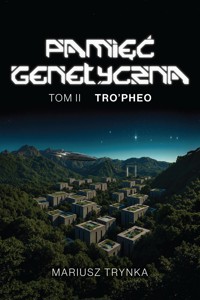




MARIUSZ TRYNKA
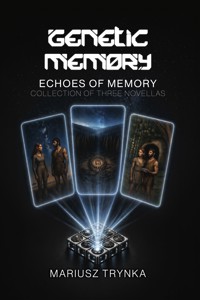
GENETIC
MEMORY
ECHOES OF MEMORY
COLLECTION OF THREE NOVELLAS
FROM THE UNIVERSE OF GENETIC MEMORY
The Seed of Memory
⏺
The Fusion of Memory
⏺
The Legacy of Memory
CRACOW 2026
Table of Contents
The Seed of Memory
Prologue
Chapter 1
Chapter 2
Chapter 3
Chapter 4
Chapter 5
Epilogue
The Fusion of Memory
Chapter 1
Chapter 2
Chapter 3
Chapter 4
Epilogue
The Legacy of Memory
Chapter 1
Chapter 2
Chapter 3
Chapter 4
Chapter 5
Epilogue
Afterword
A Word to the Readers
About the Author
Other Books by the Author
Copyright ©️ Mariusz Trynka, 2026
All rights reserved.
No part of this publication may be copied, stored in information retrieval systems, or transmitted in any form or by any means—electronic, mechanical, photocopying, sound recording, microfilming, digitization, storage on electronic data carriers, or by any other technology—with the exception of short quotations in reviews, critical articles, or scientific papers in accordance with applicable law.
First edition, Krakow 2026
Self-published by the author
This collection contains revised editions of all three novellas, each newly edited specifically for this volume.
Cover project: Mariusz Trynka
Beta-Reader: Joanna Trynka
Layout and design: Mariusz Trynka
ISBN: 978-83-68784-68-8
ISBN: 978-83-68784-67-1
You can find more books by this author at: www.mariusztrynka.com
For all —
I dedicate this collection to everyone
who is fascinated by the mysteries of memory.
Your wonder is the very reason I tell stories like these.
For the full experience, I strongly recommend reading
GENETIC MEMORY – BOOK I – OMNIS first.
That is where the story begins whose echoes resonate through these pages.
THE FIRST NOVELLA
FROM THE UNIVERSE OF GENETIC MEMORY
THE SEED OF MEMORY
PROLOGUE
The navigation systems’ hum stopped abruptly. Saon awoke from his half-sleep, his hand still on the communication module’s console. Three thousand kilometers below them, a blue world rotated, innocent and beautiful in the blackness of space.
“Entering the final descent phase,” Commander Velen announced over the ship’s internal system. “All expedition members prepare for landing.”
Five hundred souls aboard the Astral’thyss. Scientists, technicians, security personnel—the best of their species, selected for this historic mission. First contact with their old world, which, according to their sensor readings, was home to two intelligent, parallel-evolving species.
Saon checked his equipment one last time. The SACM-Lite on his arm hummed reassuringly. The full SACMs had been forbidden outside the ship—their inexhaustible Aeternis cores could power hundreds of cycles of field research, but they could also fall into alien hands.
“This world will teach us to understand,” Yelari, the leader of the away mission, had said a few hours earlier, her eyes shining with scientific anticipation. “Two species that evolved in parallel. Imagine the insights we will gain.”
The landing went perfectly. The ship touched down gently on an elevated plateau surrounded by dense forest. The air was breathable, the gravity pleasant. Ideal conditions for a long-term study.
Saon remembered the first few hours—the orderly unloading of equipment, the methodical positioning of observation posts, the first sighting of locals at the forest’s edge. Small, stocky figures with thick body hair, who watched the strange ship curiously but cautiously.
“The First Ones,” Korvain had called them. “Ruggedly built, obviously adapted to a hard life. Primitive tools, but undoubtedly intelligent.”
The first approach had been a triumph. The First Ones came out of the forest, put down their crude spears, even knelt reverently before the strangers. Chants rang out—primitive but moving melodies that sounded like worship.
“They think we’re gods,” Varek had grumbled, his hand on his weapon belt. “I don’t like that. Reverence can quickly turn into fear.”
But Commander Velen had insisted on continuing the peaceful contact. They exchanged gifts—shiny crystals for crudely carved figures. The First Ones touched the ship’s smooth walls in awe, marveling at the softly glowing holograms.
For three days, everything seemed to go perfectly.
Then something changed.
Saon still didn’t know what had triggered it. Perhaps a misunderstanding. Perhaps fear of the unknown. Perhaps the primitive instinct to destroy the unknown before it destroys you.
The attack came without warning.
They stormed out of the forest—no longer the awe-struck creatures of yesterday, but a screaming horde with spears and stone clubs raised. The holograms’ gentle hum was drowned out by wild war cries and the clatter of incoming stones.
Bones splintered. Blood splattered on the ship’s immaculate walls. The first expedition members fell, overwhelmed by the sudden brutality. Korvain screamed as a stone axe cleaved his skull.
“Back to the ship!” Varek roared, his weapon finally in his hand. Energy bolts whizzed through the air, hitting attackers, but there were too many. For every one who fell, two more came out of the thicket.
Saon ran. His SACM-Lite screamed warnings, registered the dying’s vital signs, recorded the carnage for an archive perhaps no one would ever see. His legs carried him across the bloody earth, past the torn bodies of his colleagues.
The ship. He had to reach the ship.
The airlock was still open. Survivors were entering—twenty, thirty, no more. Out of five hundred souls. The First Ones followed them, their spears red with the blood of the First Humanity.
“Seal the airlocks!” someone shouted. But it was too late. They had already invaded, these primitive beasts, turning the sterile corridors into a slaughterhouse.
Saon reached the emergency bridge, his fingers flying over the controls. Other survivors—Yelari, Theron, a few security officers—crowded around him. Outside, the battle raged—the dying, the destruction of everything they had come for.
“Commander Velen?” Yelari asked, her voice trembling.
“Dead,” Varek replied curtly. Blood ran from a wound on his temple. “They mauled him like a wild animal.”
A thud against the bridge door. Then another. The First Ones had arrived here too, hammering against the seal with their primitive weapons.
Konastin’s voice came over the intercom, distorted with pain: “The self-destruct... I can... the codes...”
“No!” Yelari screamed. “Konastin, the ship is our only way home!”
But Konastin was already dying; he could hear the First Ones’ screams near his console. His last words were barely intelligible: “Forgive me... it’s... the only way...”
The warning came over all systems simultaneously. Five minutes until the irrevocable core implosion. Saon saw Yelari’s horrified face, felt Varek’s iron hand on his shoulder, heard the energy building in the core.
“Get out!” the security officer yelled. “Everyone out! Emergency exit, sector 7!”
They ran through the bursting corridors, diving through maintenance shafts as the ship began to die around them. Twenty meters from the emergency exit, a power conduit exploded, hurling Saon against a wall.
Dazed. Consciousness faded. Strong hands dragged him forward—Varek’s hands. The bright light of the exit. Then free fall into the bushes.
The sky exploded.
* * *
That was fourteen hours ago. Now Saon sat in the makeshift camp, staring at the smoldering remains of what had once been their hope for the stars. Out of five hundred expedition members, fifty were still alive.
His SACM-Lite—a pathetic shadow of the original technology—flickered weakly on his arm. The Aeternis cores had exploded with the ship. What they had left would perhaps last a few sub-cycles. No more.
“The First Ones will come back,” Varek said into the silence. His voice sounded hollow, empty. “They’ll come after us. Kill us all.”
Yelari nodded slowly, her eyes still fixed on the smoking scar in the earth. “Then we need to get out of here. To the south. Away from them.”
“Where to?” Theron asked, his voice breaking. “Where should we go? We are stranded on a world full of beasts, without a ship, without hope of rescue.”
Saon looked at the others who remained. Men and women who had represented the future of their species just a few hours ago. Now they were just refugees in a strange world.
“We’re going south,” he said with a calmness he didn’t feel. “We’ll survive. And maybe... maybe we can find a place where we can live.”
“If such a place exists,” Varek muttered.
“It exists,” Saon insisted. “The sensors logged readings. Somewhere in the south. And maybe the inhabitants there are different...”
He took one last look at the spot where his species’ proudest ship had once stood. Then he turned away and began to pack his few belongings. Behind him, the others did the same—silently, methodically, like people who had learned the past was dead and only the future mattered.
The sun was low on the horizon. Night would soon come, and with it the darkness of a world that no longer welcomed them as visitors, but as prisoners.
But they were still alive. Fifty out of five hundred.
It was a start.
CHAPTER 1
The SACM-Lite’s faint, bluish glow flickered like dying stars in the ash-covered darkness. Yelari knelt beside the makeshift camp of camouflage material and undergrowth. Her fingers glided over the mobile medical unit, which functioned only sporadically. The familiar hum of her home’s technology had fallen silent—replaced by the agonized moans of the wounded and the distant crackle and snap of burning trees. The sky above the rocky plateau was a gloomy curtain of soot and ash. Where their proud research vessel had once stood, there was now only a smoking scar in the earth. Fifty survivors. Out of five hundred.
“The nano-patches will fail soon without sufficient power,” Yelari muttered to herself as she tended to the burns of a young geologist named Koren. His SACM-Lite blinked faintly on his upper arm mount—a dull shadow of what their technology once was.
A short distance from the camp, she examined the tracks in the churned-up ground, once she had tended to the worst cases. Barefoot prints, broad and coarse, cut through the mud like scars. Streaks of blood stained the earth dark. She closed her eyes and saw the scenes again—these barbaric creatures had stormed out of the thicket like wild beasts. Clubs and sharp stones against analysis devices and peaceful intentions.
“They worshipped us first as a divine apparition from the sky,” she whispered into the night, her voice tight with restraint. “Then they struck us down like vermin.”
Varek sat apart at the plateau’s edge, his muscular frame a dark silhouette against the smoky sky. Burns marked his right shoulder; he methodically treated them with nano-patches. Yelari knew what he could have done: as a security officer, he had been conditioned to eliminate threats—but the Code had forbidden it. Now he bore the consequences of civilized restraint on his battered skin.
“They were nothing more than animals,” he said without turning around, his voice low and cold. “We should have neutralized them instead of watching them like curiosities.”
Between the two of them, Saon, the communications specialist, squatted on the ground and drew lines in the earth with a stick. His movements were mechanical, repetitive. Yelari recognized the shock—it discharged itself in him through these meaningless patterns. “Our mission was scientific exploration, not territorial dominance,” he murmured, not looking up from his drawings. “Now we have come to the bitter realization that this world no longer wants us.”
A cold wind swept across the plateau, carrying with it the smell of smoke and decay. Yelari looked at what remained of her expedition—scientists, technicians, a handful of security officers of unshakeable discipline. All of them now wore the same forlorn look. Their advanced civilization, their genetic memories reaching back thousands of cycles, their cultural perfection—none of it had saved them from the brute force of a primitive species.
“The energy cores will hold for a few more sub-cycles,” Yelari said calmly. “But we should use them sparingly. We may need them later.”
Varek stood, moving with a soldier’s precision despite the pain. “Then we will learn the art of survival. Just like these primitives.”
In the distance, something howled in the darkness—whether predator or primitive man was indistinguishable. The night stretched endlessly, and the coming day would bring decisions that would determine the fate of the last heirs of this once-enlightened expedition.
* * *
Dawn crept lazily over the wooded hills of the Nízký Jeseník Mountains, twenty-five kilometers south of what would one day be the town of Moravice thousands of cycles later. Before them, majestic rock formations rose out of the mist. On the highest ledge, the survivors gathered around the weakening remains of their holographic projector.
Varek activated the precious device using one of their remaining energy cells. The faint hologram materialized over the cold stone—fragments of a topographical analysis showed areas where their sensors had registered increased biological activity.
“Look at these indicators,” Yelari said, pointing to a pulsing marker. “Exceptional biodiversity, stable freshwater systems, direct access to marine resources. Should we seek survival, this represents our optimal opportunity.”
An elderly geologist named Theron shook his head slowly. “That’s far too far. We should stay in this place. Locate suitable caves. Wait until a rescue expedition is dispatched.”
“There will be no rescue expedition,” Varek replied with icy determination, causing the hologram to disintegrate into flickering fragments. “Do you seriously think the High Council would risk more members of our species falling victim to these barbarians? They probably don’t even know there were survivors.” His burnt shoulder ached with every movement, but his gaze remained unwavering. “Anyone who lingers in this place will find death. These primitive creatures roam all the territories here.”
Saon, who had hardly spoken a word of meaning since the previous evening, looked down into the mist-shrouded valley. “The southern elevations revealed something of a different nature,” he said cautiously. “An alternative grouping. Their appearance is similar to ours. As if they were... fragments of a distant memory.”
Yelari stepped closer. “Elaborate on that observation.”
“Upright gait, but of slimmer stature than the First Ones. Reduced jaw muscles and expanded cranial capacity. They practice harmonious coexistence, gathering food in collective endeavors.” Saon’s voice gained vibrancy. “They could be the solution to our dilemma.”
“Or at least a promising possibility,” Yelari added thoughtfully.
Varek snorted contemptuously. “I don’t base my decisions on vague possibilities. Only on strategic movement and tactical superiority.”
The wind whipped over the rocks and tugged at their damaged, once noble uniforms. The unknown land stretched out below them—green, untamed, and full of hidden dangers. But it also held unexpected promise.
“The decision is in your esteemed hands,” Yelari announced, acknowledging everyone present with her gaze. “Remain in hopeful anticipation or move forward into life itself.”
A young biologist named Ilari stepped forward. “I will follow you, honorable Yelari. Your understanding of the forces of life surpasses ours by aeons.”
One by one, the survivors bowed their heads in agreement. Theron was the last to do so, hesitantly and with obvious reluctance. Varek straightened up to his imposing full height. “Then we will begin the march. The command will be mine. Anyone who is too weak for this expedition can stay here.”
“No one will be left behind,” Yelari contradicted sharply. “We are the last representatives of our species on this primitive world. Every memory, every precious life is invaluable.”
Saon carefully collected the last functioning data modules. “Access to home is irretrievably lost,” he murmured. “But perhaps we can establish a new one.”
As the sun rose higher, burning the mist away in slow swathes, the fifty survivors of the First Humanity left their high vantage point. They headed south, towards an uncertain destiny—away from the smoking ruins of their past, towards a future they would have to shape with their own hands.
* * *
The river, later to be called the March, meandered lazily through dense undergrowth south of the future Olomouc. Its dark waters mirrored the gloomy clouds. Several days had passed since their departure, and the expedition had turned into a silent procession, laboriously fighting its way through the relentless thicket.
Yelari knelt beside the makeshift bed of woven branches and soft moss where Ilari lay in her final throes. The young biologist was breathing shallowly, her once-pretty face gray with fever. A seemingly trivial cut on her leg, sustained while crossing a treacherous thicket of thorns, had developed into a fatal infection. Without the medical modules of their advanced technology, she was condemned to inexorable decline.
“The nano-bots have lost their effectiveness,” Yelari whispered with the quiet sorrow of one who recognizes the inevitable, stroking Ilari’s sweaty hair back from her feverish forehead. “The nano-patches’ energy sources are depleted.”
Ilari’s SACM-Lite flickered one last time and went dark. With it vanished the faint bluish light that had guided her through many a dangerous night.
“Honorable Yelari,” Ilari breathed, her voice barely audible, like a dying breath of wind. “Never forget... the Symbiosis Protocols... should you find them, the Peaceful Ones... they could be compatible...”
Her eyes closed with the grace of a wilting blossom, and her breathing faded like a dying melody.
A deep silence fell over the camp. The other survivors formed a circle around the body, their faces etched with grief and a new fear. This was the first loss since the catastrophe—and the first of many to come. They all felt it with the clarity of a dark premonition.
Yelari rose with dignity. “We will give her a burial according to the traditions of our ancestors.”
“What traditions?” Theron asked, his voice breaking. “We have no means for a proper ceremony.”
“Then we will create new traditions,” Yelari replied. She picked up a flat stone, polished by time, and began to carve symbols into it with a crystalline shard—Ilari’s name in the ancient script of their homeland, framed by the sacred signs of eternal remembrance.
The others followed. Each carved a mark into the stone, a lasting reminder of Ilari’s life. Saon drew the symbol of scientific knowledge, Varek that of courage in the face of death.
They dug a grave in the soft earth on the curving riverbank and laid Ilari’s body in it, covered with fragrant leaves and woven branches. They placed the engraved stone over it as a marker.
“May her memories live on in all of us,” Yelari spoke the ritual words, her voice solemn. “May her knowledge guide our steps until we ourselves become memories.”
Varek stood apart, his eyes fixed on the dark woods. He took no part in the ceremony—for him, death was a tactical reality of strategic significance, not a spiritual matter of sentimental nature.
Saon, on the other hand, lingered at the grave in silent contemplation. “We are losing more than mortal bodies,” he said to Yelari. “We are losing their irreplaceable memories, their precious knowledge.”
“That is why we must survive,” she replied. “Each of us carries such knowledge within us.”
When the burial was complete, they continued their march. But something fundamental had changed. They had lost more than a companion—they had lost a piece of their innocence and invulnerability. They were no longer the invincible heirs of a superior civilization. They had become mortals, wanderers between life and death, hope and despair.
The River March murmured its ancient song as the survivors of the First Humanity took their next uncertain steps into an uncertain future. Behind them lay a stone carved with strange markings—the first evidence of their presence on this wild, beautiful, and deadly world.
* * *
The vast pine forest near the future Břeclav stretched endlessly in all directions, a majestic green ocean of fragrant needles and deep shadows. About a hundred and fifty kilometers now lay between the survivors and their annihilated past. Raindrops fell steadily through the dense canopy, turning the forest floor into a slippery, treacherous quagmire.
Varek crouched at the edge of a small clearing dappled with sunlight, fitting the last crystalline shards into the split shaft of his improvised spear with careful precision. His large hands, once accustomed to the controls of the most advanced weapons, now shaped primitive hunting tools from rough wood and sharp stone.
“Our protein reserves are depleted,” Yelari said, matter-of-fact. She knelt beside the pitiful remains of their once-magnificent equipment and divided the last nutrient capsules with careful fairness. “Two more days, then we’ll have to rely on what we can hunt.”
Theron shook his head in dismay. “We are scholars, not hunters. Our genetic configuration is not geared for such crude activities.”
“Then we will learn,” Varek growled, testing the balance of his spear. “Or we starve.”
A rustling in the undergrowth made them all freeze. A slender deer moved through the trees, grazing carefully, unaware of the watchers. Varek rose with the slow patience of a predator, every muscle taut.
“Grant me a moment,” Yelari whispered, matter-of-fact as though conducting a field study. “I shall instruct you where to strike without contaminating the precious flesh.”
The security officer inclined his head in a brief, respectful nod. His eyes narrowed as he took careful measure. The ancient genes of his hunting ancestors, refined over thousands of cycles, stirred awake in this primitive moment. He swung and hurled the spear with deadly, almost supernatural precision.
The deer collapsed with a muffled thud, struck between neck and shoulder, dead almost instantly. Varek sprinted over and knelt beside the still-warm animal. “I cannot recall the last time the warm blood of a slain animal wet the hands of my ancestors,” he murmured, feeling the pulsing life between his fingers.
“Perhaps your genes remember what your mind has long forgotten,” Yelari replied, stepping up beside him. She pulled out a small, sharp crystal knife and began to dress the animal. “The first generations of our species were hunters too, before technology freed us from such necessities.”
As they worked, Saon moved along the edge of the woods, his attention caught by a group of creatures gathering berries at a distance. They walked almost upright, almost like civilized beings, but their movements were more fluid and natural than those of the First Ones.
“They communicate with each other through sounds,” he called over, excitement barely contained. “Sounds with no recognizable linguistic structure.”
Yelari looked up with heightened interest. “Could it be the Peaceful Ones?”
“Most likely not. They cooperate remarkably well—sharing the food they gather without aggression or dominance displays. No signs of territorial violence, but they are still animals. Peaceful, but animals.”
Their hard-won fire crackled in the gathering dusk as they roasted the meat over the glowing coals. The smell of roasting protein mingled with the damp earthy scent of rain. For a moment, a deep, primitive satisfaction returned—the primal satisfaction of a successful hunt, rooted in the genes of every intelligent species.
“We are undergoing a fundamental transformation,” Yelari said as she divided the simple meal fairly. “Every day we become a little more like the creatures of this planet.”
“Is that a bad thing?” Saon asked.
Varek bit into the roasted meat. “As long as it keeps us alive, any adaptation is of beneficial nature.”
In the distant darkness, the strange sounds rang out again—not a structured language like their own, but something more primal. An expression of community that needed no words.
Night fell over the ancient forest, velvet-black, and the survivors of the First Humanity slept with full stomachs for the first time since their arrival. But in their dreams, the memories of their advanced civilization mingled with the primitive instincts reawakening in this wild world.
* * *
The Mura meadows near Ptuj stretched like a green carpet to the horizon. About three hundred kilometers south of their landing site, the refugees had set up their last orderly camp before the great unknown. Swampy grassland stretched ahead of them, crossed by silver veins of water that sparkled in the rising sun.
Saon carefully activated a half-functioning projection cube—one of the last relics of their superior technology. The faint hologram materialized over the damp earth: home, as it had been when they left it. Majestic green towers reaching gracefully into a flawless sky, floating gardens among pearly clouds, the crystal seas of their distant, blessed world.
“Only memory,” he whispered, with a poet’s melancholy. “Only precious, painful memory now.”
The others gathered in silence around the flickering projection. Theron wept openly, his shoulders shaking. Varek stared stony-faced at the images of their unreachable homeland, but his hands clenched into trembling fists.
“It is lost to us forever,” Yelari said, her voice carrying clearly to all of them. “What was is irrevocably history. What will be lies solely in our own uncertain hands.”
Dark figures moved on the far horizon—too distant to identify clearly, but their squat silhouettes did not bode well. More First Ones, stubbornly tracking them like bloodhounds.
“They’re gaining on us,” Varek said, rising to his full height. “Our time is running out.”
Yelari stepped into the center of the circle and spoke like a priest giving an oath: “We carry the memory. We must become living memory.”
The others repeated the words, their voices merging into a quiet chorus. It was not a prayer to lost gods, but an oath for an uncertain future.
“Whatever lies ahead,” Yelari continued, “we carry within us the most precious things of our species. Not the fleeting technology, not the worldly power—but the invaluable knowledge, the memories, and the immortal dreams of generations.”
Saon let the hologram fade and stowed the cube in his torn robe. “And should we be forced to create entirely new memories?”
“Then we will create new ones with the art of our people,” Varek replied, surprisingly soft—an unexpected poetry in his rough voice. He took the lead as he had promised, but there was something other than sheer will to survive in his battle-hardened eyes now. “The mysterious south awaits our arrival.”
The group gathered their few belongings. They switched off the last SACM-Lites to conserve the remaining energy for emergencies. The survivors formed a line, ready for the march.
As the sun reached its zenith, the forty-nine remaining left behind the last high vantage point over the land of their traumatic arrival. Before them lay the unknown south—an endless expanse of rolling hills and dense forests stretching to the horizon.
The landscape was already changing. The barren heights gave way to fertile valleys, the climate milder with every step south. Wildflowers they had never seen before bloomed in colors they had not seen since landing—deep purple, bright yellow, a brilliant red that glowed like liquid fire among the green leaves.
Yelari walked at the head of the column, her gaze wandering over the alien beauty. “This world is so... untamed,” she murmured to Saon, who walked beside her. “And yet there is order in the wildness.”
“Nature here follows its own laws,” Saon replied thoughtfully. “Not ours. Here we must learn to adapt rather than tame.”
Varek, bringing up the rear, took one last look at the mountains, already lost in haze. Somewhere up there lay the ashes of their ship, the graves of their companions. Part of him wanted to turn back, to fight, to die on the ground that had drunk their blood. But a larger part drove him forward, into this uncertain future.
The group moved through the changing landscape like a single organism. They had learned to stick together, to look out for each other. They supported the weak, carried the wounded. No one was left behind—that was the unspoken law between them.
As evening approached, they set up camp on the bank of a small stream. The water was clear and sweet, full of life. Small fish darted among the stones, and dragonflies hovered above the surface like living jewels.
Theron fetched water in a makeshift container and watched the tiny creatures in it, fascinated. “Everything here is so... immediate,” he said. “So directly connected to life.”
The night brought new sounds—distant wolves howling, unknown creatures rustling, and owls calling. But for the first time since their arrival, they listened not only out of fear. There was curiosity now, even a kind of respect.
Yelari lay awake and gazed at the stars. Somewhere up there, impossibly far, was their true home. Would they ever contact their civilization again? Would other rescue ships come? Or were they really destined to stay here, on this wild, beautiful, dangerous world?
“So began our descent,” she whispered into the night, the words spoken more to herself than to the others. “Not just through the land—but through time itself.”
Saon stirred beside her. “Maybe it’s not a descent,” he said quietly. “Maybe it’s a... transformation.”
Yelari thought of the symbols they had carved into the stone for Ilari. Of the new tradition they had created. Of the changes that could already be felt in all of them. The way their language had become simpler, their thoughts more direct, their connection to the immediate world stronger.
“Whatever it is,” she finally said, “we’ll get through it together.”
The fire crackled softly, the stars traced their slow arcs, and the forty-nine last children of the First Humanity on this planet fell asleep. Behind them lay a civilization with a history of millions of cycles. Before them lay... everything.
CHAPTER 2
The barren coniferous forests of the Stara Planina, near the Buzludzha Peak, stretched endlessly in all directions in the moonless night. A cold wind swept across the rugged plateau, carrying the smell of resin and damp moss. Fifteen hundred kilometers now lay between the survivors and the place of their arrival. Sub-cycles of ceaseless marching had left their mark.
The First Humanity’s procession moved like shadows between the dark trees. Their once-brave steps had become a mechanical rhythm of survival—one foot in front of the other, ever onwards, ever south. Several of the injured were carried on makeshift stretchers of branches and torn robes.
Yelari stumbled over a tree root and caught herself. Her SACM-Lite had been dark for many days, conserving its last energy. In the darkness, she murmured softly to herself—fragments of her genetic memories, formulas for biochemical processes, the names of long-dead scientists from her home world.
“Korvellian synthesis... three hundred and forty-eight combinations... the blue gardens of Thessek...” The words fell from her lips like breadcrumbs from a lost civilization.
Saon moved silently beside her, head bowed as if listening to the night sounds of this strange world. The low call of an eagle owl, the crackle of falling branches, the wind rustling through pine needles—all so different from the harmonies of their homeland. He reached for a small notepad, one of the few things he still had, and scribbled notes in the darkness.
“Dissonance,” he whispered to himself. “Everything is dissonance here.”
Varek led the group with a soldier’s tenacity. His shoulder had healed, but his face bore the features of a man who had seen too much. He no longer spoke—hadn’t for days. He communicated only through hand signals and short sounds when he needed to change direction.
A faint whimper broke the silence of the night. One of the geologists, Koren, was lying on one of the stretchers, fighting the fever of an infected wound. His skin glowed despite the cool mountain air, and his eyes wandered aimlessly.
“Water,” he breathed. “Please... Water...”
Yelari stopped and reached for her last water container. Water was rationed, but she could no longer bear the sound of his agony. She dripped a few drops between his parted lips.
As they walked on, Saon noticed something at the foot of a huge boulder. He stopped and called softly for Yelari. A symbol had been carved into the stone—a simple circle with three straight lines crossing in the middle.
“It’s not natural,” Yelari murmured, running her finger over the indentations. “Someone was here before us.”
Varek had returned and was looking at the marker with narrowed eyes. “The First Ones?”
“Possibly. Or someone else.” Yelari straightened up. “Anyway, a sign that other creatures have taken this route.”
The discovery gave them a tiny spark of new energy. They were not the first to take this route. Somewhere before them, other beings had wandered through these mountains—intelligent beings who could leave signs.
“Maybe we’re not as alone as we thought,” Saon muttered as he transferred the symbol to his notebook.





