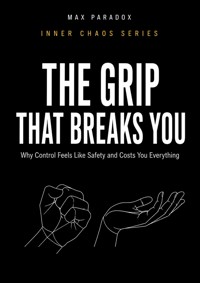
The Grip That Breaks You - Why Control Feels Like Safety and Costs You Everything ebook
Max Paradox
Uzyskaj dostęp do tej i ponad 240000 książek od 14,99 zł miesięcznie
- Wydawca: ALL-IN Rafał Płonkowski
- Kategoria: Biznes, rozwój, prawo•Biznes, rozwój
- Język: angielski
You know the feeling. The chest tightening when plans change at the last minute. The irritation - sharp and disproportionate - when someone does something differently than you would have done it. The mind that won't go quiet at two in the morning, running contingencies for contingencies, rehearsing conversations that haven't happened yet.
You call yourself thorough. Responsible. Someone who takes things seriously. And you are those things. But there is something else happening underneath - something that doesn't get named because naming it would require admitting that the planning, the preparation, the relentless forward motion of managing everything and everyone - none of it has ever quite given you what it promised. Not the peace. Not the safety. Not the sense of finally, solidly being okay.
This book is about that something else.
It is about the need for control - not the ordinary kind that helps you get things done, but the deeper, more desperate kind that has quietly organized your entire life around keeping uncertainty at bay. The kind that exhausts you in ways that sleep doesn't fix. The kind that has shaped your relationships without your full knowledge. The kind that has protected you, genuinely and at real cost, for longer than you can remember.
Across twenty-five chapters, The Grip That Breaks You traces the pattern in every domain of a life - in the body that has been holding what the mind refused to process, in the relationships managed to the edge of genuine intimacy and no further, in the perfectionism and the anger and the self-improvement project that became its own form of self-control.
It asks, in every chapter and from every angle, the question that most books don't reach: what are you actually protecting?
The answer is not weakness. It is something ordinary and precious - the belief that you are worthy of love even when you are not performing. That belief was damaged, at some point, by experiences that taught your nervous system that uncertainty means danger. The control pattern was your answer. A brilliant, functional, ultimately insufficient answer.
It worked well enough to keep you going.
It never worked well enough to give you rest.
The loosening is possible. Not as transformation - as practice. Slow, imperfect, genuinely yours.
The open hand is waiting.
So is everything it can hold.
This publication was prepared using tools that support the creative process, including solutions based on artificial intelligence. The final concept, structure, and editing are the work of the author.
Ebooka przeczytasz w aplikacjach Legimi na:
Liczba stron: 238
Rok wydania: 2026
Odsłuch ebooka (TTS) dostepny w abonamencie „ebooki+audiobooki bez limitu” w aplikacjach Legimi na:
Podobne




















INTRO - The Grip That Breaks You
You checked the weather app three times before leaving the house. Not because you didn't trust the first reading - you did, mostly - but because the second check felt like insurance, and the third felt like certainty, and certainty was the thing you were after. You brought an umbrella even though it said sunny. You left fifteen minutes early even though the drive takes twelve. You rehearsed what you were going to say in the meeting so many times that by the time you sat down, the words felt like a script you'd memorized in a language you didn't quite speak.
Nothing bad happened. It almost never does.
And yet.
There's a low hum that lives in you. Not loud enough to be called panic. Not quiet enough to be called peace. It's the hum of a mind that is always, always working - cataloguing, anticipating, preparing, scanning. The hum of someone who has decided, somewhere below the level of conscious thought, that if they can just stay one step ahead of everything, nothing will catch them off guard. Nothing will break them. Nothing will hurt.
This is what control feels like from the inside. Not like power. Like vigilance. Like a job you never applied for and can never quit.
You know the feeling. The tight chest when plans change at the last minute. The irritation - disproportionate, you know it even as you feel it - when someone does something differently than you would have done it. The way your mind races through every possible outcome of a situation before it's even begun, building contingencies for contingencies, running disaster simulations at two in the morning while the person beside you sleeps easily, effortlessly, in a way that baffles you completely.
You tell yourself you're just thorough. Responsible. A planner. Someone who takes things seriously in a world full of people who don't.
And maybe that's true. Maybe those things are part of it.
But there's another part. The part that tightens when someone else drives. The part that rewords an email four times not because the first version was wrong but because you need it to be perfect - because perfect is protected, and protected is safe. The part of you that, when life hands you something genuinely uncontrollable - an illness, a betrayal, a loss, a door closing on something you loved - doesn't grieve cleanly but instead reaches, immediately, for something, anything, you can manage. You reorganize the kitchen. You make a plan. You research. You act. Because stillness in the face of chaos feels like surrender, and surrender feels like dying.
This book is about that part.
Not about organization. Not about ambition or perfectionism or type-A personalities, though those things are in here. This book is about the specific kind of suffering that comes from needing to control the uncontrollable - and about the way that need, which began as a perfectly reasonable response to something real, became a cage you carry with you everywhere you go.
Control isn't a personality flaw. It's a strategy. It developed for a reason - a good reason, once. Somewhere, at some point, the world felt genuinely unsafe, genuinely unpredictable, genuinely unkind - and your nervous system learned that if you could just manage enough variables, you could stay ahead of the pain. That learning saved you, maybe. Or at least it felt like it did. And so it stayed. It became habit. It became identity. It became the lens through which you see almost everything.
The problem is this: the strategy that protected you then is strangling you now.
Because life - actual life, the version that keeps happening regardless of your plans - does not cooperate. It changes. It surprises. It breaks. People behave in ways you didn't anticipate. Your body does things you didn't approve. The future refuses to arrive the way you designed it. And every time that happens - every time reality deviates from the plan - the anxiety spikes, and the grip tightens, and you work harder to control the things you can because the things you can't are intolerable.
This is the loop. And this book goes inside it.
Not to fix you. Not to hand you a breathing technique and call it transformation. To show you - with honesty and some precision - what is actually happening when you grip, why it works just enough to keep you gripping, and what it's costing you in the parts of your life that matter most. The relationships you can't fully inhabit because you're too busy managing them. The moments you can't be present for because you're already in the next one, preparing. The version of yourself that is exhausted - genuinely, bone-deep exhausted - from a job that never ends and offers no rest and produces, in the end, only the temporary relief of feeling like you almost have it handled.
You picked up this book because something in the title caught you. Because part of you already knows.
Let's find out what it knows.
Chapter 1: The Illusion of Solid Ground
The call came on a Tuesday. Marta remembers that detail with strange precision - not the words her doctor used, not the exact number, but the fact that it was Tuesday, and she had a dentist appointment at three, and she'd been planning to make pasta for dinner. She remembers thinking, absurdly, about the pasta. About the fact that she had bought the good kind, the bronze-die extruded kind that holds sauce differently, and that none of that mattered now, and somehow the irrelevance of the pasta was the thing that made it real.
The diagnosis wasn't terminal. That's important to say. It was serious and treatable and the prognosis was genuinely decent. But that's not the story. The story is what happened in the weeks that followed - not to her body, but to her mind.
Within forty-eight hours, Marta had researched every oncologist within a hundred kilometers. She had created a color-coded binder. She had called her insurance company three times. She had reorganized her pantry, deep-cleaned her bathroom, and begun a spreadsheet tracking her symptoms, her sleep, her food, her mood, rated on a scale of one to ten. Her husband, Piotr, watched all of this and didn't say anything - not at first - because it looked like competence. It looked like coping. It looked like Marta being Marta: thorough, prepared, in motion.
But at two in the morning, ten days after the call, Piotr found her at the kitchen table, the binder open in front of her, and she wasn't reading it. She was just sitting there with her hands flat on the table, staring at something he couldn't see. And when he asked her if she was okay, she said - very quietly, like it cost her something to say it - "I don't know what to do about the things I can't put in the binder."
That sentence. That's the whole thing, right there.
You understand something about Marta, probably. Not the diagnosis - the binder. The impulse behind the binder. The way, when the ground moves, your hands reach for something to hold. Not because the thing you reach for will fix the ground. Because the act of holding feels, for a moment, like not falling.
The need for control is one of the most human things there is. It is not a quirk or a dysfunction or a character flaw that some people have and others don't. It is wired into the architecture of the human nervous system - built in at a level so fundamental that you could argue it's less a personality trait and more a survival mechanism that simply never got updated for modern life.
Here is how it works at its most basic. Your brain - specifically the part of your brain that is responsible for keeping you alive, the ancient, subcortical, non-verbal part - is constantly running a background process. The process has one question: safe or not safe? And it is running this question on every stimulus, every environment, every interaction, every deviation from expectation, every unknown. It is doing this faster than conscious thought. You don't decide to feel anxious. The alarm sounds, and then you feel it.
For most of human history, the way to answer "not safe" was to act. Run. Fight. Freeze. Do something physical that changes the physical situation. The threat was real and present - a predator, a flood, a rival - and the action was immediate and the resolution was observable. You ran, you survived, the cortisol dissipated, the nervous system returned to baseline.
The problem - the specific modern problem - is that most of what activates the alarm now is not resolvable through physical action. It's a medical result. A financial situation. A relationship that might be failing. A future that is genuinely uncertain. And the nervous system, which does not speak the language of abstraction, does not know this. It just knows: not safe. And it generates the same biochemical pressure to act.
So you act. You research. You plan. You organize. You rehearse. You try to manage every variable you can reach, because managing variables is the closest available substitute for running from the predator, and your nervous system accepts the substitution. For a moment. For a moment the cortisol drops and the chest loosens and it feels like you've done something real.
This is why control works. This is the mechanism. It's not irrational - it's a rational response to a system that's running the wrong program.
But here's what gets built on top of that mechanism, over years and decades and thousands of small experiences: a belief. Not a thought you have consciously, not a philosophy you'd articulate if asked. A deep, operational belief that functions like a law of your internal world. The belief goes like this: if I manage this situation well enough - if I prepare enough, anticipate enough, control enough variables - I can prevent bad things from happening.
This belief is, of course, not true. And somewhere in you, you know it's not true. You have already lived through things that proved it's not true. You planned and prepared and still the thing happened. You controlled every variable in reach and still the outcome wasn't what you designed. You know this.
And yet the belief persists. Because the alternative - really sitting with the alternative - is almost unbearable.
The alternative is this: some things that matter deeply to you are entirely outside your control, and there is nothing you can do about that, and that is the condition of being alive.
Take a breath. Notice what just happened in your body when you read that.
If there was a tightening - a subtle clench somewhere, a small internal resistance - that's the belief at work. That's the part of you that has decided, at a level beneath argument, that acceptance of uncertainty is the same as giving up. That if you stop gripping, you will fall.
Let's talk about where that belief came from. Because it didn't arrive fully formed. It was built, piece by piece, from specific experiences - and understanding those experiences is the first step to understanding why the grip feels so necessary, and why it's so hard to loosen.
People who develop strong control patterns almost always have a version of the same story. Not the same story exactly - the details are different, the ages are different, the people involved are different. But the structure is remarkably consistent. At some point, probably young, probably before you had the language or the cognitive capacity to fully understand what was happening, something in your environment became unpredictable in a way that felt dangerous. Not necessarily dangerous in a dramatic, clinical sense. Dangerous in the ordinary, devastating way that a child experiences danger: something important - a parent's mood, the safety of the home, the reliability of love - became unreliable. And you couldn't control it. And that felt like the worst thing in the world.
Consider someone like Daniel. Daniel is thirty-eight, a software architect in a mid-sized tech company, and he is by any external measure extremely functional. He is good at his job - very good, actually, the person they bring in when a system is failing and someone needs to think clearly under pressure. He works long hours not because his company demands it but because finishing feels better than leaving things open. He struggles to delegate. When he assigns work to someone else, he finds himself checking in more than he knows is reasonable, rewriting things that weren't wrong, staying in the loop on projects he's already handed off. He tells himself he has high standards. He tells himself the quality matters. And those things are true.
But Daniel grew up with a father who drank. Not violently - that's not the story. His father was a decent man who became, when he drank, a different man. Unpredictable. Sometimes warm in a way that felt good but slightly off, like warmth aimed at the wrong person. Sometimes distant and cold in a way that had nothing to do with anything Daniel had done. Sometimes he would promise something - a camping trip, a conversation, an apology - and sometimes he would deliver, and sometimes he wouldn't, and there was no pattern Daniel could identify. There was no thing he could do to make the outcome reliable.
So Daniel did what children do: he started trying to manage it. He got very, very good at reading rooms. He learned to adjust his behavior based on subtle cues - the way his father's shoulders sat, the pace of his walk, the particular silence of the house when he came home. He learned that if he was good enough, quiet enough, impressive enough, he could sometimes - not always, but sometimes - produce the warm version of his father rather than the cold one. He became, in the language of developmental psychology, hypervigilant - always scanning, always computing odds, always one step ahead in the anticipation of what was coming.
That skill kept him okay. Not happy - okay. It gave him the illusion of leverage over something that was fundamentally not his to leverage. And the illusion was enough. It had to be enough. It was all he had.
Decades later, Daniel doesn't think about his father much. He thinks about the code. He thinks about the deadline. He thinks about the junior developer who made a mistake on the API endpoint and why that mistake bothers him so much more than it should. He doesn't make the connection - not usually - between the man who couldn't be trusted and the need to stay in control of every system he touches. But the connection is there. It's been there the whole time.
This is the origin story for a lot of people. Not all of them - some control patterns develop differently, from a single acute experience rather than a chronic low-grade one, or from a cultural context that treated uncertainty as shameful, or from a body that learned anxiety early and never quite unlearned it. But the common thread is always this: somewhere, the world proved itself unpredictable in a way that felt genuinely threatening. And control was the best available response.
The tragedy - and this is the thing Marta was sitting with at two in the morning, this is the thing the binder couldn't hold - is that the strategy worked well enough to get encoded as essential, but never well enough to actually deliver what it promised.
You can prepare for every contingency and still be blindsided. You can control every variable in reach and still lose. You can grip with everything you have and still watch the thing slip through your hands.
And when that happens - when reality asserts itself in spite of all your preparation - the nervous system doesn't update the belief. It doesn't think: the strategy failed, I need a new strategy. It thinks: I didn't prepare enough. I didn't control enough variables. I need to grip harder next time.
This is the core of the loop. The failure of control doesn't reduce the need for control. It intensifies it.
Here is the part that most discussions of anxiety and control leave out, the part that makes it genuinely hard to untangle: the strategy is not entirely wrong. Control does work, sometimes. It does reduce certain risks, prevents certain outcomes, makes certain things go more smoothly than they would have otherwise. If you didn't prepare for the meeting, the meeting might go worse. If you didn't check the weather, you might get wet. The control behavior produces real results often enough to stay reinforced.
The problem is not that control never works. The problem is what happens to the parts of your life that can't be controlled - and to the version of yourself that is trying.
The parts that can't be controlled include: other people's choices, other people's feelings, your own body, the economy, the future, the past, illness, accident, the particular way grief arrives, the timing of things you love ending, and approximately ten thousand other components of a full human life. These things are not on the spreadsheet because they can't be. They are in the category that Marta was staring at across the kitchen table - the things that don't fit in the binder.
And the version of yourself that is trying - that person is tired. In a specific way that is hard to explain to someone who doesn't live it, but that you probably know intimately. It is not the tiredness of having done a lot. It is the tiredness of never being off duty. Of having a mind that never fully rests because rest feels like risk. Of holding everything tightly enough that your hands have forgotten what it feels like to be open.
There is a version of your life that you don't fully inhabit because you're always already preparing for what comes next. There are conversations you were physically present for but mentally elsewhere - running the analysis, managing the subtext, planning the response. There are moments of genuine beauty and connection that arrived while you were busy preparing for the moment after this one, and so you half-experienced them, which is a particular kind of loss that doesn't have a name but that you recognize when someone points at it.
This is what the grip costs. Not in the dramatic, obvious ways - not yet, or not always. In the slow, daily erosion of the texture of being alive.
Marta eventually closed the binder. Not because she stopped caring about her treatment - she was meticulous about it, actually, in all the right ways. But she made a distinction, slowly and with great difficulty, between the things that were hers to manage and the things that weren't. The binder held the things that were hers. And she practiced, very imperfectly and with a lot of backsliding, allowing the other category to exist without trying to get it into the binder.
She would tell you it's the hardest thing she's ever done. Harder than the diagnosis, in some ways. Because the diagnosis had a treatment plan. The other thing - learning to hold uncertainty without gripping it - doesn't have a protocol. It just has the slow, uncomfortable practice of letting the ground be uncertain and staying upright anyway.
That's not a fix. It's not a cure. It's just the thing that's actually available - and it's more than the binder ever gave her, because the binder only ever gave her the feeling of safety, and this gave her something else.
Something closer to actual ground.
The illusion of solid ground is seductive precisely because the real thing is unavailable. But there is a cost to living on an illusion - a structural cost, the kind that shows up over time in the places you least expect it. In the relationships that have grown careful and managed rather than alive. In the body that carries a chronic tension it no longer notices because it's become the baseline. In the part of you that hasn't fully rested in longer than you can remember.
What you've been gripping isn't solid ground. It's the idea of it.
The rest of this book is about learning to tell the difference.
Chapter 2: The Anxiety That Lives Under the Plan
Karolina keeps a list on her phone. Not a to-do list - she has several of those, organized by category, color-coded, with deadlines attached. This is a different list. She added to it late one night when she couldn't sleep, and she's never shown it to anyone. The list is titled, simply, "Things That Could Go Wrong."
It has 47 items.
Some of them are practical. The furnace breaking in winter. A car accident on the highway she takes to work. Her daughter missing the entrance exam for the school they've already decided on, already mentally furnished a future around. Some of them are less practical - closer to the bone, harder to look at directly. Her husband falling out of love with her slowly, so slowly she wouldn't notice until it was done. Her mother's health declining faster than expected. Herself, one day, being exposed as someone who has been faking competence so convincingly that she almost fooled herself.
She doesn't read the list often. She made it, she says, to get the thoughts out of her head. And it works, a little. Externalizing the fear gives it edges, makes it concrete, makes it something she can look at rather than something that breathes inside her chest. The list is a control mechanism disguised as relief. She knows this, vaguely. She doesn't know what else to do.
What Karolina experiences between the items on her list is anxiety. Not the clinical kind - not the kind that stops her from functioning, because she functions extraordinarily well, which is part of the problem. The kind that hums. The kind that lives in the space between the plan and the outcome. The kind that says: you have prepared, yes, but have you prepared enough? The kind that treats every moment of rest as a liability, every exhale as a risk.
Most people who live with strong control patterns don't think of themselves as anxious people. They think of themselves as prepared people. Careful people. Responsible people. The anxiety is so thoroughly woven into the preparation that it's become invisible - not a feeling they have, but the air they breathe.
Here is the thing about anxiety that most of us get backwards. We treat it as the problem to be solved - the symptom to be managed, the feeling to be eliminated. We medicate it, we breathe through it, we plan our way around it. We treat the anxiety as the enemy and control as the weapon.
But anxiety is not the enemy. Anxiety is a messenger. It is your nervous system's way of telling you that something feels uncertain and that uncertainty feels dangerous. The message itself is not the problem. The problem is what you do with it - specifically, the way the mind, in response to anxiety, reaches for control as the cure, when control is not a cure at all. It is, at best, a painkiller. And like any painkiller taken long enough and in large enough doses, it begins to cause its own damage.
The relationship between anxiety and control is one of the most intimate and destructive partnerships in psychological life. They feed each other. Anxiety generates the urge to control. Control provides temporary relief. The relief reinforces the belief that control is the answer. But control, by its nature, cannot resolve the underlying anxiety - because the underlying anxiety is about uncertainty, and uncertainty is the permanent condition of being alive. So the anxiety returns. So you control again. So the relief comes again, briefly. So the belief deepens.
This is not a metaphor. This is a measurable neurological loop.
There is a concept in psychology called the safety behavior trap. A safety behavior is anything you do to reduce anxiety in the short term that prevents you from learning, in the long term, that the feared outcome either won't happen or is manageable if it does. The person who is afraid of social rejection and so never speaks first in a group - they never find out that they would be welcomed. The person who is afraid of illness and checks their body constantly for symptoms - the checking provides momentary relief but the relief wears off quickly and the next check is needed sooner. The checking is the trap. It works just enough to keep you in it.
Control is the master safety behavior. It works just enough to keep you in it.
Tomasz is forty-four and runs his own small architecture firm. He built it from almost nothing over twelve years - a fact he is proud of but rarely mentions, because mentioning it feels like tempting fate. He makes good money. His work is respected. His team of six people is, by most measures, a good team. But Tomasz cannot fully trust them. Not because they've failed him - they've rarely failed him - but because the possibility of failure lives in any delegation, any transfer of control, and the possibility is enough.
He reviews every client email before it goes out, even the routine ones. He attends meetings that his project managers could handle without him. He has been told - by his business coach, by his wife, by at least two employees who left and said so in exit interviews - that he micromanages. He agrees, in the abstract. He sees the pattern. He has read about it. He understands that delegation would free him, would allow the firm to grow, would reduce the unsustainable number of hours he currently works.
And yet. When he tries to let go - really tries, commits to it, announces it to his team - he lasts, on average, about three days before he's back in the loop, checking, adjusting, inserting himself into processes he'd promised to release. And the thing he feels in those three days is not freedom. It is not relief. It is a mounting, specific discomfort that he can only describe as wrongness. As if something important is being neglected. As if, at any moment, something will go badly and it will be because he wasn't watching.
The wrongness he feels is the anxiety without the control. And the anxiety without the control feels, to a nervous system that has learned to use control as its primary regulation strategy, like genuine danger.
This is the part that is almost impossible to explain to someone who doesn't live it. From the outside, the solution looks obvious. Stop controlling so much. Trust the people around you. Let things be imperfect. From the inside, that advice lands in the body not as liberation but as threat. Because the nervous system is not stupid - it has a very long memory, and in its memory, relinquishing control has historically felt bad, and feeling bad has historically been the prelude to something worse.
So the anxiety lives under the plan. Not in the plan - the plan is the thing that temporarily silences it. Under it. In the gap between what you can manage and what you can't. In the three seconds between sending the email and receiving confirmation that it landed correctly. In the forty-eight hours before a medical result. In the hour before a difficult conversation, when you rehearse your lines so carefully that you've pre-written both sides of the dialogue, giving the other person no room to be unpredictably themselves.
And this is where the real cost begins to appear - not in the control itself, but in the gap, in what you do with the gap, in what the gap takes from you.