Uzyskaj dostęp do tej i ponad 240000 książek od 14,99 zł miesięcznie
- Wydawca: ALL-IN Rafał Płonkowski
- Kategoria: Biznes, rozwój, prawo•Biznes, rozwój
- Język: angielski
You know the feeling. Not a dramatic feeling - nothing that announces itself or gives you a word to use when someone asks what's wrong. It is quieter than that. It is the moment at a dinner table when everyone around you is laughing and you are watching from somewhere slightly behind your own eyes, thinking: I know I should be feeling something right now. It is the relationship that functions but does not quite connect. The life that looks like what you wanted - and that you experience from a slight, persistent distance, as though the glass between you and your own life is not thick enough to be visible but present enough that nothing fully arrives.
It is not depression, exactly. Not grief. It is the specific condition of someone who learned, at some point in their history, that feelings were too costly to be had in full. Someone who developed the ability to turn the dial down. To manage the interior life rather than inhabit it. To be present to everything and fully arrived at nothing.
You survived. That part worked. What nobody told you is that the dial doesn't discriminate. You cannot mute the pain and keep the joy. The system that learned to suppress the difficult things suppressed everything with equal efficiency. And you have been living, for months or years or decades, in a life that is functional and fine and quietly, persistently, not quite real.
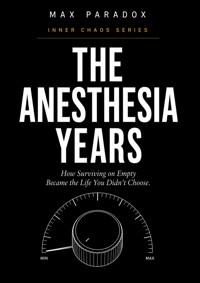
This is what The Anesthesia Years is about.
Not a dramatic condition. Not a life that has visibly fallen apart. The quiet pattern that organizes the lives of people who are, by every external measure, managing. People who function impeccably. People who show up for everyone else and nowhere for themselves. People who almost-felt something last Tuesday and managed it back into storage before it could arrive.
The dial is not broken. It was set, by a younger version of you, to a position that was correct for the conditions that version was surviving. The conditions have changed. The setting has not caught up.
This book is not a cure. It offers something more durable: the specific, honest understanding of a pattern that has been shaping your experience, possibly for most of your life, without your full awareness. Because you cannot change what you cannot see.
The thing behind the gate is not more difficult than what produced the gate.
It is only the life you have been living at reduced volume.
The full version is still there.
This publication was prepared using tools that support the creative process, including solutions based on artificial intelligence. The final concept, structure, and editing are the work of the author.
Ebooka przeczytasz w aplikacjach Legimi na:
Liczba stron: 266
Rok wydania: 2026
Odsłuch ebooka (TTS) dostepny w abonamencie „ebooki+audiobooki bez limitu” w aplikacjach Legimi na:
Podobne



















INTRO - THE ANESTHESIA YEARS
There was a moment - you probably remember it, even if you've never named it - when you made a decision you didn't know you were making.
Something happened. It could have been one catastrophic thing, or it could have been the hundred and forty-seventh small thing in a row. It could have been a phone call at 2am, or a dinner table where nobody spoke, or a relationship that ended not with a fight but with a silence so long it became a wall. Whatever it was, you felt it coming - that wave of something enormous, grief or rage or terror or all three at once - and something in you said: no.
Not out loud. Not as a conscious choice. Just - no.
And the feeling stopped.
You remember the relief. How clean it felt, suddenly. How functional. You got up the next morning and you made coffee and you went to work and you responded to emails and nobody could tell, and that felt like a victory. You had survived something that should have broken you. You were fine. You were handling it.
That was the beginning.
What you didn't know - what nobody told you, because nobody really talks about this particular kind of problem - is that you can't turn off one feeling without turning down all of them. The nervous system doesn't work that way. It's not a mixing board with individual sliders. It's a single dial. And when you turned down the pain, you turned down everything else too. The joy. The curiosity. The warmth. The aliveness that used to make certain Tuesday afternoons feel inexplicably worth being alive for.
You didn't notice at first. There was too much relief in the silence.
But eventually - maybe it was months later, maybe it was years - you started to notice the shape of what was missing. You'd be at a party, surrounded by people laughing, and you'd find yourself watching from somewhere behind your own eyes, thinking: I know I should feel something right now. You'd fall in love, or try to, and wonder why it felt like going through motions. You'd sit with someone who was crying, someone you cared about, and realize with a kind of quiet horror that you felt nothing - not coldness, not distance, just - nothing. A flatness where a feeling should have been.
You started to wonder if something was wrong with you.
This book is about that.
It's about what happens when the protection you built becomes the prison. When the skill you developed to survive becomes the thing that keeps you from living. When emotional numbness - the most underrated, least dramatic, most quietly devastating coping mechanism there is - stops being a life raft and starts being the water.
This is not a book about fixing you. You are not broken. What happened to you made complete sense. The numbness was the right response to the wrong situation, and for a while it worked, and you should not feel ashamed of it.
But you picked up this book because somewhere, underneath all that quiet, something is still alive. Something that knows the difference between being safe and being present. Something that is tired of watching its own life from a distance.
This book is for that thing.
Let's begin.
CHAPTER 1 - THE DAY THE DIAL TURNED DOWN
You were twelve years old, or you were thirty-four, or you were seven, and something happened that was too big for the container you had available.
It didn't have to be a dramatic event. That's one of the things about emotional numbness that makes it so hard to talk about: the thing that triggers it often doesn't look, from the outside, like it should be enough. A parent who went quiet for weeks and wouldn't say why. A classroom where you got something badly wrong and everyone saw. A relationship that ended not with cruelty but with something worse - indifference. A grief that nobody around you seemed to think was real enough to name.
And yet inside you, it was enormous.
Elena was nine years old the first time she felt it happen. Her parents didn't fight - that's the part she'd tell you first, as though to preempt your assumptions. They were polite. They were, by all visible measures, fine. But there was something in the house - a quality of held breath, of conversations that stopped when she entered a room, of affection that was given in correct amounts at correct times but never spilled over, never arrived unexpectedly, never felt like it was for her specifically. She learned, very early, that feelings were weather. Inconvenient. Something you waited out. She learned this not because anyone told her, but because feelings in that house produced no response. You felt them, and the world continued exactly as before, and eventually the feeling passed, and nothing had changed. The only rational conclusion, for a nine-year-old trying to make sense of her environment, was that feelings were irrelevant. Not dangerous. Not bad. Just - beside the point.
By the time Elena was twelve, she had become very good at being fine. Teachers commented on her composure. Her parents praised her self-sufficiency. She was proud of it. She didn't know yet what it was costing her.
The psychological term for what Elena developed is called emotional avoidance - a pattern of managing internal experience by suppressing, deflecting, or simply not allowing it to register consciously. But that clinical language doesn't capture what it actually feels like from the inside, so let's stay in the room with Elena for a moment. What she had actually learned was something more specific and more insidious: she had learned that her emotional experience was not data. It was noise. The adults in her life operated in a register she couldn't reach, and the gap between what she felt and what was acknowledged had become so consistent that she stopped expecting the gap to close. And when you stop expecting something consistently enough, something shifts in the wiring. You stop reaching for it. You stop bracing for the disappointment. The reaching itself stops.
This is how numbness begins for most people. Not with a single catastrophic event - though sometimes it is that - but with repetition. With the accumulated weight of feelings that had nowhere to go. With learning, over time, that the internal world is a place where things happen that don't matter.
Marcus had the dramatic version. He was nineteen and his younger brother died - an accident, meaningless and sudden and complete. He remembers the exact moment the doctor spoke in the hospital waiting room, and he remembers the specific sensation of feeling the grief arrive - a physical thing, enormous, pressing against the inside of his chest - and then, before it could break through, something shut. Like a fuse blowing. He described it to me years later as feeling the emotion "from the other side of glass." He could see it. He could identify it. But it couldn't touch him. He went home that night and lay on his bed and stared at the ceiling and felt nothing, and thought: something is wrong with me. My brother just died and I feel nothing.
Nothing was wrong with him. His nervous system had done exactly what nervous systems do when the load exceeds the available capacity. It had protected him. The psychological term is dissociation - a state in which the mind temporarily disconnects from emotional or even physical experience when the experience is too overwhelming to process. In milder forms, it's the reason you can drive a familiar route with no memory of the journey. In the acute form Marcus experienced, it's the mind pulling the emergency brake on feeling because the alternative is being crushed by it.
The problem is that the emergency brake, once pulled, can be very hard to release.
Here is the neuroscience in plain language: your brain has a threat-detection system - the amygdala, a small almond-shaped structure that scans your experience constantly for danger. When it detects something overwhelming, it can trigger a kind of emotional shutdown, reducing the activity in the prefrontal cortex - the part of your brain responsible for processing complex emotion, making meaning, staying connected to yourself. This is not a malfunction. This is an adaptation. It is your brain doing its job - keeping you functional under conditions that might otherwise make functioning impossible.
But here is the thing about adaptations: they don't know when the emergency is over.
Your amygdala doesn't get a memo. Nobody sends a signal saying: the crisis has passed, you can turn the feeling back on now. The shutdown that was temporary becomes, through repetition and reinforcement, a default setting. The nervous system learns that emotional experience is dangerous - or at least costly, difficult, unrewarding - and it begins to route around it. The way a river reroutes around a blockage, not because the water has stopped but because the path of least resistance has changed.
And you experience this not as something that was done to you, but simply as who you are. You become someone who "doesn't really feel things that strongly." Someone who is "good in a crisis." Someone who is "logical." Someone who "doesn't get emotional." These descriptions feel, after long enough, like personality traits. Like identity. Like the truth of who you are.
They are not. They are the shape of your survival.
There's a woman named Diane - fifty-one years old, an emergency room nurse for twenty-three years - who told me something I've thought about ever since. She said: "I thought I was calm. I thought being calm was just my nature. I thought it was a gift, honestly - the ability to be in the middle of chaos and not feel it the way other people did. I thought I was built differently." She paused. "What I eventually understood was that I had practiced not feeling it. For so long, in so many emergency rooms, with so many people dying in front of me, that the practice had become automatic. I hadn't been born calm. I had become - not calm. Empty. Those are different things, and it took me until my late forties to understand the difference."
Calm is a state you can move through. Empty is a state that moves with you.
The distinction is important, and it points to something that is easy to miss in the early years of emotional numbness: the absence of feeling is not the same as peace. It presents like peace. It has the visual signature of peace - the stillness, the composure, the ability to function under pressure. But peace is a fullness. It is the experience of being exactly where you are without the weight of what you're resisting. Numbness is the opposite: it is the constant, invisible effort of holding the door closed. The peace is real. The work is also real. It is happening below the level of your awareness, and it is costing you more than you know.
What it costs you, we will spend the rest of this book examining. But to understand the cost, you first have to understand the mechanism - the specific, almost elegant way in which emotional numbing works, and what it is actually managing. Because it isn't random. The dial doesn't turn down in an arbitrary way. It turns down in response to something specific.
Every person who is living with emotional numbness developed it for a reason. The reason is almost always the same: at some point, feeling was not safe. Not "dangerous" in a dramatic way - in most cases, nobody was going to hurt them for feeling. But "not safe" in a quieter, more pervasive sense. Feelings were not welcomed. Feelings were not responded to in a way that made them feel useful or valid or meaningful. Feelings were, consistently, the thing that made you vulnerable and got you nothing in return. And so the nervous system, being the extraordinarily adaptive system it is, stopped producing them at full volume. Or stopped letting them through to consciousness. Or produced them and immediately dampened them - a kind of auto-mute that triggers faster than you can notice it's happening.
The tragedy of this system is its efficiency. It works so well. The person who developed emotional numbness in childhood has typically had decades to refine it, to make it seamless, to integrate it so completely into their personality and their patterns of relating that they cannot imagine how they would function without it. And they're right, in a way. They couldn't. The version of themselves that needed it, needed it. The child in the house with no room for feelings, the teenager who learned that vulnerability produced punishment, the young adult who was crushed by a grief nobody acknowledged - those versions of you needed the dial turned down. It was the right tool for the situation.
But you are not that person anymore. And the situation has changed. And the dial is still at the same setting.
This is the thing about survival skills: they outlive the emergency. They become habit. They become self. They become the thing you can't see because it is the thing you are looking through.
This book is about learning to see it.
Not to destroy it. Not to rip the door open and flood yourself with everything you've been keeping out - that's not how this works, and anyone who tells you it is hasn't thought it through. But to understand the system. To recognize when the protection is no longer protecting anything. To begin, slowly and with full permission to be imperfect about it, to turn the dial up again.
One degree at a time.
That's all this asks of you.
CHAPTER 2 - WHAT YOU FEEL WHEN YOU FEEL NOTHING
There's a specific kind of loneliness that doesn't have a name.
It's not the loneliness of being alone. It's not the loneliness of being in a bad relationship, or of being far from home, or of being in a room full of strangers. Those loneliness types have names and shapes and the vague possibility of remedy. You could call someone. You could leave. You could find your people.
This one is different. This one lives inside you, and you carry it into every room you enter, and you cannot fix it by changing the room. It is the loneliness of being separated from your own interior life. The loneliness of being, in some essential way, not quite present in your own experience.
Adam is thirty-eight. He has a job he's good at, a marriage that functions, two kids he loves in the abstract way you love the idea of something before you've quite made contact with it. He describes a particular moment that started recurring about four years ago. He'd be sitting at dinner - his own dinner table, his wife across from him, his daughters doing the thing where they argue about something pointless and funny - and he would feel, without warning, like he was watching a movie of a family having dinner. Not dissociated, exactly. Not checked out in a visible way. But present in the way that a camera is present: recording, not experiencing. He knew he was supposed to feel something. He knew, intellectually, that this was his life, that these were people he loved, that this was, by most measures, good. But the feeling was not there. There was only the knowledge that the feeling should be.
He didn't tell anyone. How do you say that? "I love you but I don't feel it right now"? "I'm happy, I think, but I can't feel the happiness"? The language doesn't exist for it, which is part of why so many people who live with emotional numbness feel like they're speaking a language only they know.
The experience of emotional numbness is itself a feeling - which is one of its central cruelties. You feel the numbness. You feel the flatness. You feel the absence of feeling, the way you feel the silence in a room where music just stopped. And that meta-feeling - the awareness of absence - is one of the most disorienting and isolating experiences a human being can have, precisely because there's no vocabulary for it and it looks, from the outside, like nothing at all.
What does it actually feel like? Let's try to map it honestly.
There is often a kind of background gray. Not sadness - gray is different. Sadness has shape and direction and occasionally something almost beautiful about it, the way certain minor keys are more moving than major. Gray has none of that. It is just the subtraction of color from the spectrum of experience. Things that should feel vivid feel muted. Things that should feel significant feel procedural. You go through your day completing tasks, interacting with people, making decisions, and the whole thing has the quality of going through a checklist. Not painful. Just - unstirred.
There is frequently a sense of disconnection from the body. Emotional numbness and physical numbness are more connected than people realize - the same systems that manage emotional experience are deeply tied to the systems that manage physical sensation and interoception, which is the fancy word for your ability to sense what is happening inside your own body. When you stop registering your emotions, you often stop registering much of your body too. You lose touch with hunger and fullness. You stop noticing when you're tired until you're past tired. Sex can feel mechanical - technically functioning, but detached from any real sense of pleasure or connection. You live a little above your body, a little outside it, piloting it rather than inhabiting it.
There is the specific discomfort - and it is a discomfort, even when it presents as absence - of watching other people feel things you cannot access. Maya is a therapist - the deep irony of which she is fully aware - who spent fifteen years becoming expert in helping other people process emotion while being almost completely unable to process her own. She told me about sitting with a client who was sobbing after a breakthrough, and feeling a complicated mix of professional satisfaction and a private grief she couldn't quite locate. "I was glad for them," she said. "Genuinely. But there was also this - watching them feel freely while I couldn't - it was like standing outside a warm room in the cold. I could see the fire. I just couldn't feel it."
That image - standing outside a warm room - is one of the most precise descriptions of emotional numbness I have encountered. It captures the specific combination of proximity and distance. You are not a person who has never experienced warmth. You know warmth exists. You can see it, recognize it, understand it theoretically. You just cannot currently get to it, and you have stopped, at some level, believing you deserve to.
That last part is worth sitting with. Because while emotional numbness often begins as a structural response to overwhelming experience, it almost always picks up a second layer over time: shame. The person who is emotionally numb rarely just thinks "I am numb right now." They think "I am broken." They think "I am cold." They think "I am incapable of real feeling, which means I am incapable of real love, which means there is something fundamentally wrong with me." And they carry this conclusion quietly, often for years, because they have no frame of reference for it and no language that could make it intelligible to another person.
This is important to name clearly: the shame is not accurate. The conclusion is not correct.
What is true is that your capacity for feeling did not disappear. It went somewhere. The dial turned down, not off - and there is a crucial difference. "Off" would be easier in one way: it would be clean. If you truly felt nothing, you would have no awareness of the gap. You would simply be someone without an interior life, and you would live your days without the specific grief of knowing what you're missing.
But the dial turned down, not off. Which means the capacity is still there. The feelings are still being generated - researchers call this emotional generation without emotional experience, and it can be observed physiologically: your body does the things bodies do when emotions happen - heart rate changes, skin conductance shifts, hormones release - but the signal doesn't make it to consciousness. The signal gets intercepted somewhere between generation and awareness, and you are left with the physiological state without the experience of the emotion that produced it.
This is why people with emotional numbness often feel inexplicably tired. Or anxious, without knowing why. Or vaguely on edge in situations that should feel neutral. The feeling is happening. It's just not being translated into something you can recognize and work with. The body is carrying what the mind has decided not to register.
Marcus - the man who lost his brother, introduced in the previous chapter - described this beautifully without knowing he was describing it. "I didn't feel grief," he told me, "but I was exhausted all the time. For two years after my brother died, I slept nine, ten hours a night and woke up tired. I couldn't concentrate. I was irritable over tiny things. My doctor checked everything - thyroid, sleep apnea, iron. Everything was fine." He paused. "The grief was fine too, apparently. It was right there, in my body, doing all the things grief does. It just never made it to my face."
This is the lived reality of emotional numbness: it doesn't protect you from the experience. It only separates you from the information the experience is trying to deliver. The feelings keep happening. The cost keeps accruing. The body keeps the score - and that phrase, borrowed from the landmark work of psychiatrist Bessel van der Kolk, means something specific and devastating. It means that the experiences you don't process consciously do not simply dissolve. They store. They encode in the nervous system, the musculature, the regulatory systems of the body. The emotion you pushed away becomes the tension in your shoulders that won't release. The grief you anesthetized becomes the flatness you live with. The fear you locked down becomes the low-level hum of anxiety that follows you without apparent source.
You are not nothing. You are carrying everything you decided not to feel. And it is heavier than actually feeling it would have been.
Tatiana is forty-four. She came to see the pattern she'd been living in through the sideways door of a medical mystery. She had chronic pain - lower back, persistent, unresponsive to everything her doctors tried. She went through physiotherapy, cortisone injections, three different specialists. She also, at her husband's insistence, started seeing a therapist, something she resisted for years because "therapy was for people who couldn't handle things." What emerged, over the course of eighteen months, was a story of childhood loss so thoroughly buried that she hadn't thought about it, consciously, in thirty years. Not suppressed in the dramatic, Freudian sense of actively not going there. Just - archived. Placed in a room she'd stopped visiting. The chronic pain began to resolve as the emotional material began to be processed. Her doctors called it psychosomatic. She calls it her body keeping the score until she was ready to read it.
This is not to say that every chronic pain is buried grief, or that you can think your way out of a herniated disc. Bodies are physical things and they develop physical problems for physical reasons. But the relationship between emotional life and physical experience is deeper and more bidirectional than most of us are taught to believe, and the person who has been living in emotional numbness for years is almost always - in ways they may not have connected - paying a physical price for it.
The price of not feeling is not freedom from feeling. The price of not feeling is feeling everything at a muffled remove, carrying the accumulated weight of everything that had nowhere to go, living with the specific loneliness of a person who knows there is something on the other side of the glass but cannot currently get to it.
And doing all of this, quietly, without being able to explain it to anyone, including yourself.
This is what you feel when you feel nothing. This is the interior of the anesthetized life.
It is not as comfortable as it looks.
CHAPTER 3 - THE BODY THAT STOPPED LISTENING
She was sitting in a hot bath, and she couldn't tell if the water was hot.
Not numb in the physical sense - the sensation was there, technically, if she concentrated on it. But it was remote. It required deliberate attention the way hearing a conversation in the next room requires effort. Without the effort, the sensation dissolved back into a kind of background that didn't touch her. She'd been in the bath for forty minutes. She had, she realized, not really been anywhere for those forty minutes. She had been in the room where she kept herself between demands.
Her name was Priya, and she was thirty-one years old, and she had not cried in four years. She knew this because she had, at some point in year two, started counting. Not obsessively. Just - noticed. The way you might notice a headache that goes on long enough to start tracking.
The connection between emotional numbness and physical disconnection is one of the most underexamined relationships in popular psychology. We tend to treat the emotional and the physical as separate territories, referring feelings to one set of professionals and bodies to another. But the nervous system does not observe that boundary. The same system that regulates your emotional experience also regulates your physical self-awareness - your ability to sense your body from the inside, to know when you're hungry, cold, tired, in pain, in pleasure. When you turn down the emotional dial, the physical dial turns with it. They are on the same circuit.
The scientific term is interoception - your internal sense system, the network of signals that runs constantly from body to brain, reporting on temperature, pressure, fullness, fatigue, heartrate, everything that is happening in the physical container you live in. Interoceptive awareness, research increasingly shows, is deeply linked to emotional awareness. The same neural pathways carry both kinds of information, and the same suppressive systems that mute emotional signals also mute physical ones.
This is why people who are emotionally numb often have a complicated relationship with their own body. Not necessarily one of hatred or disgust - though that can be part of it - but one of foreignness. The body becomes a thing you manage rather than a place you live. You feed it, maintain it, move it through the world. But you don't quite receive it. Its signals don't quite arrive.
Daniel is forty-six. He's a project manager, extremely good at coordinating complex systems, widely regarded by his colleagues as someone who can hold a lot moving pieces together without getting rattled. He doesn't get rattled because he essentially doesn't feel the rattle. He has had three stress-related hospitalizations in the past eight years. Each time, by the time he went to the hospital, his blood pressure was in crisis range. Each time, he had felt nothing unusual. No headache, no anxiety, no warning signals. "My body tells me things," he told me, with a kind of dark humor, "but it whispers. And I stopped being able to hear whispers a long time ago."
What Daniel described - the inability to hear the body's whispers - is almost universal among people with chronic emotional numbing. The body does not stop communicating. It sends its signals constantly. But the receiver has been turned down, and so the signals have to get very loud - illness-level loud, crisis-level loud - before they breach the threshold.
The implications of this go beyond medical. When you lose touch with your body's signals, you lose crucial information about your interior life. Because your body is not separate from your emotional experience. Your body is your emotional experience, in the most literal sense. Emotions do not happen in the mind and then get reported to the body. They happen in the body first - as changes in heart rate, muscular tension, gut activity, breathing pattern - and are then interpreted by the brain as feelings. If you can't receive the body's signal, you can't receive the emotion. The message is the messenger.
This is why the work of emotional recovery, for so many people, starts not with thoughts or memories or even conversations, but with the body. With learning, again, to listen to the whispers. To notice when the shoulders rise. To register the tightening in the chest. To feel the specific quality of the feeling rather than just its name. Because the feeling has a body, and the body is how you know it's real.
Teresa, sixty-two, spent three decades working in international development, moving between countries, managing crises, being the person everyone looked to when things were falling apart. When she finally stopped - retired, or tried to - she discovered something unexpected. In stillness, she felt nothing. In motion, managing, responding, she had a purpose that organized her experience into something navigable. But in the absence of crisis, she was revealed to herself: she had been using constant activity not as ambition but as a way of never having to be still enough to receive her own interior life.
"I had to learn to sit," she told me. "Actually sit. Not with a podcast. Not with my phone. Just sit and notice what was happening in my body. It was - embarrassing, how hard it was. I would sit down, intending to be present, and within two minutes I would be reorganizing something in my head. A project. A plan. Some problem I could solve. The moment I stopped moving, my mind went looking for something to manage." She paused. "I realized that was my whole life. Keeping everything moving so there was nothing to feel."
The body remembers what the mind refuses to receive. Not metaphorically - literally. The tension you have been carrying, the held breath, the chronic low-grade bracing against the possibility of feeling something unexpected - these are stored in fascia, in musculature, in the habitual patterns of how you breathe and move and hold yourself. Bodywork practitioners, somatic therapists, and trauma-informed practitioners have documented this extensively: what the mind cannot process, the body holds in storage.
This is not mysticism. It is neuroscience and physiology. Bessel van der Kolk's decades of research into trauma and the body showed clearly that traumatic and overwhelming experiences that are not verbally processed - not given language and conscious acknowledgment - get stored in the body as physical patterns. Tension, posture, breathing, pain. The body becomes, in a very literal sense, a map of everything that has not been fully felt.
For Priya, in her bath, this manifested as a kind of muted physical experience across the board. Sex didn't feel like much. Food was fuel. Exercise was obligation. She wasn't depressed, exactly - she could function, she had good days and bad days, she laughed sometimes at things that were genuinely funny. But the fullness of physical experience - the aliveness of being in a body - had been consistently absent for years, and she had attributed this to getting older, to stress, to just not being someone who experienced things intensely.