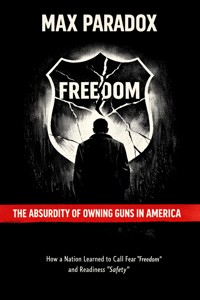
The Absurdity of Owning Guns in America - How a Nation Learned to Call Fear “Freedom” and Readiness “Safety” ebook
Max Paradox
Uzyskaj dostęp do tej i ponad 240000 książek od 14,99 zł miesięcznie
- Wydawca: ALL-IN Rafał Płonkowski
- Kategoria: Poradniki•Styl życia
- Język: angielski
America does not simply own guns.
It organizes its emotions around them.
This book is not about laws, calibers, or statistics.
It is about fear, identity, exhaustion, and the quiet ways a culture convinces itself that permanent readiness is the same as safety.
Through sharp observation, dry humor, and uncomfortable honesty, The Absurdity of Owning Guns in America explores how weapons became emotional anchors, how vigilance replaced trust, and why a society obsessed with protection feels permanently on edge.
This is not a guide.
Not a manifesto.
Not a solution.
It is a mirror.
For anyone who has ever felt that the conversation never really changes.
For anyone who suspects that “being prepared” is not the same as being at peace.
For anyone who wonders what safety would feel like if we actually meant it.
This publication was prepared using tools that support the creative process, including solutions based on artificial intelligence. The final concept, structure, and editing are the work of the author.
Ebooka przeczytasz w aplikacjach Legimi na:
Liczba stron: 139
Rok wydania: 2026
Odsłuch ebooka (TTS) dostepny w abonamencie „ebooki+audiobooki bez limitu” w aplikacjach Legimi na:
Podobne



















INTRO
America does not own guns.America wears them.
They are not objects.They are accessories.They are emotional support hardware with a Second Amendment warranty and a personality that changes depending on who is holding it and which channel is currently playing in the background.
In theory, a gun is a tool.In practice, it is a sentence starter.
• “I’m not paranoid, I’m prepared.”• “It’s not about fear, it’s about freedom.”• “If you don’t like it, move somewhere else.”
The gun is rarely the point.The conversation around the gun is.
Somewhere along the way, a piece of metal became a worldview.A lifestyle.A mood ring for unresolved national anxiety.
You can tell a lot about a person by how they talk about their gun.Even more by how quickly they mention it.
This book is not about ballistics.It is not about crime statistics.It is not about safety courses, storage rules, or responsible ownership brochures printed in reassuring shades of blue.
This book is about the feeling.
The feeling that a gun gives you a voice before you speak.The feeling that it turns inconvenience into injustice.The feeling that it quietly promises control in a country built on the idea that nobody is really in control of anything.
• The economy might collapse, but at least you’re armed.• Healthcare might bankrupt you, but at least you’re armed.• Your neighbor might have different opinions, but at least you’re armed.
The gun becomes a solution that does not require solving anything.
In America, guns are discussed with the emotional intensity usually reserved for religion and sports teams.They are inherited like traditions.Defended like beliefs.Displayed like proof.
The argument is never just about the object.It is about dignity.About masculinity.About independence.About the fantasy that danger can be negotiated if you bring enough hardware to the conversation.
• The world is complicated, but the trigger is simple.• Fear is abstract, but metal is tangible.• Trust is optional when power fits in a waistband.
You don’t buy a gun because nothing is wrong.You buy it because something might be.
And “might” is the most profitable word in American history.
This book looks at the rituals surrounding gun ownership.The language.The merch.The photos.The bumper stickers that manage to be threatening and inspirational at the same time.
It looks at how fear is packaged as preparedness.How identity is forged through accessories.How freedom somehow always requires being ready to shoot something.
• You are free, but always on guard.• You are safe, but permanently alert.• You are independent, but deeply invested in what everyone else is doing.
None of this is presented as madness.It is presented as normal.Patriotic.Reasonable.
That’s the most interesting part.
This is not a book that tells you what to think.It doesn’t need to.
It simply watches.It listens.It notices patterns.It stays quiet long enough for the absurdity to explain itself.
Because when a society insists that the ultimate expression of freedom is being prepared for violence at all times, you don’t need a lecture.
You just need to describe the room carefully and let the silence do the rest.
• The gun is always loaded with meaning.• The argument is never actually finished.• Everyone swears they’re the reasonable one.
Welcome.
Chapter 1 - The Gun Is Never Just a Gun
At first, it is always framed as practical.
A tool.A precaution.A rational response to an irrational world.
Nobody starts with ideology.They start with a story.
Something they saw on the news.Something that happened to a friend of a friend.Something that could happen if you’re not careful, and America has never been very good at “not careful.”
• It’s not fear, it’s awareness.• It’s not paranoia, it’s realism.• It’s not obsession, it’s responsibility.
The gun enters the narrative quietly, like a reasonable suggestion.
You don’t want to own one.You just don’t want to be the only idiot without one.
That’s how it begins.
Because in America, danger is never specific.It is always vague, mobile, and suspiciously flexible.
The threat could be anywhere.Anyone.At any time.
• A stranger.• A neighbor.• A government agent.• A guy who looks like he disagrees with you politically.
The beauty of this logic is that it never expires.
You don’t buy a gun to solve a problem.You buy it to permanently justify its own existence.
Once you have it, the world reorganizes itself around that fact.
Suddenly, you notice things.You notice how dark the parking lot is.How quiet the street feels at night.How close other people stand to you in line.
• You weren’t nervous before.• You weren’t alert before.• You weren’t prepared before.
Now you are all three.And you call that progress.
The gun does not reduce fear.It gives fear a hobby.
Ownership becomes interpretation.
Every sound is evaluated.Every movement is categorized.Every stranger is assigned a potential backstory involving bad intentions and poor life choices.
• You’re not imagining danger.• You’re training your instincts.• You’re finally seeing reality clearly.
Reality, in this case, looks suspiciously like a continuous low-grade action movie.
The gun is no longer an object.It is a lens.
It reframes the world into scenarios.
What if someone breaks in.What if someone follows you.What if someone reaches into their jacket too fast.
The “what if” becomes a lifestyle.
And the most important part is this:The gun never escalates anything in the owner’s mind.
It is always the other people who are dangerous.
• You are calm.• You are disciplined.• You are trained, or at least watched enough videos to feel trained.
Everyone else is chaos.
That’s how the gun stays innocent.
It is never aggressive.It is never angry.It is never emotional.
It just sits there, silently waiting to validate your worst assumptions about humanity.
At some point, practicality turns into pride.
You don’t just own a gun.You identify as someone who owns a gun.
This identity comes with vocabulary.
You don’t talk about shooting.You talk about “defense.”
You don’t talk about killing.You talk about “neutralizing threats.”
You don’t talk about fear.You talk about “situational awareness.”
• Language becomes cleaner.• Intent becomes abstract.• Consequences become hypothetical.
The gun is protected by grammar.
Then comes the moral shield.
You are not like those people.You are responsible.You follow the rules.You store it safely.You would never misuse it.
• You’re not reckless.• You’re not unstable.• You’re not the problem.
The problem is always someone else with a gun.
This is where the paradox becomes comfortable.
The country is safe because of guns.The country is dangerous because of guns.Both statements are true, depending on who is speaking and what just happened on the news.
No one ever questions the contradiction.They just reload it.
The gun also solves a deeper issue.
It simplifies morality.
In a complicated world full of gray areas, a gun offers binary thinking.
Threat or not.Good guy or bad guy.Us or them.
• You don’t need to understand people.• You don’t need to trust systems.• You don’t need to wait for help.
You just need to be ready.
This is incredibly comforting.
Especially in a society where institutions feel distant, expensive, or actively hostile.
Healthcare might fail you.Police might arrive late.The legal system might ruin you financially.
But the gun is immediate.It doesn’t ask questions.It doesn’t require paperwork once it’s already in your hand.
It promises agency in a country that sells independence as a brand but delivers it in limited quantities.
The gun becomes a shortcut to empowerment.
• You don’t have control over your job.• You don’t have control over the economy.• You don’t have control over politics.
But you have control over this.
Or at least that’s the feeling.
Nobody likes to admit how much of gun culture is emotional.Because emotion sounds weak.And gun culture does not like weakness.
So the emotions are repackaged.
Fear becomes preparedness.Anger becomes principle.Distrust becomes patriotism.
And suddenly, a deeply emotional attachment to a deadly object is framed as pure logic.
If you question it, you’re naive.If you criticize it, you’re dangerous.If you suggest limits, you’re attacking freedom itself.
• The gun cannot be wrong.• The system cannot be questioned.• The owner cannot be insecure.
The gun is never just a gun.
It is an argument.An identity.A shield against uncertainty.
And once you accept that, everything else in the culture starts to make a disturbing kind of sense.
That’s where things get interesting.
Chapter 2 - Freedom, With a Safety Off
Freedom is the word everyone reaches for first.
Not safety.Not protection.Not even survival.
Freedom.
Because freedom sounds clean.Moral.Untouchable.
You can argue about crime.You can debate statistics.You can fight endlessly over intent.
But freedom ends conversations.
• You can’t measure it properly.• You can’t define it consistently.• You can’t take it away without sounding like a villain.
So the gun is wrapped in freedom and sealed tight.
In America, freedom is not the absence of fear.It is the right to respond to fear however dramatically you choose.
The logic is elegant in its simplicity.
If you are free, you must be armed.If you are armed, you must be free.
Anything that interferes with that equation is tyranny.
This version of freedom is deeply personal.And extremely loud.
It does not care how other people feel.It cares how you feel.
• Safe.• Powerful.• Unrestricted.
Whether others feel threatened is considered an unfortunate side effect of liberty.
Freedom, in this context, is not collective.It is individual and portable.
You carry it on your hip.You store it in your nightstand.You post photos of it online with captions about responsibility.
The paradox is subtle but consistent.
You insist you are free because you are armed.But you are also permanently preparing for violence.
• You are free, but always alert.• You are free, but always suspicious.• You are free, but never relaxed.
This is not freedom as peace.It is freedom as readiness.
The gun does not liberate you from fear.It just changes the posture.
Instead of vulnerability, you get vigilance.Instead of trust, you get leverage.
And leverage feels like control.
Freedom also comes with theater.
The rhetoric is dramatic for a reason.
The moment you frame gun ownership as freedom, every argument becomes existential.
It’s no longer about regulations.It’s about rights.
It’s no longer about safety.It’s about identity.
It’s no longer about compromise.It’s about survival.
• Give an inch, they’ll take everything.• Today it’s background checks, tomorrow it’s confiscation.• First they come for the guns, then they come for you.
The slope is always slippery.The future is always one law away from collapse.
This mindset requires constant vigilance, which conveniently justifies constant armament.
Freedom must be defended.Preferably with accessories.
There is also a particular version of masculinity woven into this idea.
The armed citizen is not just free.He is capable.
He does not rely on others.He does not ask for help.He does not wait.
• He handles his own problems.• He protects what’s his.• He stands his ground, literally.
This image is powerful.Especially in a society where many people feel increasingly irrelevant, replaceable, or ignored.
The gun becomes proof of usefulness.
It says:“I matter.”“I am dangerous if provoked.”“I am not powerless.”
Freedom here is not philosophical.It is emotional reassurance with a trigger.
And like all emotional reassurance, it needs reinforcement.
That’s why freedom is constantly under threat in the narrative.
If freedom were stable, the gun would feel excessive.So freedom must always be fragile.
• The government is coming.• Society is decaying.• Crime is exploding, even when it isn’t.
Freedom must be defended today, tomorrow, and forever.
With more guns.
The strangest part is how calm this all sounds when explained.
Nobody says they want to use their gun.They say they hope they never have to.
This sentence does an incredible amount of work.
It paints the owner as reluctant.Moral.Forced into preparedness by an unjust world.
• I don’t want violence.• I just want the option.• I just want to be ready.
Freedom, apparently, is about options that involve irreversible consequences.
There is also a legal comfort here.
If something happens, the story is already written.
You were defending yourself.You feared for your life.You acted reasonably.
Freedom comes with preloaded justification.
This is why context matters so much.
The same action can be freedom or brutality depending on who performs it and how well they speak afterward.
Freedom favors confidence.
It favors familiarity.It favors those who look like they belong in the narrative of “responsible ownership.”
Everyone else is an exception.
The freedom argument also ignores exhaustion.
Living in constant readiness is tiring.
Being armed means being mentally armed.You are always scanning.Always calculating.
• Where are the exits.• Who looks nervous.• What would I do if this goes bad.
Freedom becomes work.
Unpaid.Unacknowledged.Normalized.
And yet, people cling to it fiercely.
Because giving it up feels like admitting vulnerability.
And vulnerability is treated as failure.
In this version of America, freedom is not about shared safety.It is about personal dominance over uncertainty.
You don’t trust the system.So you replace it with hardware.
You don’t trust people.So you prepare to overpower them.
You don’t trust the future.So you keep your finger close.
Freedom, with a safety off.
The gun does not guarantee liberty.It guarantees readiness to end a conversation permanently.
But as long as it is framed as freedom, that contradiction remains invisible.
• You are not aggressive.• You are not afraid.• You are just free.
And freedom, once defined that way, becomes impossible to question without sounding like the enemy.
That’s how the argument stays loaded.
That’s how it never ends.
Chapter 3 - Everyone Is the Good Guy With a Gun
Every gun owner imagines the same scene.
Not consciously.Not in detail.But it’s there.
A moment when chaos appears uninvited.A threat reveals itself clearly.And finally, finally, everything makes sense.
In this moment, you are calm.Focused.Decisive.
You do not panic.You do not hesitate.You do not miss.
Because you are the good guy.
• You act when others freeze.• You stop the bad thing from getting worse.• You restore order with confidence and accuracy.
This fantasy is never described as a fantasy.It’s described as preparedness.
Nobody practices for accidents.They practice for narratives.
The “good guy with a gun” is the central myth holding everything together.
It explains why guns are everywhere but danger is always somewhere else.It explains why more guns are always the solution to gun violence.It explains why responsibility is assumed, not tested.
In this story, the good guy is obvious.
He looks normal.He sounds reasonable.He believes himself.
The bad guy, conveniently, looks different.
• More aggressive.• Less stable.• Politically wrong.• Socially suspicious.
The line between them is clear in imagination and blurry in reality.
But imagination is doing most of the work here.
The good guy scenario is powerful because it flatters the owner.
It casts you as protector.As hero.As the last functional adult in a collapsing world.
• You are not armed because you want power.• You are armed because others are irresponsible.• You are armed because someone has to be.
This logic turns self-interest into civic duty.
And once you accept that role, everything else follows.
Training videos.Range time.Gear upgrades.Holsters designed to feel both tactical and morally superior.
The performance of responsibility becomes part of the identity.
But the fantasy requires very specific conditions.
The threat must be unmistakable.The timing must be perfect.The environment must cooperate.
There are no crowds.No confusion.No innocent people moving unpredictably.
Real life is not invited.
• Nobody screams unexpectedly.• Nobody runs in the wrong direction.• Nobody looks threatening by accident.
The good guy fantasy depends on clarity.