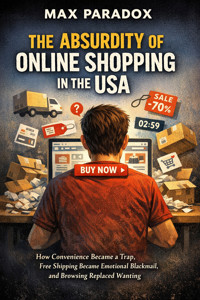
The Absurdity of Online Shopping in the USA - How Convenience Became a Trap, Free Shipping Became Emotional Blackmail, and Browsing Replaced Wanting ebook
Max Paradox
Uzyskaj dostęp do tej i ponad 240000 książek od 14,99 zł miesięcznie
- Wydawca: ALL-IN Rafał Płonkowski
- Kategoria: Poradniki•Styl życia
- Język: angielski
Buying things online was supposed to be easier.
Faster.
More convenient.
Instead, it became exhausting.
The Absurdity of Online Shopping in the USA is a sharp, ironic, and painfully accurate satire about modern American e-commerce - from free shipping thresholds and fake urgency, through reviews written by people in emotional distress, to the quiet anxiety of tracking numbers and carts that never empty.
This is not a guide.
It won’t teach you how to save money.
It won’t help you shop smarter.
It will do something worse.
It will make you recognize yourself.
Written in a dry, observant voice that cuts close to the bone, this book dissects how online shopping quietly reshaped patience, desire, responsibility, and attention - without ever asking permission.
If you’ve ever:
• Added items just to avoid paying for shipping
• Read reviews longer than the product description
• Checked tracking numbers like horoscopes
• Felt tired after “just browsing”
This book is for you.
Not to fix it.
Just to finally say it out loud.
This publication was prepared using tools that support the creative process, including solutions based on artificial intelligence. The final concept, structure, and editing are the work of the author.
Ebooka przeczytasz w aplikacjach Legimi na:
Liczba stron: 96
Rok wydania: 2026
Odsłuch ebooka (TTS) dostepny w abonamencie „ebooki+audiobooki bez limitu” w aplikacjach Legimi na:
Podobne




















INTRO
You didn’t decide to buy something online.
You drifted into it.
One moment you were a functioning adult, vaguely alive, maybe even optimistic.The next moment you were staring at a product page at 11:47 p.m., reading reviews written by people who clearly should not be allowed to vote.
Online shopping in the USA is not a convenience.It is a psychological experiment conducted at scale, without consent, and with free shipping over $35.
At first, it looks simple.
You need a thing.You search for the thing.You are shown 4,372 versions of the thing.None of them are the thing.
Instead, you are offered:
• The cheaper version that “basically does the same thing.”• The premium version that assumes you are richer and happier than you are.• The version with 38,000 reviews and an average rating of 4.3, which somehow includes both “life-changing” and “arrived cursed.”• The suspiciously perfect option that will be “delivered tomorrow,” but only if you stop asking questions.
This is where the process stops being about shopping.
It becomes about trust.And then about doubt.And then about you quietly negotiating with yourself like a hostage.
American online shopping platforms do not sell products.They sell possibility.
The possibility that this purchase will fix something.Your kitchen.Your posture.Your productivity.Your sense that you are slightly behind in life.
You are not buying a cable.You are buying the fantasy of a future where you finally have the right cable.
Every product description promises certainty.
Every review destroys it.
• One person says it arrived broken and ruined Thanksgiving.• Another says it worked perfectly but only after “some light modifications.”• A third admits they ordered the wrong item and are angry at everyone.• Someone else writes a full emotional arc involving customer service, their divorce, and a replacement unit.
You keep scrolling anyway.
Because the USA has perfected the art of making inconvenience feel like a personal failure.
If something goes wrong, it is not the system.It is you.
You clicked the wrong size.You misunderstood the return window.You didn’t notice the tiny line that said “non-returnable if opened, touched, or perceived.”
And yet you come back.
Again.And again.And again.
Because the system is fast.Because it smiles at you.Because it remembers your card number better than you remember your own passwords.
American online shopping trains you gently, relentlessly:
• To accept delays as character-building exercises.• To treat tracking numbers like horoscopes.• To believe that “out for delivery” is a state of mind.• To feel gratitude when the wrong item arrives early.
This book is not here to help you shop better.
It will not teach you hacks.It will not optimize your cart.It will not save you money, time, or dignity.
This book exists to sit with you in the moment you already know too well.
The moment when the package arrives.The box is slightly dented.You open it carefully.You see the item.
And you think:
“Yes.This is exactly what I expected.Which is somehow worse.”
If that feels familiar, good.
You’re in the right place.
Chapter 1 - You Are Not Shopping, You Are Browsing Forever
At some point, online shopping in the USA stopped being an action.
It became a state.
You don’t go shopping anymore.You exist in a low-level shopping posture at all times.
Your phone is already open.Your browser remembers.Your cart is never empty, just paused.
Browsing is not the step before buying.Browsing is the experience.
You scroll not because you need something, but because something might need you.
The system is very clear about this.
• You are always one click away from a better option.• You are never quite done looking.• You should definitely check just one more listing.
The American internet has mastered the art of infinite almost.
Almost cheaper.Almost faster.Almost higher rated.Almost the same, but somehow more adult.
You tell yourself you’re comparing.
You are not.
Comparing implies an end.
What you are doing is delaying regret.
Because choosing means committing.And committing means you might be wrong.Publicly.Financially.Emotionally.
So you scroll.
You open tabs like emotional insurance policies.
One tab for the sensible option.One tab for the aspirational version.One tab for the one with the most reviews.One tab you don’t remember opening but now feel responsible for.
Soon, the tabs are no longer about products.
They are about versions of you.
• The you who makes responsible purchases.• The you who invests in quality.• The you who refuses to overpay on principle.• The you who just wants this to be over.
American platforms encourage this fragmentation.
They show you comparisons you didn’t ask for.They highlight differences that do not matter.They bold features you will never use.
“Customers also viewed.”
Which is another way of saying:
“People like you also panicked here.”
The reviews don’t help.
They never help.
Because reviews in the USA are not evaluations.They are confessions.
One star reviews read like warnings from the future.
Five star reviews read like paid testimony given under duress.
• “It broke immediately but customer service was nice.”• “Works great after the third replacement.”• “Exactly as described, which was disappointing.”
You start reading dates.
Is this review from before or after the redesign?Was the company acquired?Did the manufacturing country change?Was this written during a global supply chain collapse?
You are now doing forensic analysis on a $19.99 item.
This is normal.
The platforms make sure of it.
They add badges.
“Best Seller.”“Amazon’s Choice.”“Limited Time Deal.”
None of these explain why.
They just imply that if you don’t act now, you are behind.
• Behind other shoppers.• Behind a better version of yourself.• Behind an algorithm that is quietly disappointed in you.
You hover over the “Add to Cart” button.
Not clicking it feels responsible.Clicking it feels reckless.
You scroll again.
You scroll past sponsored listings that look identical but feel morally compromised.You scroll past bundles that include things you did not want but are now considering.You scroll past the same product again, because the site knows you hesitate.
It watches.
It waits.
It remembers that one time you clicked something similar at 2 a.m.It remembers that you didn’t buy it, and that bothers it deeply.
Browsing never ends because ending would mean closure.
And closure is bad for business.
The USA doesn’t want you satisfied.
It wants you engaged.
Engagement is the warm hum of indecision.Engagement is the feeling that you are actively doing something while accomplishing nothing.Engagement is five minutes turning into forty.
At some point, you forget what you came for.
You notice accessories.Then alternatives.Then something completely unrelated but oddly appealing.
• You came for socks and are now reading about ergonomic mouse pads.• You came for batteries and are considering a smart home ecosystem.• You came for nothing and are leaving with anxiety.
This is not an accident.
American online shopping is designed to replace boredom with mild urgency.
Not enough urgency to act.Just enough to stay.
You close the app.
You open it again.
Because the cart is still there.Waiting.Judging quietly.
You tell yourself you’ll decide later.
Later never comes.
Later is just another browsing session with better lighting.
You don’t remember when shopping used to end.
You just know that now, it doesn’t.
Chapter 2 - Free Shipping Is Not Free, It Is Emotional Blackmail
At first, free shipping feels generous.
A gift.A courtesy.A small nod to your existence as a human being.
Then you notice the condition.
“Free shipping on orders over $35.”
This is not an offer.It is a challenge.
You didn’t want to spend $35.You wanted to spend $18.74 and feel good about it.
But now you are $16.26 short of moral victory.
And the system knows this.
American online shopping does not charge for shipping.It weaponizes it.
Shipping is not a cost.It is a test of character.
Paying $6.99 for shipping feels humiliating.Paying $6.99 for shipping feels like admitting defeat.Paying $6.99 for shipping feels like saying, “Yes, my time is worthless.”
So you do what everyone does.
You add something.
Not something you need.Something you can justify.
Something cheap enough to feel harmless, but useful enough to survive self-examination.
• Socks you did not plan to replace.• A cable you might need one day.• A kitchen tool invented to solve a problem you don’t have.
This is how carts grow.
Not through desire.Through arithmetic.
You are no longer shopping for products.You are shopping to appease a threshold.
The site helps.
It shows you a friendly progress bar.
“Only $12.43 away from FREE shipping!”
This is not information.This is emotional pressure dressed as encouragement.
The bar fills slowly, like a progress meter on a bad life choice.
You scroll through the “Add-on items” section.
This section exists solely for people in your exact emotional state.
Confused.Annoyed.Determined not to lose.
Everything here costs between $4 and $12.
Everything here looks mildly useful.
Everything here is screaming:
“Please sacrifice me so the main item can feel justified.”
You start doing math you would never do in real life.
If I add this $9 item, I save $7 on shipping.So really, it’s only $2.Which is basically nothing.Which is basically free.
This logic is airtight if you don’t look at it.
The USA has perfected this psychological funnel.
They know you will overbuy to avoid feeling foolish.They know you will resent shipping more than waste.They know you will accept clutter over principle.
• You will pay $12 extra to avoid paying $6.• You will add junk to feel efficient.• You will congratulate yourself for “beating the system.”
You didn’t beat anything.
You were gently escorted.
Free shipping also introduces time into the negotiation.
Free shipping is slower.
Paid shipping is faster.
This creates a new internal debate.
Do you value money more than time?Do you value time more than pride?Do you value pride more than admitting you want it tomorrow?
American platforms frame this as a choice.
It is not.
It is a personality quiz with financial consequences.
You tell yourself you can wait.
You always say that.
Then you imagine the item arriving later than expected.Then you imagine needing it sooner than planned.Then you imagine checking the tracking page anyway.
You upgrade.
Because waiting feels irresponsible now.
The upgrade is always presented politely.
“Get it faster for just $9.99.”
Just.
As if $9.99 is not a full meal somewhere else.As if $9.99 is not a small, sharp reminder of reality.As if $9.99 is not more than the thing you added for free shipping.
You accept it.
Because now you’re committed.
Free shipping also affects returns.
You return the item.You are refunded the item price.Shipping disappears into the past.
You feel vaguely cheated, but not enough to complain.
Complaining would require effort.Effort costs more than $6.99.
The system counts on this.
• You will not return low-value items.• You will not fight small losses.• You will quietly absorb inconvenience like a trained adult.