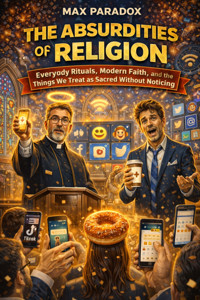
The Absurdities of Religion - Everyday Rituals, Modern Faith, and the Things We Treat as Sacred Without Noticing ebook
Max Paradox
Uzyskaj dostęp do tej i ponad 240000 książek od 14,99 zł miesięcznie
- Wydawca: ALL-IN Rafał Płonkowski
- Kategoria: Poradniki•Styl życia
- Język: angielski
Religion didn’t disappear.
It just changed outfits.
It moved into parking lots, coffee cups, fitness trackers, group chats, self-checkout lanes, and subscription boxes.
It stopped wearing robes and started wearing notifications.
The Absurdities of Religion is a satirical, observational journey through modern life, where sacred language, rituals, and beliefs quietly attach themselves to the most ordinary moments.
This book is not an attack on religion.
It is not a defense of it either.
It does not argue, explain, or convert.
Instead, it notices.
With dry humor, calm irony, and uncomfortable accuracy, Max Paradox observes how faith-like behaviors appear everywhere:
in elevators and supermarkets,
in gyms and airports,
in office potlucks and Wi-Fi passwords,
in calendars, algorithms, reviews, and sales racks.
These are not grand theological debates.
They are small, familiar moments you’ve already lived - just never stopped to look at.
There are no lessons.
No advice.
No happy endings.
Only recognition.
And once you see it, you can’t unsee it.
This publication was prepared using tools that support the creative process, including solutions based on artificial intelligence. The final concept, structure, and editing are the work of the author.
Ebooka przeczytasz w aplikacjach Legimi na:
Liczba stron: 144
Rok wydania: 2026
Odsłuch ebooka (TTS) dostepny w abonamencie „ebooki+audiobooki bez limitu” w aplikacjach Legimi na:
Podobne



















INTRODUCTION
Religion is everywhere when you’re looking for it.It’s on the bumper sticker and in the hashtag.It’s the incense of burnt toast in the kitchen and the incense of burnt incense in a temple.It is as omnipresent as background music in a supermarket and just as easy to ignore.
When I was a child, I thought religion was a dramatic thing.Men in robes, women in veils, angels with trumpets, and saints with halos.It looked like the stained glass windows in the old church my grandmother took me to on Sundays.The windows glowed.I never understood what they meant, but I liked the colors.
Now I am older, and I keep seeing religion in the least stained-glass places.It shows up in fast food chains offering fish sandwiches on Fridays.It shows up in motivational quotes about trusting the universe printed on reusable grocery bags.It pops up in the way people feel guilty for wanting a second croissant.It whispers when someone says they’re blessed after finding a parking spot.
Somewhere between sacraments and sweaters on sale, the sacred and the ordinary started sharing closet space.I am not making an argument about it.I’m not even sure how to explain it.I just notice things.My noticing has become a book.
This is not a sermon or a manifesto.It is not a warning, and it is certainly not a prayer.It is a collection of those moments when the absurdities of religion cross paths with daily life.Not the grand scandals, but the small eccentricities.Not the dogmas, but the dog-eared prayer cards tucked between recipes for banana bread.
If you are looking for an explanation, you won’t find it here.If you want me to condemn or to convert, you will be disappointed.I’m just standing in the corner at the church bazaar, sipping on lukewarm coffee, watching people bidding on holy water bottles next to bundt cakes, and thinking, well, isn’t that something.
The absurdities come in different sizes.There are the politely absurd, like the person who says grace before eating a pre-packaged salad from a vending machine.There are the quietly absurd, like the silent prayer for a good Wi-Fi signal in the confessional turned coworking space.There are the flamboyantly absurd, like the marathon runner carrying a life-sized statue of the Virgin Mary on his back for charity.
I try to pay attention to these moments.Sometimes, I jot them down on a napkin.Sometimes, I think about them in the checkout line.Sometimes, they make me chuckle; sometimes, they leave me uneasy.Mostly, they just make me feel like I’m living in a comedy that didn’t rehearse.
This book is full of short chapters because that’s how these observations appear.In fragments and flashes.In bus rides and waiting rooms.Between sips of coffee and half-heard sermons.Each chapter is its own set of scenes, its own little stained glass pane made of moments you might recognize.
I use bullet points because sometimes thoughts stack better than they line up.You’ll see them.They are not formal lists; they are the beats of an inner monologue that refuses to stay in neat paragraphs.
Religion is often described with heavy words: faith, doctrine, morality.Those words do not appear here very often.I’m more interested in the lighter artifacts: bumper stickers, keychains, leftover communion wafers taken home in plastic containers.I am interested in the way people cross themselves before crossing a street, then jaywalk anyway.I notice when someone whispers “Jesus Christ” not as a prayer but as a reaction to spilling coffee on a white shirt.
You might think I’m making fun.Sometimes I am.But I have learned that there is affection in humor, and there is truth in absurdity.We live in rituals we barely understand.We chant slogans we do not believe.We use sacred words as passwords.
If this book leaves you unsettled, I understand.If it leaves you amused, I understand that, too.If it leaves you with more questions than answers, welcome to the club.The only thing I can promise is that there are no conclusions here.No solutions.Just observations.Just recognition.
CHAPTER 1 - The Holy Parking Space
There is a particular kind of prayer uttered in a shopping mall parking lot.The car circles, and the driver whispers, “Please, God, just one spot.”These prayers are less about salvation and more about convenience.They are small bargains made with the divine while the radio hums an ad for discounted mattresses.
People talk about miracles like sunbeams through storm clouds.But I have seen a grown man cry tears of joy when a minivan pulls out just as he turns the corner.He raises his eyes to the sky.His children in the back seat cheer.This is modern grace.
If you stand by a crowded parking lot on a Saturday morning, you can see the liturgy unfold.The car slows down.The driver’s knuckles tighten.The mumbling begins.
• The whispered promise to attend church more often if the spot is close to the entrance
• The vow to stop swearing if the spot is in the shade
• The mental negotiation about whether taking someone else’s spot is a sin if they were on their phone and you were paying attention
There is no collection plate, but there is sacrifice.People will park three miles away and walk in the rain rather than pay for valet.They will confess to complete strangers about how many laps they made around the lot.They will chant “Turn signal, turn signal” like monks chanting psalms.
Outside of the mall, the city paints little white lines on asphalt and calls them sacred boundaries.To cross into someone else’s spot is an act of heresy.To leave your car too close to the line is to invite excommunication.And yet, in times of desperation, the faithful cheat.They angle their sedans into compact spots meant for smart cars and hope for absolution.
Some places have statues of saints in their parking lots.A Saint Christopher tucked beside the payment machine.A Blessed Virgin overlooking the handicapped spaces.People don’t pray to these figures; they pray around them.It’s like having a lifeguard at a beach where no one swims.
There is a man who always leaves a rosary hanging from his rearview mirror.He says it brings him luck.He also has a collection of parking passes on his dashboard.His car looks like a mobile shrine.He doesn’t go to church anymore, but he calls Saint Anthony whenever he loses his keys.He swears Anthony helps him find a parking space, too.I wonder if there is a saint for lost patience.
In some cities, parking is so scarce that people hire valets for their souls.They download apps to reserve spaces.They join loyalty programs and collect points toward redemption.The prayers now include discount codes.
• “Dear God, if you give me this spot, I promise to pay it forward by not yelling at anyone today.”
• “Holy Spirit, inspire the person in front of me to hurry up and leave.”
• “Blessed Mother, keep my car from getting dinged by those who lack courtesy and backup cameras.”
These prayers are not in any official prayer book, but they are repeated more often than the rosary.People teach their children how to cross themselves and how to spot an open space.They whisper instructions to the young and inexperienced drivers: “Patience, faith, and always put your blinker on early.”
There is ritual in the way a driver taps the steering wheel like tapping on pews.There is supplication in the way they crane their necks.There is relief in the exhale when they finally pull in.
Some say the parking lot prayer is trivial, but it reveals something.It shows that our sense of deserving divine attention extends to the mundane.It shows that we believe we are seen even when we are chasing deals on electronics.It shows that faith does not always involve candles and hymnals; sometimes it involves hazard lights and horn taps.
When the driver finally secures a space, there is a sense of completion.They turn off the engine like a candle flame snuffed.They lock the doors like closing a tabernacle.They walk toward the automatic doors that open like church doors, arms loaded with reusable bags, hearts filled with a strange sense of accomplishment.
Later, over dinner, they will recount the story.They will say, “And then, just as we were about to leave, a spot opened up right next to the entrance.”Everyone at the table will nod.Someone will murmur, “God is good.”No one will question the theology.
CHAPTER 2 - Sacred Coffee Cups
There is a ritual to the morning coffee that rivals any religious rite.A person wakes up, bleary-eyed, and reaches for the sacred mug.The mug often bears an inspirational quote, a scripture verse, or a witty saying about coffee being their holy water.They fill it with a dark liquid that smells like burnt offering.They cup their hands around it as if it were a chalice.
In the office kitchen, there is always a battle between the devout and the casual.The devout insist on grinding beans fresh.They treat the coffee machine like an altar.They argue over whether milk frothing is a sacrament.The casual pour powdered creamer like sprinkling holy water.
Some bring personal mugs that declare their allegiance.One reads “This coffee is my salvation.”Another has a cross with the words “Jesus and coffee are all I need.”A third simply says “Blessed.”The mugs line up like prayer candles on a desk.
• One colleague refuses to let anyone else use her mug.
• Another acts like a generous priest, offering a sip to anyone in need.
• A third has a collection of mugs for different days: Monday is “Life Happens, Coffee Helps,” Friday is “Worship Latte.”
There is a hierarchy at play.The person who brings a French press is seen as more devout than the one who uses instant coffee.The one who roasts beans at home is borderline evangelical.The person who orders a pumpkin spice latte in July is deemed heretical.
People take their coffee breaks like prayer times.Morning coffee at nine is Lauds.Afternoon coffee at two is Vespers.Some even have Night Prayer at ten p.m. because they have a deadline.They gather in the kitchen and commune over caffeine, confessing their sins of procrastination and gossiping about the boss.
There is a distinct act of reverence in the way they stir their drinks.The spoon clinks against the ceramic like bells at Mass.The sugar crystals dissolve like old doctrines.The foam forms patterns reminiscent of clouds in renaissance paintings.
On the wall above the coffee station, someone has hung a sign.It says, “In coffee we trust.”Someone else has crossed out “coffee” and written “God,” then someone else crossed out “God” and wrote “espresso.”The sign is a living document of faith and rebellion.
At one meeting, an executive announces a policy change.Effective immediately, all employees must bring their own mugs.No more disposables.He frames it as environmental stewardship.Half the room cheers.The other half grumbles.Someone whispers, “I didn’t sign up for this doctrine.”
I notice that no one complains about the cost of coffee pods, but everyone has an opinion about the price of salvation.They discuss tithing with more disdain than they discuss paying for oat milk.They argue about whether decaf is a lie.They call coffee breaks “breathing prayers.”
Once, I saw a man spill his coffee on a stack of Bibles.He was horrified.He tried to blot the pages with napkins, but the stain remained.He laughed nervously and said, “Well, I guess that’s what forgiveness is for.”Everyone chuckled.No one considered the symbolism.
• The way people say, “Lord knows I need my coffee.”
• The way they bring donuts on Sundays but gluten-free muffins on weekdays, as if salvation is different in the office.
• The way a Bible study group meets in a coffee shop with an ironic name like Holy Grounds.
In the city, churches have started opening cafés inside their lobbies.It draws people in.It’s less intimidating than a pew.You can sip a latte while listening to a sermon piped through speakers near the restroom.Some folks come for the coffee and leave before the altar call.Others come for the free Wi-Fi.
I once talked to a pastor about his church’s café.He said it was missional.He said coffee was a gateway to community.He said caffeine opens hearts.I asked him if he served communion bread on the side.He laughed.Then he showed me the gift shop where they sell branded coffee beans called “Grace Blend.”
There is an irony in selling a beverage that energizes people to stay awake during a sermon designed to put them to rest.There is an absurdity in baptizing beans with holy names.There is a comfort in having something to hold when the preacher is speaking about things you don’t understand.
Sometimes, at home, I brew coffee in silence.No devotional reading, no podcast, no news.Just the sound of water boiling and the smell of something familiar.It feels like prayer even though I’m not addressing anyone.It feels like ritual even though I’m alone.It feels like the universe acknowledging that we all need to warm our hands on something.
After the cup is empty, there is a moment of reflection.Some people wash their mugs right away.Others leave them in the sink as an act of rebellion.Some stack them carefully, like offering plates.The mugs dry on the rack like relics awaiting veneration.
Coffee is not salvation, but it makes mornings bearable.It is not communion, but it brings people together.It is not a sacrament, but it is treated with sacred care.In offices, kitchens, and church lobbies, the line between caffeine and communion blurs.The absurdity is not that people idolize coffee; the absurdity is that they don’t realize they are practicing a religion.
CHAPTER 3 - The Winking Saint
In my grandmother’s house, there was a small statue of a saint who seemed to have been painted in a rush.His eyes were slightly uneven, his lips too red.She told me he was Saint Jude, patron of lost causes.He stood by the stove, watching over boiling pots and burnt pancakes.Sometimes, when the light hit his glossy eyes, it looked like he was winking.
I never knew why my grandmother trusted this piece of ceramic more than her smoke detector.She talked to him while kneading dough.She told him about her back pain.She asked him to help her find her glasses.She scolded him when the bread didn’t rise.
One day, I asked her why she always turned him around when guests came over.She said some people didn’t understand.She said they would think she was silly.She said faith is personal, and she didn’t want to answer questions.Then she put him back facing the wall.
In the pantry, next to the pasta, there was a bottle labeled “Holy Water.”It looked like an old whiskey bottle.She used it to sprinkle on the door before storms.She also used it to water her plants when she ran out of tap water.The plants seemed to do fine.
• The saint had chipped paint on his fingers.
• The label on the holy water was fading.
• The rosary hanging on the doorknob had a broken bead.
These objects were treated with a reverence that had nothing to do with theology and everything to do with habit.They were as much a part of her kitchen as the salt and pepper shakers.They were worn from use, not from kneeling.
When my grandmother got older, she couldn’t cook as much.She would sit in a chair and watch me attempt her recipes.She would instruct me on how to measure flour by sight.She would tell me to stir clockwise for luck.She would occasionally ask Saint Jude to intervene when I dropped an egg.
I started to develop a relationship with the winking saint.I would glance at him when I felt like giving up on a recipe.I would whisper, “Help me,” not really expecting anything.Sometimes the bread still didn’t rise.Sometimes it did.I began to understand why she liked having him there.
After she passed away, my mother asked me if I wanted any of her things.I took the saint.He now sits on my kitchen shelf between a jar of quinoa and a can of chickpeas.He still winks when the light hits him just right.I don’t talk to him as much as she did, but sometimes I nod at him out of habit.
Friends have asked me about him.