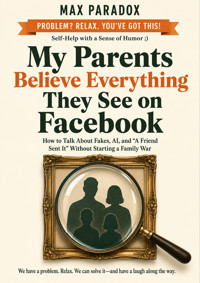
My Parents Believe Everything They See on Facebook - How to Talk About Fakes, AI, and “A Friend Sent It” Without Starting a Family War ebook
Max Paradox
Uzyskaj dostęp do tej i ponad 240000 książek od 14,99 zł miesięcznie
- Wydawca: ALL-IN Rafał Płonkowski
- Kategoria: Literatura popularnonaukowa•Nauki humanistyczne
- Język: angielski
Your dad forwards a Facebook warning that the banks are about to freeze everyone’s money. Your mom sends a video that “proves” a celebrity said something outrageous. A family friend has discovered another miracle cure, an AI-generated image is circulating as breaking news, and somebody in the group chat has written, “SHARE BEFORE THEY DELETE THIS.”
You know it’s nonsense.
Now comes the difficult part: saying so without turning Sunday dinner into an international incident.
My Parents Believe Everything They See on Facebook is a practical, funny guide to dealing with misinformation inside families-especially when fake news, AI-generated images, manipulated videos, scams, health claims, political posts, and the legendary phrase “a friend sent it” keep appearing on your phone.
Max Paradox explains why simply shouting “That’s fake!” often fails, why trustworthy people can pass along completely unreliable information, and why being factually correct does not automatically make you persuasive. More importantly, this book shows you what to do instead.
You’ll learn how to:
ask questions that make people examine claims themselves;
trace posts, screenshots, quotes, images, and videos toward their original sources;
use a simple five-minute verification habit;
distinguish “false” from “not verified yet”;
discuss AI-generated content without pretending you can detect every fake by counting fingers;
respond to scams, cloned voices, fake investment offers, suspicious bank messages, and dangerous health misinformation;
correct someone without humiliating them;
stop family group chats from turning into courtrooms;
set boundaries when you become the unpaid family fact-checking department;
know when to keep correcting-and when to stop.
This is not a book about winning arguments or proving that your generation understands the internet better. It is about building better habits, safer decisions, and calmer conversations.
Because your parents do not need to become professional fact-checkers.
They need one useful pause between seeing something and believing it.
And ideally, Steve needs to start including sources.
This publication was prepared with the assistance of tools that support the creative process, including artificial intelligence-based solutions. The final concept, structure, and editing belong to the author.
Ebooka przeczytasz w aplikacjach Legimi na:
Liczba stron: 223
Rok wydania: 2026
Odsłuch ebooka (TTS) dostepny w abonamencie „ebooki+audiobooki bez limitu” w aplikacjach Legimi na:
Podobne




















INTRO
Your dad sends you a Facebook post at 7:14 a.m. It says that a new law will soon require every household appliance to be connected to artificial intelligence so the government can monitor how often you use your toaster. The post has a blurry photo, six red exclamation marks, and the words THEY DON’T WANT YOU TO KNOW THIS written in a font usually associated with discount mattresses and minor constitutional crises.
You look at it for three seconds.
It is obviously fake.
You reply, “Dad, this isn’t true.”
He replies, “How do you know?”
You consider several possible answers. You could explain that the website was created eleven days ago, the article cites no source, the photo is from 2016, the supposed expert does not exist, and the entire story appears to have been written by someone whose relationship with punctuation has become openly hostile.
Instead, before you can type anything, another message arrives.
“My friend Steve sent it. He’s usually very informed.”
Ah.
Steve.
The Associated Press of the neighborhood barbecue.
This is how many modern family arguments begin. Not with politics, religion, inheritance, or the thermostat, but with a screenshot forwarded by someone named Steve, Linda, Carol, Uncle Mike, or “a guy from work who really researches this stuff.” One person sees nonsense online. Another person points out that it is nonsense. Within four minutes, nobody is discussing the nonsense anymore. You are now discussing respect, arrogance, generations, trust, “mainstream media,” whether young people think they know everything, and something you apparently said at Thanksgiving in 2019.
The original fake story quietly leaves the room.
It knows its work here is done.
If your parents believe too much of what they see on Facebook, YouTube, WhatsApp, TikTok, or whatever digital hallway their friends currently use to pass around alarming information, you may have tried the obvious strategy: correcting them.
Fact. Link. Explanation. Done.
Technically, this should work.
Human beings, however, have once again failed to read the technical documentation.
The problem is that you are rarely correcting only a fact. You may also be challenging a person’s judgment, social circle, identity, habits, and sense of competence. When you say, “That post is fake,” they may hear, “You are gullible.” When you say, “That image was generated by AI,” they may hear, “You cannot tell what is real anymore.” When you say, “Please stop forwarding this stuff,” they may hear, “Everything you send me is stupid, and possibly you are too.”
You did not say any of that.
Their brain may still provide subtitles.
And to make the situation more annoying, your frustration is understandable. There are only so many times you can receive a photograph of a seven-headed snake supposedly discovered behind a Walmart before your inner diplomat starts packing its bags. You may know exactly how reverse image searches work, recognize engagement bait from fifty feet away, and spot an AI-generated celebrity quote before breakfast. Watching someone you love confidently believe obvious garbage can feel like watching them pay $800 for a magic spoon because an internet doctor said forks are destroying the immune system.
You want to help.
You also want to scream into a couch cushion.
Both can be true.
The information environment has become genuinely harder to navigate. Fake news is no longer limited to badly spelled emails from imaginary princes. Images can be fabricated in seconds. Voices can be cloned. Videos can be altered. Real headlines are reposted with false captions. Old footage returns wearing a new date. Satire loses its label halfway through a chain of shares and arrives at your mother’s phone as breaking news.
Meanwhile, social platforms are very good at showing people more of whatever keeps them watching. If someone pauses on one dramatic health claim, the internet does not politely say, “Excellent, now here are three peer-reviewed papers and a calm person explaining uncertainty.”
No.
It says, “You liked one terrifying story? Fantastic. Here are nineteen more, a video with ominous piano music, and a man filming himself in his truck because apparently the truck is now a recognized research institution.”
This is not a problem solved by calling people stupid. It is also not solved by becoming the family fact-checking department, permanently on call, investigating every screenshot that enters the group chat while everyone else continues living peaceful lives.
You need a better system.
That system starts with an inconvenient truth: winning the argument is not the same as changing someone’s mind.
You can prove a claim false and still lose the conversation. You can be completely correct and make the other person more attached to the false belief than they were ten minutes earlier. You can provide fourteen links, three official statements, two expert interviews, and a chart so beautiful it deserves gallery lighting, only to hear:
“Well, that’s your opinion.”
At this point, your soul briefly leaves your body.
The useful question is therefore not, “How do I prove my parents wrong?”
It is, “How do I help someone become more careful about what they believe without turning every conversation into a courtroom?”
That requires different skills. You need to know when to correct something and when to ignore it. You need to separate harmless nonsense from claims that could cost money, damage health, destroy relationships, or lead to scams. You need ways to ask questions that make people examine a claim themselves instead of immediately defending it. You need simple verification habits that do not require a journalism degree, a cybersecurity lab, and seventeen browser tabs.
You also need boundaries.
Because sometimes the correct response to the eleventh forwarded conspiracy post is not a six-page explanation.
Sometimes it is:
“Please don’t send me these unless you’ve checked where they came from.”
A miracle may not occur. Nobody may suddenly whisper, “You know what? I have reconsidered my entire relationship with online information.”
That is fine.
This book is not about transforming your parents into professional fact-checkers who spend Sunday mornings examining metadata. It is about making family conversations less explosive and helping misinformation travel a little less easily through the people you care about.
You will learn how to recognize the psychological traps that make false stories feel convincing, how to correct without humiliating, how to talk about AI-generated content without sounding like a malfunctioning tech-support chatbot, and how to respond when the famous sentence appears:
“A friend sent it.”
We will also deal with the harder situations: repeated misinformation, scams, health claims, emotionally loaded political content, fake celebrity endorsements, AI images, manipulated videos, and relatives who interpret every correction as an invitation to debate civilization itself.
The goal is not perfect agreement.
Families have survived decades of arguments about money, parenting, directions, air-conditioning, and the correct way to load a dishwasher. We can probably survive Facebook too.
The goal is to create one small pause between seeing something and believing it.
That pause matters.
Because once someone learns to ask, “Wait—where did this come from?” the internet becomes slightly less magical. The alarming post loses some power. Steve is demoted from International Intelligence Correspondent back to a guy who owns a leaf blower.
And family dinner becomes just a little less likely to end with someone saying, “Fine, believe whatever you want,” before attacking mashed potatoes with unnecessary force.
That seems like progress.
Chapter 1 - Why Fake Stuff Feels So Real
Your mother sends you a video of a famous actor supposedly warning people that a popular grocery chain is secretly adding something dangerous to its food. The actor looks almost right. The voice sounds almost right. The lighting is suspiciously dramatic, but that describes half the internet now, including videos about air fryers.
You watch it once.
Then again.
The mouth movement is slightly off. The blinking feels wrong. The sentence structure sounds like somebody trained a robot on panic, coupons, and daytime television.
You message back, “This is fake. It looks AI-generated.”
Thirty seconds later:
“But it’s him. I can see him.”
And there, in six words, is most of the problem.
Humans are built to trust what feels direct. We see a face, hear a voice, recognize a logo, notice a familiar person sharing something, and our brains begin processing the information before the skeptical department has even found its shoes.
For most of human history, this was reasonable. If someone from your village stood in front of you and said a bridge had collapsed, you did not ask them to provide the original source, publication date, geolocation, and media-forensics report. You listened because somebody you knew was standing there saying it.
The internet has preserved that old instinct while removing almost all the old safeguards.
Now your “village” contains millions of strangers, fake accounts, recycled videos, bots, influencers, advertisers, political operatives, scammers, AI-generated people, and your cousin Ron.
Especially Ron.
The first thing to understand is that believing false information is not necessarily a sign of low intelligence. Smart people believe nonsense every day. Educated people fall for scams. Highly skeptical people become strangely unskeptical when a claim agrees with what they already think. Expertise in one area does not automatically install a universal fraud detector in the forehead.
That matters because if you approach your parents with the hidden assumption that the problem is stupidity, they will usually detect it before you finish your second sentence.
And then you are no longer discussing the post.
You are defending your facial expression.
The Brain Likes Familiar Things
Suppose your father sees the same claim three times in one week.
Monday: a Facebook post.
Wednesday: a YouTube video.
Friday: a friend sends it in Messenger.
He may experience this as three independent confirmations.
But it could be the same false story moving through three different channels.
This happens because repetition creates familiarity, and familiarity can feel like truth. Psychologists often describe this as the illusory truth effect: repeated statements tend to feel more believable, even when repetition is not evidence.
The mechanism is annoyingly simple. The second time your brain sees something, it processes it more easily. Easy processing creates a subtle sense of recognition. Recognition can be mistaken for credibility.
“I’ve heard this before” quietly becomes “There must be something to it.”
The internet loves this.
One unsupported claim can be copied into a blog post, turned into a video, quoted in a meme, reposted by fifteen accounts, discussed in a podcast, screenshotted, and returned to Facebook wearing a tie.
By the end of the week it looks less like a rumor and more like an industry.
This is one reason simply saying “That’s fake” can fail. Your correction is one sentence competing against ten encounters with the original claim.
The falsehood has had a marketing campaign.
You have a text message.
Emotion Gets to the Door First
False stories are often designed to create a reaction before you begin evaluating them. Fear, anger, disgust, outrage, hope, shock, pride, suspicion—these emotions increase the chance that someone will stop scrolling, click, comment, or share.
That is why misinformation rarely arrives saying:
“Here is a moderately interesting possibility requiring careful interpretation.”
It arrives saying:
“URGENT.”
“SHARE BEFORE THEY DELETE THIS.”
“THIS CHANGES EVERYTHING.”
“DOCTORS ARE STUNNED.”
Apparently doctors spend most of their professional lives standing in hospital corridors absolutely astonished.
Emotion is not evidence, but emotionally charged content often feels important. And when something feels important, people may share it before checking it.
Imagine your mother sees a post claiming that a common medication has been recalled because it causes severe side effects. She takes that medication. Her first reaction is not going to be a calm source audit.
Her first reaction is fear.
That is normal.
If you immediately respond, “This is obvious misinformation,” you may accidentally skip over the emotion that is driving the entire interaction. A better first response might be:
“That sounds scary. Let’s check whether there’s an actual recall.”
Notice what happened there. You did not confirm the claim. You also did not attack the person.
You joined the investigation.
This small shift is extremely useful.
Instead of:
“You believe everything you see.”
Try:
“Let’s see where this originally came from.”
Instead of:
“That’s obviously fake.”
Try:
“I’m not sure that source is reliable. Let’s check.”
Instead of:
“Come on, Mom.”
Try almost anything else.
“Come on, Mom” has never ended a family disagreement in recorded history.
Familiar People Borrow Credibility
One of the strongest reasons false information spreads through families is that it often arrives through someone trusted.
Your father may not trust a random website called TrueFreedomPatriotHealth247.net.
But he trusts Steve.
Steve sends the link.
Now the website has borrowed Steve’s credibility.
This is important because people do not evaluate every piece of information from zero. That would be exhausting. We use shortcuts. Who sent this? Do I trust them? Does this sound plausible? Have I heard something similar? Does it fit what I already believe?
Usually, this works well enough.
If your sister sends you the address of a restaurant, you probably do not launch a forensic investigation into whether the building exists.
Social trust saves time.
But misinformation exploits it.
A friend shares something from a friend who saw it in a group whose admin copied it from somebody else. Somewhere near the beginning of this chain may be a fabricated post from a fake account. By the time it reaches your father, it comes wrapped in personal trust.
That is why the sentence “A friend sent it” is not meaningless.
It tells you why the claim feels credible.
Do not respond as if your parent said, “A Nobel Prize–winning research institute verified this.”
They did not.
They are telling you, “This came through somebody I trust.”
Your job is to separate the trust in the person from the reliability of the information.
You can say:
“I’m sure Linda sent it because she thought it was useful. I just want to check where the claim itself came from.”
That is much better than:
“Linda has no idea what she’s talking about.”
Even if Linda recently posted that onions absorb viruses from bedrooms.
We are preserving family peace here.
Science may have to wait outside for a moment.
The Real Problem Is Often Identity
Some beliefs are easy to change because they are emotionally cheap.
You tell your dad the hardware store closes at six, not seven.
He checks.
“Okay.”
Civilization continues.
Other beliefs are attached to identity. They may connect to politics, religion, health, institutions, age, social group, or a broader belief about how the world works.
Those are harder.
If someone has spent years believing that traditional media constantly lies, then correcting one false Facebook post using a mainstream news source may not feel like evidence. It may feel like confirmation that you have been fooled by the very system they distrust.
You think you brought a source.
They think you brought the enemy.
This is why some arguments become bizarrely large. You begin with a fake photo of a politician and suddenly you are debating thirty years of media history.
The larger the identity connection, the less useful it is to attack the conclusion directly.
Instead, move toward process.
Ask:
“How would we know if this were true?”
“Where did this image originally appear?”
“Is there another source reporting the same thing?”
“What would count as good evidence here?”
These questions shift the conversation away from teams and toward method.
You are not saying:
“My side is right.”
You are saying:
“Let’s use a better filter.”
That is far more transferable. If you teach someone to doubt one claim only because you personally objected to it, they remain dependent on you.
If you help them build a checking habit, they can use it next time without calling the family help desk.
And you deserve retirement benefits.
Confirmation Bias Is Not a Character Defect
People naturally notice and accept information more easily when it fits what they already believe. This is often called confirmation bias.
You do it too.
Sorry.
There will be no ceremony.
If you already think a company is greedy, a story about that company behaving greedily feels immediately plausible. If you already think a politician is corrupt, a suspicious clip may require less evidence before you believe it. If you already think young people are addicted to phones, every article about teenagers and screens arrives pre-approved.
The brain likes consistency.
New information that fits the existing story slides into place like a puzzle piece.
Information that challenges the story feels irritating. It requires more work.
This is why simply dumping evidence onto someone can backfire socially even when the evidence itself is good. The person may experience your correction as an attack on an entire worldview.
The solution is not to avoid facts.
The solution is to understand what job the belief is doing.
Ask yourself:
Is this just a random false claim?
Or does believing it help my parent protect a larger story about the world?
If it is the second, go slower.
You are not only moving a fact.
You are moving furniture.
Start with the Smallest Possible Doubt
You do not need to make your parent announce:
“I hereby renounce this Facebook post and all assumptions associated with it.”
You only need to create a little uncertainty.
A useful first goal is:
“Maybe this one isn’t reliable.”
That is enough.
If your dad says, “I don’t know. Maybe it’s fake,” that may feel unsatisfying when you know it is fake.
Take the win.
You are not conducting a televised confession.
The best correction often creates a pause rather than a conversion.
Try something like:
“This account doesn’t seem to show where the video came from. That makes me cautious.”
Or:
“The image looks real, but I can’t find any original source for it.”
Or:
“This story has been reposted a lot, but they all seem to point back to the same unsupported claim.”
These responses reduce the emotional cost of changing position. Your parent does not have to say, “I was fooled.”
They can simply say:
“Huh.”
“Huh” is underrated.
“Huh” is the sound of a belief developing a small crack.
What Not to Do
There are several reliable ways to make a correction harder than necessary.
Do not lead with humiliation.
“You actually believe this?”
Wonderful opening if your goal is to turn a ten-minute conversation into a three-day diplomatic crisis.
Do not machine-gun links.
Sending twelve sources feels convincing to you because you are thinking about evidence. To the other person, it may feel like being buried alive under browser tabs.
Use one or two strong sources.
Do not correct every harmless thing.
If your mother believes a viral post claiming that bananas ripen faster when you sing to them, civilization can probably absorb the damage.
Save your energy for claims that matter.
Do not turn every conversation into a referendum on their entire generation.
Nothing useful follows the phrase:
“This is why older people shouldn’t be on Facebook.”
And do not assume one correction permanently fixes the underlying habit.
You are trying to change a process, not win a round.
The First Practical Rule
When your parent sends you something suspicious, do not begin with the verdict.
Begin with the source.
Ask:
“Where did this come from?”
Not aggressively.
Not like a detective who already knows there is a body in the basement.
Genuinely.
Then look for three things:
Who originally published the claim?
What evidence do they provide?
Can the claim be confirmed somewhere independent of the original source?
That simple sequence will solve a surprising number of cases.
If nobody can identify the original source, that is useful information.
If the original source provides no evidence, useful information.
If every “confirmation” points back to the same post, useful information.
You have now shifted the discussion from:
“You versus your parent.”
to:
“Both of you versus the claim.”
That is where you want to be.
You do not need to turn your dad into an investigator.
You need one extra pause before Share.
Today, try this: the next time a suspicious post appears, resist the urge to say, “That’s fake.” Ask where it originally came from.
You may still discover that Steve sent it.
But at least Steve will finally have to provide sources.
Chapter 2 - Stop Trying to Win
You are at dinner.
Your father mentions that a famous billionaire has supposedly admitted that artificial intelligence will soon replace ninety percent of office jobs.
You say, “That quote isn’t real.”
He says, “I saw the video.”
You say, “It was manipulated.”
He says, “How do you know?”
You pull out your phone.
This is your first mistake.
Not because checking facts is bad. Checking facts is excellent. The problem is that you are no longer having dinner.
You are opening proceedings.
Within four minutes you have three browser tabs, an original interview, two fact-checks, and a slowed-down comparison of the fake clip. Your father has crossed his arms.
Your mother is quietly eating potatoes.
Your partner has recognized the signs and is staring into the middle distance like someone who has survived this before.
You deliver the evidence.
Your father says:
“Well, I still think something like that could happen.”
You feel the internal system crash.
You have won the factual argument.
Somehow, the argument is still alive.
Being Correct Is Not the Same as Being Effective
This is one of the most irritating facts in human communication.
You can be right and still handle the conversation badly.
Your information can be accurate. Your sources can be excellent. Your explanation can be logical enough to make a spreadsheet emotional.
And still:
nothing changes.
That is because persuasion is not merely a transfer of information. It is also a social interaction.
People are constantly monitoring questions such as:
Are you respecting me?
Are you trying to embarrass me?
Do you think I’m stupid?
Are you listening?
Are we solving something together, or are you performing a victory dance with citations?
The answers affect how receptive they become.
If a correction feels humiliating, people often defend themselves before they evaluate the evidence.
That defense may sound like:
“You believe everything the media says.”
“I’m allowed to have my opinion.”
“You young people think you know everything.”
“Why are you getting so worked up?”
The final sentence is especially impressive when you are the calmest person at the table.
Congratulations.
You have now entered the ancient family tradition of arguing about who is arguing.
The Wrong Goal
A lot of people enter misinformation conversations with this hidden goal:
I need them to admit I am right.
That is emotionally understandable.
It is also usually useless.
An admission of defeat is a very expensive social product. Most people do not buy it casually, especially from their children.
Your parents spent years teaching you how to use a spoon, cross a street, and avoid licking electrical outlets. They may not transition smoothly into a relationship where you explain the internet to them with the tone of a disappointed IT administrator.
Even when you are correct.
Especially when you are correct.
A better goal is:
I want them to become slightly more skeptical next time.
That shifts everything.
You no longer need a confession.
You need movement.
Maybe your mother does not admit that the post was false. But next week she asks, “Do you think this one is real?”
That is progress.
Maybe your father still thinks “there might be something to it,” but stops forwarding the claim.
Progress.
Maybe they start checking whether an article has a date before sharing it.
Progress.
None of these outcomes provide the emotional satisfaction of standing on a chair shouting, “THE COURT FINDS IN MY FAVOR.”
Unfortunately, the chair method has poor long-term results.
Preserve an Exit
One of the best things you can do in a disagreement is give the other person a way to change position without humiliation.
People resist corrections more when admitting error threatens their dignity.
So make changing position cheap.
Instead of:
“You fell for another fake story.”
Try:
“This one is pretty convincing. The edit is good.”
Instead of:
“I told you it was fake.”
Try:
“Yeah, it looks like this one was manipulated.”
Instead of:
“How could you not see that?”
Try:
“I probably would’ve checked twice too.”
You are not lying.
Modern misinformation can be extremely convincing.
AI-generated media keeps improving. Recycled stories gain authority through repetition. Fake screenshots imitate real outlets. Scams copy bank websites. Edited videos remove context while preserving every pixel of the original.
Your parent does not need additional shame.
They need a better habit.
There is a difference between protecting dignity and pretending all claims are equally reasonable. You can remain clear.
“This isn’t real.”
“It’s a scam.”
“That quote was fabricated.”
“The health claim isn’t supported.”
Clarity and respect can coexist.
This is a surprisingly advanced technology.
Ask Before You Explain
Suppose your mother sends you a suspicious photo.
Your instinct may be to launch into an explanation of generative AI, image artifacts, reverse search, metadata, source tracing, and why hands used to be strange but now hands are less strange because apparently AI has been attending anatomy classes.
Pause.
Ask what she believes about the image.
“What do you think happened here?”
Or:
“Where did you see this?”
Or:
“Do you know who originally posted it?”
This serves two purposes.
First, you learn what you are actually correcting.
Maybe she did not believe the image. Maybe she sent it because she was unsure.
You were preparing a lecture for a student who had not enrolled.
Second, questions reduce defensiveness. They invite participation.
A person who explains their own reasoning may notice the weakness in it.
Imagine this exchange:
“Where did it come from?”
“My friend shared it.”
“Do you know where she got it?”
“No.”
“Does the post link to anything?”
“I don’t think so.”
“Then I’d be cautious. Let’s see if there’s an original source.”
You have just introduced doubt without saying:
“Mother, I regret to inform you that the internet has defeated you again.”
Much better.
Use the One-Point Rule
A common mistake is correcting everything at once.
Someone sends a false post.
You respond by correcting:
the source,
the statistic,
the image,
the political framing,
the history,
the science,
and a typo.
By the end, the original claim has disappeared beneath an educational landslide.
Choose the strongest point.
If the video is fake, prove the video is fake.
If the source does not exist, show that.
If the supposed quote was never said, focus there.
Do not also explain eleven adjacent misconceptions unless they matter.
This is the one-point rule:
Correct the claim at the narrowest useful level.
If your father says, “This doctor says coffee cures dementia,” you do not need to settle the entire history of coffee, dementia research, medical publishing, corporate agriculture, and whether espresso is better in Italy.
You need: