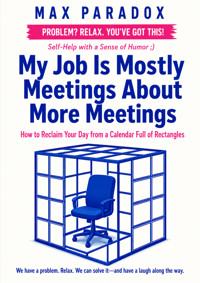
My Job Is Mostly Meetings About More Meetings - How to Reclaim Your Day from a Calendar Full of Rectangles ebook
Max Paradox
Uzyskaj dostęp do tej i ponad 240000 książek od 14,99 zł miesięcznie
- Wydawca: ALL-IN Rafał Płonkowski
- Kategoria: Biznes, rozwój, prawo•Biznes, rozwój
- Język: angielski
Your calendar is full.
Your work is not finished.
Somehow, both things are true.
You start the day with good intentions, open the document you actually need to finish, and immediately join a meeting to prepare for another meeting. Then comes the project sync, the stakeholder review, the status call, the “quick catch-up,” and a thirty-minute invitation with no agenda beyond the chilling phrase “touch base.”
By 5:00 p.m., you have been professionally busy for eight hours and still need two quiet hours to do your actual job.
My Job Is Mostly Meetings About More Meetings is a practical, funny guide to reclaiming your day without becoming the colleague who declines everything, disappears into “deep work,” and communicates exclusively through mysterious calendar blocks.
Max Paradox takes apart the everyday mechanics of meeting overload: why calendars fill so easily, why recurring meetings refuse to die, why everyone gets invited “for visibility,” why status updates turn into forty-five-minute performances, and why the easiest solution to workplace uncertainty is often another rectangle.
More importantly, the book shows you what to do instead.
You will learn how to identify which meetings genuinely deserve live time, how to replace routine reporting with clearer asynchronous communication, how to shorten meetings without simply talking faster, how to define decisions before inviting people, how to reduce attendance without creating political drama, and how to protect focused work when everyone else can see an empty space on your calendar and thinks, “Perfect.”
You will also get practical methods for handling the harder cases: a boss who loves meetings, mandatory corporate calls, global teams, overloaded weeks, project crises, recurring meetings that grew out of temporary problems, and colleagues who send “Got 15 mins?” with the confidence of people who do not know what happened to your previous fifteen minutes.
This is not an anti-meeting manifesto.
Meetings can be useful. Some are essential. A good twenty-minute conversation can save days of messages and confusion.
The problem is using meetings as the automatic solution to information, anxiety, unclear ownership, poor documentation, weak decisions, and the vague desire to “get everyone aligned.”
The goal is simple: enough coordination to keep work moving, enough uninterrupted time to actually do the work, and fewer afternoons that end with you wondering why you were extremely busy but produced nothing except notes from meetings about future meetings.
No guru routines.
No 4:30 a.m. wake-ups.
No complicated productivity system requiring seventeen tags and a dashboard.
Just practical changes you can begin with your next calendar invitation.
Because your calendar is supposed to support your job.
It is not supposed to become it.
This publication was prepared with the assistance of tools that support the creative process, including artificial intelligence-based solutions. The final concept, structure, and editing belong to the author.
Ebooka przeczytasz w aplikacjach Legimi na:
Liczba stron: 199
Rok wydania: 2026
Odsłuch ebooka (TTS) dostepny w abonamencie „ebooki+audiobooki bez limitu” w aplikacjach Legimi na:
Podobne



















INTRO
At 9:00 a.m., you join a meeting to prepare for the 11:00 a.m. meeting. The 11:00 a.m. meeting exists because yesterday’s meeting ended with the conclusion that “we should align separately.” At 1:30 p.m., there is a follow-up to clarify what was decided at 11:00, which is useful because nobody is entirely sure anything was decided. By 3:00, you are in a meeting called “Quick Sync,” a title that has the same relationship to reality as “light refreshments” at an airport hotel.
Somewhere between the fourth rectangle on your calendar and the fifth person saying, “I’ll give everyone five minutes back,” you remember that you technically have a job.
Not meetings. A job.
There are tasks attached to it. Work that requires concentration, judgment, writing, planning, analysis, designing, selling, building, fixing, deciding, or occasionally staring at a spreadsheet until it confesses. You would like to do this work. In fact, you may even be evaluated on whether you do it. Unfortunately, your calendar has been colonized by discussions about the work, updates on the work, preparation for the work, reviews of why the work is late, and one recurring meeting devoted to improving the process by which everyone discusses the work.
The work itself has been asked to wait in the lobby.
This is how a normal workday becomes a strange corporate escape room. You begin with eight hours. Someone takes thirty minutes for a team check-in. Another person needs forty-five minutes to “touch base.” A project requires an hour. Then comes a cross-functional sync, a stakeholder review, a status call, a planning session, and a meeting to make sure everyone is ready for the planning session. Lunch becomes something you eat while muted. The only open space on your calendar is 4:30 to 5:00, which is apparently when the human brain is expected to produce its finest strategic thinking.
Naturally, that is when someone sends, “Got 15 mins?”
The meeting problem is sneaky because meetings are not automatically bad. Some are necessary. Some save time. Some prevent expensive mistakes. Some allow five people to make a decision in twenty minutes instead of exchanging forty-seven emails, three spreadsheets, and a message that says, “Circling back on this.” A good meeting can be efficient, clarifying, even energizing.
The problem is that bad meetings wear the same clothes.
They have calendar invitations. They have agendas, sometimes. They contain serious-looking adults. They use respectable verbs like align, review, discuss, connect, socialize, cascade, ideate, and my personal favorite, workshop, which can mean anything from “make an important decision” to “stare at a slide while Greg explains a box.”
Because meetings look like work, they are difficult to challenge. If you spend six hours in calls, nobody can accuse you of doing nothing. You were extremely busy. Your webcam has evidence. You nodded thoughtfully at least eleven times. You said, “That makes sense,” even when it did not. You may have written down three action items, two of which are to attend more meetings.
Busy has been achieved.
Useful is still under investigation.
The deeper problem is not simply that there are too many meetings. It is that calendars gradually become default decision-making systems. Something feels important, so somebody schedules time. Something feels unclear, so somebody schedules time. Somebody wants visibility, so everybody schedules time. Nobody wants to make a decision alone, so twelve people are invited to witness the decision forming in captivity.
This creates a very expensive form of emotional reassurance.
A meeting can make us feel that progress is happening because people are present. But presence is not progress. Talking about a blocked project does not unblock it unless the conversation leads to a decision, an owner, a next step, or information that changes what someone does. Otherwise, it is just professionally formatted concern.
And concern has excellent calendar integration.
There is another reason the problem survives: refusing meetings feels socially dangerous. Decline too many and you worry you will look unhelpful, uninformed, disengaged, difficult, or mysteriously “not collaborative.” So you accept. Then you sit through forty-five minutes of material that could have been six bullet points because declining felt riskier than losing the time.
This book is not going to tell you to become the office hermit who answers every invitation with “No.” That would certainly clear your calendar, although possibly in the same way quitting clears your calendar. The goal is not fewer meetings at any cost. The goal is to recover control over your day without becoming the person everyone describes as “very efficient” immediately before adding “but exhausting.”
We are going to separate necessary meetings from habitual ones, identify why your calendar keeps reproducing like a confused family of rabbits, and build simple ways to reduce, shorten, combine, decline, redesign, or replace meetings. You will learn how to tell whether a meeting actually needs to exist, how to push for decisions instead of endless discussion, how to protect focus time without writing a manifesto, and how to escape recurring meetings that have outlived the project, the purpose, and possibly several employees.
You will also learn what to do when you are not the boss.
This matters because most meeting advice becomes suspiciously easy if you control everybody’s calendar. “Simply cancel all unnecessary meetings,” says the executive who can cancel all unnecessary meetings. Excellent. Next week: how to reduce traffic by owning the highway.
For normal people, the solution needs to work with managers, clients, colleagues, office politics, hybrid work, remote teams, and that one person who considers a twelve-minute voice note “more efficient.” You need methods that are practical enough to use on Tuesday, not principles that sound magnificent in a conference keynote and collapse when your boss sends a mandatory invite titled “Alignment on Alignment.”
We will start small. You do not need to delete half your calendar tomorrow. You do not need a new productivity system, a special planner, or an app that creates a dashboard showing how much time you spend looking at dashboards. You need to understand which meetings are costing you real work, which ones can be fixed, and which ones are basically ceremonial.
Then you need permission to act accordingly.
Not emotional permission from the universe. Practical permission from evidence, clear communication, and a better alternative.
By the end, the goal is not an empty calendar. An empty calendar is not the point unless your profession is lighthouse keeper. The goal is a calendar that reflects your actual priorities, contains meetings with a reason to exist, and leaves enough uninterrupted time for you to do the work everyone keeps meeting about.
Because if your entire job is discussing the work, eventually somebody may ask a deeply uncomfortable question.
Who is doing the work?
Wklejony tekst
Chapter 1 - Your Calendar Is Not Your Job
At 8:57 a.m., you open your laptop with a beautiful idea: today you will finally finish the thing.
You know the thing. The presentation that has been “almost done” for three days. The proposal waiting for actual thinking. The analysis nobody else can complete because the important part lives inside your head. You have coffee, a reasonable amount of optimism, and exactly three minutes before the first meeting.
At 9:00, the calendar takes over.
The first meeting is a team update. At 9:30, you have a project sync. At 10:00, somebody wants to review a document that nobody has read because everybody has been in meetings. At 11:00, there is a stakeholder call. At noon, lunch exists theoretically. At 12:30, someone has placed thirty minutes on your calendar to “pick your brain,” which sounds unpleasant but apparently remains legal.
By 2:00 p.m., you have been working for five hours and have done approximately seventeen minutes of the thing.
This is the first trap: a full calendar creates the emotional experience of a full workday.
You are tired. You have participated. You have spoken. You have listened. You have made decisions about fonts, timelines, responsibilities, next steps, previous steps, and whether another meeting should be scheduled. Your brain feels used. Your battery agrees. So when the real work is still sitting there at 4:45, it feels unfair.
Haven’t you already been working all day?
Yes.
That is precisely the problem.
Meetings are work, but they are not automatically the work that produces the result your job ultimately requires. A surgeon can spend all day discussing surgery and still, at some point, somebody may reasonably expect surgery to occur. A salesperson can spend six hours in internal calls and discover that customers remain surprisingly unmoved by the company’s excellent internal alignment.
Your job contains two broad categories of activity: coordination and production.
Coordination is everything that helps people understand, decide, sequence, inform, assign, review, or unblock. Meetings often live here. Production is the actual creation of the value your role exists to produce: writing, building, selling, designing, analyzing, negotiating, planning, solving, coding, preparing, deciding, or delivering.
You need both.
The trouble begins when coordination eats production and then schedules a meeting to discuss why production is behind.
This happens because coordination is easier to see. A meeting appears on a calendar. It has attendees. It starts and ends. Production often looks suspiciously like one person staring at a screen while occasionally deleting a sentence and muttering.
From the outside, meetings look active.
Thinking looks like you may be checking sports scores.
So calendars become accidental performance theater. If every hour is booked, you look needed. If two hours are blocked for focused work, somebody may view that space as available because you are apparently doing nothing more urgent than your actual job.
This is how work becomes something you do between work.
The first step is to stop treating your calendar as a neutral record of your day. It is not. Your calendar is a resource allocation system. Every rectangle is making a claim on your attention, energy, and output.
A sixty-minute meeting is not merely sixty minutes.
It may require preparation. It may leave you with follow-up work. It may break a ninety-minute concentration block into two useless fragments. It may force lunch later. It may turn a task requiring deep thought into something you attempt at 5:20 while your brain is already putting on its coat.
A meeting from 10:00 to 10:30 can quietly destroy the useful part of 9:30 to 11:00.
The calendar says thirty minutes.
Your nervous system has submitted a different invoice.
To see what is actually happening, do not begin by canceling anything. Begin by measuring.
For one normal workweek, look at your calendar and classify each meeting into one of four categories:
decision;
information;
collaboration;
habit.
A decision meeting exists because a decision genuinely needs several people at the same time. A collaboration meeting requires real-time interaction because people are solving, designing, negotiating, or working through something together. An information meeting exists mainly to transfer information. A habit meeting exists because the meeting existed last week and has developed tenancy rights.
This simple classification is more useful than asking, “Was the meeting important?”
Everything at work is important if described by the person who scheduled it.
The weekly update is important. The steering committee is important. The status sync is important. The pre-read review is important. Greg’s thirty-minute walkthrough of a spreadsheet he emailed yesterday is apparently part of national infrastructure.
Instead ask what function the meeting performs.
If ten people attend a meeting mostly to hear updates, you have identified an information transfer problem wearing business casual.
If six people gather because one person needs approval from one manager, you may have a decision-path problem.
If the same group meets every Tuesday at 10:00 with no clear output except surviving until 10:45, you have discovered habit.
Habit is especially dangerous because recurring meetings stop having to justify themselves. They were once created for a reason. The reason may have disappeared in March. The invitation remains, immortal and optimistic.
Recurring meetings are the office equivalent of a subscription you forgot to cancel.
Only more expensive.
Now calculate the cost in attention, not just time.
Suppose you have five hours of meetings in a day. That does not necessarily leave three productive hours. If the meetings are scattered at 9:00, 10:30, 1:00, 2:30, and 4:00, you may never get a long enough uninterrupted block to do demanding work properly.
Your day has been sliced into deli meat.
You can answer email in the gaps. You can update a tracker. You can move cells around in a spreadsheet and briefly feel powerful. But substantial work becomes harder because starting complex work has a setup cost. You need to remember where you were, reconstruct the problem, reopen files, recover concentration, and persuade your brain that no, we are not checking messages right now.
Then twenty-three minutes later, another rectangle arrives.
This is why protecting work time is not indulgent. It is operational.
Try a simple exercise. At the end of each day for one week, write down two numbers:
hours spent in meetings;
hours spent on your highest-value work.
Do not include email, Slack, administrative cleanup, or arranging future meetings unless one of those things is actually your highest-value responsibility.
The comparison may be uncomfortable.
Good.
Useful information often is.
If you discover that your calendar contains six hours of meetings and your core work receives forty-five minutes, you do not have a motivation problem. You have a structural problem.
This distinction matters because people often respond to structural problems with personal discipline.
They wake earlier.
They work later.
They answer emails during calls.
They skip lunch.
They listen to one meeting while writing something for another project, creating the exciting possibility of doing two things badly at once.
Multitasking then becomes an emergency adaptation to a calendar problem.
The employee starts wondering why concentration is poor, why work spills into evenings, and why every day feels rushed. The obvious explanation is ignored because it is sitting openly in Outlook wearing fifteen pastel rectangles.
Your calendar is not your job.
It is supposed to support your job.
That sentence sounds obvious until you compare it with how many workplaces actually operate.
A useful calendar should contain enough coordination to keep work moving and enough protected space for the work to happen. If one side consumes the other, the system is badly balanced.
So what should you do today?
Do not cancel seven meetings and announce a personal revolution. Revolutions create follow-up calls.
Instead, take next week’s calendar and mark the three largest blocks of time you need for actual production. Treat them as real commitments. Not vague hopes like “maybe I can work on this after the sync.” Put them on the calendar.
Call them something concrete if that helps:
“Proposal Draft” “Quarterly Analysis” “Client Strategy” “Project Build” “Research and Writing”
Avoid “Focus Time” if your organization interprets that as “Available, but currently being dramatic.”
Then inspect the meetings surrounding those blocks. Ask one question:
Does this meeting justify breaking the work block?
Not “Would it be nice to attend?”
Not “Could somebody theoretically say something useful?”
Not “Will people notice if I’m absent?”
Does it justify breaking the block?
If yes, keep it.
If not, you have found your first candidate for change.
The change may be small. Move the meeting. Ask for notes. Join only the part relevant to you. Request the decision afterward. Suggest an asynchronous update. Decline a recurring session once and see whether civilization continues.
Usually it does.
Plan B: if you have almost no control over your calendar, begin with one protected block of sixty to ninety minutes twice a week. That is enough to test the idea without requiring organizational reform. Put the hardest, highest-value work there. Turn off chat notifications. Do not spend the first twenty minutes reorganizing your task list.
The task list already knows it is beautiful.
Your minimum viable solution is even smaller: protect one uninterrupted hour this week and use it for the work that matters most.
Not email.
Not preparation for another meeting.
The work.
The goal is not to become anti-meeting. The goal is to remember that meetings are a tool. Tools are useful when they help produce something.
If the tool consumes the entire day, eventually you have to ask whether you are building anything or merely polishing the hammer.
Chapter 2 - Why Meetings Multiply
Nobody wakes up on Monday morning thinking, “You know what this organization needs? More meetings.”
And yet by Thursday, there are seven new ones.
This is one of the great mysteries of modern work. Meetings are widely complained about, routinely mocked, and somehow continue reproducing faster than anyone can decline them. Every company contains people who say, “We have too many meetings,” often while scheduling one to discuss the matter.
How does this happen?
Usually not because people are foolish. Usually because meetings solve several uncomfortable problems quickly, even when they create larger problems later.
The first uncomfortable problem is uncertainty.
Imagine a project is drifting. Nobody is completely sure who owns the next decision. The deadline is approaching. Two teams have different assumptions. Information is scattered across email, chat, documents, and the memory of someone currently on vacation.
What is the easiest response?
Schedule a meeting.
Suddenly, the uncertainty feels contained. It now has a date, a time, and a Teams link.
Nothing may actually be solved yet, but emotionally, the problem has been upgraded from “chaos” to “Wednesday at 2:00.”
That feels like progress.
The second problem is responsibility.
Making a decision alone can feel risky. If the decision turns out badly, your name is attached to it. But if nine people attended a meeting, the decision becomes wonderfully communal. Everybody was there. Everybody nodded. Nobody remembers who actually said yes.
Responsibility has been converted into mist.
This is one reason simple decisions attract large audiences. A manager who needs one opinion invites six people “for visibility.” Those six invite two more people because the topic “might affect them.” Soon fourteen adults are spending forty minutes deciding whether the launch should happen on Tuesday or Wednesday.
Total labor consumed: more than nine hours.
Decision achieved: Wednesday.
Excellent efficiency.
The third cause is social insurance.
People invite others because excluding them feels dangerous. What if they need to know? What if they feel left out? What if later they say, “Why wasn’t I included?”
So the invitation list expands.
This produces a common meeting species: the person who has no role in the conversation but has been invited to prevent a future complaint. They sit quietly, camera off, processing email. They are not participating in the meeting. They are being stored there.
Some organizations call this transparency.
It is actually human cloud storage.
The fourth cause is poor written communication.
Writing a clear update takes effort. You have to decide what matters, organize it, explain the context, and possibly reveal that the situation is not as complicated as everyone has been pretending.
Talking is easier.
You can open a meeting and say, “Maybe I’ll just walk everyone through it.”
Forty minutes later, six people have heard what could have been a well-written paragraph.
This does not mean every spoken explanation should become an email. Complex issues benefit from conversation. Emotionally sensitive topics benefit from nuance. Negotiation often works better live. Brainstorming can improve when people react in real time.
But a recurring status meeting where each person reads information that already exists elsewhere is not collaboration.
It is an audiobook with payroll.
The fifth cause is managerial visibility.
Managers need to know what is happening. This is reasonable. Unfortunately, one of the easiest ways to obtain visibility is to gather everyone into a call and ask them to report.
Monday update.
Wednesday checkpoint.
Friday wrap-up.
Soon employees spend a surprising portion of the week explaining what they are doing instead of doing it.
The manager feels informed.
The employees feel observed.
The project feels hungry.
The problem is not visibility itself. The problem is using synchronous time as the default mechanism for visibility.
If the information can be standardized, written down, displayed in a shared dashboard, or updated asynchronously, the meeting may not need to exist. Or it may need to exist less often. Or it may need only the people who are actually resolving exceptions.
This brings us to the sixth cause: no one owns meeting hygiene.
Most organizations have rules for spending money.
Want to buy a laptop? Approval.
Want to hire someone? Approval.
Want to send twelve people into a recurring one-hour meeting every week for a year?
Please click “Send.”
Nobody calculates the cost because no invoice arrives.
But the cost is real.
Take a one-hour weekly meeting with ten people. Over forty-eight working weeks, that is 480 person-hours. Add preparation and follow-up, and you can easily move past 600.
That is several months of full-time work.
For one recurring rectangle.
This does not mean you should start calculating salary cost during every call and shouting, “THIS DISCUSSION HAS NOW COST $873.”
That will make people avoid meetings with you for reasons unrelated to productivity.
But you should start thinking about meetings as investments. They consume collective attention, and collective attention is expensive.
An investment needs a return.
A decision.
A solved problem.
A coordinated plan.
A piece of work improved by real-time collaboration.
A conflict resolved.
A blockage removed.
Information whose discussion genuinely matters.
If the return is simply “everyone heard the update,” there may be a cheaper method.
Now look at your own behavior, because the meeting problem is always easier when all unnecessary meetings are scheduled by other people.
Unfortunately, you may be contributing too.
Do you schedule a call when you feel uncertain?
Do you invite extra people “just in case”?
Do you create recurring meetings because scheduling one every time feels inconvenient?
Do you ask for a meeting when a written question would do?
Do you attend because declining feels awkward?
Do you stay for the full hour even after your part is finished?
Most people do some version of this.
That is good news.
It means you do not need permission from the entire organization to begin improving things.
Start with the meetings you create.
For the next two weeks, before scheduling anything, answer three questions:
What must be true when this meeting ends?
Why does this require people to be present at the same time?
Who must actually be there for that outcome?
If you cannot answer the first question, the meeting is not ready.
If you cannot answer the second, try an asynchronous method first.
If you cannot answer the third, your guest list is probably experiencing inflation.
“What must be true when this meeting ends?” is especially powerful because it forces a meeting to have an outcome.
Compare:
“We need to discuss the budget.”
with:
“We need to decide which two initiatives remain in the budget.”
The first invites wandering.
The second points toward a finish line.
Compare:
“Let’s sync on the launch.”
with:
“By the end, we need confirmed owners for the three launch risks.”
Now people know why they are there.
A meeting with no defined outcome behaves like a road trip with no destination. It can continue for a surprisingly long time while everyone insists they are making progress.
Next, question recurring meetings.
A recurring invitation should not be a lifetime appointment.
Add an expiration point.
Instead of creating a weekly meeting “ongoing,” create six sessions and review whether it still needs to exist. If your calendar system allows an end date, use one.
Projects change.
Teams change.
Problems disappear.
Meetings, left unsupervised, do not.
They continue every Thursday at 10:00 like a small administrative ghost.
If you already own recurring meetings, pick one and ask the group:
“What would we lose if we stopped this for a month?”
Not, “Does everyone still find this useful?”
People are polite. They will say yes while internally drafting escape plans.
Ask what would actually be lost.
If the answer is vague, cancel one session.
That is the experiment.
You are not abolishing communication. You are testing whether the meeting is carrying its weight.