


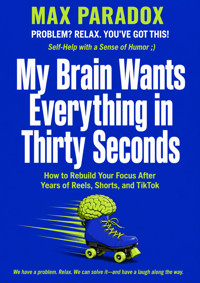
My Brain Wants Everything in Thirty Seconds - How to Rebuild Your Focus After Years of Reels, Shorts, and TikTok ebook
Max Paradox
Uzyskaj dostęp do tej i ponad 240000 książek od 14,99 zł miesięcznie
- Wydawca: ALL-IN Rafał Płonkowski
- Kategoria: Biznes, rozwój, prawo•Biznes, rozwój
- Język: angielski
You sit down to answer one email. A few minutes later, you are watching a stranger restore a rusty knife, checking whether your package moved three states east, and wondering why you opened your laptop in the first place.
If that feels familiar, your brain is not broken. It has simply become very good at the rhythm you have been practicing: swipe, switch, check, repeat.
My Brain Wants Everything in Thirty Seconds is a practical and genuinely funny guide to rebuilding your ability to focus after years of Reels, Shorts, TikTok, notifications, second screens, infinite feeds, and the increasingly suspicious belief that a nine-minute video is “too long.”
Max Paradox skips the motivational speeches and goes directly to what actually helps. You will learn why slower tasks can start feeling painfully boring after constant high-speed stimulation, why deleting one app rarely fixes the entire problem, and how everyday habits quietly train your brain to abandon anything that does not reward you immediately.
More importantly, you will learn what to do about it.
Inside, you will discover how to:
rebuild focus in realistic ten-, fifteen-, and twenty-minute blocks;
tolerate boredom without treating every empty second as an emergency;
reduce automatic switching without throwing your phone into a lake;
redesign your phone so distraction becomes slightly less convenient;
read books and long articles again without checking something every two pages;
take breaks that actually help you return to work;
stop obeying every urge to check messages, news, feeds, and random questions;
recover on tired, chaotic, low-focus days;
restart quickly when old scrolling habits return;
create a simple attention system that survives real life.
There is no requirement to wake at 5:00 a.m., meditate beneath a waterfall, delete the internet, or become the sort of person who uses the phrase “cognitive optimization” at dinner.
You can keep the memes.
You can keep short videos.
You can even keep the completely unnecessary online research into whether raccoons recognize individual humans.
The goal is choice.
To work when you intend to work. Read when you want to read. Watch entertainment because you chose it. Listen to another person without your phone winning the conversation. And stay with worthwhile things long enough for them to become interesting.
Your brain wants everything in thirty seconds.
This book will teach it that some good things take thirty-one.
This publication was prepared with the assistance of tools that support the creative process, including artificial intelligence-based solutions. The final concept, structure, and editing belong to the author.
Ebooka przeczytasz w aplikacjach Legimi na:
Liczba stron: 203
Rok wydania: 2026
Odsłuch ebooka (TTS) dostepny w abonamencie „ebooki+audiobooki bez limitu” w aplikacjach Legimi na:
Podobne
















INTRO
You sit down to watch one short video. Not because you’re avoiding anything. Obviously. You’re just giving your brain a tiny break before doing something useful. Thirty seconds later, a golden retriever is wearing sunglasses. Twenty seconds after that, someone is renovating a kitchen you do not own. Then a man explains three signs your coworker secretly hates you, a woman folds a fitted sheet with the confidence of a military commander, and someone in Arizona is making a sandwich large enough to require zoning approval.
You look up. Forty-seven minutes have passed. This would be less impressive if you had intended to spend forty-seven minutes doing something. But you didn’t. You intended to watch one video. Your thumb simply continued operating under emergency powers.
Later, you try to read an article. The first paragraph is six sentences long, which now feels suspiciously ambitious. You skim, jump ahead, check how much is left, and open another tab because the article mentions a person you vaguely recognize. That tab leads to a video. The video is nine minutes long, which is apparently a documentary now, so you speed it up to 1.5×. At some point you realize something uncomfortable: your brain has started acting like every piece of information should arrive with subtitles, quick cuts, background music, and a payoff before you have time to adjust your posture.
This does not mean you have become stupid, and it does not mean your attention span has been permanently destroyed by one too many videos titled “Wait for it.” Your brain is doing what brains do: adapting to what you repeatedly ask of it. If you spend hours moving through fast, high-novelty content, you get very good at moving through fast, high-novelty content. Then you open a 14-page report at work and your brain reacts as if you have handed it a shovel and announced that together you will now dig a canal.
“Fourteen pages? Without music? Can we at least swipe?”
No. Apparently this workplace has standards.
The problem is not that short-form video exists. Reels, Shorts, and TikTok are not evil little rectangles plotting against your career. They are extremely efficient entertainment systems built around speed, novelty, and low friction. The trouble begins when that rhythm quietly becomes your default rhythm for everything else. A book feels slow. A meeting feels unbearable after twelve minutes. A movie has “too much setup.” A long email looks hostile. You pick up your phone during a conversation because your friend has been explaining one topic for nearly a full minute without introducing a plot twist.
Even boredom changes. It used to be an empty moment: standing in line, waiting for coffee, sitting in a parked car before going inside. Now an empty eight seconds can feel like a technical malfunction that must be repaired immediately with content. Elevator? Phone. Bathroom? Phone. Microwave running for ninety seconds? Apparently we need entertainment.
You can no longer heat soup without checking what a stranger thinks about airport lounges.
None of this makes you weak. But it creates a practical problem: the parts of life that matter often require staying with something after the first burst of stimulation disappears. Learning. Reading. Writing. Planning. Listening. Solving a complicated problem. Finishing the boring middle of a task. Having a conversation that does not come with a progress bar. Focus is not the ability to feel fascinated for six hours. That would be convenient, but so would having a personal chef and knees that never make noises. Focus is the ability to remain with something long enough for your mind to get past the “this is not instantly rewarding” phase.
That ability can get rusty.
Rusty is not gone.
This book is about rebuilding it without turning your life into a digital monastery. You do not need to throw your phone into a lake, delete every app, buy a $300 notebook, wake up at 5:00 a.m., or begin referring to yourself as someone who is “protecting their cognitive bandwidth.” You can keep your phone. You can keep TikTok. You can even keep the videos where someone cleans a rug so dirty that the first half appears to be about archaeology. The goal is not to become a person who never wants quick entertainment. The goal is to stop needing quick entertainment every time reality takes more than thirty seconds to become interesting.
We will work on what actually matters: reducing unnecessary stimulation without making your life miserable, rebuilding tolerance for slower tasks, making distraction harder at the moments when it matters, and training your attention in realistic doses. We will also deal with the usual rescue attempts: the dramatic digital detox that lasts eleven hours, the productivity system with seventeen rules, the app blocker you disable because you are “just checking one thing,” and the heroic plan to read fifty pages every night when you currently get restless halfway through a restaurant menu.
You do not need a heroic plan. You need a repeatable one.
The most important idea is simple: attention responds to practice. If you repeatedly practice switching, you become very practiced at switching. If you repeatedly practice staying, staying becomes easier too. You do not have to make the second practice impressive. You just have to make it regular enough that your brain stops treating five uninterrupted minutes as a hostage situation.
At first, you may sit down to read and feel an urge to check your phone after ninety seconds. Good. Not pleasant, but useful. That urge is not proof that you cannot focus. It is the moment when focus training actually begins. Before the urge, you were just reading. After the urge, you are practicing staying. And no, you do not need to win every time.
If your current attention has the structural integrity of wet toast, we are not going to begin by asking it to support a cathedral. Ten focused minutes can be useful. Five can be useful. Even noticing that you reached for your phone without deciding to is useful, because automatic behavior becomes easier to change once it stops being invisible. The smallest effective version counts. Especially on the days when your energy level is approximately potato.
The plan is not to shame yourself for what happened to your attention. Shame is a terrible productivity tool. It mostly produces guilt, avoidance, and extremely committed research into whether you should buy a different desk lamp. The plan is to understand the pattern, change the environment, practice the missing skill, and make the better behavior easier to repeat.
You will not leave this book with the attention span of a medieval monk copying manuscripts by candlelight. You probably do not want that. He had focus, yes, but very poor Wi-Fi. You will leave with something more useful: a way to read longer without immediately escaping, work without checking five unrelated things, tolerate boredom without treating it as a medical emergency, and use short-form content because you chose to—not because your thumb filed the paperwork while you were mentally absent.
Your brain wants everything in thirty seconds.
Fine.
We are going to teach it that some good things take thirty-one.
Chapter 1 - You Didn’t Lose Your Focus Overnight
You open your laptop to answer one email. The email contains a link, so naturally you click it. The link opens a document, and while the document loads, you glance at your phone because apparently three seconds of loading time now qualifies as an extended wilderness experience.
There is a notification. You check it. Nothing urgent.
Then another app has a red badge.
You do not like red badges.
Nobody likes red badges. They sit there like tiny administrative threats.
You clear that one too, notice a message, reply to the message, see a short video someone sent you, watch it, and because the app has generously prepared another video beneath it, you watch that as well. Seven minutes later you return to the laptop and stare at the original email with the quiet confusion of someone arriving at the scene of an accident.
What was I doing?
This is usually the point where people announce that their attention span is terrible.
Sometimes they say it with the solemnity of a medical diagnosis.
“I just can’t focus anymore.”
Maybe. But before declaring your attention officially deceased, it helps to notice what actually happened. You did not sit still for ten minutes and discover that your mind was biologically incapable of concentrating. You attempted to focus inside an environment containing a laptop, a phone, multiple apps, alerts, links, messages, browser tabs, infinite feeds, and several companies whose business model improves when you do literally anything except finish that email.
This distinction matters.
If you believe the problem is “I have no attention span,” the solution sounds enormous. You need to fix your brain. Become disciplined. Transform your personality. Purchase a productivity book thick enough to qualify as furniture.
If the problem is partly “I have trained myself to interrupt nearly everything,” the solution becomes much more practical.
You need to interrupt less.
Not never.
Less.
Attention Is Not One Thing
We talk about focus as if the brain contains a single internal flashlight marked FOCUS, and yours has weak batteries. Real attention is messier. You can concentrate brilliantly on one thing and terribly on another.
Give someone a spreadsheet containing insurance renewals and they may develop an urgent need to clean the dishwasher filter.
Give the same person a conspiracy documentary at 11:40 p.m. and suddenly they possess the concentration of an air traffic controller.
This is why “I can’t focus” is often too broad to be useful. Usually the real sentence is closer to:
“I struggle to stay with tasks that are slower, harder, less novel, or less immediately rewarding when faster alternatives are available.”
That is a much less dramatic sentence.
It is also far more helpful.
Short-form feeds provide a remarkable combination: something new arrives constantly, the cost of moving on is almost zero, and you never have to remain with something after your interest drops. If a video is boring after two seconds, swipe. If the next person annoys you, swipe. If you have already understood the point, swipe. If you have not understood the point, there is still a respectable chance you will swipe.
Your thumb has developed editorial authority.
Traditional activities do not work this way. A book can have a slow paragraph. A work task can remain unpleasant for fifteen consecutive minutes. A conversation may contain a story whose destination is not immediately clear. Learning a skill includes moments when you are confused and nothing entertaining happens.
You cannot swipe the middle of learning to receive a more exciting middle.
Unfortunately.
What repeated short-form use can change is not some magical permanent “attention span number.” It can strengthen habits and expectations around stimulation. You get used to fast transitions. You get used to frequent novelty. You get used to escaping quickly when interest falls.
Then slower activities feel unusually slow by comparison.
Imagine eating intensely flavored snack food all afternoon and then biting into a plain cucumber.
The cucumber has not changed.
Your afternoon has.
This is one reason ordinary tasks can begin to feel strangely underpowered. Reading ten pages is not objectively more boring than it used to be. But if the ten pages arrive immediately after twenty minutes of rapid jokes, arguments, transformations, recipes, scandals, cute animals, celebrity clips, and a man restoring a rusty knife from 1894, the book has a difficult opening act to follow.
Page one clears its throat.
Your brain asks where the knife went.
The Hidden Training Session
Every time you use a feed, you are not deliberately “training your attention.” You are probably trying to relax, procrastinate, avoid standing up, or discover whether someone can build a swimming pool out of shipping containers.
But repeated behavior teaches patterns anyway.
Suppose your normal evening looks like this: watch television, check phone, return to television, reply to message, return to television, look up actor, accidentally read interview with actor, see related clip, return to television, realize you missed important dialogue, rewind television, check phone while rewinding.
You are technically consuming one movie.
Operationally, you are running a small media company.
The brain gets a great deal of practice switching. It gets less practice staying. Then we become surprised that staying feels difficult.
This does not mean you have damaged yourself beyond repair. Skills and habits adapt in both directions. A person who has become accustomed to constant switching can gradually become more comfortable with continuity again.
But first you need to stop misidentifying discomfort as incapacity.
That difference is enormous.
When you sit with a slow task and suddenly want to check something, you may interpret that sensation as:
“I cannot concentrate.”
A more accurate translation may be:
“I want more stimulation.”
Those are not the same statement.
The first sounds like a limitation.
The second is an urge.
Urges can be noticed without automatically obeying them.
You already do this in other areas of life. You may want to leave a meeting, but you remain because standing up and announcing “I have absorbed enough of this project update” would affect your professional development.
You may want another cookie and choose not to have one.
You may want to correct someone on the internet and occasionally, in a magnificent display of human maturity, continue with your day.
Attention works partly through the same ordinary ability: noticing an impulse without converting it immediately into behavior.
The First Mistake: Testing Yourself in the Worst Possible Conditions
People often test their focus like this: phone beside them, notifications active, browser open, music playing, chat application blinking, and twenty-three tabs waiting overhead like anxious pigeons.
Then they try to read something difficult.
Three minutes later:
“See? My brain is ruined.”
That is not a fair test.
That is like checking whether you can eat healthily while sitting inside a bakery holding a warm cinnamon roll.
Environment matters because attention has a cost. Every visible possibility can become a tiny decision: check or not check? Open or not open? Reply now or later? Click the headline or stay with the task?
Even when you resist, you are repeatedly negotiating.
A better first test is deliberately boring:
Put the phone somewhere you cannot reach without standing up.
Close everything on the computer that the task does not require.
Choose one specific activity.
Set a timer for ten minutes.
When the urge to switch appears, notice it and continue unless there is a genuine reason to stop.
Ten minutes.
Not ninety.
We are gathering evidence, not auditioning for a monastery.
During those ten minutes, your mind may still wander. That is normal. The goal is not to maintain flawless concentration with the emotional stability of a marble statue. The goal is simply to reduce external switching long enough to see what happens.
You may discover that you can focus better than expected once five alternative forms of stimulation are not sitting within six inches of your hand.
This is excellent news because rearranging six inches is easier than rebuilding your personality.
The Second Mistake: Confusing Interest with Focus
Another common misunderstanding appears when someone says, “But I can focus for two hours on things I like.”
Good.
That tells us the machinery works.
The difficulty is not necessarily producing attention. It is directing attention when the task does not constantly reward you for remaining there.
This is especially obvious in work. You might spend forty minutes comparing hotel rooms for a vacation and then struggle with a twelve-minute expense report. Both involve reading, evaluating information, clicking, and making decisions.
Only one contains infinity pools.
Your brain has noticed.
Useful focus must work even when the activity does not continuously entertain you. Not perfectly. Not indefinitely. Just enough to finish necessary things without requiring a small orchestra and three motivational speeches.
This is why the solution cannot be “make everything interesting.” Sometimes the report is the report. The laundry is the laundry. Chapter four of the textbook does not become thrilling because you use a prettier highlighter.
At some point, attention requires tolerating a temporary reduction in stimulation.
That tolerance is trainable.
The Third Mistake: Waiting to Feel Ready
You decide that tomorrow you will focus properly.
Tomorrow arrives.
You are tired.
So perhaps Monday.
Monday arrives with emails.
Next week, then.
This is how people accidentally turn concentration into a ceremonial event that requires ideal weather, strong coffee, a clear calendar, emotional stability, and the blessing of several minor gods.
The problem is that focus gets stronger through ordinary repetitions, not occasional heroic performances.
You do not need to feel unusually motivated before practicing ten minutes of uninterrupted attention. In fact, waiting for motivation teaches you exactly the wrong lesson: “I can only stay with something when staying feels easy.”
We want the opposite lesson.
“I can stay a little longer even when switching would feel nicer.”
That is the beginning.
Run a Focus Audit, Not a Character Assassination
For one day, do not try to become more disciplined. Just notice when you switch.
You are looking for patterns, not evidence for the prosecution.
Pay attention to three things:
What were you doing before you switched? Reading? Working? Watching something? Talking to someone? Waiting?
What triggered the switch? A notification? Boredom? Difficulty? A thought? Seeing the phone? Habit?
Where did you go? Messages? Short video? Email? News? Search? Another work task that conveniently felt more urgent?
Do not count every microscopic movement. You are not conducting a government census of your thumbs. Look for recurring situations.
You may discover, for example, that you rarely interrupt enjoyable tasks but almost always interrupt work when you reach uncertainty. Or you may check your phone whenever a page loads, whenever someone leaves the room, or whenever you finish one small step and have not yet chosen the next one.
That tells you where the habit lives.
And habits are easier to change when you know their address.
Instead of “My Focus Is Broken”
Try a more specific diagnosis.
Instead of:
“I have no attention span.”
Use:
“I switch too quickly when a task gets slow.”
Or:
“I have made my phone the automatic response to boredom.”
Or:
“I keep difficult work next to extremely easy entertainment.”
Or:
“I have trained myself to fill every pause.”
Specific problems create specific solutions.
If your phone is the automatic response to boredom, we will change what happens during boredom.
If uncertainty triggers escape, we will make the next action clearer.
If visible distractions are the problem, we will change the environment.
If short-form entertainment has become your default break, we will build breaks that do not immediately turn into forty-minute expeditions through other people’s kitchens.
This is far more promising than standing in the middle of the problem announcing:
“My brain is bad.”
Your brain would like to file an appeal.
Today’s Minimum Version
Do one ten-minute focus test.
Pick a mildly demanding activity: read, write, study, review a document, organize something, or complete one work task. Put the phone out of reach. Close unrelated windows. Stay with the activity for ten minutes.
If the urge to switch comes, do not fight it dramatically.
Just notice:
“There it is.”
Then continue.
If you make it ten minutes, good.
If you make it four before switching, also useful. You now have a baseline.
The point of Chapter 1 is not to prove that your attention is excellent. It is to replace a vague, hopeless diagnosis with something workable.
You probably did not lose your focus overnight.
You practiced interrupting it.
Now we can practice something else.
Chapter 2 - Your Brain Has Learned to Switch
You are reading a message when an email arrives.
You open the email because it might be important.
It is not.
While closing it, you notice another email whose subject line contains the word “urgent,” a term that in modern office culture can mean anything from “the building is on fire” to “please review this spreadsheet before Thursday.”
You open that.
Halfway through, you remember the original message.
You return to the message, begin replying, then wonder whether you have already answered a related question in another conversation. You search for it, find a completely different thread, see something you forgot to do, open your calendar, and twenty minutes later discover five half-started activities sitting around your screen.
Nothing is finished.
But everything has been visited.
Welcome to switching.
Switching feels productive because there is movement. Windows open. Messages disappear. Tabs appear. Your fingers remain active. At no point are you lying on the floor staring at the ceiling.
Therefore, surely, work is occurring.
Not necessarily.
A person can spend an entire morning professionally rearranging unfinished thoughts.
Switching Has a Price
When you move from one task to another, the brain does not always change context cleanly. Some part of the previous task can remain mentally active while you attempt to enter the next one. Then you switch again before fully settling there.
The result is familiar: you are technically doing Task C while still thinking about Task B and trying to remember what happened to Task A.
Your mental workspace starts resembling a kitchen in which six people have begun recipes and nobody remembers who turned on the oven.
This is why frequent switching can make a day feel both busy and strangely unproductive. You perform many beginnings. Beginnings produce visible activity. Finishing requires remaining long enough for the less exciting middle.
Short-form content intensifies this habit because switching there is not a side effect. It is the basic action.
Next.
Next.
Next.
A different face. Different topic. Different emotion. Different sound. Different visual. The subject can move from relationship advice to geopolitics to cake decoration in under forty seconds, which is an educational model previously available only during a severe fever.
Your brain becomes familiar with rapid context change.
Then, later, it encounters something requiring continuity.
A thirty-minute task.
One topic.
Same document.
Same person.
No soundtrack.
And the brain quietly reaches for the eject button.
Novelty Is Extremely Persuasive
Human attention naturally responds to change. Something new may matter. A movement in the bushes deserves more attention than the same unmoving bush. A new sound can be important. An unexpected message might contain useful information.
Modern feeds take that perfectly normal preference for novelty and offer novelty on industrial scale.
You do not have to search for something new.
Something new reports for duty every second.
This creates a practical imbalance. The task in front of you may offer one meaningful result after twenty minutes. Your phone can offer twenty small changes in twenty seconds.
The report says:
“Stay with me. Eventually we will understand regional sales performance.”
The phone says:
“Would you like to see a raccoon stealing cat food?”
The sales report never had a chance.
But here is the important part: novelty preference does not mean you must obey every novelty opportunity. The mistake is not enjoying new stimulation. The mistake is surrounding every slow task with immediate access to faster alternatives and then expecting willpower to win hundreds of tiny negotiations.
That is exhausting.
We need fewer negotiations.
Stop Calling Everything a Break
You work for twelve minutes and feel restless.
“Quick break.”
You open TikTok.
This sounds reasonable because breaks are good. Unfortunately, not everything that interrupts work restores your ability to work.
Sometimes the “break” is simply a more stimulating activity.
After ten minutes of fast videos, returning to a slow spreadsheet can feel harder, not easier. The contrast has increased. You have gone from fireworks back to conditional formatting.
This is why some breaks refresh you and others make the original task feel even less attractive.
A useful break lowers demand without creating a huge stimulation gap.
Examples:
stand up and stretch;
make coffee or tea without taking the phone;
walk to another room;
look outside;
refill water;
spend a few minutes doing nothing in particular;
take a short walk.
I know.
Absolutely electrifying.
Nobody is going to create a highlight reel called “Man Refills Water and Looks Through Window.”
That is partly the point.
A low-stimulation break allows your brain to stop working without instantly starting another high-intensity stream of information. It is rest, not entertainment wearing a fake mustache.
The Two-Minute Escape
One of the most useful things you can notice is the moment immediately before switching.
There is often a small discomfort.





