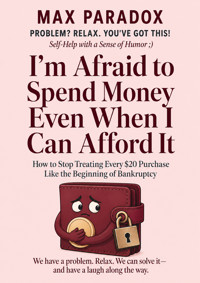
I'm Afraid to Spend Money Even When I Can Afford It - How to Stop Treating Every $20 Purchase Like the Beginning of Bankruptcy ebook
Max Paradox
Uzyskaj dostęp do tej i ponad 240000 książek od 14,99 zł miesięcznie
- Wydawca: ALL-IN Rafał Płonkowski
- Kategoria: Biznes, rozwój, prawo•Biznes, rozwój
- Język: angielski
You have money in the bank. Your bills are paid. You can afford the purchase.
So why does spending $20 feel like the first scene of a documentary called How I Lost Everything?
I'm Afraid to Spend Money Even When I Can Afford It is a practical, funny guide for people who are responsible with money but have somehow become so responsible that buying a sweater, booking a trip, replacing a worn-out item, or ordering dinner can trigger a full internal audit.
Max Paradox explores what happens when sensible caution turns into spending anxiety: every purchase feels like a loss, saving becomes a moral score, the cheapest option always seems safest, and the future is allowed to invent unlimited emergencies to defeat anything you might enjoy today.
This is not a book about spending more for the sake of it. It will not tell you to “treat yourself,” manifest abundance, or celebrate every credit-card transaction like a personal breakthrough. The goal is much more useful: to build a system that tells you when spending is genuinely safe, worthwhile, and consistent with your priorities.
Inside, you will learn how to:
separate actual financial risk from emotional discomfort;
create a clear safe-to-spend number;
stop using guilt as evidence that a purchase was wrong;
define emergency savings so “what if something happens?” has an answer;
decide which purchases deserve research-and when to stop researching;
use waiting periods without postponing purchases forever;
identify where paying more for quality or convenience makes sense;
handle expensive purchases with a repeatable process;
deal with partners, family, friends, and social pressure around money;
recover from overspending or financial setbacks without imposing a personal spending prison;
recognize which expenses genuinely improve your life;
stop treating responsible spending like a personality test.
Along the way, you will meet dying frying pans, suspiciously expensive sandwiches, fantasy-self purchases, heroic sale prices, emergency funds that refuse to be used, and enough browser tabs to qualify as a part-time research career.
The aim is not to make you careless with money.
It is to make you calm enough to use it.
Because money should protect your future without making your present feel permanently unauthorized.
If you already know how to save but still struggle to spend, this book will help you stop asking for emotional permission every time money leaves your account-and start making decisions based on facts, priorities, and value instead.
Your future matters.
So does the person living today.
This publication was prepared with the assistance of tools that support the creative process, including artificial intelligence-based solutions. The final concept, structure, and editing belong to the author.
Ebooka przeczytasz w aplikacjach Legimi na:
Liczba stron: 205
Rok wydania: 2026
Odsłuch ebooka (TTS) dostepny w abonamencie „ebooki+audiobooki bez limitu” w aplikacjach Legimi na:
Podobne
















INTRO
You are standing in a store holding a perfectly ordinary twenty-dollar item.
Maybe it is a shirt. Maybe it is a kitchen gadget that would save you from attacking onions with a knife like a contestant on a low-budget survival show. Maybe it is a book, a nicer bottle of shampoo, a dinner out, or the replacement charger you have needed for three months because your current one only works when bent at an angle normally associated with orthopedic emergencies.
You can afford it.
Your rent is paid. The bills are covered. You have savings. Buying this thing will not cause the bank to send a tactical unit to your home. Nobody from the Federal Reserve is monitoring the purchase. Your financial future will not collapse because you ordered Thai food on a Wednesday.
And yet your brain reacts as if you have just proposed buying a private island with borrowed money.
“Twenty dollars?”
Yes.
“Twenty whole dollars?”
Still yes.
“Do you understand what twenty dollars could become if invested for forty-seven years at a hypothetical rate of return?”
You are trying to buy socks.
This is where being careful with money stops being useful and starts wearing a fake mustache. Caution can be smart. Saving can be smart. Comparing prices can be smart. But when every nonessential purchase triggers guilt, fear, mental arithmetic, and a small internal hearing before the Supreme Court of Personal Finance, the problem is no longer simply that you “care about money.”
The problem is that spending has started to feel unsafe even when it is objectively manageable.
That creates a strange life. You may have money in the bank but behave as if you are one coffee away from financial ruin. You may spend forty minutes comparing two products that differ by four dollars, then feel exhausted enough to order takeout because decision fatigue has beaten you with a folding chair. You may delay replacing something broken, avoid experiences you would genuinely enjoy, or feel guilty after buying something you planned and could easily afford.
The purchase is over.
The trial begins.
You replay the decision. Did you really need it? Could you have found it cheaper? What if something happens next month? What if the car breaks? What if the roof leaks? What if the economy collapses, the refrigerator dies, and your dentist suddenly discovers a tooth that costs exactly $8,700?
Your brain does not need a realistic emergency. It is happy with a trailer for one.
This book is not going to tell you to “just enjoy life” and start spending with the relaxed confidence of a celebrity who has never opened a utility bill. It is also not going to tell you that every hesitation around money is irrational. Sometimes not buying something is exactly the right decision. Sometimes your budget really is tight. Sometimes the annoying voice saying, “Maybe not today,” is the only adult currently on duty.
The goal is not to turn you into a reckless spender.
The goal is to stop treating ordinary, affordable spending like evidence of moral failure.
That distinction matters, because many people who fear spending are actually quite responsible. They save. They think ahead. They avoid debt. They research purchases. On paper, this looks excellent. The problem begins when responsibility quietly expands into hypervigilance: every dollar must justify its existence, every purchase must prove maximum efficiency, and every bit of enjoyment requires a financial defense attorney.
You start asking the wrong question.
Not: “Can I afford this?”
But: “Can I prove beyond all reasonable doubt that buying this is the mathematically optimal use of money?”
Good luck with that.
Money has more than one job. Yes, it protects you. It pays bills, absorbs emergencies, creates options, and gives future you a softer landing. But money also supports present life. It buys convenience, comfort, time, experiences, replacements, little pleasures, and occasionally a sandwich that costs more than making one at home because you are outside and do not carry a portable kitchen in your backpack.
If money only feels successful when it remains untouched, you can become very good at accumulating security while becoming increasingly bad at using that security.
That does not mean you should spend because “you deserve it.” That phrase has financed enough questionable purchases already. It means you need a better system than fear.
Fear is a terrible budgeting app. It has no categories, no useful reports, and every notification says, “WHAT IF SOMETHING HAPPENS?”
A functional spending system should tell you, before the purchase, what is safe to spend, what needs more thought, and what should wait. It should reduce the number of decisions you re-litigate afterward. It should make room for future goals without requiring present-day life to operate like a monastery with free Wi-Fi.
That is what we are going to build.
We will look at why affordable purchases can still feel dangerous, how past financial stress can keep influencing present decisions, why guilt is not the same thing as financial wisdom, and how “being good with money” can become an identity trap. We will also separate useful caution from anxiety-driven restriction, because those two can look almost identical from across the room.
More importantly, we will get practical.
You will learn how to define a safe spending zone, create rules for everyday purchases, decide when comparison shopping is useful and when it becomes a part-time job, use waiting periods without turning them into permanent exile, and recover from a purchase you regret without declaring yourself financially unfit for civilization.
We will also deal with the annoying cases: irregular income, expensive months, surprise bills, family attitudes about money, partners who spend differently, and the moment when your carefully designed system meets real life and real life says, “Cute spreadsheet.”
There will be no requirement to love spending.
You do not need to transform into someone who joyfully taps a credit card while shouting, “Abundance!”
Please do not do that in public.
You only need to reach a point where a normal purchase can be evaluated with normal questions. Do I want it? Will I use it? Does it fit my budget? Does buying it interfere with something more important? If the answers are reasonable, the decision can end there.
No three-day guilt hangover.
No reopening the bank app six times.
No imagining your future self living under a bridge because present you bought better coffee.
The aim is not emotional perfection. You may still feel a little discomfort sometimes. That is fine. A feeling does not automatically become a financial instruction. You can notice it, check the facts, make the decision, and continue with your day instead of appointing the feeling Chief Financial Officer.
By the end of this book, you should have something much more useful than permission to spend.
You should have criteria.
Because “spend whatever you want” is bad advice, and “never waste a dollar” is not much better. One leads to chaos. The other can turn life into a museum where you own things but are afraid to touch them.
We are aiming for the middle: responsible, intentional, and calm enough to buy socks without conducting a stress test on the global economy.
That seems reasonable.
Wklejony tekst
Chapter 1 - When Spending Feels Like Losing
You are at the checkout.
The total is $37.84.
You knew roughly what it would cost. Nothing in the cart is reckless. There is no diamond-encrusted toaster hiding beneath the groceries. You bought what you came for, plus one thing you wanted, and financially the entire event is about as dramatic as replacing a toothbrush.
Still, when the card reader says APPROVED, you feel a tiny drop in your stomach.
Money has left.
This is the first thing to understand: for someone who is afraid to spend, the emotional experience of paying can be completely different from the mathematical reality of paying. Your spreadsheet may say, “Fine.” Your nervous system says, “We have suffered a loss.”
The number in your account was higher.
Now it is lower.
Case closed.
That sounds obvious, but it explains a surprising amount of behavior. Saving creates visible progress. Spend $100 and the number goes down. Save $100 and the number goes up. One direction feels like winning. The other feels suspiciously like reversing.
If you have trained yourself to measure financial success mainly by watching account balances grow, spending can begin to feel like destroying progress—even when the entire reason for building that progress was to eventually use some of the money.
This is how you end up with $18,000 in savings and a frying pan that has been trying to retire since the Obama administration.
You do not replace it because the old one still technically works. “Technically” is doing a lot of work here. The handle moves, everything sticks, and cooking an egg requires the negotiating skills of an international diplomat, but technically, yes, heat continues to occur.
A new pan costs $55.
Your brain sees two possible futures.
Future A: You have $18,000 and a bad frying pan.
Future B: You have $17,945 and a good frying pan.
Financially, Future B may be entirely reasonable. Emotionally, however, Future A has the larger number.
The larger number wins.
This is one of the central traps in spending anxiety: you begin to treat money as if its only successful state is “unspent.”
But money is not a high score.
The purpose of money is not simply to remain money forever.
A useful way to think about it is that money has several jobs. Some dollars protect you from emergencies. Some pay for essentials. Some move you toward long-term goals. Some buy time. Some buy comfort. Some buy experiences. Some replace worn-out things. Some allow you to live a little better today without harming tomorrow.
The problem begins when every dollar is assigned the same job:
Stay here.
Do not move.
Nobody touch anything.
This can make even financially healthy spending feel like theft from your future self. You buy dinner and imagine that future you has been robbed of retirement. You replace your shoes and see the compound interest that $90 might have earned over thirty years. You take a weekend trip and mentally calculate what the same amount could become if invested instead.
This logic has one inconvenient feature.
If applied consistently, you should spend almost nothing beyond survival.
Every restaurant meal could have been invested. Every vacation could have been invested. Every comfortable chair, concert ticket, hobby, birthday gift, nicer hotel room, and emergency airport sandwich could have been invested.
Your future self could become extremely wealthy.
Unfortunately, present you would have lived like a witness in a financial protection program.
The solution is not to stop thinking about opportunity cost. Opportunity cost is real. Spending $500 means you cannot simultaneously save that same $500. But useful financial thinking asks, “What am I giving up, and is the trade worth it?”
Anxious financial thinking asks, “Could I theoretically have saved this?”
The answer is almost always yes.
That makes the test useless.
You need a better definition of financial loss.
If you spend money that was needed for rent, create expensive debt, derail an important goal, or repeatedly buy things you do not value, then yes, you may have made a bad financial decision.
But if you spend planned, affordable money on something that improves your life, you have not simply “lost” money. You have exchanged money for something.
Sometimes the exchange is excellent.
Sometimes it is mediocre.
Sometimes you buy a gadget that promises to revolutionize vegetable preparation and discover that the real revolution is how aggressively it occupies one-third of a kitchen cabinet.
Fine. Civilization continues.
The key is to judge the exchange instead of reacting only to the declining bank balance.
Try this the next time you feel that little post-purchase jolt. Instead of saying, “I just lost $60,” finish this sentence:
“I exchanged $60 for __.”
Maybe the answer is:
a dinner with a friend;
shoes that do not leak;
three hours of saved time;
a haircut;
a birthday present;
something beautiful for your home;
a tool you use every week;
a completely unnecessary but genuinely enjoyable Saturday activity.
That sentence forces your brain to see both sides of the transaction.
Money left.
Something arrived.
This sounds almost embarrassingly simple, which is useful because most good financial habits are less cinematic than we would prefer.
Nobody is going to make a documentary called The Person Who Started Thinking About Transactions More Accurately.
Netflix will survive.
The second step is to separate three categories that anxious spenders often mix together:
money that must not be spent;
money that may be spent;
money that should probably be spent.
The first category is obvious: rent, taxes, emergency reserves, minimum debt payments, upcoming essential bills, and money committed to important goals. If spending would endanger these, caution is appropriate.
The second category is flexible money. This is where entertainment, hobbies, upgrades, convenience, restaurants, clothes beyond basic needs, and other discretionary expenses live. This money can be spent if the purchase fits your priorities.
The third category is where things become interesting.
Some spending prevents larger problems.
Replacing worn tires.
Going to the dentist.
Buying a proper desk chair when you work at home every day.
Replacing shoes that hurt.
Getting a broken appliance repaired before it becomes an indoor waterfall.
Paying for something that meaningfully saves time during an overloaded period.
People afraid to spend often treat these expenses as optional because they are not due today. Then they postpone them until the problem becomes more expensive, more painful, or both.
Saving $120 by ignoring a problem that later costs $800 is not frugality.
It is a payment plan with suspense.
You need permission to distinguish between “I do not want to waste money” and “I am refusing to deploy money for the exact purpose money exists.”
A simple weekly exercise can help.
Look at three purchases from the previous seven days. Do not judge them based on whether they were “necessary.” That word is too strict. Food is necessary. Electricity is necessary. Technically, decorative pillows are not necessary, yet the economy appears to have survived them.
Instead, rate each purchase on three questions:
Could I afford it without harming essentials or major goals?
Did it provide enough value for what I paid?
Would I make the same choice again knowing what I know now?
If the answers are yes, yes, and yes, the purchase was probably fine.
You do not need a fourth question asking whether Abraham Lincoln could have lived without it.
He could.
That is not relevant.
If the answers are yes, no, no, you learned something. Maybe the purchase was disappointing. That does not make spending itself dangerous. It means one purchase was poor.
This distinction matters because anxious spenders often turn individual regret into a global policy.
You buy one overpriced lunch.
“That was stupid.”
Then:
“I need to stop eating out.”
Then:
“I waste money.”
Then:
“I clearly cannot trust myself.”
A sandwich has now produced an identity crisis.
Try to keep the verdict proportionate to the crime.
You overpaid for lunch.
Next time, choose somewhere else.
The republic stands.
Another useful rule is to decide what counts as “small enough not to revisit.” Pick an amount appropriate to your finances—perhaps $10, $20, $30, or $50. If a purchase is below that number, fits your normal discretionary budget, and does not violate a specific rule you have set, the decision ends once you make it.
No post-purchase investigation.
No checking whether another store had it for $3 less.
No nighttime retrial.
This is not because small purchases never matter. Repeated small spending can absolutely become expensive. Fifteen dollars every day is not the same as fifteen dollars once. Frequency matters.
But if you already control the category overall, repeatedly analyzing individual transactions adds stress without adding useful information.
Suppose you give yourself $250 per month for flexible personal spending. You buy a $24 book.
The useful question is not:
“Was this the perfect use of $24?”
The useful question is:
“Does this fit within the $250 I intentionally allowed myself?”
If yes, stop.
This is the advantage of creating spending boundaries before you are standing in front of a payment terminal. The decision has already been partially made.
Your plan says some money is allowed to move.
Now it may move.
You may still feel discomfort at first. That does not mean the rule is wrong. If you have spent years treating every decrease in your balance as failure, your emotional reaction will not instantly update because you created a budget category on Tuesday.
The feeling may say:
“Danger.”
You can answer:
“Noted. The numbers disagree.”
This is an important skill: allowing facts to outrank the first emotional signal.
You are not trying to become numb about money. You are trying to make the alarm system more accurate.
A smoke detector that goes off during a house fire is useful.
A smoke detector that goes off every time you make toast eventually gets hit with a broom.
Your money alarm should work the same way. It should warn you when spending is genuinely threatening your stability or priorities—not whenever twenty dollars changes teams.
For today, do one thing. Identify one amount of money in your current finances that is genuinely available to spend without harming your obligations or goals. It does not have to be large. The point is not to spend it immediately.
The point is to label it correctly.
Not “money I could theoretically avoid spending.”
Not “money future me might accuse me of wasting.”
Money available to spend.
That category needs to exist.
Otherwise every purchase will feel like it came from somewhere forbidden.
And if every dollar is forbidden, money stops being a tool.
It becomes a hostage situation.
Chapter 2 - Your Brain Remembers Expensive Lessons
You earn more now than you did ten years ago.
Your savings are better.
Your bills are manageable.
You have an emergency fund, a stable income, and enough room in the budget to replace your ancient laptop.
So naturally you spend four months researching laptops.
Not because there are complicated technical requirements. You use email, spreadsheets, video calls, and seventeen browser tabs devoted to deciding which laptop to buy.
The real issue is the price.
$1,100.
You can afford it.
But some part of your brain is still operating from a time when $1,100 was not “a planned purchase.” It was “call three people, check the account twice, and perhaps alert the clergy.”
This is important because financial behavior is not created only by current numbers. It is also shaped by previous experience.
If money was tight for a long time, spending may still feel dangerous after your situation improves.
Your bank account can update faster than your nervous system.
Maybe you grew up in a home where money was always discussed with tension. Every unexpected bill became an event. Adults argued about spending. Purchases were postponed. You heard phrases such as “We can't afford that,” “Money doesn't grow on trees,” or “Do you know how much that costs?” often enough that spending became associated with risk before you ever had your own checking account.
Maybe your family was not actually poor, but money was treated as if disaster were always one invoice away.
Maybe they were extremely frugal. Nothing was thrown away while it retained even theoretical molecular usefulness. Gift bags had multi-generational careers. Plastic containers lived longer than some marriages. A broken appliance was not replaced until it had been repaired with tape, hope, and the family screwdriver.
You learned something from that environment.
Spending is serious.
Waste is shameful.
More savings are always safer.
Buying something for pleasure requires a strong defense.
Those lessons may have been useful at the time. Some may still be useful now. But inherited financial rules often continue long after the conditions that created them have changed.
Your parents may have needed to watch every dollar.
You may not.
That does not make them wrong.
It makes your financial situation different.
There is another route to the same problem: you personally went through a difficult financial period.
Maybe you lost a job.
Maybe you had debt that took years to clear.
Maybe your income was unpredictable.
Maybe you lived through a period when one broken car part could ruin the month.
Maybe you once had almost no financial cushion and remember exactly what it felt like to check your account before buying groceries.
That experience can teach excellent habits.
It can also install software that keeps running after the emergency ends.
Financial scarcity changes how people think because scarcity demands attention. When resources are limited, you need to monitor them closely. That is adaptive. If you have $140 until payday, spending $35 matters.
The problem is that your brain can learn:
Spending $35 is dangerous.
Then years later, when you have several months of expenses saved, the same $35 still triggers the old reaction.
The circumstances changed.
The emotional rule did not.
This is why telling yourself, “Come on, I can afford it,” often fails. You are arguing with a system that was not built from logic alone.
You may understand the math perfectly.
You may still feel the fear.
The answer is not to insult yourself for being irrational. That usually creates an impressive two-problem package: spending anxiety plus shame about spending anxiety.
Very efficient.
Instead, you need to identify which financial rules belong to the present and which are leftovers from the past.
Start by completing these sentences quickly, without trying to sound intelligent:
“Spending money means…”
“People who spend a lot are…”
“If I stop being careful with money…”
“If my savings go down…”
“If I buy something unnecessary…”
“If I spend money on myself…”
Your first answers may be revealing.
Spending money means losing control.
People who spend a lot are irresponsible.
If I stop being careful, everything could fall apart.
If my savings go down, I am moving backward.
If I buy something unnecessary, I am wasteful.
If I spend money on myself, I am selfish.
These are not financial calculations.
They are beliefs.
And beliefs can quietly control dozens of decisions while disguising themselves as common sense.
Suppose you believe, “Responsible people do not waste money.”
Reasonable enough.
But your brain then needs to define “waste.”
A coffee bought outside when coffee exists at home?
Waste.
A taxi when public transportation exists?
Waste.
A nicer hotel room?
Waste.
A jacket before the old one physically disintegrates?
Suspicious.
A convenience purchase that saves two hours?
Well, you could have done it yourself.
Soon “do not waste money” becomes “always choose the cheapest acceptable option.”
Then “cheapest acceptable” becomes a lifestyle.
This is how people with adequate finances spend fifteen minutes squeezing the last microscopic amount of toothpaste from a tube as though an auditor is arriving at dawn.
To be clear, there is nothing wrong with using things fully. There is nothing wrong with finding deals, repairing items, bringing lunch, buying used, or choosing the cheaper option.
The question is whether you are choosing these things because they suit you or because not choosing them creates guilt.
Freedom is not spending more.
Freedom is being able to choose without fear automatically making the decision.
That means some old rules need to be rewritten.
Take:
“Never spend money unnecessarily.”
Replace it with:
“Nonessential spending is fine when it fits my plan and gives me enough value.”
Take:
“Always save as much as possible.”
Replace it with:
“I save enough to protect my priorities, and I can use some remaining money for life now.”
Take:
“Expensive means irresponsible.”
Replace it with:
“Price alone does not determine whether a purchase is responsible.”
That last one matters.
A $300 item used every day for five years may be a better purchase than five separate $40 items you barely use. A $150 hotel room that lets you sleep properly before an important day may give more value than a $90 room beside an elevator that appears to host a bowling league at 2:00 a.m.
Cheap and responsible are not synonyms.
Neither are expensive and stupid.
Context is doing the heavy lifting.
One useful exercise is what I call the Current Reality Check.
When a purchase triggers disproportionate fear, write down four numbers:
the cost of the purchase;
your available discretionary money;
your current emergency cushion;
the actual effect the purchase would have on your next major financial goal.
Suppose you want a $70 dinner with your partner.
You have $600 left in this month's discretionary budget.
Your emergency fund is untouched.
Your retirement contribution has already been made.
The dinner delays no meaningful goal.
Those are current facts.
Then ask: