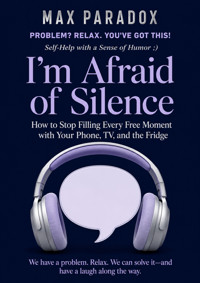
I'm Afraid of Silence - How to Stop Filling Every Free Moment with Your Phone, TV, and the Fridge ebook
Max Paradox
Uzyskaj dostęp do tej i ponad 240000 książek od 14,99 zł miesięcznie
- Wydawca: ALL-IN Rafał Płonkowski
- Kategoria: Biznes, rozwój, prawo•Biznes, rozwój
- Język: angielski
You finally have a free moment.
So naturally, you grab your phone.
Then the TV goes on. Then a podcast. Then a snack. Then you open the refrigerator even though you already checked it five minutes ago and, disappointing as this may be, no new food has materialized.
If every quiet moment in your day seems to require immediate entertainment, information, noise, food, or scrolling, I'm Afraid of Silence is for you.
This practical, funny self-help guide explores why silence can start feeling strangely uncomfortable-and what to do when your brain treats thirty unoccupied seconds like a minor emergency. Max Paradox takes apart the habits that keep constant stimulation running: reflex phone checking, background TV, endless audio, two-screen evenings, compulsive news refreshes, boredom avoidance, late-night scrolling, and the mysterious belief that waiting for coffee requires supporting content.
But this is not a digital-detox manifesto.
You will not be told to throw your phone into a lake, move to a cabin, meditate for four hours, or become the kind of person who discusses “intentional stillness” before breakfast.
Instead, you will learn how to make quiet ordinary again.
Inside, you will discover how to identify what you are actually escaping when you reach for stimulation, distinguish real rest from endless low-level input, build tolerance for boredom without turning it into punishment, create small quiet transitions during a normal day, stop using multiple sources of stimulation at once, make your phone less physically automatic, choose entertainment before algorithms choose it for you, and recover quickly when old habits return.
The methods are deliberately small.
Five quiet minutes.
One screen-free meal.
A phone parking space.
A short walk without audio.
A pause before opening an app.
A simple evening descent instead of going from maximum stimulation directly to sleep and wondering why your brain is still hosting a conference.
You will also learn what to do when silence brings up stress, fatigue, loneliness, unfinished tasks, uncertainty, or plain old boredom. Because sometimes you do not need more discipline.
Sometimes you need sleep.
Sometimes you need to make a phone call.
Sometimes you need to solve the thing you have been avoiding.
And sometimes you need to stop opening the refrigerator as if it contains emotional customer support.
I'm Afraid of Silence is for anyone who wants a healthier relationship with phones, screens, entertainment, information, and their own attention-without becoming anti-technology, joyless, or weirdly proud of owning a dumbphone.
The goal is simple:
Use stimulation because you choose it.
Enjoy it when you want it.
And recover the ability to let nothing happen for a few minutes without treating the situation as an emergency.
This publication was prepared with the assistance of tools that support the creative process, including artificial intelligence-based solutions. The final concept, structure, and editing belong to the author.
Ebooka przeczytasz w aplikacjach Legimi na:
Liczba stron: 184
Rok wydania: 2026
Odsłuch ebooka (TTS) dostepny w abonamencie „ebooki+audiobooki bez limitu” w aplikacjach Legimi na:
Podobne




















INTRO
You sit down on the couch after a long day and, for approximately eleven seconds, nothing happens. No one needs you. No email is arriving. No meeting is beginning. There is no laundry emergency, no delivery driver asking whether you live at “the blue building,” and no app informing you that a person you vaguely remember from high school has posted a new photo.
It is quiet.
Your hand reaches for your phone before you have consciously decided to move it.
This is not because you are weak, broken, lazy, or secretly controlled by a tiny executive committee inside your thumb. It is because silence has become suspicious. A free moment used to be a free moment. Now it feels like an empty loading screen that must be filled immediately. Phone. TV. Podcast. Music. News. Snacks. Refrigerator inspection. Another refrigerator inspection, just in case the cheese has developed a new plot.
You unlock your phone. There is nothing important. So naturally, you continue looking.
First messages. Then email. Then weather, despite being indoors. Then headlines, because apparently the correct response to being tired is to check whether the entire planet has also had a difficult day. A short video appears. Then another. One person is organizing a pantry with military precision. Another is explaining five signs that you may be emotionally unavailable. A third is making pasta in a wheel of cheese the size of a car tire. Twelve minutes disappear.
You were not looking for anything.
You simply did not want nothing.
That distinction matters, because the problem is not really your phone. It is not Netflix, YouTube, Spotify, social media, or the refrigerator, although the refrigerator has certainly enjoyed the increased traffic. These things are tools, entertainment, conveniences, and occasionally excellent places to find hummus. The real problem begins when every quiet gap starts feeling uncomfortable enough that you automatically cover it with stimulation.
You finish a show and immediately start another. You brush your teeth with a video playing beside the sink. You walk from the car to the store while checking messages. You wait thirty seconds for the microwave and somehow decide this is an unacceptable period of psychological isolation. Your brain has been alone with itself for nearly half a minute. Clearly, intervention is required.
The strangest part is that you may not even enjoy what you use to fill the silence. You can scroll while bored, watch while distracted, eat while not hungry, and listen to a podcast you are barely following. The goal is no longer pleasure. The goal is occupancy.
Every available square inch of attention gets furnished.
This can look harmless because each individual moment is tiny. Checking your phone for one minute is not a crisis. Turning on the TV while eating dinner is not a moral failure. Opening the fridge because you are restless will not trigger an international inquiry. But small habits become a pattern, and the pattern teaches your brain something important: whenever there is no stimulation, escape.
Then silence starts to feel louder.
At first, boredom is the enemy. Later, it may be thoughts. You notice unfinished tasks, awkward feelings, uncertainty, loneliness, tension, resentment, or the vague sense that you should probably make a decision about something you have been carefully not deciding about since April. Silence does not create these things. It simply removes the background noise that was covering them.
Your brain, naturally, responds with dignity.
“Oh, an uncomfortable thought. Shall we examine it?”
Absolutely not.
“Would you prefer a video of a golden retriever wearing rain boots?”
Yes. Immediately.
The problem is that avoidance works. At least for a while. The moment you pick up the phone, turn on a show, grab a snack, or flood the room with sound, discomfort drops. Your brain learns from relief very quickly. If action A makes unpleasant feeling B disappear, action A gets promoted. Soon you do not need to choose distraction. It arrives automatically, like a very eager intern who has misunderstood the job description.
This is why simply telling yourself to “use your phone less” rarely solves the problem. You may delete an app and then open the browser. You may turn off the TV and start a podcast. You may put the phone in another room and suddenly become fascinated by the nutritional label on a bottle of mustard. The specific distraction can change while the underlying habit remains completely intact.
Your brain is not loyal to Instagram.
It is loyal to not sitting there with nothing happening.
And yet, learning to tolerate a little nothing is surprisingly useful. Silence gives your attention somewhere to land. Boredom allows thoughts to finish. Unfilled time lets you notice whether you are actually hungry, actually tired, actually lonely, actually avoiding something, or merely standing in the kitchen because your body has confused “mild internal discomfort” with “perhaps crackers.”
This book is not going to ask you to move to a cabin, throw your phone into a lake, meditate for three hours, or spend Sunday staring at a white wall until you become spiritually compatible with it. You do not need to become a monk. You need to become a person who can wait for the kettle without requiring supporting entertainment.
We are going to make silence smaller, less dramatic, and much easier to tolerate. You will learn how to notice the moments when you automatically reach for stimulation, how to interrupt that reflex without turning your life into a digital punishment camp, and how to build short stretches of quiet that do not feel like you have been abandoned by civilization.
You will also learn what to do when silence brings up things you would rather not think about. Sometimes the answer is to sit with the feeling. Sometimes the answer is to solve the problem. Sometimes the answer is to call someone, go outside, eat an actual meal, or go to bed because your “existential crisis” began at 12:47 a.m. after four hours of scrolling.
Timing matters.
Most importantly, we will not treat technology as the villain. Your phone is useful. Television is enjoyable. Music is wonderful. Snacks are one of humanity’s more convincing achievements. The goal is not to remove stimulation from your life. The goal is to stop needing it every time the room gets quiet enough for you to hear yourself think.
Because when every free moment is filled, you never really get a free moment.
You get a queue.
One more video. One more episode. One more notification. One more trip to the fridge. One more small dose of something before you have to be alone with the terrifying experience of existing without content for forty-five seconds.
We can do better than that.
Not perfectly. Not silently. Not while sitting cross-legged on a mountain.
Just better.
Chapter 1 - The Forty-Second Emergency
You are standing in an elevator.
The ride will take maybe twenty seconds. There is no emergency, no difficult decision, and no urgent message expected. Yet before the doors have fully closed, your phone is already in your hand.
You do not even know what you are checking.
Messages? Nothing new.
Email? Nothing useful.
Weather? Still weather.
You put the phone away. The elevator reaches another floor, someone gets in, and now you have to perform the ancient social ritual known as looking vaguely at the numbers above the door.
This is apparently unbearable.
So the phone comes back out.
The problem is easy to miss because the distraction is tiny. Twenty seconds here. Ninety seconds there. Two minutes while waiting for coffee. Three minutes before the meeting starts. Forty seconds while the website loads. None of these moments looks important enough to worry about individually.
Together, however, they reveal something interesting: your brain has started treating unoccupied attention like an error message.
Something must be happening.
If nothing is happening, make something happen.
This is why silence is not only about sound. You can be sitting in a perfectly noisy café and still be unable to tolerate an empty moment. You can have traffic outside, people talking nearby, and a dishwasher apparently rebuilding an aircraft engine in the kitchen. The important silence is internal: nobody is demanding your attention for ten seconds, and you suddenly feel the urge to assign it somewhere.
That urge is the habit we need to understand.
You probably did not consciously build it. Nobody sat down one afternoon and said, “I would like to become incapable of waiting for pasta water without watching twelve strangers review hotel breakfasts.”
It happened gradually.
Phones became faster. Internet connections improved. Streaming stopped asking you to wait a week for the next episode. Apps learned how to remove every tiny pause between wanting stimulation and receiving it. There is almost always something available, and because something is always available, your brain has become less practiced at experiencing nothing.
This does not mean technology destroyed your attention and civilization is ending Thursday afternoon.
It means your brain adapted.
Brains are annoyingly good at that.
If you repeatedly respond to a certain feeling in the same way, the response becomes easier and faster. Feel a moment of boredom? Check. Feel uncertain? Check. Sit down after work and notice tension? Play something. Enter the kitchen while mildly restless? Open refrigerator.
Eventually the sequence becomes so automatic that the feeling and the response seem like one event.
Pausephone.
Boredomscrolling.
Kitchencheese.
Medical science has not approved these terms, but your thumb understands them perfectly.
The important point is that automatic behavior feels like preference even when it is mostly repetition. You may think, “I wanted to check Instagram,” when the more accurate description is, “There was an empty moment, and my hand performed its usual procedure.”
This is why motivation is a weak place to begin. If you wait until you genuinely want to sit quietly instead of checking your phone, you may be waiting a while. Your phone contains entertainment, messages, novelty, outrage, shopping, weather, sports, adorable animals, deeply questionable financial advice, and a man in Ohio explaining how to clean grout with a toothbrush.
Silence contains silence.
It is not competing on equal terms.
So the first goal is not to make silence more exciting. That would defeat the purpose rather spectacularly. The first goal is to notice the moment in which your brain decides that empty space requires immediate repair.
That moment is smaller than you think.
Imagine sitting down after dinner. You finish eating, put the plate aside, and for one second there is no next instruction. Then the feeling appears.
Now what?
You may barely notice the question. The phone answers before you do.
Or you finish a work task and need thirty seconds before beginning another. Your brain could simply remain idle, but instead it requests a quick reward. You open a news site “for a second.” Twelve minutes later, you are reading comments beneath an article you did not originally care about, written by people who appear to be conducting a civil war over electric kettles.
This is not a problem of information.
It is a problem of transition.
Many of the moments you fill are transitions: between tasks, between places, between work and home, between one episode and bedtime, between eating and getting up, between sending a message and receiving a reply.
Transitions are naturally less structured. There is no obvious thing to do for a few seconds or minutes, and your brain dislikes a vacuum. So it inserts the easiest available activity.
Usually one with a screen.
The first practical step is therefore not “reduce screen time by 47 percent” or “schedule a digital detox.” It is much simpler.
Catch three transitions.
For one day, notice just three moments when you reach for stimulation without having decided what you actually want from it. You are not trying to stop yourself yet. You are collecting evidence.
The easiest moments to observe are usually:
waiting for something;
finishing something;
moving from one place to another;
sitting down after a task;
getting into bed;
eating alone;
entering the bathroom with your phone as if you are preparing for a week-long expedition.
When you notice one, ask a single question:
“What was I about to avoid?”
Do not make the question dramatic. You are not conducting psychoanalysis beside the microwave.
Sometimes the answer is simply boredom.
Sometimes it is fatigue.
Sometimes it is an unfinished thought.
Sometimes it is nothing more profound than, “I had six seconds available and my thumb has standards.”
The purpose is to separate the urge from the action. Instead of experiencing “I checked my phone,” you begin to notice, “I felt a tiny gap, then wanted to check my phone.”
That separation is useful because habits become easier to change when you can see the trigger.
You cannot change an event that, from your perspective, never happened.
This is also why screen-time reports are only partly helpful. They tell you that you spent three hours and forty-eight minutes on your phone. Excellent. A number has arrived. You may now feel guilty with improved statistical accuracy.
What the number usually does not tell you is why those hours happened.
Was it one enjoyable movie?
Work messages?
Directions?
A forty-minute call with your mother?
Or did your day dissolve into eighty-seven little sessions you barely remember?
The total matters less than the pattern.
A person who deliberately watches two hours of television may have less of a silence problem than someone who checks their phone seventy times during a four-hour period. The first person chose entertainment. The second may be running an automatic anti-quiet system.
Intent changes the picture.
This gives us a useful distinction:
Chosen stimulation is something you decide to use.
Reflex stimulation is something you use because a gap appeared.
You do not need to eliminate chosen stimulation. In fact, please do not turn this book into a campaign against fun. Watch the series. Play the game. Listen to the album. Eat the dessert because it tastes good.
The target is the reflex.
The five-second weather check even though you checked ten minutes ago.
The news refresh when no new information is required.
The television switched on before you have decided whether you want to watch anything.
The snack eaten because sitting in the kitchen felt strangely incomplete.
The problem is not pleasure.
The problem is filling.
Once you see that distinction, another strange thing becomes obvious: many distractions do not even satisfy you.
You open an app, scroll briefly, close it, and immediately open another one. Then you return to the first app as if perhaps new civilization has emerged there during the seventeen seconds you were away.
Nothing was wanted.
Nothing was received.
The loop simply needed movement.
This is one reason your brain can feel tired after a day that contained very little actual rest. You may have technically stopped working several times without ever becoming mentally unoccupied. Every break was filled.
Work.
Phone.
Work.
News.
Work.
Video.
Work.
Message.
Dinner.
TV.
Phone during TV.
Phone because TV is temporarily less interesting than phone.
Then a second screen becomes involved and we have reached advanced civilization.
Rest is not identical to entertainment. Entertainment can be restful, but not automatically. If your attention is constantly selecting, switching, reacting, reading, judging, and anticipating, your brain is still doing something.
Sometimes the most restorative activity is embarrassingly unremarkable.
Sitting.
Walking.
Showering without a podcast.
Driving without calling anyone.
Making coffee without learning seven surprising facts about the Roman Empire.
Your brain does not need every pause turned into content.
This does not mean you should suddenly create an hour of silence. That is the kind of heroic plan people make at 10:30 p.m. and abandon at 10:37.
Start with one transition.
Tomorrow, pick one predictable moment that you normally fill automatically. It could be the first two minutes after getting into your car, waiting for coffee, standing in an elevator, or sitting down after lunch.
Leave it empty.
Not productive.
Not mindful in an impressive way.
Not accompanied by breathing instructions from an app that will congratulate you afterward.
Just empty.
Notice what happens.
You may feel an urge within seconds. Your hand may move automatically. You may suddenly remember five things you should do. You may experience the shocking discovery that elevators are not particularly entertaining.
Good.
That discomfort is not proof the exercise is failing.
It is the exercise.
You are noticing the reflex before obeying it.
If two minutes feels absurdly long, make it thirty seconds. If thirty seconds feels annoying, use ten.
The minimum version still counts.
You are not training to become a professional silence athlete. You are reminding your brain that a gap can exist without being immediately filled.
There is one important exception. If quiet consistently brings overwhelming anxiety, panic, traumatic memories, or severe emotional distress, this is not something you need to force your way through alone. A mental health professional can help you approach that safely. The goal here is not to prove toughness.
For most everyday restlessness, however, the first intervention is wonderfully ordinary.
Notice.
Pause.
Do not immediately fix the pause.
That is all.
The first victory is not enjoying silence.
It is surviving thirty seconds without appointing your phone Minister of Empty Moments.
Chapter 2 - What You Are Really Escaping
You open the refrigerator.
There is yogurt, milk, cheese, eggs, vegetables, leftovers, and the same jar of something nobody remembers buying.
You close the refrigerator.
Two minutes later, you open it again.
This time, perhaps, the yogurt will have developed a personality.
Nothing has changed. You are not especially hungry. You are not preparing food. You are not even looking for anything specific.
You are standing there because something inside you wanted a small event.
The refrigerator provided light.
This is where the silence problem becomes more interesting. If all we had to do was stop touching devices whenever we were bored, this book could end after twelve pages and we could all go home early.
But you do not always fill silence because silence itself is unpleasant.
Sometimes silence reveals something else.
Fatigue.
Loneliness.
Anxiety.
An unfinished task.
A difficult decision.
A conversation you are avoiding.
A strange sense of dissatisfaction you would prefer to address immediately after watching another episode.
The stimulation is often not the main event.
It is the curtain.
This explains why removing distraction can initially make you feel worse. You put the phone away and expect instant peace. Instead, you remember the email you have been avoiding, notice that your shoulders are tense, and realize you are worried about tomorrow.
Excellent.
You have achieved serenity.
This is the moment many people conclude, “Silence does not work for me.”
Of course it does not feel pleasant yet. The distraction was covering something. Removing the cover does not automatically repair what is underneath.
If your smoke alarm is beeping, putting headphones on may improve the experience.
The fire remains somewhat unconvinced.
This is why the question from the previous chapter—“What was I about to avoid?”—is so useful. The answer tells you what kind of problem you actually have.
Most silence-filling falls into a few common categories.
The first is simple understimulation.
You are bored.
Nothing is wrong. Nothing emotionally significant is happening. Your brain just wants novelty because novelty is available.
This is the easiest category.
You wait in line, the line is slow, and your brain says, “Could we perhaps receive several interesting new facts, three messages, a joke, and a tiny amount of outrage before reaching the cashier?”
You can answer no.
Boredom is uncomfortable mostly because you have become unaccustomed to it. When you let it exist briefly, it tends to rise, complain, and then become much less impressive.
The second category is fatigue.
This one causes a great deal of confusion because tired people often seek stimulation while claiming they need rest.
You finish work exhausted and immediately scroll for an hour.
Why?
Because true rest requires stopping, and stopping creates awareness of how tired you are. Stimulation lets you remain pleasantly half-activated. You are too tired to do something meaningful but not willing to enter full rest, so you drift through low-effort content.
This creates the famous evening experience of saying, “I need to go to bed,” while continuing to watch strangers renovate a laundry room.
Nobody knows these people.
The laundry room is doing very well without you.
Fatigue requires a different response from boredom. If you are tired, the solution is not always to practice more silence. Sometimes the solution is to stop behaving as if your body has submitted a suggestion rather than a requirement.
Sleep.
Sit down.
Take a shower.
Eat.
Dim the lights.
Do something genuinely low-demand.
Your phone can feel easier than rest because it provides stimulation without requiring much physical effort, but mental activity is still activity.
The third category is emotional discomfort.
This is where silence gets blamed for crimes it did not commit.
You sit down and suddenly feel lonely.
The silence did not make you lonely.
It allowed you to notice.
You stop watching television and feel worried about money.
The television did not create financial stability while it was playing.
It merely had excellent timing.
You put your phone away and become irritated about an argument from earlier.
Again, silence is not manufacturing the emotion. It is removing competition for your attention.
This can be uncomfortable, but it gives you useful information.
An emotion you notice can be dealt with.
An emotion you continuously drown in stimulation tends to return wearing increasingly elaborate disguises.
Maybe loneliness becomes endless messaging with people you do not particularly want to talk to. Anxiety becomes compulsive news checking. Frustration becomes snacking. Uncertainty becomes researching the same decision for the fourteenth time.
You are doing something.
Therefore it feels as though you are handling the problem.
You may not be.
This is where a tiny rule helps:
Name before numb.