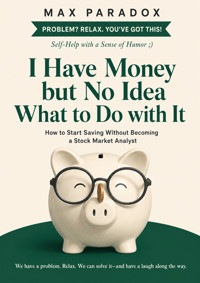
I Have Money but No Idea What to Do with It - How to Start Saving Without Becoming a Stock Market Analyst ebook
Max Paradox
Uzyskaj dostęp do tej i ponad 240000 książek od 14,99 zł miesięcznie
- Wydawca: ALL-IN Rafał Płonkowski
- Kategoria: Biznes, rozwój, prawo•Biznes, rozwój
- Język: angielski
You finally have some money left over.
Excellent.
Now what?
Leave it in checking? Build an emergency fund? Pay down debt? Open a retirement account? Invest it? Wait for the market to crash? Read forty-seven articles comparing index funds until your original question becomes a minor economics degree?
I Have Money but No Idea What to Do with It is a practical, funny guide for people who want to start handling money intelligently without turning personal finance into a second career.
Max Paradox strips away the noise, hype, financial jargon, and internet panic to show you how to build a simple system around one basic idea: every dollar needs a job.
Inside, you will learn how to separate money for near-term expenses, emergencies, medium-term goals, and long-term investing; how to decide what deserves priority when several goals compete for the same money; how to automate saving so it does not depend on leftover cash or monthly motivation; and how to approach investing without trying to predict which stock, sector, or economic forecast will win next.
You will also learn how to think realistically about risk, diversification, fees, debt, emergency funds, lifestyle inflation, recurring expenses, market headlines, windfalls, setbacks, and the deeply human tendency to redesign a perfectly good financial plan because someone on YouTube looked confident beside a chart.
This is not a book about getting rich quickly.
It will not teach you how to day-trade from a beach, turn $500 into a private jet, or predict the next market crash before breakfast.
Instead, it will help you build something considerably more useful: a financial system that works while you are busy living your life.
You will learn what to do first, what can wait, what should stay boring, what deserves professional advice, and how to create a minimum version when your energy level is approximately potato.
No guru worship.
No motivational shouting.
No requirement to become fascinated by bond yields.
Just practical decisions, realistic examples, clear explanations, and enough humor to make personal finance feel less like compulsory homework.
If you have ever looked at money sitting in your account and thought, “I know I should be doing something with this, but I have absolutely no idea what,” this book starts there.
By the end, you will know how to give your money instructions-and when to stop touching it.
This publication was prepared with the assistance of tools that support the creative process, including artificial intelligence-based solutions. The final concept, structure, and editing belong to the author.
Ebooka przeczytasz w aplikacjach Legimi na:
Liczba stron: 224
Rok wydania: 2026
Odsłuch ebooka (TTS) dostepny w abonamencie „ebooki+audiobooki bez limitu” w aplikacjach Legimi na:
Podobne




















INTRO
You check your bank account and, for once, the number does not cause you to stare silently at the ceiling. There is money there. Actual money. Not “technically I have money if nobody charges my card until Thursday” money. Not “I could survive an emergency provided the emergency costs no more than two sandwiches” money. Real, unused cash has somehow accumulated, and now you face a problem nobody warned you about: apparently having money creates homework.
At first, this seems ridiculous. You spent years believing the difficult part was getting the money. Surely once it arrived, a small brass band would appear and a responsible adult version of you would calmly know what to do next. Instead, you open your banking app, look at the balance, and think, Okay. Now what? Leave it here? Put it in savings? Invest it? Buy something sensible? Pay something off? Start a retirement account? Learn what an index fund is? Move to a cabin and refuse to participate in capitalism?
Naturally, you do what modern adults do when uncertain.
You search the internet.
This is where a manageable question—“How should I start saving?”—transforms into a postgraduate program in global finance. One person says cash is trash. Another says the stock market is about to collapse. A cheerful twenty-six-year-old with three monitors explains that you are losing money every second you remain uninvested. Someone else has apparently become financially independent by purchasing twelve rental properties before breakfast. Then a man whose profile photo features a rented sports car informs you that traditional saving is for people who “don’t understand leverage.”
You close the browser slightly poorer in confidence.
The problem is not that you are irresponsible with money. In fact, sometimes the opposite is true. You finally have enough that making the wrong decision feels expensive. When you had fifty dollars left until payday, there was no elaborate strategic discussion. The strategy was mainly “please do not let the washing machine develop ambitions.” But once you have a few thousand dollars sitting around, every choice suddenly feels permanent. If you leave it in cash, maybe inflation eats it. If you invest it, maybe the market falls twelve minutes later specifically because it sensed your arrival.
Congratulations. You have money and performance anxiety.
This is how perfectly sensible people end up doing nothing. The money stays in a checking account for months or years while they wait to become “more knowledgeable.” They save articles about investing. They bookmark videos about retirement accounts. They compare savings rates. They download a budgeting app. They subscribe to a financial newsletter. At some point they may even create a spreadsheet with seven tabs, three colors, and a section called “Long-Term Strategy.”
The money remains exactly where it was.
Information feels like progress because it is safer than making a decision. You cannot choose the wrong savings account while watching your nineteenth video comparing savings accounts. You cannot make an imperfect investment if you postpone investing until you understand every possible investment. And because personal finance contains enough terminology to make a normal person suspect they accidentally entered an economics conference, postponement can look extremely responsible.
It often is not.
The good news is that becoming better with money does not require becoming fascinated by money. You do not need to wake up excited about bond yields. You do not need to follow the market during lunch. You do not need to know what the S&P 500 did at 10:17 a.m., and unless managing investments is your profession, you certainly do not need three monitors glowing in a dark room like you are trying to contact Wall Street from a submarine.
You need a system.
That distinction matters because financial media often makes ordinary money management look much more complicated than ordinary money management actually is. Markets are complicated. Tax law can be complicated. Building sophisticated investment portfolios can be complicated. But the first steps toward handling your money sensibly are usually much less dramatic: know what the money is for, keep appropriate cash available for near-term needs and emergencies, automate regular saving, understand the basic trade-off between risk and return, use simple diversified options when investing makes sense for your situation, and stop making every financial decision compete in the Olympic Games of Optimization.
You are allowed to be financially competent without making finance your personality.
This book is for the person who has reached the strange stage where the problem is no longer only “I need more money.” Maybe you have built a small cushion. Maybe your income increased. Maybe you received a bonus, finished paying off something expensive, inherited money, or simply reached the end of several months without spending everything that entered the building. Whatever happened, there is now a gap between having money and knowing what job to give it.
That gap creates two common reactions. The first is paralysis: “I’ll decide when I understand more.” The second is random action: “This person on YouTube sounded confident, so apparently I now own shares in a lithium company.” Neither is ideal. One keeps your money permanently waiting for instructions. The other gives it instructions from strangers whose main qualification may be excellent lighting.
We are going to build something less exciting and significantly more useful.
You will learn how to separate money by purpose instead of treating your entire bank balance as one mysterious blob. You will learn how to create a saving system that does not depend on remembering to behave responsibly on the twenty-seventh of every month. We will look at the difference between money you may need soon and money that can stay untouched for years, why that difference matters, how to think about risk without either worshipping it or hiding under the table, and how to recognize when simplicity is not laziness but good design.
We will also deal with the emotional nonsense that comes free with money. The fear of starting too late. The suspicion that everybody else understands investing except you. The temptation to wait for the perfect moment. The belief that a small amount is not worth saving. The sudden urge to optimize everything after watching one personal-finance video at 11:43 p.m.
Nighttime You is often extremely ambitious with Future You’s money.
This is not a book about beating the market, discovering secret investments, predicting economic crashes, or transforming your spare cash into a yacht by next Thursday. Anyone promising certainty in investing should immediately make you curious about what they are selling. Returns are not guaranteed, investment values can fall, taxes and account rules vary by location and circumstances, and some decisions genuinely deserve advice from a qualified financial or tax professional. Especially when large sums, complicated taxes, debt problems, inheritance, pensions, business ownership, or unusual financial circumstances are involved, getting individualized help can be worth far more than another forty browser tabs.
For ordinary saving decisions, however, you can usually make enormous progress before you become an expert.
That is our goal.
Not to turn you into a stock market analyst.
Not to make you discuss expense ratios at dinner until your friends quietly create another group chat.
Not to build the mathematically perfect financial system that requires forty-five minutes of maintenance every Sunday and collapses the first weekend you go away.
We are going to build a system simple enough that you actually use it.
Because the real achievement is not knowing everything about money. It is being able to look at the money you have and know what happens next.
Preferably without opening nineteen new tabs.
Chapter 1 - Your Money Is Waiting for Instructions
You open your banking app and see $8,430 sitting there.
This should feel good. Eight thousand dollars is not a private island, but it is considerably better than eight dollars. Yet instead of satisfaction, your brain immediately begins assigning imaginary responsibilities to every dollar. Emergency fund. Vacation. Retirement. New laptop. Future house. Car repair. Investments. Dental work. Something called “wealth building,” which sounds important even though nobody is entirely sure what it means before coffee.
Five minutes ago, you had money.
Now you have an understaffed financial department.
The first problem is surprisingly basic: most people think about money by location instead of purpose. There is checking-account money. Savings-account money. Cash. Maybe investment money. Perhaps money sitting in an account you opened three years ago because the interest rate was exciting for approximately eleven minutes.
But the location tells you very little.
Imagine opening your refrigerator and organizing everything according to which shelf it happens to be sitting on.
“What are we having for dinner?”
“Top shelf.”
That is roughly how many people manage money.
A checking account might contain money for next week’s groceries, next month’s insurance bill, a future vacation, an emergency reserve, and $2,000 that could potentially be invested for twenty years. The dollars look identical on the screen, so your brain treats them as one large number.
That creates confusion because one number is being asked to solve several completely different problems.
Money needs jobs.
Not complicated jobs. You do not need a seventeen-category financial command center with laminated procedures and quarterly staff meetings. You simply need to know what each meaningful chunk of money is supposed to do.
If you do not give money a job, two things usually happen.
First, you are afraid to use it.
You may have $10,000 in the bank, but spending $700 on a necessary car repair feels terrifying because you do not know how much of that $10,000 is genuinely available. Was the $700 secretly for an emergency? Retirement? Christmas? A future move? Your brain does not know, so it reacts as though the mechanic has arrived with a crowbar and requested access to your financial future.
Second, you may spend money too easily.
The same $10,000 can look surprisingly generous when a vacation deal appears. You tell yourself, “I have ten grand saved,” which is technically true in the same way that saying “this hotel has 300 rooms, so I personally have 300 rooms” is technically creative.
Some of that money may already belong to future expenses.
The number in your account is not the same thing as money available to spend.
That distinction is boring.
It is also one of the most useful sentences in personal finance.
The Big Balance Illusion
A large account balance can create a false sense of wealth because your brain does not naturally subtract future obligations every time you look at it.
Suppose you have $12,000.
Very nice.
But then you remember that $2,500 is for estimated upcoming expenses you already know about. Another $4,000 is your emergency reserve. You want $1,500 available for a trip later this year. Suddenly, the mysterious pile of $12,000 becomes several smaller piles with actual purposes.
Nothing bad happened.
You did not lose money.
You simply turned a blurry picture into a clear one.
This can feel disappointing at first because unassigned money has tremendous fantasy potential. It can be anything. New furniture. A business idea. A trip to Japan. An investment portfolio. A heroic early-retirement strategy. Possibly a motorcycle, although nobody mentioned motorcycles until you saw one online at 11:20 p.m.
Assigned money is less glamorous.
“This $4,000 sits there in case the roof, car, job, tooth, or universe develops a problem.”
Not sexy.
Extremely useful.
The purpose of financial organization is not to make your money look impressive. It is to make your decisions easier.
Start With Time, Not Products
One of the easiest ways to make saving unnecessarily complicated is to start by asking:
“What should I invest in?”
That question arrives too early.
The better first question is:
“When might I need this money?”
Time changes what a sensible choice looks like.
Money you may need next month has a different job from money you probably will not need for fifteen years. Your emergency reserve should not be taking the same risks as retirement money. The money for next summer’s vacation does not need to embark on a personal-growth journey through the stock market.
A simple way to think about your money is to separate it into three broad time zones.
Soon money is money you expect to use relatively soon: regular bills, annual expenses, planned purchases, travel, repairs you know are coming, and other near-term needs.
Safety money is your financial shock absorber: cash you keep available for genuine unexpected expenses or a temporary interruption in income.
Later money is money you reasonably expect not to need for years. This is where longer-term saving and, when appropriate for your circumstances and risk tolerance, investing may enter the picture.
That is enough for now.
Notice what is missing.
Crypto.
Small-cap growth stocks.
Real estate syndicates.
A forty-seven-minute debate about whether international equities are currently undervalued.
Your money does not need a TED Talk.
It needs a calendar.
“But I Don’t Know Exactly What I’ll Need”
Of course you do not.
Nobody does.
You are not trying to predict your complete financial future. If you could do that, you would not need this book because you would already know next year’s lottery numbers and would be reading this from the deck of something expensive.
The goal is simply to make reasonable distinctions.
You probably know whether money is intended for next month or twenty years from now.
You probably know that a broken transmission is different from a retirement goal.
You probably know that the $1,800 you intend to spend on a vacation in six months should not be treated exactly like money you hope to leave invested until your hair has filed for retirement.
That level of clarity already improves your decisions enormously.
The Four-Question Test
Take any significant amount of money you currently have and ask four questions.
What is this money for?
When might I need it?
How bad would it be if its value dropped before I needed it?
Does it need to grow, stay available, or simply wait safely?
These questions are more useful than asking which financial product is “best,” because no product is best independently of purpose.
A hammer is excellent if your problem is a nail.
It is less impressive as soup equipment.
The same principle applies to money.
A savings vehicle that is appropriate for short-term cash may be a poor long-term growth strategy. An investment that may make sense over decades can be unsuitable for money needed soon because markets can fall at inconvenient times. And markets are exceptionally talented at being inconvenient without checking your calendar first.
This is why purpose comes before product.
Your Emergency Money Is Not Lazy
Many people become uncomfortable once they learn that money can potentially earn more if invested.
They begin looking at cash as though it has betrayed the family.
“You’re just sitting there.”
Yes.
That may be its job.
Emergency money is supposed to be boring, accessible, and dependable. Its purpose is not necessarily to win the annual performance contest. Its purpose is to be there when you need it.
Think of a fire extinguisher.
You would not complain that it spent the entire year attached to the wall generating no return.
“Absolutely useless. Twelve months and not one dividend.”
The fact that you did not need it is good news.
How much safety money you personally need depends on your expenses, job stability, household situation, insurance, access to other resources, and comfort with risk. There is no magical number that fits everyone. Someone with stable income, low fixed expenses, and two earners in the household has a different situation from someone self-employed with variable income and three dependents.
So do not turn somebody else’s rule of thumb into a religious text.
Use it as a starting point, then adapt it to your actual life.
The First Mistake: Making Everything “Savings”
People often say, “I want to save more,” but that sentence can mean five different things.
Save for what?
If every future goal lives inside one category called SAVINGS, your brain eventually has to choose between goals that were never separated.
You withdraw $1,200 for a trip and feel guilty because your savings balance dropped.
But if $1,200 was specifically vacation money, nothing went wrong.
The money completed its assignment.
This sounds obvious when stated plainly. Yet emotionally, people often treat every decrease in savings as failure.
That is how you end up with somebody proudly accumulating money for a vacation and then feeling irresponsible when they actually book the vacation.
The vacation fund has one job.
It is not to become a museum exhibit.
The Second Mistake: Waiting for a Perfect Financial Master Plan
Perhaps you are thinking, Fine, but before I divide anything, I should probably calculate my retirement needs, decide whether I will buy a home, estimate future inflation, understand taxes, choose investments, compare account types, forecast my salary, and determine whether I may one day develop an expensive interest in sailing.
No.
This is precisely how the spreadsheet becomes a hostage situation.
You do not need a lifetime financial plan before organizing the next few years.
Start with what you know.
Maybe you have $6,000 and can confidently say:
$3,000 should remain available for emergencies.
$1,000 is for a trip.
$500 is for a predictable annual expense.
$1,500 currently has no specific near-term job.
Excellent.
You have already learned more about that money than someone who has spent six months wondering which stock will outperform the market.
The unassigned $1,500 can wait briefly while you decide what longer-term role it should play. “I do not know yet” is a valid temporary category.
Temporary is the important word.
The Money Map
Here is your first practical exercise.
Do not build a budget for the next forty years.
Do not download anything.
Do not watch a video titled “7 MONEY MOVES YOU MUST MAKE BEFORE MIDNIGHT.”
Open a note, piece of paper, or simple spreadsheet and write down the money you currently have available outside your normal monthly spending.
Then assign it, approximately, to these categories:
Known near-term spending
Emergency/safety reserve
Longer-term money
Unassigned for now
That is the entire exercise.
If you have several accounts, ignore the account names initially. Focus on purpose.
You might discover that your “savings” account contains three completely different types of money. Good. You have found the source of some of the confusion.
You might discover that almost all your current cash already has jobs. Also good. You now know that you do not actually have a giant mysterious pile waiting to be invested.
Or you might discover something more interesting: after covering near-term needs and keeping an appropriate safety reserve, you have money with no job for the next several years.
That is where later chapters become useful.
What If You Have Debt Too?
Debt complicates the picture, but it does not make the exercise useless.
If you have high-cost debt, deciding whether additional money should go toward debt repayment rather than saving or investing may be a major priority. The exact choice depends on the debt’s cost, terms, your emergency reserves, taxes, and personal circumstances.
Do not automatically assume that “investing” is always smarter because somebody quoted an average historical market return.
Guaranteed borrowing costs and uncertain investment returns are not the same thing.
This is one of those areas where specific numbers matter, and where personalized professional advice can be valuable if the amounts are large or your situation is complicated.
But even before solving the debt question, assign the money.
Clarity first.
Optimization later.
Plan B: If Even This Feels Too Complicated
Perhaps you have irregular income, multiple accounts, upcoming expenses you cannot estimate, and financial paperwork currently distributed across your home according to a system best described as archaeological.
Fine.
Use the minimum version.
Pick just three buckets:
Need soon.
Keep safe.
Not needed for years.
Put every meaningful dollar into one of those three groups.
Done.
You can refine it later.
The goal is not to create the perfect structure. The goal is to stop looking at one account balance and expecting it to explain your entire financial life.
Money without a purpose creates anxiety because every choice feels like it might secretly damage another goal.
Money with a purpose becomes much easier to manage.
Your action for today is simple: take the money you already have and give it jobs before you give it products.
The dollars have been standing around long enough.
Chapter 2 - You Do Not Need a Finance Degree
At some point after deciding to “get serious about money,” you encounter a chart.
The chart is probably colorful.
It contains several lines.
One line goes dramatically upward, another line behaves badly, and somebody is explaining that if you had invested $10,000 in a particular asset at exactly the right historical moment, you would now own a small country.
You watch politely.
Then another chart arrives.
Before long, you are learning about market capitalization, duration, tax efficiency, factor exposure, yield curves, expense ratios, asset allocation, rebalancing, sequence-of-returns risk, dollar-cost averaging, and something involving Monte Carlo simulations.
You wanted to save $300 a month.
You are now apparently preparing to advise a sovereign wealth fund.
This is one of the strangest features of personal finance: the beginner often receives expert-level information before mastering beginner-level behavior.
It is like asking how to cook eggs and being handed the architectural plans for a restaurant.
No wonder people postpone starting.
Knowledge Can Become a Hiding Place
Learning is useful.
Avoiding decisions by learning indefinitely is something else.
The distinction can be difficult to see because research looks responsible. Nobody feels guilty reading an article called “How to Optimize Your Portfolio for Long-Term Risk-Adjusted Returns.”
It sounds much better than “I am scared to make a decision.”
But sometimes they are the same activity wearing different glasses.
Imagine two people.
Alex knows almost nothing about investing but has a simple system. Every payday, money automatically moves into savings. Alex maintains an emergency reserve, uses a diversified long-term investment approach appropriate to his situation, keeps costs low, and rarely touches anything.
Jordan knows significantly more. Jordan has read six books, follows financial news, compares funds every weekend, watches interviews with economists, and has strong opinions about central-bank policy.
Jordan has not invested yet.
Jordan is “still researching.”
Three years later, Alex may still be unable to explain half the vocabulary Jordan uses.
Alex also has three years of consistent behavior.
Personal finance rewards knowledge, but it often rewards boring behavior more.
That is extremely inconvenient for the part of the internet that needs new content every day.
“Keep doing the simple sensible thing” is difficult to turn into 146 videos.
The Competence Trap
Once you understand that financial decisions matter, you may believe that a responsible person should understand every detail before acting.
This sounds admirable.
It is also impossible.
You use electricity without being an electrical engineer. You drive a car without personally designing the transmission. You probably eat yogurt despite having incomplete knowledge of industrial fermentation.
Competence does not require total mastery.
You need enough knowledge to understand what you are doing, the major risks involved, the costs, the time horizon, and the basic alternatives.
Beyond that point, additional knowledge may improve your decisions.
Or it may simply improve your ability to discuss decisions you still have not made.
The goal is informed simplicity.
Not ignorance.
Not obsession.
What You Actually Need to Understand
Before putting long-term money into any investment, you should understand a few basic ideas.
Not fifty.
A few.
First, higher expected returns generally come with meaningful risk. Investments that can grow more over time can also fall, sometimes sharply. There is no legitimate button labeled HIGH RETURN / NO BAD DAYS.
If someone appears to have found one, investigate carefully.
Preferably while keeping your wallet in another room.
Second, time matters. Money you may need soon should generally not depend on a risky asset recovering on your schedule. Long investment horizons give you more ability to tolerate temporary declines, but they do not make losses impossible.
Third, diversification matters. Concentrating all your money in one company, industry, country, or speculative asset means your financial future depends heavily on one specific outcome. Spreading exposure does not eliminate risk, but it can reduce the damage caused by one investment behaving like it has recently discovered chaos.
Fourth, costs matter. Fees reduce what you keep. A small annual difference can matter substantially over long periods because fees repeat.
Fifth, behavior matters enormously. A theoretically excellent investment plan becomes considerably less excellent if you panic during every decline, sell after markets fall, buy after excitement returns, and repeat the process until your money files a complaint.
That is enough foundation to begin thinking sensibly.
You do not need to memorize market history back to 1926.
Simple Does Not Mean Stupid
People sometimes distrust simple financial solutions because the subject feels important.
Important things should feel complicated.
Otherwise, what are all these professionals doing with their spreadsheets?
This creates a dangerous instinct: if an investment strategy can be explained in a few sentences, it must be unsophisticated.
Not necessarily.
A simple diversified approach may be simple because unnecessary decisions have been removed.
Complexity is not automatically intelligence.
A restaurant menu with 214 dishes is not necessarily better than one with twenty excellent dishes. It may simply indicate that somewhere in the kitchen a freezer is experiencing things.
The same applies to investing.
Every additional decision creates another opportunity to make a mistake, hesitate, chase performance, pay unnecessary fees, or change direction because somebody online sounded persuasive during breakfast.
A simple system can protect you from yourself.
This is an underrated feature.
The Market Does Not Need Your Daily Supervision
If your goal is long-term investing rather than active trading, constantly watching markets can make ordinary fluctuations feel like emergencies.
You invest $5,000.
The next day it becomes $4,912.
Your nervous system reacts as though somebody entered your home and removed a microwave.
You check again at lunch.
$4,876.
This is unacceptable.
You begin searching:
“WHY MARKET DOWN TODAY”
Now you are reading an article explaining that investors are concerned about inflation, interest rates, earnings, oil prices, employment figures, geopolitical uncertainty, consumer confidence, and possibly a speech given by a man you had never heard of until eleven seconds ago.
By dinner, the account is back at $4,943.
Excellent.
You have sacrificed an entire afternoon to observe $57 move around.
Long-term investing involves uncertainty. Prices move. Sometimes they move a great deal. This is not a malfunction in the system. It is part of the reason risky assets have the potential to offer higher returns than safer ones.
If normal volatility causes you immediate panic, the answer may not be “watch harder.”
It may be to reconsider how much risk you are taking.
Risk Tolerance Is Not Who You Are During a Bull Market
People tend to overestimate their tolerance for risk when investments are rising.
It is easy to declare yourself “aggressive” while every chart points northeast.
Then markets fall 25 percent.