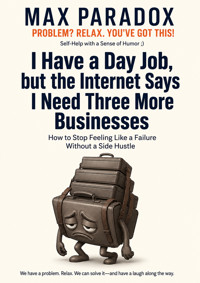
I Have a Day Job, but the Internet Says I Need Three More Businesses - How to Stop Feeling Like a Failure Without a Side Hustle ebook
Max Paradox
Uzyskaj dostęp do tej i ponad 240000 książek od 14,99 zł miesięcznie
- Wydawca: ALL-IN Rafał Płonkowski
- Kategoria: Biznes, rozwój, prawo•Biznes, rozwój
- Język: angielski
You have a job. It pays you. You may even like it.
So why does the internet keep making you feel as if you are professionally underachieving because you do not also run an agency, sell digital products, own rental properties, publish a newsletter, build a personal brand, and somehow generate passive income while sleeping?
I Have a Day Job, but the Internet Says I Need Three More Businesses: How to Stop Feeling Like a Failure Without a Side Hustle is a practical, funny guide for anyone who has started confusing ordinary employment with failure.
Max Paradox takes apart the modern pressure to monetize every skill, optimize every evening, and treat free time like unused commercial real estate. With sharp observational humor and practical advice, this book helps you distinguish genuine ambition from anxiety imported through social media.
You will learn how to decide whether you actually need a side hustle, whether a better-paying primary job might solve the problem faster, how to evaluate side-business ideas using realistic time and money calculations, and how to protect your free time from becoming a second unpaid shift.
If you do want additional income, the book shows you how to build it sanely: start with skills you already have, test demand before spending money, price your time properly, create simple systems, protect your main job, define capacity limits, and let a business earn the right to grow.
You will also learn what to do when motivation disappears, life disrupts your plans, a side hustle fails, or success itself creates pressure to keep expanding.
Most importantly, you will create your own definition of enough.
Because financial security is not measured by the number of logos in your LinkedIn bio. A stable salary, useful skills, savings, investments, strong employability, a small side business-or no side business at all-can all be valid parts of a sensible financial life.
This is self-help for people who want practical answers without being told to wake up at 4:30 a.m., build a seven-figure funnel before breakfast, and spend Sunday evening optimizing their personal brand.
You do not need more hustle.
You need a plan that fits your actual life.
And possibly a Saturday that is allowed to remain Saturday.
This publication was prepared with the assistance of tools that support the creative process, including artificial intelligence-based solutions. The final concept, structure, and editing belong to the author.
Ebooka przeczytasz w aplikacjach Legimi na:
Liczba stron: 222
Rok wydania: 2026
Odsłuch ebooka (TTS) dostepny w abonamencie „ebooki+audiobooki bez limitu” w aplikacjach Legimi na:
Podobne




















INTRO
You finish work at 5:30 p.m. You have done your job, answered messages, attended meetings that could have been emails, attended emails that somehow became meetings, and survived the mysterious period between 2:17 and 3:04 when the human brain officially stops cooperating. You close the laptop feeling reasonably productive.
Then you open Instagram.
A man who appears to be twenty-three tells you that relying on one income is “financially irresponsible.” Another person explains that your evenings should be spent building a personal brand. A third has apparently created seven income streams while traveling through Bali, although one of those income streams seems to involve teaching other people how to create seven income streams while traveling through Bali.
You look at your regular job.
Suddenly it feels embarrassingly singular.
Ten minutes ago, you were a functioning adult with employment, responsibilities, and perhaps even health insurance. Now you are apparently one Etsy store, two rental properties, a newsletter, a podcast, an AI automation agency, and a refrigerated vending-machine empire behind schedule.
The internet has reviewed your career.
Results are disappointing.
This is one of the stranger achievements of modern work culture. Having a job used to mean that you had, well, a job. You exchanged time, knowledge, skills, patience, or the ability to pretend a spreadsheet was “almost finalized” for money. The arrangement was not always glamorous, but everyone understood the basic structure.
Now employment can feel like merely the disappointing first layer of your professional identity.
You work full-time? Nice start. What else?
Do you freelance?
Are you investing?
Have you monetized your expertise?
What about consulting?
Digital products?
Affiliate income?
A YouTube channel?
Rental property?
An online course?
A newsletter?
A newsletter teaching people how to start newsletters?
At some point, the obvious question becomes socially unfashionable:
What if I just want to have a job?
Not a job plus a startup. Not a job plus a content calendar. Not a job plus three online businesses managed from a laptop while drinking something aggressively green. Just a job that pays reasonably well, gives you some degree of stability, and eventually ends for the day so you can go make dinner.
This book is for people who have started feeling weirdly guilty about that.
Maybe you are doing perfectly fine financially but keep seeing people claiming that a salary is a trap. Maybe money is tighter than you would like, so side-hustle content hits harder because it offers both hope and accusation. Maybe you genuinely want additional income but have somehow turned that reasonable goal into a permanent feeling that every free evening should become productive.
You sit on the couch at 8:14 p.m.
Your brain says, “You could be building something.”
You reply, “I have been building PowerPoint presentations since 8:30 this morning.”
Apparently those do not count.
The problem is not that side businesses are bad. They can be excellent. A second income stream can create security, fund a goal, help you test a business idea, or eventually let you leave a job you dislike. Plenty of people enjoy building something of their own after work. There is nothing wrong with wanting more money, more independence, or more interesting work.
The problem begins when “you could” quietly becomes “you should.”
You could start consulting.
Therefore you should.
You could sell templates.
Therefore you are wasting your skills if you do not.
You could learn video editing, build a following, launch a product, create a course, automate fulfillment, optimize conversion, and spend Sunday afternoon discussing payment processors with a stranger named Chase.
Therefore sitting in the garden with coffee begins to feel like poor asset allocation.
This is how optional ambition becomes mandatory ambition.
And mandatory ambition is exhausting because it has no finish line. If you start one side hustle, the internet can immediately explain why you need another. Your freelance work should become an agency. Your agency should become scalable. Your scalable business should generate passive income. Your passive income should be diversified. Your diversified income should be invested.
Eventually you are expected to become a small private equity firm because you once wanted an extra $400 a month.
There is also a visibility problem. Ordinary stability is almost invisible online. Nobody makes a viral video called:
“I worked my normal job today, put some money into savings, made pasta, and watched two episodes of a show. Everything is basically fine.”
There are no dramatic camera cuts.
No Lamborghini appears.
The algorithm gets bored and leaves.
What you do see are extremes: the person who quit corporate life and now earns $40,000 a month, the twenty-year-old founder with an impressive revenue screenshot, the employee who built a business before breakfast, the investor who owns twelve properties, and the creator explaining why everyone else is thinking too small.
You usually do not see the full context. You do not see how long it took. You do not see the failed attempts, financial support, debt, previous audience, unpaid labor, spouse with stable benefits, inheritance, lucky timing, selective reporting, or the awkward possibility that the person teaching you how to get rich mainly gets rich by teaching people how to get rich.
Your brain, meanwhile, performs a beautifully unfair comparison.
It compares your entire life to someone else’s marketing department.
Then it announces the results as objective science.
This can create a specific kind of dissatisfaction: nothing terrible has happened, yet your perfectly legitimate life begins to feel inadequate. Your job becomes “just a job.” Your weekends become “unused capacity.” Your hobbies start looking suspicious because nobody is paying you for them.
You bake excellent bread.
Someone says, “You should sell this.”
You take good photos.
“You should monetize that.”
You know a lot about fitness.
“Start coaching.”
You make people laugh.
“Build a TikTok.”
Apparently enjoying something privately is now an unfinished business model.
This book is not going to tell you to abandon ambition, delete LinkedIn, throw your phone into a lake, and announce that capitalism has been defeated because you took Wednesday evening off. It is also not going to tell you that everyone should remain happily employed forever. Some people absolutely should start businesses. Some should change jobs. Some need more income. Some want a side project because creating something genuinely energizes them.
The goal is simpler: to help you separate genuine desire from imported pressure.
You need to know whether you actually want a side hustle or merely feel ashamed that you do not have one. You need to know what financial security realistically requires, what additional income could genuinely improve, and what is just productivity theater wearing a baseball cap and talking about “grind.”
You also need a better definition of enough.
Because without one, every achievement immediately creates another deficiency. You get the raise, then learn you need a second income. You create the second income, then someone tells you it is not scalable. You make it scalable, then discover that serious people supposedly own assets. You buy assets and are informed that you have failed to build a personal brand.
Congratulations.
You have won nothing.
Over the next twenty chapters, we are going to dismantle the pressure without dismantling useful ambition. You will learn how to judge whether a side hustle makes sense for your actual finances, goals, energy, skills, and life—not for a stranger filming motivational videos beside a rented sports car. We will look at comparison, status, fear, income insecurity, opportunity cost, burnout, career growth, and the surprisingly radical idea that free time is allowed to remain free.
You will also get practical ways to make decisions. Not “follow your passion.” Not “believe in abundance.” Not “wake up earlier.”
If waking up earlier reliably created wealth, every parent of a toddler would own a yacht.
Instead, we will ask useful questions. Do you need more income, or do you need a better-paying primary job? Do you want entrepreneurship, or simply more control? Would a side business improve your life after accounting for taxes, stress, administration, evenings, weekends, and the fact that customers occasionally behave as though purchasing a $14 digital product has made them majority shareholders?
And if you do decide to build something, we will keep it sane.
You do not need twelve revenue streams.
You need a life that works.
Maybe that includes a side hustle.
Maybe it does not.
Either answer is allowed.
The internet does not get a vote.
Wklejony tekst
Here are Chapters 1 and 2, continuing directly from the INTRO.
Chapter 1 - Your Job Did Not Suddenly Become Embarrassing
At 10:42 on a Tuesday morning, you are doing something reasonably useful. Maybe you are preparing a report, fixing a problem, dealing with a customer, designing something, coordinating people, analyzing numbers, repairing equipment, teaching a class, writing code, or sitting in a meeting trying to determine whether anyone in the meeting knows why the meeting exists.
You are employed.
This is traditionally considered good news.
Then, during lunch, you open your phone and encounter a video with a caption like:
YOUR SALARY IS KEEPING YOU POOR.
A man standing in front of a whiteboard explains that “wealthy people never trade time for money.” He says this while trading his time for money by filming a video about not trading time for money.
The philosophical situation is complicated.
Five minutes later, another creator explains that if you depend on one paycheck, you have “one point of failure.” Someone else says employment is modern slavery. A fourth person insists that working for someone else is “building somebody else’s dream.”
You look at the sandwich you brought from home.
It has become the sandwich of a defeated person.
Nothing about your job has changed since 10:42. Your salary is the same. Your benefits are the same. Your career prospects are the same. Your responsibilities are the same.
Only the story changed.
And stories matter because the human brain does not evaluate life entirely through objective conditions. It also evaluates life through comparison, expectation, and whatever nonsense entered through the phone while you were eating lunch.
The Great Downgrade of Normal Employment
A stable job used to occupy a fairly respectable position in the adult achievement hierarchy.
You found work.
You became competent.
You earned more over time.
Maybe you changed employers when better opportunities appeared. Maybe you built expertise, moved into management, developed a trade, or created a professional reputation.
None of this guaranteed happiness, obviously. Offices have contained nonsense since the invention of offices. Somewhere in ancient Rome, a junior administrator was probably sitting through a meeting about amphora storage thinking:
This could have been a wax tablet.
Still, employment was generally understood as a normal foundation for adult financial life.
Now the internet often frames employment as merely the beginner level before you unlock your real economic identity.
Employee.
Freelancer.
Founder.
Investor.
Founder-investor.
Founder-investor-content-creator.
Founder-investor-content-creator who posts photos from Dubai explaining that sleep is a limiting belief.
The hierarchy is imaginary, but repeated often enough it begins to feel real.
That matters.
If you repeatedly consume content suggesting that ordinary employment represents a lack of ambition, you may begin to reinterpret your perfectly reasonable career as evidence that you are falling behind.
A promotion stops feeling like progress because you did not launch anything.
A raise feels inadequate because it is still a salary.
A free weekend feels suspicious because apparently somebody else used theirs to build an Amazon business before Sunday brunch.
You are no longer asking:
“Is my job working for me?”
You are asking:
“Does my life look ambitious enough compared with people whose business model depends on looking ambitious online?”
Those are very different questions.
Only one is useful.
A Job Is an Economic Tool
Let us remove some unnecessary drama.
A job is a tool.
It provides some combination of:
income;
stability;
experience;
training;
professional relationships;
insurance or benefits;
access to resources;
career progression;
predictable financing capacity;
separation between work and personal financial risk.
How good that tool is depends on your specific job.
Some jobs are excellent.
Some are tolerable.
Some are underpaid.
Some are unstable.
Some are toxic enough that the office plant has started applying elsewhere.
The correct question is not whether jobs are universally good or bad.
The correct question is:
What is this job doing for my life, and what is it costing me?
That is an adult financial question.
“Employees are losers” is not an adult financial question.
It is a slogan.
A person earning $140,000 in a role they enjoy, saving 25 percent of their income, building useful expertise, receiving benefits, and leaving work at a reasonable hour is not automatically economically inferior to someone making $18,000 from three side businesses and spending every waking minute answering customers.
Revenue streams are not Pokémon.
You do not need to collect them all.
The Internet Loves Structure-Free Comparisons
Online comparisons tend to remove every inconvenient detail.
Someone says:
“I quit my nine-to-five and now I make $20,000 a month.”
Interesting.
But from what?
Revenue or profit?
Before or after expenses?
Every month or one particularly photogenic month?
How many hours?
How many years did it take?
What did they earn before quitting?
Did they have savings?
Did their spouse pay the mortgage during the first year?
Did they already have an audience?
Did they have investors?
Did their parents own the warehouse?
Did they accidentally begin the story at Chapter 14?
Context is not sexy.
Screenshots are.
So you see the number.
Your brain sees your paycheck.
And now an employee earning a stable $7,000 a month can somehow feel behind a creator whose business generated $22,000 last month but required $17,000 in advertising, software, contractors, refunds, equipment, and one increasingly concerning caffeine habit.
Income is not one number.
And business income especially is not one number.
A salary is also incomplete, of course. Taxes matter. Benefits matter. commuting costs matter. Hours matter. Job security matters. Career growth matters.
But comparison becomes useless when you compare salary to revenue, guaranteed compensation to a best month, or your normal Tuesday to somebody’s promotional highlight reel.
That is not analysis.
That is emotional accounting.
Emotional accounting has terrible bookkeeping.
Do You Actually Dislike Your Job?
This question is more important than it sounds.
Many people do not hate employment.
They hate their current conditions.
Maybe you are underpaid.
Maybe there is no path upward.
Maybe your boss manages people with the delicate touch of a shopping cart rolling downhill.
Maybe you are bored.
Maybe commuting steals two hours every day.
Maybe you have outgrown the role.
Maybe the company is unstable.
Those are real problems.
But notice what can happen after enough side-hustle content enters your brain.
Instead of solving the actual problem—
“I should look for a better-paying role.”
—you create a completely different problem:
“I need to start a business.”
Maybe you do.
But maybe you need a new job.
This distinction can save you an extraordinary amount of time.
Imagine that you earn $65,000 and want another $15,000 annually.
You could spend fifteen hours a week trying to build a side business that eventually produces that amount.
Or you could discover that your market value is $80,000 and spend several weeks improving your résumé, talking to recruiters, practicing interviews, and applying strategically.
Same additional income.
Very different lifestyle.
We often assume entrepreneurship is the most ambitious option because it looks dramatic. But sometimes the highest-return decision is embarrassingly conventional.
Ask for more money.
Change employers.
Earn a certification.
Develop a scarce skill.
Move into a better specialty.
Negotiate.
Conventional solutions struggle online because “UPDATE YOUR RÉSUMÉ” does not look as exciting written across the hood of a Lamborghini.
It may still work.
The Side-Hustle Detour
Consider Chris.
Chris wants an extra $500 a month.
Reasonable.
Chris watches videos.
Less reasonable.
By Thursday, Chris has learned about print-on-demand, affiliate marketing, vending machines, newsletter monetization, dropshipping, digital courses, Amazon reselling, and a business where people apparently buy storage units without knowing what is inside them.
Chris begins with print-on-demand.
Three weeks later, somebody says margins are terrible.
Chris pivots to affiliate marketing.
Then AI-generated YouTube channels.
Then a newsletter.
Then a “micro-SaaS,” despite not being entirely certain what SaaS stands for.
Six months later, Chris has earned $143.
He has also bought three software subscriptions, one course, a premium design template, and a microphone.
Chris’s side hustle is currently earning negative money with excellent audio quality.
The original goal was not “become an entrepreneur.”
The original goal was “find another $500.”
This is where you need to become annoyingly specific.
What problem are you actually solving?
More income?
More security?
Escape from your employer?
Creative freedom?
A future career change?
Something interesting outside work?
Proof that you are ambitious?
Those goals are not interchangeable.
A side business may solve some of them beautifully and others badly.
The Four Questions Before You Insult Your Own Career
Before deciding that your job is insufficient, answer four questions.
1. Is my income actually insufficient?
Use numbers, not vibes.
Can you cover your normal expenses?
Are you carrying expensive debt?
Can you save?
Are you progressing toward important goals?
Is your income likely to support the life you want over the next few years?
If the answer is genuinely no, something needs to change.
But even then, the answer is not automatically “side hustle.”
You have several levers:
earn more in your current role;
move to a better-paying employer;
move to a better-paying field;
reduce major expenses;
restructure expensive debt;
add temporary extra work;
build a side business;
build investment income over time.
Choose based on impact and feasibility.
Do not choose based on which option has the best thumbnails.
2. Is my job damaging my life?
Separate “jobs are bad” from “my job is bad.”
Look at:
stress;
hours;
culture;
commute;
management;
autonomy;
physical strain;
emotional strain;
stability;
flexibility.
If one employer is making you miserable, entrepreneurship is not the only emergency exit.
There are other employers.
This information is sometimes omitted by people who sell entrepreneurship courses for reasons scientists have not yet been able to explain.
3. Am I learning or stagnating?
A good job can build value even beyond the paycheck.
You may be developing skills, reputation, leadership experience, technical expertise, industry knowledge, relationships, and credibility that increase your future income.
This is professional capital.
And unlike “hustle points,” professional capital is a thing.
If your job is giving you valuable skills and increasing your market value, remaining employed may be an active growth strategy rather than passive complacency.
If you are learning nothing and see no path forward, that is useful information too.
Then make a plan.
4. Do I want a business—or the result I associate with one?
This question catches people.
You may not want entrepreneurship.
You may want freedom.
Or money.
Or recognition.
Or a less annoying boss.
Or work you care about.
Or a schedule you control.
A business is one possible route to those things. It is not the definition of those things.
Sometimes people say, “I want my own business,” when what they really mean is, “I want to stop attending the Thursday status meeting.”
That is a very expensive way to avoid a meeting.
When a Job Really Is Not Enough
There are situations where relying exclusively on one employer may create risk.
Your industry may be unstable.
You may work on short contracts.
Your household may depend entirely on your income.
You may have little emergency savings.
Your employer may be struggling.
Your skills may be highly specific to one company.
In those cases, diversification can make sense.
But diversification does not necessarily mean launching three businesses.
You might first:
build a proper emergency fund;
keep your résumé current;
maintain professional relationships;
develop transferable skills;
earn a relevant certification;
occasionally freelance;
create a small second income stream;
build investments gradually;
understand what jobs you could realistically get within sixty days.
Career resilience has many forms.
Some are extremely boring.
Boring is underrated.
Fire extinguishers are boring until Tuesday at 2:16 p.m.
The Status Trap
Part of the pressure around side hustles has nothing to do with money.
It is status.
“Founder” sounds more impressive than “senior analyst.”
“Entrepreneur” sounds more independent than “employee.”
“CEO” sounds particularly impressive when you temporarily avoid asking how many people work at the company.
Sometimes one.
Sometimes the CEO is also customer service, bookkeeping, marketing, shipping, IT, janitorial services, and the person who forgot the password to the Instagram account.
Titles are cheap.
Life quality is harder.
You need to judge your career based on what it gives you, not how it performs in a bio.
If you earn enough, enjoy reasonable stability, keep developing, and have time for people and activities you care about, you have built something valuable.
Even if your LinkedIn headline does not contain a vertical bar followed by the word “Founder.”
What to Do Instead
For the next week, stop evaluating your career through entrepreneurial content.
Evaluate it like an analyst.
Write four headings:
Money
Time
Growth
Life
Under each heading, give your job a score from 1 to 10 and write two sentences explaining why.
For example:
Money — 7/10 My income covers my expenses and allows regular savings, but compensation is probably below market. A 10–15 percent increase seems realistic if I change employers.
Time — 8/10 I usually finish on time and rarely work weekends. The commute is annoying but manageable.
Growth — 5/10 I am competent, but I have stopped learning much. I need either a new responsibility or a new role within twelve months.
Life — 8/10 The job leaves enough energy for relationships and hobbies. Stress is mostly contained to work hours.
Now you have information.
Maybe the answer is:
“My job is actually pretty good.”
Excellent.
You are not required to damage it for character development.
Maybe the answer is:
“My job pays badly but everything else works.”
Then prioritize compensation.
Maybe:
“The money is good, but this job is eating my personality.”
That needs attention too.
What matters is that you solve the real weakness instead of automatically attaching a second job to the first.
Because sometimes the problem with working forty hours a week is not that you have failed to add another twenty.
If You Have Very Little Energy
Use the minimum version.
Ask only:
If I ignored everything online for six months, what would I want to change about my work?
Write the first honest answer.
That is enough for today.
If the answer is “nothing,” do not manufacture a crisis.
A functioning life does not become a failure merely because it cannot be converted into a motivational carousel.
Your job did not suddenly become embarrassing.
Your feed just got louder.
Chapter 2 - You Are Comparing Yourself to Advertising
At 9:06 p.m., you are brushing your teeth.
This should be one of the safest moments in the day.
You are not making career decisions. You are not analyzing your income. You are participating in basic dental maintenance.
Then you make the tactical error of picking up your phone.
A creator says she built a six-figure company after work in nine months.
Scroll.
A man claims he owns seventeen rental properties at twenty-eight.
Scroll.
Someone else says, “If your weekends are for relaxing, don’t complain about being broke.”
You stop brushing.
Apparently plaque is no longer your biggest problem.
Within ninety seconds, your brain has opened a full investigation into your life choices.
Why did you watch that movie on Saturday?
Why did you spend Sunday visiting your parents?
Why have you not launched anything?
Why do you have only one source of income?
Why did you buy a PlayStation when you could apparently have purchased seventeen apartment buildings?
The phone has transformed dental hygiene into a performance review.
Impressive technology.
Comparison Is Not New
Humans have always compared themselves with other humans.
Your neighbor bought a better car.
Your cousin got promoted.
Your school friend bought a house.
Someone at work took a vacation you cannot afford.
This behavior did not begin with social media.
What changed is the scale.
Previously, you compared yourself mostly with people in your actual environment: coworkers, friends, relatives, neighbors, classmates.
Now you can compare yourself with the most successful, attractive, wealthy, disciplined, productive, genetically fortunate, strategically lit people on Earth before breakfast.
And the sample refreshes every few seconds.
Your brain was not designed for this.
It thinks repeated visibility means normality.
If you see enough thirty-year-old millionaires, your brain begins to feel suspicious about being a thirty-eight-year-old non-millionaire.
Never mind that the videos were selected precisely because the results are unusual.
Average outcomes do not become viral because they are average.
Nobody clicks:
MAN EARNS REASONABLE SALARY FOR REGION
“After eight years in accounting, Kevin now earns somewhat more than he did five years ago. He has dental coverage and may replace the kitchen cabinets next spring.”
Fourteen views.
Eleven are family.
You Are Seeing a Selected Population
Suppose ten thousand people try to build side businesses.
Many quit.
Many earn almost nothing.
Some earn a few hundred dollars.
A smaller group builds meaningful income.
A tiny group becomes spectacularly successful.
Which group creates the most compelling content?
Usually the spectacular group.
Then there is another filter.
Within that spectacular group, who gets shared most?
The people with the cleanest story.
“I tried one thing, worked hard, and succeeded.”
That narrative spreads better than:
“I tried six businesses over eleven years, received help from family, had several lucky breaks, nearly went bankrupt twice, changed industries, met the right partner, entered the market at the right moment, and now earn excellent money although last quarter was frightening.”
The second story may be more truthful.
The first fits on a Reel.
So your brain ends up comparing ordinary life against exceptional outcomes that have been cleaned for presentation.
It is like watching Olympic highlights and wondering why everyone at your local gym is so slow.
Some of It Is Literally Advertising
This point deserves more attention because it solves a lot of confusion.
When somebody tells you that employment is a trap, ask:
What are they selling?
Sometimes the answer is nothing. They genuinely believe what they are saying.
Sometimes the answer is:
a course;
coaching;
a mastermind;
software;
a newsletter;
consulting;
an investing service;
a business opportunity;
affiliate products;
paid community access.
And suddenly the message becomes easier to interpret.
If someone sells a $997 program called Escape the 9-to-5 Forever, it would be commercially inconvenient for them to say:
“Actually, a good job with competitive compensation and decent work-life balance is a completely reasonable financial strategy.”
That sentence may be true.
It is terrible for conversions.