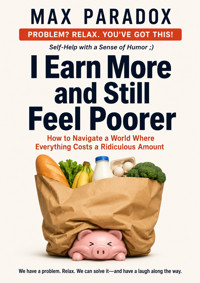
I Earn More and Still Feel Poorer - How to Navigate a World Where Everything Costs a Ridiculous Amount ebook
Max Paradox
Uzyskaj dostęp do tej i ponad 240000 książek od 14,99 zł miesięcznie
- Wydawca: ALL-IN Rafał Płonkowski
- Kategoria: Biznes, rozwój, prawo•Biznes, rozwój
- Język: angielski
You got the raise.
So why does your money still disappear like it has somewhere else to be?
You earn more than you used to, yet groceries feel insulting, insurance keeps climbing, restaurants require emotional preparation, and every subscription company appears to believe your bank account exists as a community resource. On paper, you are doing better. In real life, you keep wondering why “better” feels suspiciously similar to “still worried about money.”
I Earn More and Still Feel Poorer is a practical, funny guide to understanding what is actually happening-and fixing the parts you can control.
Max Paradox breaks down the three forces that usually create the problem: genuine increases in the cost of living, lifestyle creep that quietly absorbs every raise, and expectation inflation that convinces you a normal life should include the visible highlights of five different rich people at once.
Instead of telling you to stop buying coffee and become emotionally attached to coupons, this book shows you how to focus on the decisions that actually matter.
You will learn how to:
calculate what your real life actually costs;
separate expensive from genuinely unaffordable;
identify lifestyle creep before it becomes permanent;
reduce spending without turning your budget into punishment;
review the large recurring costs that matter more than tiny purchases;
use sinking funds so predictable expenses stop behaving like emergencies;
build a realistic budget around the person you actually are;
make every raise permanently improve something;
protect the spending that genuinely improves your life;
decide when cutting expenses is no longer enough and earning more is the correct solution;
build financial margin so one bad month does not wreck the entire system;
create warning signs that tell you when financial pressure is returning;
define what “enough” means before the world keeps moving the finish line.
This is not a book about living as cheaply as possible.
It is about creating a life that costs less than your financial capacity while still containing things you actually enjoy.
No guru speeches. No magical abundance. No fifty-category budget requiring weekly administrative meetings with yourself.
Just practical systems, realistic trade-offs, useful examples, and enough humor to make financial planning feel slightly less like being audited by your own kitchen.
You may not be able to control inflation.
You can control whether every raise disappears.
And you can absolutely stop measuring financial success by whether someone online appears to own a nicer outdoor pizza oven.
This publication was prepared with the assistance of tools that support the creative process, including artificial intelligence-based solutions. The final concept, structure, and editing belong to the author.
Ebooka przeczytasz w aplikacjach Legimi na:
Liczba stron: 210
Rok wydania: 2026
Odsłuch ebooka (TTS) dostepny w abonamencie „ebooki+audiobooki bez limitu” w aplikacjach Legimi na:
Podobne




















INTRO
You get a raise.
For approximately eleven minutes, you feel richer.
You open the email from HR, see the new number, and experience the ancient human emotion known as “Finally, I can stop thinking about money every six minutes.” You imagine sensible things. Maybe you will save more. Maybe you will replace the laptop that currently makes a noise suggesting it has seen combat. Maybe you will order guacamole without first conducting a cost-benefit analysis.
Then normal life resumes.
The grocery bill is somehow $146, even though you bought no champagne, no lobster, and nothing that could reasonably explain $146. Your car insurance renews. Your electric bill has developed ambitions. A streaming service sends you a cheerful message announcing that your plan will now cost “only” a few dollars more per month, as though you and the company have been discussing this together and reached a beautiful compromise. You need toothpaste, detergent, coffee, toilet paper, and possibly a small personal loan.
You look at your paycheck again.
“Didn’t this number used to impress me?”
That is the strange part. You may genuinely earn more than you did three years ago, five years ago, or even last year. Your salary went up. Your bank balance occasionally contains an amount that younger you would have photographed for historical records. Yet somehow your money feels weaker. It arrives with confidence and leaves like it has another appointment.
This is not entirely in your imagination.
Prices rise. Housing can consume an absurd portion of income. Insurance, food, utilities, transportation, childcare, health care, subscriptions, travel, restaurants, services, repairs, and the mysterious category called “things that suddenly cost $79” can all climb faster than your emotional ability to accept them. A salary increase looks impressive in isolation. Life, unfortunately, does not charge you in isolation.
You cannot pay your grocery bill with the sentence, “But technically I make more now.”
The cashier will remain unmoved.
At the same time, there is another part of the problem that nobody enjoys discussing because it is much more satisfying to blame eggs.
As income rises, life often quietly expands around it. The apartment gets slightly better. The car gets newer. The vacations get nicer. Convenience becomes normal. Delivery fees become invisible. The $14 lunch becomes the $22 lunch because that is apparently what lunch has decided to become. You stop comparing certain prices because you can technically afford them, and “technically affordable” slowly turns into a monthly financial ecosystem involving twelve subscriptions, three delivery apps, upgraded seats, premium parking, and a coffee that comes with an origin story.
None of these decisions has to be ridiculous on its own.
That is exactly why this gets difficult.
Almost nobody wakes up one morning and announces, “Today I will destroy my financial breathing room through forty-seven perfectly reasonable transactions.”
It happens gradually.
You upgrade one thing because you can. You keep another expense because canceling it would require finding the password. You pay extra for convenience because Tuesday was exhausting. You decide not to worry about a $9 charge because nine dollars is not a financial emergency. Then nine dollars recruits several friends.
Meanwhile, the world keeps offering you new definitions of what a normal life is supposed to include. Your phone is particularly helpful here. It can show you, before breakfast, someone’s renovated kitchen, someone else’s trip to Japan, a third person’s new car, a fourth person’s “simple everyday outfit” containing $1,800 worth of fabric, and a financial influencer explaining that if you are not maxing out six investment accounts while building three passive income streams, you have apparently misunderstood adulthood.
You were just trying to drink coffee.
Now you are behind in life.
This creates one of the most annoying financial experiences available to modern adults: earning objectively decent money while feeling as if you are constantly losing a race against prices, expectations, and your own upgraded definition of normal.
So you respond in one of several completely understandable ways.
You may obsess over every price. You stand in the supermarket comparing two jars of pasta sauce to save seventy cents, then order $38 worth of takeout because you are too tired to cook the pasta. You may avoid looking at your accounts because numbers are stressful, which is financially similar to covering the fuel gauge with a sticky note. Or you may tell yourself you simply need to earn more.
More income can absolutely help. Sometimes it is the biggest part of the solution.
But “earn more” becomes dangerous when it is the only solution you have.
Because if every additional dollar immediately gets assigned to a more expensive version of your current life, the finish line moves with you. You earn $60,000 and think $75,000 will fix everything. At $75,000, you become convinced the real number is $90,000. At $90,000, your expenses have somehow discovered artisanal cheese, airport lounges, and a deep emotional commitment to next-day shipping.
The target keeps jogging away.
This book is not going to tell you that coffee is ruining your future. Coffee has suffered enough.
It is also not going to tell you that money is “just energy,” that abundance begins when you visualize a yacht, or that the secret to financial peace is waking at 5:00 a.m. and writing affirmations about compound interest. If that works for you, excellent. Your notebook and I wish you well.
We are going to do something less glamorous.
We are going to figure out what “feeling poorer” actually means in your life.
Because several different problems can produce the same feeling. Your essential expenses may genuinely have risen faster than your income. Your lifestyle may have expanded almost invisibly. You may be comparing your current life to an unrealistic standard. You may have plenty of income but no margin. You may be spending on things you barely care about while feeling guilty about things you deeply value. You may have automated so much of your financial life that money now leaves your account with the efficiency of a professional extraction team.
Or you may have a combination of all of them.
Congratulations. Your problem comes as a bundle.
The good news is that you do not need to become a spreadsheet monk.
You need clarity.
You need to know which costs are actually hurting you, which ones merely annoy you, which lifestyle upgrades are worth keeping, which have become expensive wallpaper, and how much financial breathing room you need before your income starts feeling like income again instead of a temporary visitor.
You also need a system that works when life is expensive.
Not a fantasy budget created by someone who believes adults can simply stop needing car repairs, birthday gifts, dentist appointments, vacations, furniture, school supplies, pet emergencies, and occasionally a meal they did not cook themselves.
Real life keeps happening.
The goal is not to defeat inflation personally. That would be ambitious.
The goal is to stop feeling powerless every time the price of something changes.
By the end of this book, you will know how to separate genuine cost pressure from lifestyle creep, decide which expenses deserve your money, build margin without turning your life into punishment, respond when prices rise, and make income increases actually improve your financial situation instead of simply financing a more expensive version of the same stress.
You will also learn when cutting costs is the wrong answer, when earning more really is necessary, and what to do when your budget looks perfectly sensible but you still feel poor.
Most importantly, you will stop treating every financial irritation as evidence that you are failing.
Sometimes the problem really is the economy.
Sometimes it is your spending.
Sometimes it is both.
And sometimes you are standing in a grocery store holding a bag of ordinary grapes that costs $11 and wondering whether they have recently received professional certification.
We will deal with all of it.
Preferably before the grapes require financing.
Wklejony tekst
Chapter 1 - Your Salary Went Up. Your Purchasing Power Did Not Get the Memo
The raise lands on Friday.
By Saturday, you have mentally promoted yourself to a slightly better class of human being.
You are not becoming reckless. Obviously. You are simply acknowledging reality. The better coffee beans are now reasonable. The nicer hotel room is not “luxury”; it is basic spinal protection. Paying an extra $8 for delivery is justified because your time has value now.
Your time had value before.
It just apparently needed a salary increase to receive formal recognition.
Then the bills arrive, and something feels wrong. You earn more than you used to, yet the improvement in your life is strangely difficult to locate. You are not necessarily struggling in the traditional sense. You may be paying everything on time. You may have savings. You may even be doing objectively well.
But your money feels less impressive than the number printed next to your name.
This happens because income and purchasing power are not the same thing.
If your pay rises 5% while the collection of things you regularly buy rises by roughly the same amount—or more—you have received a larger number without necessarily receiving a meaningfully larger life. I am simplifying the economics here, because this is a practical guide, not an attempt to make you regret skipping graduate school.
The important question is not:
“How much more do I earn?”
It is:
“What can my income actually buy now?”
Those are very different questions.
Imagine that three years ago your monthly take-home pay was $4,500. Today it is $5,200. On paper, excellent. Future-you from three years ago would probably look at $5,200 and assume current-you has become financially sophisticated, drinks sparkling water exclusively, and no longer checks the price of parking.
But suppose rent or mortgage costs went up. Groceries went up. Insurance rose. Restaurants became more expensive. Your utility bill developed a side hustle. Flights that used to feel reasonable now require you to whisper, “For that price, I assume I’m helping fly the plane.”
Your income increased.
So did the price of existing.
The mistake is judging your present financial comfort against your old salary while ignoring your present expenses.
That creates false disappointment. You tell yourself, “I should be doing better. I make much more now.”
Maybe.
Or maybe the extra money is already doing useful work just keeping your standard of living where it was.
That is not failure.
It is arithmetic wearing an unpleasant outfit.
Start with reality, not nostalgia
When people feel poorer, they often compare today’s expenses with prices they remember emotionally rather than accurately.
“Coffee used to be two dollars.”
Maybe. Somewhere. During an administration you can barely remember.
“Flights were cheap.”
Some flights were cheap. Some were not. Memory has a wonderful filtering system. It remembers the $189 vacation flight and quietly deletes the one where you paid $642 because your cousin decided to get married during a holiday weekend.
Still, some price increases are very real, and pretending otherwise is useless.
So rather than arguing with the price of eggs in your head, make the problem specific.
Take your five biggest recurring categories:
housing;
groceries;
transportation;
insurance and health costs;
fixed subscriptions, childcare, debt payments, or other major recurring obligations.
Do not begin with every transaction.
That is how a simple financial check becomes a three-hour forensic investigation into why you spent $6.84 at a convenience store on March 14.
Start big.
Compare what those categories cost you now with what they cost you one or two years ago. You do not need perfect historical records. Bank statements, old bills, lease documents, insurance renewals, and rough monthly averages are enough.
You are trying to answer one question:
“How much of my raise has already been absorbed by the same basic life?”
That number matters.
Suppose your take-home income increased by $700 a month, but your core recurring expenses rose by $520. You did not really gain $700 of new flexibility.
You gained about $180.
Suddenly the mystery becomes less mysterious.
You are not terrible with money because the $700 raise did not transform your life. Most of it had already been assigned a job before it arrived.
Money loves arriving pre-employed.
The three ways you can feel poorer
There are three common situations hiding behind the sentence “I earn more but feel poorer.”
The first is real cost pressure. Your essential life genuinely costs more. Housing, food, transportation, insurance, medical expenses, or family costs have increased faster than your income.
The second is lifestyle expansion. Your income increased, and some of the extra money became permanently attached to a more expensive life.
The third is expectation inflation. You earn more, but your idea of what you should be able to afford increased even faster.
Most people have some combination of all three.
This distinction matters because each problem needs a different solution.
If rent increased by $400, canceling a $12 music subscription is not going to restore financial peace.
If your fixed expenses are reasonable but your lifestyle quietly added $900 a month in convenience, entertainment, upgrades, and shopping, blaming the economy alone will not help either.
And if your finances are actually strong but you spend every evening watching people online renovate vacation homes, the spreadsheet may not be the main emergency.
You need the right diagnosis before you start cutting things.
Otherwise you end up aggressively saving on paper towels while leaving the real leak untouched.
Do not confuse expensive with unaffordable
This distinction can save you a surprising amount of stress.
Something can be outrageously expensive and still be affordable for you.
These are separate judgments.
You can stand at a restaurant, look at a $26 burger, and correctly think:
“That is ridiculous.”
You can also afford the burger.
Both things can be true.
People often merge these thoughts:
“This price annoys me.”
therefore:
“I cannot afford this.”
But annoyance is not insolvency.
The reverse mistake also happens:
“I can technically pay for this.”
therefore:
“This is affordable.”
Not necessarily.
If paying for something regularly destroys your savings, forces you onto a credit card, delays bills, or keeps you from funding priorities that matter more, the fact that your debit card approves the transaction is not a financial endorsement.
Your bank is not your life coach.
It is a machine with a green button.
A more useful definition is:
Affordable means you can pay for it without damaging more important obligations or goals.
This is especially important in a world where many normal things have become expensive enough to feel offensive.
You do not need to react to every bad price emotionally.
Ask:
“Is this expensive?”
Then:
“Is it affordable for me?”
Then:
“Is it worth it?”
Three different questions.
A $150 dinner might be expensive, affordable, and absolutely worth it for your anniversary.
A $17 monthly app might be cheap, affordable, and completely pointless because you have not opened it since the day you subscribed.
Price alone tells you very little.
Your personal inflation rate matters more than the headline
You will hear general inflation numbers in the news. Those numbers can be useful for understanding the broader economy, but your household does not spend money exactly like the statistical average household.
If you rent in a city where housing costs jumped sharply, your personal experience may feel worse.
If you own your home with a stable payment, drive very little, and spend modestly on groceries, it may feel less dramatic.
If you have young children, several insurance policies, a long commute, and a dog who has apparently formed a strategic partnership with the veterinarian, your expenses will follow their own path.
Your personal inflation rate is not an official economic statistic.
It is a practical question:
“How much more does my actual life cost?”
You do not need to calculate this to three decimal places.
Please do not.
Nobody needs to announce at dinner, “Our household inflation is currently 6.72%.”
Your family will leave.
Instead, look at the categories that matter most and estimate the change.
For example:
Last year:
housing: $2,000
groceries: $700
transportation: $600
insurance/health: $500
other fixed essentials: $500
Total: $4,300
Now:
housing: $2,150
groceries: $820
transportation: $680
insurance/health: $590
other fixed essentials: $560
Total: $4,800
Your core monthly life became about $500 more expensive.
If your take-home pay rose by $450 over the same period, you did not become richer in practical terms.
You became $50 more annoyed.
The numbers do not need to be perfect. They need to be useful.
What does not work: fighting every price increase
One common reaction to higher prices is to start treating every purchase as a moral crisis.
You stand in the grocery aisle staring at cereal.
“This used to be $4.29.”
Now it is $5.49.
You stare harder.
The cereal remains unmoved by your historical evidence.
Then you check three stores online, drive twelve minutes to save eighty cents, and return home feeling financially victorious despite spending gas, time, and part of your remaining emotional stability.
Price awareness is useful.
Price obsession is expensive in a different currency.
Your goal is not to defeat every price increase.
Your goal is to protect your overall financial position.
That means focusing on decisions with meaningful impact.
Saving $100 a month on insurance matters.
Reducing a housing cost by $300 matters.
Changing an expensive commuting pattern might matter.
Getting angry at a fifty-cent increase in mustard is mostly cardio.
Use the 80/20 financial irritation test
When a price increase annoys you, ask two questions:
Does this expense happen often?
Is the dollar impact meaningful over a year?
If the answer to both is yes, investigate.
If not, consider letting it go.
Suppose your gym membership increased by $8 a month.
Annual impact: $96.
If you use the gym four times a week and genuinely value it, spending an hour trying to save $96 may not be a useful project.
But suppose your auto insurance increased by $85 a month.
Annual impact: $1,020.
That deserves attention.
Call. Compare. Requote. Ask about discounts. Review coverage.
Do not perform equal emotional labor for unequal financial consequences.
Money management gets much easier when every price increase does not receive a full congressional hearing.
Your action for this chapter
Today, do one simple calculation.
Write down:
Monthly take-home income increase over the last one or two years: $_
Then estimate:
Increase in major recurring expenses: $_
Subtract the second from the first.
That remaining number is a much better estimate of how much financial progress your raise actually created.
If the result is strong, good. The problem may be lifestyle expansion or expectations.
If it is tiny, your feeling makes sense. Most of the raise has been absorbed.
If it is negative, cost pressure is real and you will need a bigger response than finding cheaper laundry detergent.
No shame.
No drama.
Just the correct problem.
You cannot control every price.
But you can stop being confused about what your income is actually doing.
And confusion is expensive enough already.
Chapter 2 - The Lifestyle Creep That Wears Normal Clothes
Lifestyle creep rarely enters your house carrying a designer bag and yelling, “I HAVE COME FOR YOUR SAVINGS.”
That would be easier.
You could refuse entry.
Instead, it arrives as sensible upgrades.
You earn more, so you move to a slightly better apartment. Reasonable.
You buy a newer car because your old one has started making a sound engineers would classify as “concerning.” Reasonable.
You subscribe to a meal service because work is busy. Reasonable.
You upgrade your phone plan, choose better hotels, start using rideshares more often, order groceries occasionally, buy nicer clothes, replace cheap furniture, pay someone to clean twice a month, and stop checking menu prices quite so carefully.
Individually, almost everything makes sense.
Collectively, your raise has disappeared.
This is lifestyle creep.
Not wild spending.
Not financial stupidity.
Just a slow increase in the cost of your normal life.
That word matters: normal.
The dangerous part is not buying something expensive once.
It is turning a higher level of spending into the new minimum.
One upgrade becomes the baseline
Imagine your old monthly lifestyle cost $3,500.
You get a raise and gain an extra $700 a month after tax.
Excellent.
You decide to improve a few things:
better apartment: +$250;
nicer car payment or lease: +$180;
meal delivery and convenience: +$120;
subscriptions and services: +$60;
eating out slightly more: +$150.
Total increase: $760.
Your $700 raise has now produced a $60 monthly deficit.
Financial progress has somehow achieved negative numbers.
This does not mean every upgrade was wrong.
Maybe the apartment shortened your commute by forty minutes. Maybe the car is safer. Maybe meal delivery prevents you from eating cereal over the sink on Wednesday night while staring into the middle distance.
Quality of life matters.
The problem is upgrading without deciding what the raise is supposed to accomplish first.
Most people do this backward.
The extra income arrives.
Then life expands.
Then whatever remains is called “savings.”
Often, very little remains.
Savings gets the leftovers like an unpopular dinner guest.
Give the raise a job before your lifestyle finds one
The easiest time to control lifestyle creep is before you get used to the higher income.
When income increases, divide the increase deliberately.
For example:
You receive an extra $600 a month after tax.
Before changing anything, decide:
$250 to savings or investing;
$150 to debt reduction or another financial goal;
$150 to lifestyle improvement;
$50 left as extra monthly margin.
The percentages are not sacred. Your situation may require a completely different split.
The principle is what matters:
Decide how much of the raise is allowed to become lifestyle.
Do this before your brain discovers premium groceries.
Humans adapt quickly to improvements. This is useful when surviving difficult situations and deeply inconvenient when trying to appreciate a heated steering wheel.
The first week:
“This is incredible.”
Three months later:
“Cars without heated steering wheels should probably be illegal.”
Once an upgrade becomes normal, removing it feels like a loss.
That is why lifestyle creep is so sticky.
You are not comparing the expense with your old life anymore.
You are comparing cancellation with your current life.
Lifestyle creep hides in recurring convenience
Large purchases attract attention.
Small recurring conveniences are stealthier.
Consider the modern convenience stack:
grocery delivery, restaurant delivery, streaming, premium music, cloud storage, app subscriptions, expedited shipping, rideshares, automatic car washes, meal kits, prepared food, premium banking, upgraded phone storage, subscription software, pet services, housekeeping, coworking, extra data plans, and various memberships you joined because someone offered the first month free.
None of these is automatically bad.
That is important.
I am not here to tell you to cancel everything and wash your clothes in a river.
Convenience is one of the best things money can buy.
If spending $120 a month on cleaning gives you six hours back and prevents Saturday from becoming an argument involving dust, that may be an excellent purchase.
But convenience should solve a problem you actually care about.
Otherwise you are paying a permanent tax on habits you no longer notice.
Open your bank or card statement and find recurring conveniences.
For each one, ask:
“Would I sign up for this today at this price?”
Not:
“Do I use it occasionally?”
Not:
“Could it theoretically become useful again?”
Not:
“Was canceling difficult last time?”
Would you actively choose it today?
If the answer is no, that tells you something.
Your financial life contains fossils.
Beware of the upgraded ecosystem
Some lifestyle upgrades do not cost what they appear to cost.
They create supporting expenses.
A larger home may mean:
higher utilities;
more furniture;
more maintenance;
higher insurance;
more cleaning;
more things to decorate because apparently an empty wall is a personal insult.
A more expensive car can bring:
higher insurance;
higher taxes or registration costs;
more expensive tires;
more expensive maintenance;
premium fuel in some cases;
a sudden inability to park near shopping carts because “someone might scratch it.”
A more expensive social life can bring:
better restaurants;
pricier drinks;
rideshares;
nicer clothes;
trips;
gifts;
events;
the financial black hole known as “we should all do a weekend somewhere.”
This is why big upgrades should be evaluated as systems.
Do not ask:
“Can I afford the payment?”
Ask:
“What does owning this version of the thing make my life cost?”
That question is much less exciting.
It is also much more useful.
The “I deserve it” trap
After working hard, earning more can feel like permission.
You deserve the upgrade.
You deserve the trip.
You deserve the convenience.
You deserve to stop looking at prices.
Maybe you do.
But “I deserve it” is not a budgeting category.
This phrase becomes dangerous when it ends the decision instead of informing it.
You can deserve a vacation and still choose the cheaper hotel.
You can deserve a new car and decide your current one is fine.
You can deserve takeout after a brutal day without converting brutal days into a weekly restaurant subscription.
Deserving something does not answer whether it is worth the trade-off.
The better question is:
“What do I want this money to do for me?”
Sometimes the answer is pleasure.
Excellent.
Spend it.
Sometimes the answer is relief, convenience, security, freedom, time, or lower stress.
Also excellent.