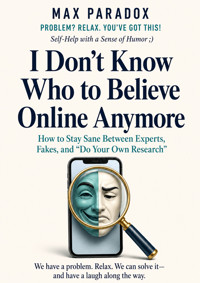
I Don't Know Who to Believe Online Anymore - How to Stay Sane Between Experts, Fakes, and “Do Your Own Research” ebook
Max Paradox
Uzyskaj dostęp do tej i ponad 240000 książek od 14,99 zł miesięcznie
- Wydawca: ALL-IN Rafał Płonkowski
- Kategoria: Biznes, rozwój, prawo•Biznes, rozwój
- Język: angielski
The internet was supposed to put the world’s knowledge in your pocket.
Instead, your pocket now contains experts who disagree, influencers who are absolutely certain, screenshots with no source, statistics with no denominator, old videos presented as breaking news, and a stranger in a truck explaining why everyone except him is lying.
So whom are you supposed to believe?
I Don't Know Who to Believe Online Anymore: How to Stay Sane Between Experts, Fakes, and “Do Your Own Research” is a practical, funny guide to evaluating online information without becoming either gullible or permanently suspicious of civilization.
Max Paradox shows you how to separate confidence from evidence, judge whether an expert is actually relevant to the topic, trace screenshots and viral claims back to their original sources, read scientific research without needing a PhD, recognize misleading statistics, distinguish real disagreement from manufactured controversy, and decide when you have enough information to stop researching.
You will learn how to:
identify the exact claim hiding underneath emotional language;
tell the difference between popularity and credibility;
detect cherry-picked numbers, cropped quotes, misleading clips, and missing context;
use experts intelligently without treating credentials as magic;
recognize when your own confirmation bias is helping a claim through security;
build a fast verification routine for everyday situations;
handle claims when credible sources genuinely disagree;
talk to friends and relatives who send questionable information without turning the family chat into a tribunal;
know when to say “I don’t know” and continue having a perfectly normal day.
This is not a book about distrusting everything. Blind distrust is just blind trust wearing darker sunglasses.
It is a book about calibrated trust.
About knowing what deserves confidence, what deserves caution, what deserves another source, and what deserves the ancient research technique known as closing the tab.
The advice is designed for normal people with jobs, families, limited energy, and no desire to spend every evening performing forensic analysis on TikTok. Each chapter moves from recognizable everyday absurdity to clear, practical methods you can actually use.
No guru language.
No demand that you become an amateur intelligence agency.
No requirement to personally replicate a clinical trial before breakfast.
Just a better system for thinking clearly in an information environment that profits when you do the opposite.
Because the goal is not to become impossible to fool.
The goal is to become harder to fool, quicker to correct, and much better at knowing when the evidence is strong enough to act.
And perhaps to stop donating entire evenings to a screenshot posted by someone named @TruthHammer1776.
This publication was prepared with the assistance of tools that support the creative process, including artificial intelligence-based solutions. The final concept, structure, and editing belong to the author.
Ebooka przeczytasz w aplikacjach Legimi na:
Liczba stron: 201
Rok wydania: 2026
Odsłuch ebooka (TTS) dostepny w abonamencie „ebooki+audiobooki bez limitu” w aplikacjach Legimi na:
Podobne

















INTRO
You are sitting on the couch, holding your phone, trying to answer what should be a simple question.
Is this true?
That is all. You are not decoding intercepted military communications. You are not testifying before Congress. You are not examining a mysterious briefcase discovered under a park bench. You just want to know whether something you saw online is actually true.
Unfortunately, the internet has other plans.
One article says yes. Another says absolutely not. A doctor in a video explains that the first article is dangerously misleading. A man filming himself in a truck says doctors cannot be trusted because “they don’t want you to know this.” Someone in the comments says the truck guy has been debunked. Someone else says the debunkers are funded by the same people who funded the original study, which was apparently conducted by criminals, lobbyists, pharmaceutical companies, the government, Big Broccoli, or some exciting combination of all four.
Twenty minutes later, you know less than when you started.
But you do have eleven browser tabs open.
This is one of the strangest problems of modern life. We have access to more information than any ordinary person in history, yet sometimes finding out what is true feels like trying to identify the most trustworthy raccoon in a dumpster. Everyone is making noise. Several of them appear confident. One has a podcast.
The problem is not simply that there is misinformation online. There has always been misinformation. Humans were confidently telling one another nonsense long before Wi-Fi arrived. The internet merely gave nonsense excellent distribution, professional lighting, subtitles, dramatic background music, and a button that says SHARE.
The harder problem is that bad information increasingly looks like good information.
A ridiculous claim does not necessarily arrive wearing a ridiculous hat. It may have charts. It may cite studies. It may be delivered by someone with letters after their name. It may appear on an expensive-looking website whose design politely whispers, “We have definitely checked this.”
Meanwhile, accurate information can look uncertain, complicated, and annoyingly unsatisfying. A legitimate expert may say, “The evidence suggests this, although there are limitations and we need more data.”
Then a stranger on TikTok says:
“No. Here’s what they’re hiding from you.”
One of these statements is much more exciting.
Guess which one gets twelve million views.
Our brains do not naturally evaluate information like calm little scientific committees. We notice confidence. We like clear stories. We remember emotional claims. We trust people who sound familiar, speak our language, share our frustrations, or confirm something we already suspected. We are especially vulnerable when the topic makes us angry, scared, hopeful, disgusted, or eager to forward something to the family group chat before Uncle Steve beats us to it.
This does not mean you are stupid.
It means you own a human brain.
Unfortunately, so does Uncle Steve.
The normal reaction to all this confusion is to search harder. You read more posts, watch more videos, open more links, and keep going until certainty finally appears.
Often, certainty does not appear.
Fatigue does.
After enough conflicting information, people usually drift toward one of two bad strategies. The first is believing whatever feels most convincing. The second is giving up completely and deciding that nobody knows anything, every institution is corrupt, every expert is compromised, every study is fake, and the only intellectually responsible position is apparently sitting in the kitchen saying, “Who can really know?” while refusing to trust the expiration date on milk.
Neither approach works.
Blind trust makes you easy to fool.
Blind distrust does too.
That second point matters because skepticism has developed an excellent public image. Being skeptical sounds intelligent. It sounds independent. It suggests you are not one of those gullible people who simply believe things because an authority said them.
Good.
You should not believe something merely because an authority said it.
But automatically rejecting something because an authority said it is not independent thinking either. That is just obedience with the direction reversed.
If someone says, “Experts believe X,” and your automatic response is, “Then X must be false,” the experts are still controlling your opinion. You have simply installed the rebellious version of the software.
This book is about developing a better system.
Not a perfect system. You are not going to finish Chapter 20 and become a walking lie detector who can identify fabricated statistics from across a parking lot. There is no magical checklist that turns every complicated issue into a five-minute certainty festival.
Some questions really are difficult.
Experts genuinely disagree sometimes. Research changes. Early conclusions get revised. Journalists make mistakes. Institutions can fail. Companies have incentives. Politicians spin facts. Influencers oversimplify. People misunderstand studies. Algorithms reward outrage. Your cousin can read three paragraphs about something on Tuesday and begin offering consultations by Wednesday.
Reality is messy.
The goal is not to remove uncertainty.
The goal is to stop being helpless in front of it.
You will learn how to separate a claim from the person delivering it, judge expertise without worshipping credentials, recognize common manipulation tactics, check whether a source actually supports what someone says it supports, and decide when a disagreement matters. You will learn how to handle studies without pretending you need a PhD in statistics before buying toothpaste. You will learn why screenshots, clips, graphs, anonymous insiders, viral anecdotes, and impressive-looking numbers deserve different levels of trust.
Most importantly, you will build a practical method for deciding what deserves your attention.
Because another major problem is not merely believing false things. It is spending ridiculous amounts of time investigating claims that never deserved fifteen seconds of your life.
Someone posts:
“Scientists FINALLY admit coffee changes your DNA.”
Now you are reading a forty-page paper at 11:47 p.m. despite having no idea what half the terminology means.
This is not media literacy.
This is being kidnapped by a headline.
We will also deal with the phrase that has become both reasonable advice and an international comedy project:
“Do your own research.”
Yes, you should check things for yourself when the issue matters. No, this does not mean watching seventeen videos until someone finally agrees with you. Research is not an Easter egg hunt where the prize is the opinion you wanted at the beginning.
Sometimes doing your own research means reading the original source.
Sometimes it means comparing multiple reliable sources.
Sometimes it means finding out what qualified people in a field broadly agree on.
And sometimes it means admitting, “I do not know enough about semiconductor manufacturing, monetary policy, vaccine development, structural engineering, and maritime law to personally settle this before dinner.”
That sentence is not intellectual failure.
It is intellectual adulthood.
You do not need to know everything. You need to know how to decide what deserves confidence, what deserves caution, what deserves further checking, and what deserves the ancient scholarly response of closing the tab.
That is what we are going to build.
A system calm enough to work when the internet is screaming.
Simple enough to use when you are tired.
Skeptical without becoming cynical.
Open-minded without leaving the front door of your brain unlocked.
You will still encounter bad information. You will occasionally believe something that turns out to be wrong. So will I. So will experts. So will the person currently posting “WAKE UP” beneath a video recorded vertically in a parked car.
The goal is not to become impossible to fool.
The goal is to become much harder to fool—and much easier to correct.
That is a far more useful superpower.
Wklejony tekst
Chapter 1 - Confidence Is Not Evidence
A man appears in your feed looking directly into the camera.
He is calm. Serious. Certain.
“Everything you’ve been told about this is wrong.”
Excellent.
Apparently Tuesday has been canceled.
He speaks quickly but clearly. He has dates, names, percentages, and screenshots. At one point he says, “I’ve spent hundreds of hours researching this,” which sounds impressive until you remember that people have also spent hundreds of hours building medieval castles in Minecraft. Time invested proves dedication. It does not automatically prove correctness.
Still, the video works.
You feel yourself leaning toward belief.
Not because you have checked the evidence yet. You have not even finished your coffee. You believe him a little more because he sounds like someone who knows.
This is one of the internet’s most important illusions:
confidence feels like evidence.
It is not.
Confidence is a delivery style.
Sometimes knowledgeable people are confident because they genuinely understand the subject. Sometimes poorly informed people are confident because they do not understand enough to realize how complicated the subject is. Sometimes people are confident because uncertainty performs terribly online.
Nobody builds a viral video around:
“I’ve looked into this fairly carefully, and my current interpretation is that the answer is probably yes under several conditions, although there are limitations.”
That may be responsible.
It is not exactly setting TikTok on fire.
Certainty is simpler. Certainty is satisfying. Certainty gives the brain a chair to sit in.
“This is what happened.”
“This is what causes it.”
“These people are lying.”
“This product works.”
“This food is toxic.”
“This investment cannot lose.”
“This politician personally controls the price of cereal.”
The last one is especially useful because cereal prices, like all complex systems, are obviously governed by one person standing behind a curtain with a large red Kellogg’s lever.
The human brain likes clear cause and effect. We prefer a confident explanation over an accurate fog of probabilities. When something feels confusing, a person who seems absolutely certain can provide emotional relief.
That relief is dangerous if we confuse it with verification.
Why confidence persuades us
Imagine two people answering the same question.
Person A says:
“The evidence is mixed. Several studies point in this direction, but there are limitations, and the effect seems smaller than people often claim.”
Person B says:
“This has been proven. Anyone telling you otherwise is either ignorant or lying.”
Person B sounds stronger.
But notice what has happened.
You have learned almost nothing about the quality of the evidence. You have mainly learned about the speaker’s willingness to remove uncertainty from the sentence.
That is not the same thing.
Real expertise often produces more precise language, not more dramatic language. Someone who understands a complicated subject knows where the edges are. They may distinguish between strong evidence and weak evidence, correlation and causation, early findings and established knowledge.
This can make actual expertise sound less impressive than amateur certainty.
The expert says:
“It depends.”
The influencer says:
“It’s obvious.”
Your brain says:
“Finally. Someone useful.”
Poor brain.
It means well.
The certainty discount
A simple rule will make you harder to fool:
The more certainty someone displays, the more you should ask what justifies that certainty.
Do not automatically distrust confident people. Confidence is not evidence of dishonesty either. Sometimes the answer really is clear.
The point is to separate two questions:
How confidently is this person speaking?
How strong is the support for what they are saying?
Those are different questions.
Online, they are constantly merged.
Someone may speak with 100 percent confidence while supporting only 30 percent of the claim.
This happens especially when the claim goes beyond the evidence.
A study finds that people who do X have a slightly higher rate of Y.
The headline becomes:
“Scientists Discover X Causes Y.”
The video becomes:
“STOP DOING X IMMEDIATELY.”
The comments become:
“I always knew X was poison.”
By lunchtime, X has gone from statistical association to attempted murder.
This is how information grows while traveling.
Not better.
Larger.
Separate the claim from the performance
When you see a confident statement, mentally remove the speaker.
Imagine the exact same words appearing as plain text on a blank page.
No dramatic music.
No expensive studio.
No lab coat.
No blue check.
No furious eyebrows.
Would the claim still seem strong?
This is surprisingly useful because presentation affects judgment more than we like to admit.
A person in a studio with a microphone can look authoritative.
A person standing beside a bookshelf can look intellectual.
A person wearing medical scrubs can look clinical.
A person standing next to a sports car can apparently explain cryptocurrency.
Human civilization has made several questionable design decisions.
Strip away the aesthetics and write down the actual claim.
Not the entire post.
The claim.
For example:
“Eating this ingredient causes inflammation.”
“The government changed this statistic.”
“This study proves the treatment is ineffective.”
“This video shows what happened at the protest.”
“This company is about to collapse.”
“This expert was paid to say this.”
Once the claim is isolated, you can investigate it.
Before that, you are often reacting to theater.
The Claim Test
Whenever a piece of online information matters enough to influence your beliefs, purchases, health decisions, money, vote, relationships, or general level of panic, run three quick questions.
1. What exactly is being claimed?
Be specific.
“This is bad for you” is not a useful claim.
“Eating one serving per day increases the risk of X by Y percent” is something you can examine.
Likewise:
“They’re manipulating the data” is vague.
“Agency A changed metric B in 2024, which reduced the reported figure from X to Y” is testable.
Vague claims are excellent hiding places.
You cannot easily disprove:
“They don’t want you to know.”
Who are “they”?
What do they not want you to know?
Why?
How?
Apparently “they” have enormous resources yet remain unable to stop Derek from Ohio uploading a fourteen-minute video.
2. What evidence is being offered?
Look for the actual support.
A screenshot?
A study?
A statistic?
A quote?
A clip?
A personal experience?
A link to another person making the same claim?
These forms of evidence are not equally strong.
If someone says, “There are dozens of studies,” but shows none, you currently have zero studies.
You have a sentence about studies.
This distinction saves time.
3. Does the evidence support the whole claim?
This is where many persuasive posts fall apart.
The evidence may support part of the claim but not the dramatic conclusion.
For instance:
Evidence: A company closed three locations.
Claim: “The company is collapsing.”
Possible.
But three closures do not prove collapse.
Evidence: A scientist previously worked for a pharmaceutical company.
Claim: “Therefore the study is fraudulent.”
Possible conflict worth examining.
Still not proof of fraud.
Evidence: A politician made an incorrect statement.
Claim: “Everything this politician says is false.”
That would require an almost supernatural level of consistency.
Humans are not that efficient.
The question is not:
“Can I imagine a story connecting the evidence to the conclusion?”
The internet specializes in stories.
The question is:
“Does the evidence actually justify the size of the conclusion?”
That is much stricter.
And much more useful.
Beware the confidence costume
Certain phrases should not automatically make you reject a claim, but they should make your verification antenna rise slightly.
For example:
“This changes everything.”
“They don’t want you to know.”
“This proves it.”
“There is zero doubt.”
“Anyone who disagrees is lying.”
“Do your research.”
“I’ve connected the dots.”
“The media will never show you this.”
Sometimes these statements may accompany something true.
But they are also common tools for manufacturing certainty.
Strong evidence should be able to survive without emotional scaffolding.
If the claim needs you to feel betrayed before you examine it, that is useful information.
It does not prove the claim is false.
It proves persuasion is happening.
Those are different things.
The five-minute experiment
Try this today.
The next time you encounter a claim that immediately makes you think, “Wow,” “That’s terrifying,” or “I knew it,” do not share it.
Do not comment.
Do not begin a research expedition requiring snacks.
Write the claim in one neutral sentence.
Then ask:
What is the evidence?
Where did that evidence originally come from?
Does it support the entire claim?
What would make me change my mind?
That final question matters.
If your answer is “nothing,” you are no longer investigating.
You are defending.
There is a difference.
When confidence actually matters
Confidence can still be useful information when it is properly connected to expertise and evidence.
If a structural engineer says a particular bridge design is unsafe, the confidence matters partly because the person has relevant knowledge.
But even then, credentials alone are not the whole case. You would want to know what the concern is, whether other qualified engineers agree, and whether the explanation fits the available facts.
Likewise, if a random social-media user says the bridge is unsafe because they “looked at the vibrations,” the equal confidence does not create equal expertise.
This sounds obvious until both appear in adjacent videos and the second person has better editing.
Modern epistemology has many enemies.
One is ring lighting.
Instead of this, do this
Instead of asking:
“Does this person sound convincing?”
Ask:
“What would convince me if I did not know who said it?”
Instead of:
“They seem very sure.”
Ask:
“What is the strongest evidence they provide?”
Instead of:
“They have a lot of followers.”
Ask:
“Are they knowledgeable about this specific subject?”
Instead of:
“This confirms what I already thought.”
Ask:
“What evidence would challenge this?”
That last question feels less fun.
Which is exactly why it works.
Plan B: when you do not have time to verify
You will not investigate every claim you see.
You should not.
If you attempted to verify the entire internet before breakfast, your employment situation would soon change.
When the claim is low-stakes and you do not have time to check it, use a temporary category:
Unverified.
Not true.
Not false.
Not “probably true because Kevin posted it.”
Unverified.
This is one of the most useful mental categories because it prevents your brain from demanding a verdict when no verdict is necessary.
You are allowed to say:
“I don’t know.”
You may even continue eating lunch afterward.
Nothing happens.
There are no sirens.
Your action
For the next twenty-four hours, notice the first claim online that produces a strong emotional reaction.
Do not investigate immediately.
First reduce it to one neutral sentence.
Then identify what evidence is actually being offered.
That is the skill.
Before checking whether something is true, make sure you know exactly what “something” is.
A confident voice can point you toward evidence.
It cannot replace it.
The internet has enough performers.
You need a system.
Chapter 2 - Your Brain Has Favorites
You open two articles.
The first says something you already believe.
Excellent article.
Well researched.
Very sensible.
Possibly the finest journalism produced in the English language.
The second challenges your opinion.
Poorly written.
Biased.
Suspicious funding, probably.
Who approved this font?
Within fifteen seconds, your brain has completed a rigorous peer review based partly on whether the conclusion was emotionally convenient.
Welcome to confirmation bias.
Do not worry. Everyone else has it too, including the people currently explaining online that confirmation bias affects everyone except them.
Confirmation bias is the tendency to notice, remember, seek out, and favor information that supports what we already believe. It does not mean you consciously decide to ignore facts.
Usually it is much quieter.
Information that agrees with you simply feels better.
It slides into place.
“That makes sense.”
Information that contradicts you creates friction.
You suddenly become a forensic investigator.
“Who funded this?”
“What was the sample size?”
“Was this published on a Tuesday?”
“Interesting that the author once attended a conference sponsored by Pepsi.”
The questions may be legitimate.
The suspicious part is that you did not ask any of them about the article you liked.
Your standards can move
Imagine you believe a particular diet is excellent.
You see a headline:
“New Study Finds Popular Diet Improves Heart Health.”
You think:
Interesting.
You read the summary.
Seems reasonable.
Later you see:
“New Study Raises Concerns About Popular Diet.”
Now suddenly you want methodology.
You want participant demographics.
You want the preregistration.
You would like to personally interview the statistician.
Maybe the second study deserves scrutiny.
But so did the first one.
A fair information system applies roughly similar standards whether the conclusion feels good or bad.
This is difficult because belief is not just intellectual. Beliefs can become connected to identity, community, pride, fear, previous decisions, and the unbearable possibility that someone named Brad was right in an argument six months ago.
Nobody wants that.
Especially Brad.
Why changing your mind feels expensive
Suppose you have publicly argued for something.
You posted about it.
You defended it.
You sent your friend three articles.
At one point you wrote:
“Please educate yourself.”
Dangerous sentence.
Now new evidence appears suggesting you may have been wrong.
This is no longer simply an information problem.
It is a reputation problem.
If you change your mind, you may need to admit it. Maybe only to yourself. Maybe to the person who received seventeen messages from you at 1:12 a.m.
Your brain notices the cost.
So instead of asking:
“Is this new information correct?”
you may unconsciously ask:
“How can I make this new information go away?”
Very different research project.
This is why intelligent people are not immune to misinformation. Intelligence can sometimes help people defend bad beliefs more skillfully.
A clever person can build a beautiful argument around almost anything if the goal is not truth but victory.
Give the brain enough motivation and it becomes a lawyer.
Not a neutral judge.
A lawyer.
And its client is your existing opinion.
The favorite-story problem
We all have stories we prefer.
Big companies are greedy.
Small businesses are honest.
Experts know best.
Experts are arrogant.
Natural things are safer.
Technology solves problems.
Technology creates problems.
Politicians are incompetent.
Politicians are secretly masterminds capable of coordinating thousands of people without anyone accidentally replying all.
Different people prefer different stories.
The danger begins when every new event gets forced into the same story.
If you believe corporations are always malicious, every corporate mistake becomes evidence of a plot.
If you believe institutions are always trustworthy, every institutional failure becomes an exception.
If you believe outsiders are always brave truth-tellers, every outsider becomes credible merely because established people criticize them.
That last one is especially common online.
A person gets rejected by experts.
They say:
“See? They’re afraid of me.”
Maybe.
Or maybe the experts rejected the claim because it is nonsense.
Being opposed by authority does not automatically make you Galileo.
Sometimes you are just Gary with a Facebook Live.
The emotional speed test
One useful warning sign is speed.
How quickly did you want to believe the claim?
If the answer is “immediately,” pause.
Fast belief often means the claim connected with something you already wanted to be true.
This is especially important with content that produces:
vindication;
outrage;
fear;
tribal pride;
revenge;
moral superiority;
relief.
Consider the sentence:
“New report proves your side was right all along.”
That is intellectual candy.
Your brain wants to unwrap it immediately.
Do not deny yourself candy.
Just check whether it is actually candy.
The internet has handed out several batteries in attractive wrappers.
The Opposite-Day Test
Here is a simple method.
When you encounter a claim you agree with, imagine the conclusion were reversed.
Then ask:
Would I accept this evidence if it supported the other side?
Suppose someone posts a survey showing that 72 percent of people agree with your position.
You like the result.
Now imagine the survey showed 72 percent agreeing with the opposite position.
Would you suddenly ask:
Who conducted the survey?
How were participants selected?
How was the question worded?
How many people responded?
If yes, congratulations.
You have discovered your actual quality standards.
Use them both times.
The same principle works with experts.
If you dismiss an expert because they received industry funding, would you also dismiss an expert supporting your view for the same reason?
If you distrust a newspaper because it has made mistakes, do you apply the same rule to the website you regularly share?
If one inaccurate prediction destroys credibility for a person you dislike, how many inaccurate predictions are allowed for the person you enjoy listening to?
This exercise is uncomfortable.
Good.
Comfort is not the goal.