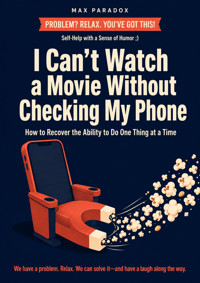
I Can't Watch a Movie Without Checking My Phone - How to Recover the Ability to Do One Thing at a Time ebook
Max Paradox
Uzyskaj dostęp do tej i ponad 240000 książek od 14,99 zł miesięcznie
- Wydawca: ALL-IN Rafał Płonkowski
- Kategoria: Literatura popularnonaukowa•Nauki humanistyczne
- Język: angielski
You sit down to watch a movie you actually wanted to see. Ten minutes later, you are checking messages. Then the weather. Then the actor who looks familiar. Then a restaurant that appeared in the background. By the time you look up again, someone has been betrayed, a suitcase has disappeared, and you have absolutely no idea who Daniel is.
If this sounds familiar, I Can't Watch a Movie Without Checking My Phone is for you.
This practical, funny self-help guide tackles a very modern problem: the growing inability to stay with one activity without reaching for another source of stimulation. It is not about declaring smartphones evil, deleting every app, or moving to a cabin where the strongest available signal comes from a suspicious squirrel.
It is about recovering choice.
Max Paradox explains why constant checking becomes automatic, why boredom suddenly feels intolerable, why notifications are only part of the problem, and why the urge to reach for your phone often begins before the phone enters the story. You will learn how fragmented attention affects movies, work, reading, meals, conversations, rest, and the small empty moments that used to be known simply as “waiting.”
More importantly, the book gives you concrete ways to change it.
You will learn how to use short single-task blocks, build realistic phone boundaries, create deliberate checking windows, stop following every thought the second it appears, stay through the moment when an activity becomes less stimulating, and recover quickly after interruptions. You will also learn how to make these methods work on tired days, stressful days, chaotic workdays, and evenings when your energy level is approximately potato.
There are no heroic digital detoxes here. No lectures about discipline. No demand that you meditate at sunrise while holding a handcrafted notebook.
Instead, you get practical methods designed for normal people with jobs, families, messages, responsibilities, habits, bad days, and Wi-Fi.
The goal is not to stop using your phone.
The goal is to stop letting your phone automatically enter every movie, meal, conversation, task, walk, and quiet moment.
Because attention is not valuable only when you are working. It determines how much of your own life you actually experience.
One thing at a time can feel strangely difficult.
It can also become normal again.
And yes, you may finally discover why the suitcase mattered.
This publication was prepared with the assistance of tools that support the creative process, including artificial intelligence-based solutions. The final concept, structure, and editing belong to the author.
Ebooka przeczytasz w aplikacjach Legimi na:
Liczba stron: 208
Rok wydania: 2026
Odsłuch ebooka (TTS) dostepny w abonamencie „ebooki+audiobooki bez limitu” w aplikacjach Legimi na:
Podobne



















INTRO
You sit down to watch a movie you actually chose. Not something your partner picked while you negotiated for “anything except a three-hour historical drama,” but a movie you genuinely wanted to see. The lights are low, the snacks are within reach, and for once nobody needs anything from you. Seven minutes later, your hand is holding your phone. You are not sure when this happened. One second the hero was discovering a mysterious key; the next you were checking whether a person you have not spoken to since college has posted a vacation photo.
The movie continues bravely without your full participation.
You put the phone down and return to the plot. Someone is running. There is a suitcase. Apparently a betrayal has occurred. You rewind thirty seconds, watch the scene again, and then notice a message notification. It is from a group chat containing seventeen messages, thirteen of which are reactions to a photo of somebody’s dinner. You open it anyway. By the time you look back at the television, the suitcase is gone and a new character exists who you are expected to recognize. You blame the movie for being confusing.
This is a very efficient system if your goal is to watch the same scene four times.
The problem is not that your phone is evil or your attention span has permanently dissolved into glitter. Your brain has simply become extremely practiced at switching. Check the movie. Check the phone. Search the actor because he looks familiar. Discover he was in a show you watched in 2019. Check what happened to that show. Read a headline. Return to the movie. Wonder why everyone is suddenly in Paris. Your brain is not failing to focus because it has forgotten how. It is responding exactly as you have trained it to respond: when one thing becomes even slightly slow, uncertain, quiet, or demanding, go find another thing.
And the phone is always ready with another thing.
The same pattern shows up when you read three pages of a book and realize your eyes have been moving while your mind has been shopping for headphones. It appears when you answer an email, stop halfway to check a message, open a browser tab, remember you need toothpaste, and somehow end up watching a comparison of electric toothbrushes narrated by a man who takes gum health more seriously than most governments take infrastructure. Twenty-five minutes later, the email still begins, “Hi Sarah,” which now feels less like correspondence and more like an archaeological site.
The phone is especially good at exploiting tiny moments of discomfort. A movie slows down for character development? Phone. A work task becomes difficult? Phone. You are waiting for someone for ninety seconds? Phone. You sit on the couch and experience a mysterious four-second gap in stimulation? Absolutely not. Emergency deployment of content. We have trained ourselves to treat boredom like smoke coming from the engine.
The strange part is that most checks are not even rewarding. You pick up the phone expecting something interesting and receive an email about a sale, a notification from an app you forgot you installed, two headlines designed to raise your blood pressure, and a photo of someone else’s lunch. Then you put the phone down feeling neither informed nor entertained. Ten minutes later, you check again, as if the internet may have undergone a major renovation.
Maybe this time there will be better furniture.
None of this means you lack discipline. You are dealing with a device and an environment built around interruption, novelty, and extremely low-friction access to stimulation. Your phone contains messages, work, music, maps, photos, shopping, news, entertainment, banking, social life, weather, calendars, videos, and enough opinions to keep a medium-sized civilization arguing until 4:00 a.m. The advice to “just put it down” is technically correct in the same way that “just spend less” is correct financial advice. Lovely. We have identified the final step. Now perhaps we could discuss the inconvenient part where a human being has to do it.
This book is about that inconvenient part.
You are not going to be asked to move into a cabin, buy a minimalist alarm clock carved from sustainable wood, or announce that you are “doing a digital detox” as if your phone has been living on bourbon. The goal is more ordinary and more useful: to recover the ability to stay with one thing long enough to actually experience it. A movie. A meal. A conversation. A page. A task. A walk. Even a moment in which nothing particularly dramatic happens and you do not immediately summon a rectangle to rescue you.
That ability can feel surprisingly uncomfortable at first. When you stop checking, your brain may produce excellent arguments. What if someone messaged? What if something happened? What if you suddenly need to know the name of the actor playing the detective? What if the weather has changed since nine minutes ago? These questions feel urgent because checking has become automatic, and automatic behaviors are excellent lawyers. “I only need one second” has probably caused more lost evenings than many activities that openly admit they are a bad idea.
The answer will not be to become stricter and angrier with yourself. White-knuckling attention works until you are tired, stressed, bored, lonely, procrastinating, or simply sitting through a movie scene in which two people talk quietly in a kitchen. In other words, it works beautifully until normal life begins. Instead, we will look at what triggers the reach, what makes switching so attractive, why removing one notification helps but is not magical, and how to make single-tasking easier without turning your home into a monastery with Wi-Fi restrictions.
You will learn how to create enough friction that checking stops being the default, how to rebuild tolerance for slower moments, how to separate useful phone behavior from compulsive checking, and how to practice sustained attention without heroic motivation. You will also learn what to do when the sensible plan fails because you are exhausted and your brain has decided that watching forty-seven short videos is now a medical necessity. There will be minimum versions and fallback versions for days when your energy level is approximately potato.
Most importantly, the standard is not “never get distracted again.”
That is not a standard. That is a hostage demand.
The standard is simpler: notice sooner, switch less, return faster, and make it easier to stay. You do not need perfect concentration. You need attention that belongs to you often enough to use it on purpose. If you can watch a movie without conducting a parallel investigation into the cast, the weather, your messages, and three product reviews, excellent. If you can finish a work task without opening six unrelated tabs because one sentence became difficult, even better.
So the next time you sit down to watch something and your hand begins its mysterious journey toward your phone, do not treat that movement as proof that your brain is ruined. Treat it as evidence. A habit is happening. Habits can be changed.
Preferably before you have to rewind the movie again.
Chapter 1 - You Are Not Watching the Movie
The movie has been playing for twenty-three minutes, which means you have technically been watching it for twenty-three minutes. In reality, you have watched perhaps fourteen. The missing nine minutes were spent checking messages, reading a headline, looking up the actor who plays the neighbor, and briefly investigating whether the restaurant shown in one scene exists in real life.
It does.
You now know its Yelp rating.
You do not know why the neighbor has a gun.
This is the first thing worth understanding: distraction does not merely interrupt an activity. It changes the activity itself. Watching a movie while repeatedly checking your phone is not quite “watching a movie with occasional phone use.” It is a different experience built from fragments: movie, phone, movie, phone, search, movie, message, movie, rewind. The brain keeps reconstructing the story from pieces while you wonder why modern screenwriting has become so difficult to follow.
Sometimes the screenwriting is innocent.
The same thing happens elsewhere. You sit down to eat while scrolling, and twenty minutes later the plate is empty but you barely remember eating. You call someone you care about and check an incoming notification while they are talking. You read an article while jumping between tabs and reach the bottom with the uncomfortable sense that your eyes attended the meeting but your brain worked from home.
You were physically there.
Attention was freelancing.
The Myth of “I’m Still Following”
One reason this habit survives is that we are remarkably generous when evaluating our own ability to multitask. We tell ourselves we are still following the movie. We are still listening. We are still working. We are simply performing a tiny secondary activity at the same time.
The secondary activity is always described as tiny.
“I’m just checking something.”
“Just” has an impressive résumé.
You are watching a scene in which two characters have an important conversation. Your phone lights up. You glance down for three seconds. You read the first line of a message. Your brain begins interpreting it. Maybe you type a quick reply. Then you look back at the television.
From the outside, perhaps only fifteen seconds disappeared. Internally, however, your attention has not returned as neatly as a browser window clicking back into focus. Part of your mind is still carrying the message. If it was funny, irritating, emotional, work-related, confusing, or involved the sentence “Can we talk tomorrow?”, congratulations: you are now watching a movie with an unpaid background process running.
Your brain has opened another tab.
And unlike your browser, it does not show you how much memory the tab is using.
Switching attention has a cost. You need to notice where you are, recover the context, remember what was happening, and rebuild involvement. With simple material, that recovery can be quick. With anything complex—a difficult task, a serious conversation, a dense book, a film with sixteen characters who all own similar coats—it can take much longer.
This is why repeated checking creates a strange experience. You are never entirely lost, but you are rarely fully inside anything either. You understand enough to continue, but not enough to feel absorbed.
You are present in standard definition.
Why Movies Expose the Problem So Well
Movies are unusually good at revealing fractured attention because they require very little from you physically. You sit there. That is basically the operational plan. Nobody asks you to solve an equation, carry a box, or perform emergency plumbing.
And yet staying with one screen can feel surprisingly difficult.
Why? Because movies contain natural fluctuations in stimulation. There are exciting moments, but also quiet dialogue, atmosphere, setup, pauses, transitions, and scenes whose purpose becomes clear only later. Those slower moments used to be part of the experience. Now they often feel like an opening.
Nothing has exploded for forty seconds.
Your phone would like to submit a proposal.
This matters because sustained attention is not simply the ability to focus when something is thrilling. Most people can focus when the building is on fire. The useful skill is staying present when something is merely interesting, moderately demanding, or temporarily slow.
That is where real life spends quite a lot of time.
A conversation is not always fascinating. A task is not exciting every minute. A book has paragraphs that do not arrive with fireworks. Your partner occasionally tells a story containing background information. A meeting may include a sentence beginning, “Just to give everyone some context.”
You cannot require every second of life to compete with an infinite feed designed to keep your thumb employed.
Well, you can.
The results are currently available for inspection.
The Phone Is Usually Not the Beginning
It is tempting to think the phone causes the urge.
Sometimes it does. A vibration, banner, sound, or glowing screen catches your attention directly. That is the easy version because there is something obvious to remove.
But often the sequence starts before the phone enters the story.
You are watching.
The scene slows down.
You feel a tiny flicker of restlessness.
Then your hand reaches.
This flicker matters. It may be boredom, uncertainty, impatience, curiosity, discomfort, habit, or simply the expectation that another source of stimulation is available. The phone is often the answer, not the original question.
The question is:
“Do I really have to stay with this one thing?”
Your brain has learned that the answer is no.
That lesson has been reinforced thousands of times. Every time a moment becomes slightly dull and you check, you escape the dullness. Every time a task becomes difficult and you open something easier, you escape the difficulty. Every time you are waiting and you scroll, you escape the waiting.
The reward is not always pleasure.
Often the reward is relief.
That is important because relief is an excellent teacher. If an action removes a mildly unpleasant feeling, you become more likely to repeat that action the next time the feeling appears.
You do not need to love what is on your phone.
You only need to prefer it to the next thirty seconds of discomfort.
The Four-Second Problem
Imagine you are standing in line at a coffee shop. The person ahead of you is ordering something involving six modifications and what appears to be a small architectural project.
There is nothing to do for perhaps one minute.
Your hand reaches for your phone.
This is normal enough that nobody around you notices, mainly because they are all doing the same thing.
Now imagine leaving the phone in your pocket.
The first few seconds may feel weirdly empty.
There is no emergency. Nothing is wrong. You are simply standing in a room where nothing has been assigned to your brain. Fifty years ago, this condition was known as “waiting.”
Today it can feel like a software malfunction.
That tiny discomfort is the training ground. If every gap gets filled instantly, the brain stops practicing how to remain in a gap. The tolerance shrinks. Then even very short pauses begin generating the urge for stimulation.
The problem is not that you are incapable of patience.
You have simply outsourced too many micro-moments of patience to a device.
Stop Measuring the Wrong Thing
People often judge their phone use by total screen time.
That number can be useful, but it does not tell the whole story. Four hours of deliberate phone use is not identical to four hours built from 180 tiny interruptions scattered across your day. One long video call, navigation, reading, and listening to music may produce a large screen-time number without constantly shredding your attention.
The more revealing question is:
How often does the phone break into something else?
You may use your phone for only two hours a day and still check it every six minutes. That pattern can make reading, working, conversations, meals, movies, and rest feel chopped into pieces.
Attention suffers from frequency, not only duration.
Think of it like someone knocking on your door. One visitor staying for two hours may be manageable. A person knocking every four minutes from breakfast until bedtime is a different experience.
Even if each visit lasts only fifteen seconds, eventually you begin considering moving.
The First Exercise: Catch the Moment Before the Reach
Do not begin by trying to stop every check.
That is too ambitious for day one and also slightly ridiculous. If your current habit is automatic, demanding immediate perfection is like discovering you have poor balance and beginning with rooftop gymnastics.
Start with observation.
For one day, choose one activity during which you frequently check your phone. A movie is ideal, but it could also be:
eating a meal;
reading;
working on one specific task;
watching an episode of a show;
talking with someone;
sitting on public transportation.
Your job is not yet to become disciplined. Your job is to notice the exact moment the impulse appears.
When you feel the reach, ask one question:
What happened immediately before I wanted the phone?
Do not conduct a psychological investigation requiring a leather chair and ten years of childhood memories. Keep it simple.
Maybe:
the scene got slow;
the task got difficult;
you remembered something;
you felt bored;
you wondered whether somebody replied;
you had an unrelated thought;
you felt awkward;
you reached without any conscious reason at all.
That final answer is extremely common.
“My hand apparently has its own management structure.”
Good. That is useful information.
The goal is to identify the trigger before trying to eliminate the behavior.
What Not to Do: Turn It Into a Moral Crisis
When people notice how often they check, they sometimes become irritated with themselves.
“This is terrible.”
“I have no attention span.”
“My brain is destroyed.”
“I can’t even watch one movie like a normal adult.”
This produces shame but very little useful change. It also makes the problem feel bigger and more permanent than it is.
You are not investigating your character.
You are investigating a loop.
Something happens.
You feel an urge.
You check.
You receive novelty, information, stimulation, or relief.
The loop becomes easier next time.
That is a behavioral pattern, not a personality test.
If the kitchen light keeps turning off because the switch is faulty, you do not stand beneath it and whisper, “I am fundamentally weak.”
You look at the switch.
A Better Metric: Unbroken Minutes
Instead of asking, “Did I stay off my phone all evening?”, start measuring something smaller:
How long can I remain with one chosen activity before switching?
Do not make this competitive. If your answer is currently twelve minutes, fantastic. That is a number.
You are not applying for the International Federation of Concentration.
Tomorrow you might try fifteen.
The point is to make attention visible. A vague goal such as “use my phone less” gives the brain plenty of negotiating room. “Watch the next twenty minutes without checking” is concrete.
The first builds aspiration.
The second builds a behavior.
For a movie, try this:
Put the phone somewhere you cannot reach without standing up.
Choose a twenty-minute block.
Watch normally.
If you feel the urge, notice what triggered it.
Do not immediately act on it.
At the end of twenty minutes, decide consciously whether you want to check.
That last step matters. You are not banning the phone. You are moving the check from automatic to deliberate.
You are inserting a decision where there used to be a reflex.
“But What If I Need My Phone?”
Good.
Keep it.
This book is not participating in the fashionable tradition of pretending smartphones contain nothing useful. They are extraordinarily useful. That is part of the problem. If they only contained bad dance videos and arguments with strangers, giving them up would be considerably easier.
You may need to be reachable because of children, work, family, health, logistics, or other real responsibilities. In that case, do not create a rule that makes ordinary life impossible.
Use a narrower rule.
For example:
“During the movie, calls from my favorites can come through. Everything else waits.”
Or:
“I will check once halfway through because I am expecting an important update.”
Or:
“My phone stays face down on the table, but I will not open anything unless it is genuinely urgent.”
A realistic boundary beats a dramatic boundary that survives eleven minutes.
Plan B: If Twenty Minutes Feels Impossible
Make it ten.
If ten feels ridiculous, make it five.
Yes, five minutes.
The goal is not to impress anyone. Nobody will arrive at your home with a certificate stating that you watched Dune without touching Instagram.
You are rebuilding a capacity.
Capacities improve through repeatable practice, not theatrical suffering.
Choose five minutes of deliberate single-tasking. When the timer ends, continue if you want. If not, check consciously and start another block later.
Five minutes may sound too small to matter.
That is fortunate.
Small things are easier to repeat.
What You Are Actually Training
You are not training yourself to hate the phone.
You are training three abilities:
First, noticing the urge before obeying it.
Second, tolerating the brief discomfort that appears when you do not switch.
Third, returning your attention to the thing you chose.
Those are the foundation. Later we can change the environment, reduce triggers, redesign notifications, create stronger boundaries, and deal with the situations in which your phone appears to have achieved executive authority over the household.
For now, catch the moment.
Tonight, pick one activity and protect one short block of it. Twenty minutes if that feels reasonable. Ten if it does not. Five if today has already defeated you in several unrelated departments.
Then notice what makes you want to leave.
Your first task is not to win.
It is to catch yourself reaching for round two.
Chapter 2 - Your Brain Likes the Exit Door
You open a document to work on something that should take about forty minutes. The first paragraph goes well. The second requires thought. Halfway through the third, you encounter a sentence that refuses to cooperate.
You stare at it.
It stares back.
Then, with no formal decision having been made, your phone appears in your hand.
You check a message.
There is no important message.
You check the weather.
The weather continues existing.
You open another app.
Five minutes later, you are watching a man restore a rusty tool you do not own, do not need, and could not identify under oath.
The difficult sentence remains where you left it.
It has learned nothing.
This is one of the most important mechanisms behind compulsive checking: the phone provides an exit door.
Not necessarily from pain. Usually from something much smaller—effort, boredom, uncertainty, waiting, awkwardness, mental friction, or the terrible burden of experiencing one emotion for more than six consecutive seconds.
The exit door is always nearby.
Eventually, you begin using it before you even realize you wanted to leave.
The Problem Is Not “Low Attention”
When people struggle to stay with one thing, they often conclude that their attention span has become short.
Sometimes that description is useful, but it can also hide what is actually happening. You may be perfectly capable of focusing for forty-five minutes on something that is fast, rewarding, novel, emotionally engaging, or exactly aligned with your interests.
Then you try to read six pages of a moderately difficult book and suddenly your attention develops a medical emergency.
Interesting.
The capacity did not vanish.
The willingness to remain with lower stimulation changed.
This distinction matters because the solution is not simply “focus harder.” If the real pattern is escaping mild discomfort, then the useful skill is learning to stay through that discomfort without immediately changing channels.
You need fewer heroic speeches about discipline.
You need more practice not leaving.
Every Check Solves a Tiny Problem
A phone check often looks meaningless from the outside. You pick up the device, look around, put it down.
But internally, something usually happened.
You were bored.
Checking solved boredom.
You felt unsure how to continue.
Checking delayed the uncertainty.
You were waiting for a reply.
Checking temporarily answered, “Has it arrived yet?”
You felt lonely.
Checking created a sense of contact.
You were stressed.
Checking changed the subject.
You had one second in which nobody needed anything from you.
Checking corrected that administrative oversight.
The behavior survives because it performs a function.
If you try to remove the phone without understanding that function, the urge can feel strangely strong. You have removed your quickest escape route while leaving the thing you were escaping from exactly where it was.
That is why people put the phone in another room, sit down to work, and then discover a sudden urgent need to reorganize a drawer.
The brain is flexible.
If one exit closes, it will inspect the windows.
Boredom Is Not the Enemy
Boredom has acquired a terrible reputation, partly because it is not very good at marketing itself.
Nobody posts:
“Had twelve unfilled minutes today. Transformative.”
But boredom is not automatically a problem. Often it is simply the sensation that the current level of stimulation is lower than the level your brain expects.
If you constantly alternate between messages, video, audio, news, scrolling, work, and more scrolling, the expected level rises. Ordinary activities can then feel comparatively flat.
Reading one page cannot provide six unrelated novelties every thirty seconds.
A conversation cannot offer swipe-based content selection.
A movie director may spend an entire minute building atmosphere without asking whether you would like to see a dancing dog.
Under these conditions, slower activities have not necessarily become worse.
Your comparison point has become louder.
This is why the first minutes without the phone can feel underwhelming. The brain has been eating highly seasoned stimulation all day and you have just served it plain rice.
Nothing is wrong with the rice.
Your brain has recently been licking the spice cabinet.
The Expectation of Something Better