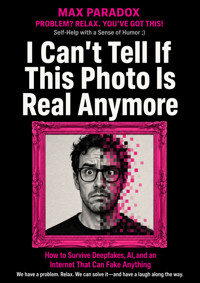
I Can't Tell If This Photo Is Real Anymore - How to Survive Deepfakes, AI, and an Internet That Can Fake Anything ebook
Max Paradox
Uzyskaj dostęp do tej i ponad 240000 książek od 14,99 zł miesięcznie
- Wydawca: ALL-IN Rafał Płonkowski
- Kategoria: Literatura popularnonaukowa•Nauki ścisłe
- Język: angielski
You see a shocking photo online.
You zoom in. The hands look normal. The shadows seem reasonable. Nobody has seventeen teeth. Excellent.
So… real?
Maybe.
Welcome to an internet where artificial intelligence can generate convincing photographs, clone familiar voices, alter video, create fake screenshots, and make you question whether that celebrity really endorsed an investment platform or whether someone simply gave a computer too much free time.
But the problem is bigger than AI.
A photograph can be completely real and still mislead you because the caption is false. A genuine video can be cut to reverse its meaning. An old image can return as “breaking news.” A cloned voice can sound exactly like someone you love while asking for money they never requested.
I Can't Tell If This Photo Is Real Anymore is a practical, funny guide to navigating that mess without becoming permanently paranoid or spending every evening analyzing suspicious ears.
Max Paradox shows you how to build a simple verification system that works for normal people-not digital-forensics specialists with twelve monitors and a mysterious basement.
You’ll learn how to:
check suspicious photos, videos, screenshots, and audio;
trace viral media back toward its original source;
distinguish authentic content from misleading context;
verify dates, locations, events, and captions;
use reverse image searches, metadata, and AI detectors without treating them like magic truth machines;
recognize urgency, emotional manipulation, fake authority, and repost laundering;
protect yourself from cloned-voice and impersonation scams;
verify important requests through a second communication channel;
decide how much evidence a claim actually deserves;
handle conflicting sources and detector results;
correct misinformation after you have accidentally shared it;
build habits that remain useful even as AI technology improves.
This is not a book about distrusting everything.
That would be exhausting.
It is about knowing when to slow down, where to look, what evidence matters, and when “I don’t know yet” is a much smarter answer than confidently joining forty thousand strangers who have all examined the same blurry screenshot.
You do not need to become impossible to fool.
You need to become harder to fool, less likely to spread nonsense, and much better at making important decisions when the internet suddenly presents you with “proof.”
Reality has become harder to verify.
Fortunately, the method is easier than the comment section makes it look.
This publication was prepared with the assistance of tools that support the creative process, including artificial intelligence-based solutions. The final concept, structure, and editing belong to the author.
Ebooka przeczytasz w aplikacjach Legimi na:
Liczba stron: 217
Rok wydania: 2026
Odsłuch ebooka (TTS) dostepny w abonamencie „ebooki+audiobooki bez limitu” w aplikacjach Legimi na:
Podobne
















INTRO
You’re looking at a photo of a politician standing next to someone they absolutely should not be standing next to.
Your first reaction is immediate: Wow.
Your second reaction arrives about four seconds later: Wait. Is this real?
So you zoom in.
The hands look normal. This is suspicious, because for a while weird hands were practically the official watermark of artificial intelligence. The shadows seem reasonable. The background contains no floating furniture. Nobody has fourteen teeth. You search for obvious errors and find none. Then you read the comments, which is always a courageous decision.
“FAKE.”
“100% REAL.”
“My cousin works in cybersecurity and confirmed this.”
“Look at the left ear.”
“Wake up, people.”
“Source?”
“Do your own research.”
Excellent. The internet has assembled its finest forensic laboratory.
Five minutes later, you have seventeen browser tabs open, two screenshots saved to your phone, and a growing suspicion that reality has been outsourced to a company with terrible customer service.
This is the new problem.
For most of human history, seeing something with your own eyes was considered fairly strong evidence. Not perfect evidence, obviously. Magicians have built entire careers around exploiting that loophole. But if your neighbor showed you a photograph of a dog sitting on his kitchen table wearing sunglasses, you could reasonably conclude that at some point a dog had been on the kitchen table wearing sunglasses.
Now?
Maybe.
The image could be real. It could be edited. It could be generated from scratch. It could combine a real face with a fake body, a real background with a fake event, or a genuine photo with one tiny alteration that completely changes what it seems to prove. A video can show someone saying something they never said. An audio clip can sound like a person who never spoke those words. A screenshot can look official while having approximately the same relationship with reality as your online dating profile’s claim that you “love hiking.”
Technically true.
Twice.
In 2019.
The problem is not merely that fake content exists. Fake content has existed forever. Humans were inventing stories long before electricity, broadband, or a button labeled “Generate.” What has changed is the speed, quality, accessibility, and volume of fabrication. Creating convincing false material no longer necessarily requires a movie studio, professional editing skills, or a mysterious person in a dark basement surrounded by monitors.
Sometimes it requires a laptop and lunch break.
That changes the job of being a normal person on the internet.
You are now expected to perform several roles before breakfast: reader, viewer, amateur investigator, source checker, scam detector, psychologist, cybersecurity analyst, and occasionally facial-shadow specialist. Someone sends you a dramatic video in the family group chat and suddenly you are examining compression artifacts while your coffee gets cold.
You did not apply for this position.
There was no interview.
The salary is terrible.
The natural response is to become suspicious of everything. Unfortunately, that solution creates a different problem. If every photograph might be fake, every video might be manipulated, every voice might be cloned, and every screenshot might be fabricated, you can eventually arrive at a wonderfully useless conclusion:
Nothing can be trusted.
This feels safe because you can never be fooled if you refuse to believe anything.
You can also never cross a street if you refuse to trust traffic lights, road markings, drivers, maps, weather forecasts, or the basic existence of streets.
Total skepticism is not intelligence. It is paralysis wearing glasses.
The goal of this book is not to turn you into a digital detective who studies pixels at 2:14 a.m. while whispering, “Interesting,” to an image of a celebrity buying cereal. You do not need to become an expert in generative AI, forensic imaging, metadata analysis, neural networks, or the terrifying internal politics of online comment sections.
You need a better system for deciding what deserves belief, what deserves doubt, and what deserves five minutes of verification before you forward it to twelve people with the message, “Is this true???”
That system begins with an uncomfortable fact: your eyes are no longer enough.
Neither are your ears.
And—please remain calm—neither is your confidence.
People often assume that being fooled feels like uncertainty. It does not. Sometimes being fooled feels exactly like being completely certain. That is what makes manipulation useful. If fake content arrived with a banner saying HELLO, I AM CURRENTLY MANIPULATING YOU, the industry would face serious growth challenges.
The strongest deepfakes and AI-generated images do not need to be perfect. They only need to survive the few seconds during which you are emotional, distracted, rushed, angry, excited, or delighted that something confirms what you already suspected.
That last part matters.
A fake image that supports something you dislike gets inspected like evidence in a murder trial.
A fake image that supports something you already believe gets promoted to senior management.
This is not because you are stupid. It is because you have a human brain, and the human brain enjoys efficiency. It makes rapid judgments based on patterns, expectations, context, and emotion. Most of the time, this is useful. You do not need to conduct a twelve-step verification process every time you see a photo of someone’s lunch.
If your friend posts a picture of pancakes, you may safely continue your day.
Probably.
The trouble begins when low-stakes habits are used on high-stakes information. We scroll quickly, react quickly, share quickly, and verify sometime between “later” and “never.” A dramatic image enters the feed. It looks plausible. The caption supplies a story. Thousands of people have already reacted. The brain sees social proof, emotional intensity, and visual evidence arriving together.
Case closed.
Except the case has not even opened.
Throughout this book, you are going to build a practical way to handle this without becoming professionally suspicious. You will learn how to slow down at the right moments instead of distrusting everything all the time. You will learn which visual clues are actually useful and which ones are outdated internet folklore. You will learn how to verify the source rather than conducting amateur archaeology on someone’s eyebrows.
You will also learn when the most useful question is not:
“Can I prove this image is fake?”
but:
“Can I prove the claim attached to it is true?”
That distinction saves enormous amounts of time.
Because sometimes people become so obsessed with detecting AI that they forget the original problem. Imagine spending twenty minutes deciding whether a photo was generated, only to discover that the photo is completely real but the caption is false.
Congratulations.
You have successfully verified the wrong thing.
This book will give you simple procedures for suspicious photos, videos, audio clips, screenshots, breaking-news posts, viral claims, fake celebrity endorsements, manipulated political content, and messages that arrive with the timeless scientific phrase: “They don’t want you to know this.”
You will also learn what to do when verification fails.
Because sometimes it will.
There will be images you cannot confidently authenticate. Videos with no clear source. Audio that sounds real but cannot be independently confirmed. Situations where reputable sources disagree or where the evidence simply has not caught up with the speed of the rumor.
In those moments, you need something more useful than panic.
You need permission to say:
“I don’t know yet.”
This sentence has suffered terribly on the modern internet. It has been replaced by immediate certainty, confident speculation, and people solving global events from a kitchen chair before the first reliable report has been published.
“I don’t know yet” is not weakness.
It is quality control.
The aim is not to make you impossible to fool. Nobody gets that guarantee. Experts can be fooled. Journalists can be fooled. Researchers can be fooled. People who make fake media can sometimes be fooled by other fake media, which feels like the digital equivalent of two burglars accidentally robbing each other.
The realistic goal is better.
You will become harder to fool, slower to spread nonsense, faster at checking important claims, and much more comfortable living in an internet where seeing is no longer automatically believing.
You will not need to inspect every pixel.
You will not need to distrust your grandmother.
Although if Grandma suddenly sends you a video of herself skydiving with Taylor Swift, perhaps we ask one follow-up question.
By the end, you should have a calm, repeatable process that works even when technology improves, because the strongest methods do not depend on spotting six fingers or strange earrings. They depend on source, context, corroboration, motive, evidence, and knowing when certainty has not yet been earned.
Reality has become more difficult to verify.
That does not mean reality has disappeared.
It just means we need slightly better habits than zooming in until the pixels become the size of bathroom tiles and announcing, “Something about the nose seems off.”
We have work to do.
Fortunately, most of it is easier than the comment section suggests.
Chapter 1 - Your Eyes Are Not a Security System
You are looking at a photograph that feels wrong.
Not dramatically wrong. Nobody has six fingers, the moon is not inside a living room, and the president is not riding a rhinoceros through a Costco. The image is normal enough to be dangerous. A person is standing in an ordinary place, wearing ordinary clothes, doing something entirely plausible.
Still, something bothers you.
The skin looks a little too smooth. The background feels strangely tidy. One earring may be slightly different from the other. Or perhaps you have simply been staring at the image for so long that every human face now looks suspicious.
This happens faster than you might expect.
After five minutes of deepfake investigation, your own family photos start looking fake.
“Why does Uncle Mike’s left hand look like that?”
Because Uncle Mike has a left hand.
The first mistake people make when trying to detect fake images is believing that the answer is hidden somewhere inside the image itself. They zoom in, inspect reflections, count fingers, compare teeth, study ears, and eventually develop the visual intensity of an art historian trying to determine whether a Renaissance painter secretly hated elbows.
Sometimes this works.
Often it does not.
Early AI-generated images frequently contained obvious mistakes: strange hands, distorted text, impossible jewelry, objects melting into each other, confused backgrounds, and humans who appeared to have been assembled from spare parts during a power outage. Those clues trained millions of people to believe that detecting artificial images was mostly a matter of finding the weird thing.
Then the technology improved.
That should not be surprising. We do not still identify modern cars by checking whether someone is walking in front waving a red flag.
Visual defects remain useful clues, but they are clues, not verdicts.
That distinction matters.
A real photograph can contain strange hands because hands are strange. Motion blur can deform fingers. Reflections can look impossible. Compression can destroy detail. Wide-angle lenses can stretch faces and limbs. Poor lighting can create unnatural skin. Phone cameras apply heavy processing automatically. Screenshots get resaved, cropped, compressed, filtered, sharpened, and passed through messaging apps until the original image has experienced more transformations than a reality-TV contestant.
Meanwhile, a fake image can look flawless.
So if your entire verification strategy is:
“Do the fingers look normal?”
you have built a security system around the artistic reputation of fingers.
We can do better.
The difference between a clue and proof
Suppose someone posts a photograph of a famous actor supposedly being arrested outside a restaurant. You inspect it.
The police badges are difficult to read.
Suspicious.
The actor’s left ear looks slightly unusual.
Very suspicious.
One officer seems to have a weird thumb.
Case closed?
No.
You have found three reasons to investigate further. You have not established that the image is fake.
This is where online analysis often becomes theater. Someone enlarges a tiny section of an image, circles an object in red, adds three arrows, and writes:
“LOOK AT THIS.”
There is something deeply persuasive about a red circle.
You can circle a toaster and half the internet will assume an international conspiracy is underway.
The problem is that once people start searching for errors, they become excellent at finding things that look like errors. This is partly because photographs are messy. Reality contains bad lighting, awkward posture, blur, reflections, shadows, accidental alignments, strange expressions, and occasionally furniture designed by people who dislike symmetry.
Your job is not to prove that an image contains something odd.
Your job is to determine whether the oddity actually tells you anything.
That requires a small change in mindset:
Do not ask, “What looks fake?”
Ask, “What evidence would make this claim more or less credible?”
That moves you away from pixel astrology and toward verification.
Pixel astrology is when you stare at an image long enough to predict its political affiliation from a blurry lamp.
Avoid it.
Use the image as a starting point, not the whole investigation
When you encounter a suspicious photo, begin with three quick questions.
First: What exactly is the image claiming happened?
Do not answer, “It shows a politician.”
That is not enough.
Is it claiming that the politician met a particular person? Attended a protest? Accepted money? Visited a location? Wore a certain symbol? Was present on a certain date?
Define the claim precisely.
A photograph is rarely important because of its pixels. It is important because of the story attached to those pixels.
Second: Where did the image come from?
Not where you found it.
Where it came from.
Those are different questions.
You may have found it on a social platform. The person posting it may have copied it from another account, which copied it from a screenshot, which copied it from a messaging group, which copied it from someone whose profile photo is a wolf standing in front of lightning.
We have now traveled quite far from evidence.
Try to identify the earliest source you can reasonably find. Was it published by a news organization? A government office? A photographer? The person shown in the image? A parody account? A random profile created three weeks ago?
The source does not automatically determine whether something is true, but it changes how much confidence you should place in it.
Third: Can the event be confirmed independently?
This is the most powerful question of the three.
If a photograph supposedly shows a major public event, there may be other photos, videos, reports, eyewitness accounts, official statements, or coverage from unrelated sources.
A major event that exists only in one mysterious image deserves skepticism.
Not automatic rejection.
Skepticism.
There is a useful difference.
The ten-second inspection
You do not need to conduct a forensic examination every time someone posts a suspicious image. Most situations deserve a quick initial check.
Give yourself roughly ten seconds and look for obvious problems:
impossible or inconsistent anatomy;
garbled or nonsensical text;
repeated objects or patterns;
mismatched reflections;
lighting that seems to come from several incompatible directions;
objects blending into each other;
details that change strangely across the image;
logos or symbols that are almost correct but not quite;
background people with distorted faces or bodies.
If you find something strong, investigate further.
If you find nothing, do not conclude that the image is real.
You have merely completed the easiest stage.
This is important enough to say plainly:
Passing the visual inspection does not authenticate an image.
It only means the image did not fail immediately.
A very convincing fake can pass.
A very ugly real photograph can fail.
Your phone camera has probably produced at least one picture in which a loved one appears to be dissolving into a curtain.
Reality has bad frames too.
The context check
After the visual inspection, look at the context around the image.
Who posted it?
When?
What explanation is given?
Is there a source?
Does the caption name a location, date, event, or person?
Are other credible sources discussing the same event?
This is where many fake or misleading images collapse.
The image itself may be genuine, but the context may be false.
A photograph of a crowd from 2017 gets reposted as a protest happening today.
A picture from one country is claimed to show another.
A real image of a fire becomes evidence of an unrelated attack.
A still from a movie becomes “footage the media won’t show you.”
The internet has discovered something important: you do not always need to manufacture a fake image.
Sometimes you just need to lie about a real one.
Much cheaper.
Also environmentally friendly. Reuse, recycle, miscaption.
This is why checking the story around the image is usually more valuable than staring at individual pixels.
The emotion test
Now ask yourself something uncomfortable:
Did I want this image to be true?
Or:
Did I immediately fear that it was true?
Strong emotional reactions make us worse investigators.
Anger creates urgency.
Fear creates urgency.
Excitement creates urgency.
Outrage arrives carrying a megaphone and shouting, “SHARE FIRST, ESTABLISH FACTS DURING THE APPEAL PROCESS.”
If an image strongly confirms something you already believe, slow down.
If it proves that a politician you dislike is corrupt, slow down.
If it proves that a celebrity you admire did something heroic, slow down.
If it shows a company you already hate behaving badly, slow down.
You do not need to become emotionally neutral. That would require becoming either a monk or a refrigerator.
You simply need to notice when emotion is pushing you toward a conclusion.
A useful rule is:
The stronger the emotional reaction, the slower the share button.
That one habit will prevent a remarkable amount of nonsense.
A simple verification routine
For ordinary use, try this four-step method:
1. Identify the claim. What does this image supposedly prove?
2. Check the source. Who first published it, or where can you trace it back to?
3. Look for independent confirmation. Can another reliable source confirm the event?
4. Inspect the image for supporting clues. Only now give serious attention to visual anomalies.
Notice the order.
Most people do step four first.
They begin with the ear.
Always the ear.
The better approach begins with the claim and the source because those often provide stronger evidence than tiny visual details.
Imagine someone sends you a picture supposedly showing a famous athlete secretly meeting with a controversial political figure. You spend fifteen minutes analyzing shadows.
Then you discover that the photo came from a comedy account whose biography says:
“Everything here is satire.”
The shadows have been cleared of all charges.
What not to do
Do not trust an image simply because it looks professional.
Fake images can look professional.
Do not distrust an image simply because it looks strange.
Real images can look strange.
Do not assume large engagement numbers make a post credible.
Millions of people can look at something inaccurate simultaneously.
That is not verification.
That is scale.
Do not rely on one magical visual clue.
There is no universal fake-image birthmark.
And do not assume someone else in the comments has checked it properly.
A person writing “DEBUNKED” in capital letters has not necessarily debunked anything.
Sometimes capital letters are just regular letters experiencing confidence.
When you cannot verify it
You will encounter images that remain uncertain.
Perhaps there is no original source.
Perhaps the event is too recent.
Perhaps you find conflicting reports.
Perhaps the image looks plausible, but there is not enough evidence to confirm it.
In that situation, use a three-level conclusion instead of forcing yourself into TRUE or FAKE:
Confirmed enough to trust
Uncertain
Strong reasons to doubt
This is far more realistic.
Most information does not arrive with a courtroom verdict attached.
You are allowed to keep something in the middle category.
In fact, “uncertain” is one of the most useful labels on the internet.
It allows you to avoid two equally bad mistakes: believing everything and dismissing everything.
If you must make a decision based on the image, increase the standard of proof according to the consequences.
A funny celebrity picture?
Low stakes.
A photograph influencing whether you send money, accuse someone publicly, make a medical decision, vote, travel somewhere dangerous, or believe an emergency warning?
Higher stakes.
The bigger the consequence, the more verification you need.
This is not paranoia.
It is the same reason you do not investigate a restaurant recommendation and a mortgage contract with identical intensity.
“Seems legit” is acceptable for tacos.
Less so for refinancing your house.
Your practical action
The next time a suspicious image appears, do not immediately zoom in.
Pause and say:
What is this image asking me to believe?
Then check the source and look for independent confirmation before you begin studying eyelashes.
If you still want a minimum version, use this:
Claim. Source. Confirmation.
Three words.
That is enough to interrupt the reflex of treating your eyeballs like laboratory equipment.
Your eyes are useful.
They are just no longer the final authority.
Frankly, they have been asking for too much responsibility anyway.
Chapter 2 - The Caption Is Part of the Trick
A photograph shows hundreds of people running through a city street.
The caption says:
“Mass panic in downtown Chicago after explosion. Media silent.”
You look at the image.
Smoke in the distance.
People running.
Police vehicles.
Looks convincing.
Someone comments, “My friend lives there. This is real.”
Another person writes, “Why isn’t this on the news?”
A third responds, “Because THEY control the news.”
We have reached the stage of online verification where the absence of evidence can be promoted to evidence before lunch.
You search for reports of an explosion in Chicago.
Nothing.
Now you have a decision to make.
Either every major news organization, emergency service, hospital, government office, local journalist, resident, traffic camera, and person with a smartphone has joined an impressively coordinated silence…
or the caption might be wrong.
You investigate further.
The photograph is real.
The event is real.
The city is not Chicago.
The year is not this year.
There was no explosion.
The picture came from a street disturbance in another country several years earlier.
The image passed.
The story failed.
This is one of the most important ideas in the entire subject:
A real image can create a false belief.
You do not need artificial intelligence for that.
You need a photo and a dishonest caption.
That combination has been available for quite some time.
AI has made fabrication easier, but old-fashioned misrepresentation remains extremely effective because people naturally treat photographs as evidence. If the picture feels emotionally consistent with the caption, the brain tends to merge them into one unit.
Photo plus words becomes event.
But they are two separate pieces of information.
The image may be authentic.
The caption may be fiction wearing a name tag.
Separate the picture from the story
Whenever an image matters, mentally split it into two questions.
Question one: Is this image authentic?
Question two: Is the description of the image accurate?
These questions overlap, but they are not the same.
Suppose you see a genuine photo of a politician shaking hands with a businessman.
The caption says:
“Secret meeting proves illegal deal.”
The handshake may be real.
The meeting may be public.
The businessman may be attending an official conference.
The supposed illegal deal may exist only in the imagination of the person who wrote the caption while eating cereal.
Authenticating the photograph does not authenticate the interpretation.
This is where many arguments online go wrong.
Person A says, “The photo is real!”
Person B says, “The claim is misleading!”
Person A responds, “So you admit the photo is real!”
Congratulations.
Two people are now fighting over different questions.
The internet has successfully created another renewable source of electricity.
Look for the missing information
Misleading captions often work by leaving something out.
They may omit:
the date;
the location;
what happened immediately before the photo;
what happened immediately after it;
who the people actually are;
why they were there;
whether the event was staged, rehearsed, ceremonial, fictional, or satirical;
whether the image comes from a different incident entirely.
Sometimes the missing information is more important than everything visible in the picture.
Imagine a photo of a man handing another man a thick envelope of cash.
Suspicious.
Now add context:
They are actors filming a scene.
Less suspicious.
Or:
It is prize money at a charity event.
Still less suspicious.
Or:
It is your uncle paying a contractor in cash because your uncle believes bank transfers are part of a government surveillance program.
Different problem.
Same photograph.
Context changes meaning.
This is why verification requires more than asking, “Is the photo fake?”
Sometimes the better question is:
What information has been removed to make this look more dramatic?
Beware the urgency caption
Certain phrases should immediately increase your skepticism.
Not because they automatically indicate false information, but because they often push you toward sharing before checking.
Examples include:
“SHARE BEFORE THEY DELETE THIS.”
“Media won’t show you.”
“This is happening RIGHT NOW.”
“Everyone needs to see this.”
“They are trying to hide this.”
“Send this to everyone.”
“Proof.”
“Finally exposed.”
“Wake up.”
These phrases do something psychologically useful for the person spreading the post: they turn verification into disobedience.
If you pause, you are supposedly helping “them.”
If you question the claim, you are naive.
If you do not share immediately, you are participating in the cover-up.
Very efficient.
The post has now appointed itself both evidence and emergency instruction.
Treat urgent sharing language as a reason to slow down, not speed up.
If information is true now, it will usually remain true after three minutes of checking.
Truth does not expire because you opened another tab.
Screenshots deserve special suspicion
Screenshots feel convincing because they look like captured reality.
A post.
A headline.
A text message.
An email.
A government announcement.
A bank alert.
A private conversation.
There it is, on the screen.
Except screenshots are incredibly easy to edit, recreate, crop, fabricate, or remove from context.
A screenshot of a news headline does not prove that the news outlet published it.
A screenshot of a social-media post does not prove the account posted it.