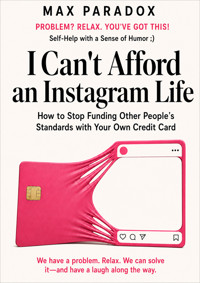
I Can't Afford an Instagram Life - How to Stop Funding Other People's Standards with Your Own Credit Card ebook
Max Paradox
Uzyskaj dostęp do tej i ponad 240000 książek od 14,99 zł miesięcznie
- Wydawca: ALL-IN Rafał Płonkowski
- Kategoria: Literatura popularnonaukowa•Nauki humanistyczne
- Język: angielski
Your life was perfectly acceptable until somebody on Instagram renovated a kitchen, booked a luxury vacation, bought a new car, upgraded their wardrobe, ordered a $19 smoothie, and somehow made all of it look like a normal Tuesday.
Now your couch looks tired, your vacation feels basic, your phone appears prehistoric, and your credit card is being asked to finance a lifestyle designed by several thousand strangers.
I Can't Afford an Instagram Life is a practical, funny guide to escaping comparison-driven spending without becoming a joyless minimalist who considers coffee a moral failure.
Max Paradox explains why social media can quietly change your definition of “normal,” how visible consumption hides invisible debt and financial tradeoffs, and why buying something often has less to do with the object than with belonging, status, identity, stress, convenience, or the person you hope to become.
More importantly, this book shows you exactly what to do about it.
You will learn how to identify spending triggers, create waiting periods that stop impulse purchases, build a lifestyle budget that survives real life, choose the few categories where spending more genuinely matters to you, set personal price filters, resist lifestyle creep, handle expensive friends and group plans, recover quickly after overspending, and create financial rules that still work when life becomes chaotic.
You will also learn how to enjoy expensive things without automatically owning them, how to distinguish real preferences from borrowed standards, and how to define “enough” before the internet defines it for you.
There are no lectures about giving up every pleasure, living on rice forever, or retiring at thirty-two after moving into a van.
The goal is not to spend as little as possible.
The goal is to stop spending your money on somebody else's definition of a successful life.
Because an expensive lifestyle is not automatically a good life, a modest lifestyle is not automatically a failure, and your credit card should not be responsible for making strangers think you are doing well.
Practical, direct, and full of painfully recognizable humor, I Can't Afford an Instagram Life is for anyone who has ever bought something after scrolling, upgraded something that still worked, felt poor while earning more than before, or looked at somebody else's vacation and briefly forgotten that the photo did not include their credit-card statement.
You do not need to stop enjoying money.
You need to decide what your money is for.
Preferably before somebody with a ring light decides for you.
This publication was prepared with the assistance of tools that support the creative process, including artificial intelligence-based solutions. The final concept, structure, and editing belong to the author.
Ebooka przeczytasz w aplikacjach Legimi na:
Liczba stron: 201
Rok wydania: 2026
Odsłuch ebooka (TTS) dostepny w abonamencie „ebooki+audiobooki bez limitu” w aplikacjach Legimi na:
Podobne




















INTRO
You are standing in your kitchen holding a perfectly functional mug.
This mug keeps liquids inside it. It has a handle. It has survived the dishwasher, several Mondays, and one incident involving a cat that remains under investigation. By every reasonable standard, the mug is doing an excellent job.
Then you open Instagram.
Someone is drinking coffee from a handmade ceramic cup in a sunlit apartment with limewashed walls, an olive tree, and a kitchen island roughly the size of your first apartment. The coffee appears to have been prepared by a barista who also studied architecture. Beside it sits a croissant displaying structural integrity normally associated with suspension bridges.
You look at your mug again.
Suddenly it has disappointed you.
Nothing happened to the mug. It did not crack. It did not insult your family. It did not quietly subscribe you to a streaming service. Three seconds ago, it was perfectly acceptable.
Now it looks like evidence that you have failed at adulthood.
This is how an Instagram life gets expensive.
It usually does not begin with you saying, “Today I would like to destroy my financial stability in order to impress people I went to high school with.”
That would at least be efficient.
Instead, it arrives in small, reasonable-looking pieces. A nicer jacket because everyone suddenly seems to own one. A weekend trip because people your age apparently spend every Saturday in Lisbon. A skincare routine containing enough individual products to require warehouse management software. A new couch because your current couch looks suspiciously like a couch rather than an editorial statement about who you are as a person.
None of these purchases necessarily seems ridiculous on its own.
That is the problem.
A $70 dinner here. A $240 pair of sneakers there. A phone upgrade because the camera on your current phone captures only seventeen million details instead of nineteen million. A hotel you cannot quite afford because your regular vacation photos would otherwise lack a rooftop infinity pool and a woman in the background looking thoughtfully toward Sicily.
Then the credit card bill arrives.
It is considerably less aesthetic.
There are no linen curtains. No golden-hour lighting. No slow-motion soundtrack. Just numbers.
Very direct numbers.
And suddenly the life that looked effortless online has developed monthly payments.
This book is not about never buying nice things. Nice things are nice. That is why they were given such a compelling technical name. You are allowed to enjoy clothes, restaurants, travel, furniture, gadgets, skincare, concerts, excellent cheese, and whatever mysterious object the internet decides everyone needs next Tuesday.
The problem is not wanting things.
The problem begins when you stop being sure whether you want them.
That distinction sounds simple until you spend twenty minutes looking at photos of somebody’s renovated bedroom and become emotionally convinced that your own bedroom is preventing you from reaching your full potential.
Social comparison has always existed. Your neighbor bought a new car, your cousin had a nicer wedding, somebody at work returned from vacation suspiciously tanned. Humans have been checking what other humans own for approximately as long as we have had both humans and objects.
But there used to be practical limits.
You might compare yourself with twenty people.
Now you can compare yourself with twenty thousand before breakfast.
And these are not twenty thousand randomly selected people showing you an honest statistical sample of normal Tuesday life. You are not seeing Gary arguing with his insurance company, Denise eating cereal over the sink, or Marcus discovering that the decorative shelf he bought requires drilling six holes into a wall he rents.
You are seeing the highlights.
The renovated kitchen. The new car. The engagement ring. The destination wedding. The outfit. The hotel. The brunch. The home gym. The spotless living room containing one beige blanket placed diagonally across a chair that nobody is apparently allowed to sit in.
You see the purchase.
You rarely see the payment plan.
You see the vacation.
You do not see the argument afterward about how much the vacation cost.
You see the designer bag.
You do not see the person quietly transferring money from savings because their credit card statement has become aggressive.
The internet is excellent at displaying consumption and remarkably shy about displaying consequences.
This creates a peculiar financial hallucination: everyone seems richer than you, everyone seems to travel more than you, everyone seems to dress better than you, and apparently nobody has ever looked at the price of restaurant appetizers and whispered, “Absolutely not.”
Of course, many people can genuinely afford what they show. Some earn more. Some inherited money. Some prioritize travel and spend almost nothing elsewhere. Some receive products for free. Some are businesses disguised as lifestyles. Some are deeply in debt.
You usually do not know which is which.
Yet your brain happily compares your complete financial reality with somebody else’s edited display window.
That is not a fair contest.
It is like entering a cooking competition with your actual Tuesday dinner while the other contestant submits a food advertisement photographed over six hours by twelve professionals.
“Here is my pasta.”
“Excellent. Their pasta has a lighting director.”
No wonder yours feels inadequate.
The financial damage does not always look dramatic. Most people do not wake up one morning with a new Lamborghini, four mortgages, and no memory of what happened. The danger is slower. Your spending standard gradually rises until things that once felt optional begin to feel normal, and things that once felt luxurious begin to feel necessary.
A basic hotel becomes “a little depressing.”
A functional coat becomes “something I really should replace.”
Cooking at home becomes “wasting the weekend.”
An older phone becomes embarrassing.
Flying economy becomes a human-rights discussion.
And because each upgrade is only a little more expensive than the last one, the entire process can feel perfectly reasonable while your bank account lies on the floor asking whether anybody intends to call for help.
There is another problem: buying the thing often works.
Briefly.
The package arrives. You open it. Excellent. Tiny hit of excitement. Maybe you wear it, photograph it, use it, admire it, or casually position it in your home where guests can accidentally notice it.
For a moment, you have caught up.
Then the feed refreshes.
Someone has something newer.
Congratulations. Your victory lasted eleven minutes.
Trying to reach permanent satisfaction through comparison is expensive because the finish line is operated by people whose business model requires moving it.
This does not mean Instagram, TikTok, influencers, advertising, friends, or society are secretly controlling your credit card with a remote. You still make the purchase. That matters, because if you make the purchase, you also have the power to change the pattern.
The goal is not to become immune to influence. Nobody is. The goal is to notice influence before it turns into a transaction.
Throughout this book, we are going to separate what genuinely improves your life from what merely improves the imaginary version of you being observed by strangers. You will learn how to spot comparison spending, delay purchases without feeling deprived, decide what is actually worth your money, reduce lifestyle creep, handle social pressure, build spending rules that work in ordinary life, and recover when you inevitably ignore one of those rules because a jacket looked incredible at 11:47 p.m.
There will be no requirement to delete every app, move into a cabin, wear the same gray shirt until retirement, or develop a spiritual relationship with compound interest.
We are aiming for something more useful.
You should be able to see someone else’s beautiful kitchen without financing a new one.
You should be able to attend a wedding without turning the event into your personal debt festival.
You should be able to enjoy a vacation even if your hotel breakfast is served indoors.
And you should be able to buy something expensive because you deliberately decided it was worth your money—not because three people on the internet made your existing life look temporarily unacceptable.
That is the real objective.
Not spending less at all costs.
Spending with your own standards.
Because there are few things more absurd than working for your money, handing it to a credit card company, and then discovering the whole operation was organized to impress someone who did not notice.
Chapter 1 - Your Feed Is Not a Census
At 8:12 on a Saturday morning, you open Instagram while still in bed.
This is your first mistake.
Within four minutes, you encounter someone renovating a farmhouse in Tuscany, someone opening a package containing three pairs of shoes that each cost more than your monthly grocery budget, and someone explaining that “real self-care” means booking a solo weekend at a luxury wellness resort.
You are currently wearing an old T-shirt and wondering whether the milk is still good.
The contrast is not subtle.
Your brain, however, does not respond by saying, “Interesting. I have encountered a highly selected stream of exceptional and commercially optimized images.”
It says:
“Apparently this is normal now.”
That sentence is expensive.
The quiet shift from “nice” to “normal”
One of the most financially dangerous things social media can do is not make you want something.
It can make you think everyone already has it.
That changes the emotional category of the purchase. A $900 phone is one thing when it feels like a luxury. It becomes something else when your feed quietly persuades you that yours is ancient because three creators posted the latest model in the same week.
A $400 weekend getaway may be obviously optional when you first consider it. After scrolling through twelve romantic cabins, five rooftop hotels, and a video titled “You deserve to romanticize your life,” staying home begins to look like evidence of poor strategic planning.
You did not necessarily become more materialistic.
Your reference point moved.
That matters because people rarely judge whether something is expensive in absolute terms. We judge it relative to what feels normal around us.
If everybody in your immediate environment drives ten-year-old cars, your five-year-old car may feel fairly new. If your feed contains forty people collecting new luxury SUVs, the same vehicle can start looking like something archaeologists discovered.
The car did not age during the scroll.
Your comparison group changed.
And you chose none of the members personally.
You are comparing against a fictional neighborhood
Before social media, your comparison group had limits. Family. Friends. Coworkers. Neighbors. Perhaps one irritating cousin whose kitchen was always suspiciously clean.
Now your comparison group can contain professional athletes, influencers, startup founders, celebrities, people living in countries with completely different costs of living, couples with two high incomes and no children, people receiving free products, and strangers whose parents quietly paid the down payment on the house they describe as “our little fixer-upper journey.”
All of them can appear in one feed.
This is financially equivalent to building a neighborhood where every house belongs to the richest person from a different town and then wondering why your garage looks modest.
Your feed is not a representative sample of people like you.
It is a selection system.
Platforms tend to show content that attracts attention. Attention is often attracted by novelty, beauty, status, transformation, aspiration, outrage, or excess. “I bought an ordinary toaster and it works fine” has not yet become a dominant content category.
Although I would follow that account.
A normal life is usually less visually competitive. It contains repeat outfits, reheated leftovers, older furniture, discount codes, free weekends, forgotten laundry, and a surprising number of evenings where nothing worth filming happens.
It is also where most human life takes place.
The algorithm does not know your budget
Imagine hiring a personal shopper.
You explain that your financial goals include reducing credit-card debt, building emergency savings, and eventually taking a vacation without needing to recover financially from the vacation.
The personal shopper nods.
Then every morning, they enter your bedroom carrying a tray of luxury watches, expensive hotels, skin treatments, furniture, restaurants, cars, limited-edition sneakers, and a machine that makes artisanal sparkling water using technology developed by Swiss astronauts.
“Would you like any of this?”
“No.”
“Excellent. I will return in six minutes.”
That would be an insane service.
It is also roughly how an algorithm behaves.
The algorithm is not malicious in the personal sense. It does not wake up thinking, “Today I will ruin Daniel’s debt-to-income ratio.” It is simply optimized around attention and engagement, not around your personal financial stability.
It learns what you pause on.
What you search for.
What you replay.
What you click.
What you almost buy.
And if you spend thirty seconds watching a beautiful apartment renovation, it does not conclude, “This person admires interior design but is currently prioritizing retirement contributions.”
It concludes:
“MORE SOFAS.”
So you get more sofas.
Soon you begin believing everyone has curved bouclé furniture.
They do not.
Your phone has simply noticed that you are vulnerable to beige.
Exposure creates fake necessity
There is a basic pattern worth noticing:
You see something once.
You think it is interesting.
You see it repeatedly.
It begins to look common.
Common begins to feel expected.
Expected begins to feel necessary.
Visa becomes involved.
Repetition changes perception.
This is why one viral product can suddenly seem like a universal household requirement. The internet becomes saturated with it. Reviews appear. Comparison videos appear. “Things I wish I bought sooner” videos appear. Someone explains that their mornings have been transformed since buying it.
You still do not know what it does.
But apparently your mornings are operating below professional standards.
This is especially powerful when the product is not presented as status. It is presented as optimization, wellness, self-care, convenience, quality, productivity, or “investing in yourself.”
Those categories are dangerous because they turn spending into moral progress.
You are not buying a $180 water bottle.
You are “taking hydration seriously.”
You are not replacing a perfectly good desk.
You are “creating an environment that supports your best work.”
You are not booking a luxury hotel.
You are “choosing experiences over things.”
The credit card company accepts all philosophies.
The first practical move: audit your fake normals
You do not need to delete social media.
You do need to identify which spending categories have had their definition of “normal” altered by your feed.
Take five minutes and list the areas where your standards have clearly risen over the last few years. Do not judge them yet. Just observe.
Possible examples:
restaurants;
vacations;
clothes;
skincare;
phones;
home decor;
weddings;
gifts;
cars;
fitness;
coffee;
children’s activities;
gadgets;
beauty treatments;
furniture.
Then ask one useful question:
What did “good enough” look like to me before I started seeing this category constantly online?
That question can be surprisingly uncomfortable.
Maybe you once considered a clean three-star hotel completely fine.
Now anything without a rooftop pool feels like a municipal building.
Maybe you once spent $40 on jeans and wore them for years. Now you regularly browse $180 jeans because a stranger in Los Angeles described them as “the only denim you need.”
Apparently the only denim you need comes in six washes.
Try to recover the earlier standard—not necessarily because the earlier standard was automatically correct, but because you want to see how much your expectations changed.
You cannot make an intentional decision if you do not know when the baseline moved.
The “would I still want this?” test
Here is one of the simplest filters in the book.
Before a nonessential purchase influenced by social media, ask:
Would I still want this if nobody could see it?
Not “would I use it?”
Not “is it nice?”
Not “can I technically pay for it?”
Would you still want it if:
you could not post it;
nobody asked where it came from;
your friends never saw it;
nobody complimented it;
it did not signal taste, success, wellness, sophistication, or membership in a mysterious club of people who own expensive lamps?
If the answer is yes, excellent. It may genuinely matter to you.
If the answer becomes awkward, pay attention.
The purpose is not to shame status motives. Humans care about status. Pretending otherwise is itself a kind of status performance.
The purpose is to know what you are buying.
There is a difference between:
“I love this coat.”
and:
“I want to look like someone who owns this coat.”
Both feelings can lead to a purchase.
Only one of them is definitely about the coat.
Another useful question: “Compared with whom?”
Whenever you catch yourself thinking:
“My apartment is small.”
“My vacations are boring.”
“My clothes are cheap.”
“My car is old.”
“My wedding will look basic.”
“My kitchen is embarrassing.”
Add:
Compared with whom?
This forces your brain to produce the invisible comparison target.
Sometimes the answer will be reasonable. Perhaps most people in your actual peer group do have something you value and can afford.
But sometimes the answer is essentially:
“Compared with fifteen people whose primary job is looking expensive online.”
That is useful information.
You would not compare your cooking with a Michelin-starred restaurant every Tuesday and conclude that your scrambled eggs represent a personal failure.
Do not compare your financial life with professional aspiration content and call the result realism.
Curate the pressure, not just the content
The usual advice is “unfollow accounts that make you feel bad.”
That is not wrong, but it is too vague.
Instead, unfollow or mute accounts that repeatedly trigger spending you later regret.
This is measurable.
If you repeatedly:
save products after seeing one account;
browse expensive travel after another;
feel embarrassed about your home after another;
buy beauty products after another;
start “researching” upgrades you did not need twenty minutes earlier;
you have found a financial trigger.
You do not need to hate the creator.
You do not need to write a dramatic farewell comment.
You do not need to announce, “For my mental and financial wellness, I am entering a new chapter.”
Just mute them.
Quietly.
Like an adult removing a smoke alarm that only activates when someone buys linen pants.
Also add accounts that normalize financial reality: repeat outfits, realistic homes, affordable cooking, no-buy projects, debt payoff, low-cost hobbies, normal travel, repair rather than replacement, and people who discuss the actual price of things.
Your feed will influence your sense of normal either way.
You might as well hire better neighbors.
A small experiment for the next seven days
For one week, whenever you feel the urge to buy something after seeing it online, write down three things:
what you wanted;
where you saw it;
what emotion appeared immediately before the urge.
You are looking for patterns.
The emotion may be envy.
But it may also be boredom, loneliness, insecurity, stress, fatigue, or the sudden belief that your bathroom is insufficiently Scandinavian.
Do not buy immediately.
Just record it.
This creates a gap between stimulus and purchase. That gap is where choice returns.
Without it, the process is:
see → feel → buy.
With it:
see → feel → notice → decide.
That additional step looks tiny.
Tiny steps have prevented larger financial nonsense.
What if your feed is your job?
Some people cannot simply avoid visual comparison because their work depends on trends, fashion, social media, branding, marketing, design, travel, beauty, or products.
Fine.
You do not need purity.
Create two mental categories:
Professional observation
and
Personal standard.
You may need to know what people are buying without deciding you must also buy it.
A chef can understand foie gras without eating it every Tuesday.
A fashion editor can recognize a trend without replacing an entire wardrobe.
A marketer can analyze luxury travel without booking a suite because “technically this is research.”
Your expense report may reject that final argument.
The point of this chapter
Your feed can make expensive lifestyles look ordinary because it removes context and concentrates unusually attractive examples in one place.
The first solution is not extreme frugality.
It is accurate perception.
This week, identify three categories where the internet has raised your definition of normal. Mute at least one repeated spending trigger. Then use one question before any aspirational purchase:
Would I still want this if nobody could see it?
You do not need to win against the whole internet.
You just need to stop treating it like your neighborhood.
Chapter 2 - The Price Tag You Never See
A friend posts a photo from a beautiful resort.
The room has an ocean view. The breakfast includes seventeen kinds of fruit. The pool looks like it continues directly into the Mediterranean, which would be an engineering concern but photographs very well.
You see the photo and think:
“I should travel more.”
What you do not see is anything else.
You do not see whether the trip cost $900 or $9,000. You do not know whether their employer paid for part of it, whether they used points, whether they saved for a year, whether their parents covered the flights, whether they put the entire thing on a credit card, or whether they are currently eating canned beans because the hotel had excellent lighting.
You see the outcome.
You do not see the financial structure underneath it.
This is one of the central tricks of lifestyle comparison: visible spending is easy to observe. Financial health is mostly invisible.
Rich-looking and financially strong are not the same thing
A person can look wealthy and have little financial stability.
Another person can look completely ordinary and have excellent savings, low debt, strong retirement accounts, and enough emergency cash to survive three broken appliances and one surprise dental procedure without writing a tragic poem.
These two people may stand beside each other in line at Starbucks.
You cannot tell.
Consumption is visible.
Savings are invisible.
Debt is invisible.
Inheritance is invisible.
Monthly cash flow is invisible.
Financial anxiety is invisible.
A financed car looks exactly like a paid-off car.
A designer handbag purchased in cash looks exactly like one sitting on a credit card at 24% APR.
A luxury vacation bought after twelve months of saving looks exactly like one bought through six months of denial.
The photo contains no footnotes.
This is why comparing your finances with visible lifestyles is so unreliable. You are comparing the part people display with the part of your life you fully understand.
It is like judging restaurants entirely by the front door.
Some have chandeliers.
The kitchen may be on fire.
“But they can afford it”
Maybe.
You do not know.
This is a sentence worth practicing:
I do not know what this costs them.
Not only in dollars.
In debt.
In stress.
In work hours.
In delayed goals.
In other things they choose not to buy.
Someone may spend heavily on travel and live cheaply in every other category. Someone may own an expensive car but have no retirement savings. Someone may wear designer clothes bought secondhand. Someone may earn four times your salary.
Without the full picture, the comparison is useless.
Yet we make decisions based on these fragments all the time.
“They go out every weekend.”
“They renovated their kitchen.”
“They always fly somewhere.”
“Their kids do three activities.”
“They upgraded their car.”
“We should probably be doing more.”
Maybe.
Or maybe you have accidentally turned somebody else’s spending pattern into a requirement without knowing their income, debt, goals, obligations, or financial priorities.
That is not financial planning.
That is costume design.
The hidden variables behind every lifestyle
When you see someone spending more than you, there are at least seven unknowns:
Income They may simply earn significantly more.
Debt The lifestyle may be financed.
Family support Parents, inheritance, gifts, housing help, childcare help, or family money may be involved.
Priorities They may spend aggressively in one category and almost nothing elsewhere.
Free or sponsored access Products, travel, restaurants, clothing, and services may be gifted or discounted.
Timing You are seeing one purchase, not twelve months of ordinary life.
Consequences You usually do not see what was delayed, sacrificed, or stressed about afterward.
This does not mean you should become suspicious of everybody with nice things.
“Look at that watch. Probably terrible retirement planning.”