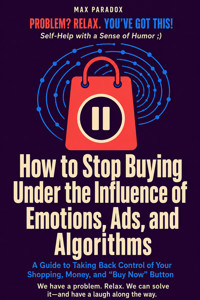
How to Stop Buying Under the Influence of Emotions, Ads, and Algorithms - A Guide to Taking Back Control of Your Shopping, Money, and "Buy Now" Button ebook
Max Paradox
Uzyskaj dostęp do tej i ponad 240000 książek od 14,99 zł miesięcznie
- Wydawca: ALL-IN Rafał Płonkowski
- Kategoria: Biznes, rozwój, prawo•Biznes, rozwój
- Język: angielski
If this feels familiar, this book is for you.
How to Stop Buying Under the Influence of Emotions, Ads, and Algorithms is a practical guide to understanding why shopping becomes so persuasive when you are stressed, bored, lonely, tired, celebrating, comparing yourself with other people, or simply scrolling at the wrong moment. It is not a book about never buying anything again, living with one chair, or treating every coffee like a financial emergency. It is about putting you back in charge of the decision.
With the trademark practical humor of Max Paradox, this book explains how emotional spending works, why sales and scarcity feel urgent, how personalized advertising keeps products in your attention, why influencers and social proof can quietly reset your idea of "normal," and how one-click checkout removes the pauses that once protected your wallet.
More importantly, it shows you what to do.
You will learn how to identify your personal spending triggers, separate genuine wants from emotional promises, use waiting periods without obsessing over the product, create friction around your weakest shopping categories, manage wish lists and carts, resist free-shipping traps, review subscriptions, reduce regret spending, and build a discretionary budget that still leaves room for enjoyment. You will also learn how to shop for your real life instead of your fantasy self, make sales compete with meaningful financial goals, and recover quickly when you do overspend.
There are no lectures about becoming perfectly disciplined. No demand that you delete joy from your budget. No assumption that the solution is simply to "have more self-control," which is excellent advice if you happen to be a spreadsheet wearing shoes.
Instead, the book gives you realistic systems that can survive bad days, late-night scrolling, holidays, social pressure, bonuses, major sales, and the occasional product that suddenly appears to represent your entire future happiness.
You will also build a simple long-term shopping system: clear rules for large purchases, practical Plan B options when motivation disappears, stronger boundaries for high-risk categories, and a way to make your savings goals emotionally competitive with whatever your feed is trying to sell you today. Because "being responsible" is vague. A trip, a debt-free goal, or a financial cushion is something your brain can actually picture.
The goal is simple: fewer purchases you regret, less clutter and guilt, more money for what actually matters, and a calmer relationship with shopping.
You can still enjoy beautiful things. You can still buy something ridiculous occasionally. You can still say yes.
You just get to decide when the answer is yes.
How to Stop Buying Under the Influence of Emotions, Ads, and Algorithms is a practical, funny guide to breaking the loop between stress, boredom, FOMO, personalized advertising, and impulsive checkout. Learn how to spot spending triggers, slow down "Buy Now," build useful shopping friction, ignore fake urgency, protect your money, and spend confidently on what actually matters.
Less guilt. Fewer regret packages. More control.
This publication was prepared with the assistance of tools that support the creative process, including artificial intelligence-based solutions. The final concept, structure, and editing belong to the author.
Ebooka przeczytasz w aplikacjach Legimi na:
Liczba stron: 232
Rok wydania: 2026
Odsłuch ebooka (TTS) dostepny w abonamencie „ebooki+audiobooki bez limitu” w aplikacjach Legimi na:
Podobne


















INTRO
ductory periods end.
Prices rise.
You stop using things.
Look at each recurring charge and ask:
“Would I sign up for this today at this price?”
This is better than asking:
“Do I sometimes use it?”
You can sometimes use almost anything.
There is probably an app on your phone you open twice per year.
That does not automatically justify funding its corporate headquarters.
If you would not subscribe today, cancel.
If you are unsure, cancel.
You can resubscribe later.
Companies have developed sophisticated technology allowing former customers to return.
They call it a button.
Beware the Free Trial
Free trials exploit forgetting.
You sign up.
You intend to cancel.
You do not.
Three months later, your bank statement reveals you are apparently a committed member of a premium meditation platform.
You have meditated once.
It was stressful.
Whenever you start a free trial, immediately create a calendar reminder two days before billing.
Better yet, if the service allows cancellation while retaining access until the trial ends, cancel immediately after signing up.
Then the default changes.
If the service proves valuable, you actively renew.
This places purchasing authority back where it belongs.
With you.
Not with your inability to remember what you did last Tuesday.
Buy Now, Pay Later Makes Small Feel Smaller
Installment services can make a purchase feel dramatically cheaper.$240 becomes:
Four payments of $60.
Or:
Only $20 per month.
The total has not changed.
The emotional experience has.
This can be useful for planned purchases when handled carefully.
But for emotional spending, splitting payments can weaken the pain of paying.
You stop asking:
“Is this worth $240?”and begin asking:
“Can I handle $60?”
That is a different question.
Worse, multiple installment purchases overlap.
A jacket.
Headphones.
Furniture.
Shoes.
A device.
Each payment appears manageable.
Together, they form a small private tax system.
Before using installment payment for a nonessential purchase, always write down the full price.
Then ask whether you would buy it if you had to pay the full amount today.
If the answer is no solely because the full number feels uncomfortable, take that discomfort seriously.
It may be useful information.
Digital Money Feels Quieter
Cash leaves your hand.
You see less cash afterward.
Cards, digital wallets, one-click payments, stored balances, and app-based purchases create less physical feedback.
Again, these tools are extremely convenient.
The solution is not necessarily to carry envelopes of cash through modern life like a traveling accountant.
But some people benefit from making discretionary spending more visible.
One method is to create a separate monthly spending account for nonessential purchases.
Transfer a fixed amount into it.
Use that card for entertainment, personal shopping, takeout, and other chosen discretionary categories.
Now the remaining balance provides feedback.
Instead of asking:
“Can I afford this?”which your brain may interpret creatively, you can see:
“I have $180 left in this category until next month.”
The decision becomes concrete.
Create a Weekly Spending Number
Monthly budgets are useful, but a month is surprisingly long.
You can overspend enthusiastically for three weeks before discovering that the final week has been financially canceled.
Convert discretionary money into a weekly number.
Suppose you decide you have $800 per month for flexible spending.
Roughly speaking, that might become about $185 per week depending on how you structure the month.
Now you can see patterns sooner.
If you spend $170 by Tuesday, you know the rest of the week should probably become culturally rich in free activities.
Weekly limits provide feedback while there is still time to adjust.
They also make small spending easier to notice.
Three little purchases can suddenly matter when they consume half the week's allowance.
Use the “One More Thing” Log
For seven days, write down every unplanned purchase under a chosen threshold.
Perhaps everything under $50.
Do not change your behavior yet.
Just record:
What you bought.
Price.
Where.
What you were feeling.
Why you justified it.
This last part is important.
Common justifications include:
“It was cheap.”
“I was already ordering.”
“I deserved it.”
“I might need it.”
“Free shipping.”
“It was on sale.”
“I didn't feel like cooking.”
“Everyone recommends it.”
“I can return it.”
“I'll use it eventually.”
At the end of the week, add the total.
Then read the reasons.
You may discover that emotional spending has a small vocabulary.
Your brain keeps using the same five lines.
Once you know the script, it becomes easier to interrupt.
Give Small Purchases a Category Cap
Trying to evaluate every $8 decision individually is exhausting.
Instead, control the category.
For example:$100 per month for takeout.$75 for books.$80 for beauty.$50 for hobby extras.$150 for clothes.
Your numbers will depend entirely on your income, obligations, goals, and priorities.
The point is not the amount.
The point is pre-deciding.
Now you can spend inside the category without guilt.
But when the category reaches zero, you stop until the next period.
This removes repeated moral drama.
You do not have to ask whether you are a good person because you ordered Thai food.
You have a number.
Numbers are less judgmental than people give them credit for.
Find Your High-Leak Category
Most people do not overspend equally everywhere.
One or two categories often create most of the problem.
Maybe clothing.
Food delivery.
Beauty.
Electronics.
Home décor.
Online marketplaces.
Gaming.
Collectibles.
Hobby gear.
Children's items.
Travel upgrades.
You do not need to optimize seventeen categories if one category causes 60 percent of your regret.
Find the leak.
Focus there first.
This is much easier than trying to become universally disciplined.
If food delivery is costing you $600 per month and unused subscriptions cost $25, begin with delivery.
Do not spend three afternoons canceling a $2.99 app while ignoring the financial rhinoceros in the kitchen.
Make the Better Choice Easier
If convenience spending is the problem, prepare alternatives.
If you order food because there is nothing easy at home, keep three emergency meals available.
Frozen food counts.
Sandwich ingredients count.
Breakfast for dinner counts.
Nobody from the culinary academy is coming.
If you buy drinks or snacks while traveling, keep some with you.
If boredom causes small online orders, create a list of free activities you actually enjoy.
If small beauty purchases accumulate, stop entering stores or websites without a list.
Your system should solve the situation before your wallet is asked to solve it.
Use a “No Tiny Orders” Rule
Online shopping makes very small purchases strangely easy.
A $7 cable.
A $12 organizer.
A $9 kitchen tool.
Nothing wrong with these items.
But frequent tiny orders keep you in continuous shopping mode.
Try consolidating.
Keep a running essentials list.
Order once per week or once every two weeks.
This creates distance between noticing a want and purchasing it.
It also gives you time to delete items.
An astonishing number of “needs” expire after four days on a list.
Farewell, avocado storage device.
Your service will not be required.
Plan B: You Love Small Luxuries
Keep them.
Seriously.
If a daily café visit, Friday takeout, monthly beauty purchase, or regular book purchase brings you genuine pleasure and fits your financial priorities, you do not have to eliminate it because somebody online calculated what it would be worth if invested for eighty-seven years.
Life is not a spreadsheet competition.
The goal is conscious enjoyment.
There is an enormous difference between:
“I spend $120 per month on coffee because I love the ritual and have chosen it.”and:
“I somehow spend $120 per month on coffee and complain every month that I have no idea where my money went.”
Same amount.
Different relationship.
One is intentional.
The other is invisible.
Your practical action for this chapter is to review the last thirty days of transactions and identify every nonessential purchase below your chosen “small” threshold.
Add them together.
Do not judge the number.
Then divide the purchases into categories.
Which category is largest?
Which brought genuine enjoyment?
Which barely registered?
Which occurred mainly because of convenience, mood, or habit?
Choose one category to reduce, not eliminate, next month.
Aim for something realistic.
Twenty percent less.
One fewer order per week.
Two canceled subscriptions.
One shopping-free weekday.
Small changes are appropriate here because small purchases are the issue.
You do not need dramatic financial punishment.
You need visibility.
A thousand tiny transactions lose much of their power once they stop being tiny invisible transactions.
Your money was not eaten by ducks.
It was spent.
Which is good news.
Because spending is something you can redesign.
Chapter 1 - The Purchase Was Never About the Thing
At 6:12 p.m., you leave work after a day that has somehow contained nine hours and seventeen years. Three people needed something “ASAP,” one meeting could have been an email, and someone wrote “gentle reminder” in a message that felt neither gentle nor remotely forgettable.
You stop at a store on the way home.
You need toothpaste.
That is the official mission.
Twenty-three minutes later, you are carrying toothpaste, a scented candle, a sweater, two skin-care products, a bag of fancy coffee, and a ceramic bowl that looks handmade despite being produced by a company with 14,000 employees.
The bowl has character.
Apparently this was important.
Nothing on the receipt says, “Compensation for a terrible day.” Stores have not yet reached that level of transparency. But emotionally, that may be exactly what you bought.
This is one of the first things to understand about emotional spending: the object and the reason for buying the object are often two different things.
You think you are buying shoes.
You may actually be buying relief.
You think you are buying new headphones.
You may be buying a small event to look forward to.
You think you are buying home décor.
You may be trying to create the feeling that your life is organized, calm, and inhabited by someone who never leaves three mugs beside the bed.
The product is real.
The promise attached to it may be something else entirely.
The Emotional Job of a Purchase
Every purchase has a practical function, but many purchases also have an emotional job.
A practical purchase solves a concrete problem. Your shoes are falling apart, so you replace them. Your phone charger stopped working, so you buy another one. You need groceries because cereal eaten dry over the sink cannot continue to carry the entire nutritional system.
An emotional purchase is different. The item is being asked to change your internal state.
You are sad, so you browse.
You are stressed, so you upgrade.
You feel ignored, so you reward yourself.
You feel behind in life, so you purchase equipment for your imagined future personality.
You feel bored, so you create excitement by ordering something.
You feel out of control, so you control one thing: which color arrives on Friday.
This is why simply asking, “Do I need it?” is not always enough. Your brain is capable of presenting an extraordinary legal argument for almost anything once it wants the emotional payoff.
“Do I need another jacket?”
Technically, no.
“But this one is waterproof.”
You already own a waterproof jacket.
“Yes, but this one is lighter.”
How many emergency grams of jacket weight are we currently dealing with?
Silence from the defense.
The emotional brain does not enjoy cross-examination.
That does not mean the emotion is fake or foolish. The stressful day happened. The loneliness is real. The boredom is real. The desire for comfort is real. The problem is that buying something often works just well enough in the short term to train you to repeat it.
You feel bad.
You shop.
You feel briefly better.
Your brain takes notes.
Excellent, it thinks. Apparently we treat disappointment with sneakers now.
Why Buying Can Feel So Good Before Anything Even Arrives
The pleasure of shopping does not begin when the package reaches your house. Often, the strongest part happens earlier.
You discover something.
You imagine owning it.
You compare versions.
You read reviews.
You picture yourself using it.
You hit the button.
Suddenly there is anticipation. Something is coming. Tomorrow has acquired a feature.
This is important because emotional spending is often driven less by ownership than by the sequence leading up to ownership. Searching and choosing give your attention somewhere to go. Anticipation interrupts an unpleasant mood. The purchase creates a tiny sense of progress, even when nothing in the original problem has changed.
Your boss is still difficult.
Your relationship is still tense.
Your apartment is still messy.
But now a package is moving through Ohio.
Progress.
Sort of.
That brief improvement can be powerful because emotions often want immediate relief. They are not particularly interested in whether the relief creates a credit-card bill, more clutter, or the fascinating experience of returning four boxes on Saturday morning.
Emotions are terrible accountants.
They operate mainly in the department of “right now.”
The Four Common Emotional Shopping Modes
Your pattern may change depending on the day. Most emotional spending tends to fall into a few recognizable modes.
1. Reward ShoppingYou survived something unpleasant, worked hard, handled a difficult situation, or simply reached Thursday without shouting into a decorative pillow.
So you deserve something.
There is nothing wrong with rewarding yourself. The problem begins when spending becomes the automatic reward for every demanding experience.
Hard week? Buy something.
Finished project? Buy something.
Had to call the insurance company? Frankly, that may deserve a parade, but still.
When every emotional achievement produces a transaction, your spending begins to function like a loyalty program run by your nervous system.
2. Comfort ShoppingThis is the classic “I feel bad and want to feel better” purchase.
Comfort shopping tends to appear when you are lonely, rejected, anxious, angry, exhausted, or disappointed. The item creates softness around a hard feeling.
Sometimes the purchase is modest: a book, takeout, a small treat.
Sometimes the emotional logic begins expanding.
“I need something nice.”becomes:
“I rarely buy anything for myself.”which becomes:
“I work hard.”which becomes:
“Life is short.”which somehow becomes:$286.
43.
That escalated efficiently.
3. Identity ShoppingIdentity shopping is about becoming somebody.
The runner.
The cook.
The organized person.
The stylish person.
The minimalist person, who strangely keeps purchasing storage containers to support minimalism.
You buy objects associated with the identity because owning them creates a temporary feeling of progress toward becoming that person.
There is a basic problem.
Buying a guitar and practicing guitar are two completely different transactions.
One takes ninety seconds.
The other has scales.
Identity purchases are especially seductive because they do not feel like consumption. They feel like self-improvement. You are not buying a $170 blender. You are “taking your health seriously.”
Perhaps.
Or perhaps you bought an extremely confident smoothie machine.
4. Escape ShoppingThis is shopping as distraction.
You do not want to think about the report, the argument, the bills, the laundry, or the life decision sitting in the corner wearing a serious expression.
So you browse.
Shopping sites are excellent places to hide because they provide constant novelty and tiny decisions.
Black or navy?
Small or medium?
Standard shipping or express?
Would you like to save 15 percent by surrendering your email address forever?
Every tiny decision occupies mental space. The original problem temporarily disappears.
Unfortunately, it is very patient.
It will be waiting when the browsing session ends.
Find the Moment Before the Purchase
If you want to reduce emotional spending, studying the receipt is less useful than studying the twenty minutes before you opened the shopping app.
That is where the pattern lives.
You do not need a psychological laboratory. For one week, whenever you strongly want to buy something that was not planned, write down three things:
What happened immediately before I wanted to shop?
What am I feeling right now?
What do I expect the purchase to change?
Keep the answers brutally simple.
“Argument with partner. Angry. Want distraction.”
“Boring Sunday. Restless. Want something to anticipate.”
“Saw coworker’s new watch. Insecure. Want to feel successful.”
“Finished stressful presentation. Relieved. Want reward.”
Do not write an autobiography. You are identifying the trigger, not submitting evidence to a documentary crew.
After several entries, patterns usually become visible.
Maybe you shop after conflict.
Maybe you shop late at night.
Maybe Friday paydays are dangerous.
Maybe social media creates the urge.
Maybe you buy beauty products when you feel unattractive, productivity tools when you feel behind, or home products when your life feels chaotic.
That information matters because different emotional triggers need different substitutes.
If the problem is boredom, a budget lecture will not fix it.
If the problem is exhaustion, a spreadsheet will not hug you.
If the problem is envy, deleting your saved card details helps, but you also need to understand what comparison is doing to your decisions.
The goal is not merely to make buying harder.
It is to make the emotion visible before the emotion starts shopping on your behalf.
Use the Ten-Minute Translation
When you feel a strong urge to buy something unplanned, do not immediately ask, “Should I buy this?”
First ask:
“What am I hoping this purchase will do for me?”
Translate the product into the emotional promise.
“I want these shoes.”becomes:
“I want to feel more attractive.”
“I want this expensive planner.”becomes:
“I want to feel like I have my life under control.”
“I want new living-room furniture.”becomes:
“I am embarrassed by my apartment.”
“I want this limited-edition collectible.”becomes:
“I am excited by the chase and afraid of missing out.”
Now the decision is clearer.
You may still decide to buy the item. That is allowed.
But at least the product has been removed from witness protection.
You know what job you are hiring it to perform.
Then give yourself ten minutes to address the real need without purchasing anything. If you are stressed, take a short walk, shower, call someone, eat, rest, or deal with the problem directly if possible. If you are bored, choose an activity that provides stimulation. If you need a reward, pick one from a prepared list of rewards that are free or inexpensive.
Ten minutes will not cure loneliness, repair your career, or solve your childhood.
That is not the assignment.
The assignment is simply to break the automatic sequence:emotion → browse → buy.
Even a small pause creates space for a different decision.
Build a Reward Menu Before You Need It
One reason shopping becomes the default reward is that it is easy. When you are exhausted, creativity drops. Nobody comes home after a brutal day and enthusiastically announces, “Wonderful. I shall now design a balanced portfolio of emotionally appropriate coping strategies.”
You open an app.
So make the alternatives in advance.
Create a short reward menu with things you genuinely enjoy. It might include a favorite show, coffee somewhere nice, a long shower, an hour with a game, calling a friend, going for a drive, ordering one favorite meal, taking the evening off from chores, reading, listening to music, or doing absolutely nothing with impressive commitment.
Your menu should contain at least a few options that cost nothing.
This is not because spending money on enjoyment is morally suspicious. It is because if every mood improvement requires a payment method, life becomes expensive very quickly.
The best reward is the one that actually satisfies the need.
If you are exhausted, perhaps the answer is not new shoes.
Perhaps the answer is going to bed.
Terrible news for the shoe industry.
Do Not Replace Emotional Shopping with Financial Punishment
A common response to overspending is to swing violently in the opposite direction.
“That’s it. No unnecessary spending for three months.”
This sounds powerful at 8:00 a.m. on the first day.
By Day 11, a $7 coffee begins to feel like an uprising against tyranny.
Extreme rules create two problems. First, they turn normal enjoyment into guilt. Second, they can create a binge-and-restrict cycle in which spending is tightly controlled, then suddenly explodes.
A better approach is to decide in advance how much money you can comfortably use for discretionary spending after your essential obligations and financial priorities are handled.
That creates a category where pleasure is permitted.
Imagine that.
A financial system designed for humans.
When money for fun exists intentionally, every small purchase no longer requires a courtroom trial. The question becomes not “Am I allowed to enjoy anything?” but “Is this how I want to use this part of my money?”
That is a much healthier decision.
The 24-Hour Rule Is Useful, but Only If You Use It Properly
You have probably heard some version of this advice: wait twenty-four hours before making an impulse purchase.
Good advice.
Frequently ignored.
The problem is that people interpret “wait” as “keep the item in the cart, revisit it twelve times, watch three review videos, check whether the sale is still active, and emotionally adopt it.”
That is not waiting.
That is a long-distance relationship with a pair of boots.
For unplanned nonessential purchases above a threshold you choose, use a genuine pause. Save the item somewhere that does not keep shouting at you. Close the store. Do not research it during the waiting period.
Then revisit the decision later when your emotional state has changed.
Ask:
Do I still want this?
What problem does it solve?
Do I already own something that does the same job?
Where will it live?
Would I buy it at full price?
If I could not tell anyone I owned it, would I still want it?
That final question is especially useful for status-driven purchases.
Sometimes the answer remains yes.
Great.
The goal is not to prevent every purchase.
The goal is to prevent temporary emotions from receiving permanent purchasing authority.
Plan B: When You Already Bought It
You will still make emotional purchases.
You are a person, not a monastery with Apple Pay disabled.
When it happens, do not turn the mistake into a character judgment. That usually makes the emotional cycle worse: guilt creates discomfort, discomfort creates a desire for relief, and somehow you are browsing again while feeling guilty about browsing.
Instead, use the purchase as information.
Ask what triggered it.
Return it if returning it makes sense and the return window is still open. If you keep it, record the lesson and move on.
Do not punish yourself.
Investigate yourself.
One produces shame.
The other produces data.
Your practical action for this chapter is simple: during the next seven days, record at least three unplanned buying urges before acting on them. Write the trigger, the feeling, and the emotional promise of the purchase.
You are not trying to become someone who never wants things.
You are learning to notice who is holding the shopping basket.
And sometimes it is stress wearing your face.
Chapter 2 - Your Brain Loves a Shortcut with Free Shipping
You open a shopping app because you need replacement razor blades.
The homepage has other ideas.
A banner announces a weekend sale. A row labeled “Inspired by your recent activity” contains products you do not remember inspiring. Another section says “Customers like you also bought,” although you have never met these customers and are beginning to question what exactly the algorithm believes it knows about your social circle.
You find the razor blades.
Before checkout, a message appears:
“You’re only $12 away from free shipping.”
Only.
A dangerous word.
You were going to spend $18.
Now the website has convinced you that spending $30 is a form of saving money.
Somewhere, mathematics has left the building.
Modern shopping environments are not neutral shelves. They are designed to reduce hesitation, increase attention, encourage larger orders, bring you back frequently, and make leaving without buying feel strangely incomplete.
This does not mean every retailer is operating a secret underground laboratory where psychologists stroke white cats and whisper, “Increase conversion.”
The cats may work remotely.
It simply means businesses optimize systems to sell more. Your job is not to become outraged by this. Your job is to stop entering the system as if nobody has designed it.
Your Brain Is Easy to Nudge When It Is Busy
You make hundreds of small decisions every day. What to eat. What to answer. Whether to reply now or later. What route to take. Whether “sounds good” in a text message sounds genuinely good or quietly furious.
Your brain likes shortcuts because constant deliberate analysis would be exhausting.
Most of the time, shortcuts are helpful.
You do not perform a twelve-point assessment before choosing a spoon.
Shopping systems exploit some of these same shortcuts. They make products appear scarce, popular, personalized, discounted, recommended, urgent, or easy to obtain because those signals reduce the amount of careful thinking required.
You see “Best Seller.”
Your brain hears, “Other people already investigated this.”
You see “Only 2 left.”
Your brain hears, “Delay may create loss.”
You see “Was $149, now $89.”
Your brain begins comparing $89 with $149 rather than comparing $89 with keeping $89.
That last comparison is less exciting for retailers.
Discount Is Not a Reason
A sale changes the price.
It does not create a need.
This distinction is simple enough to print on a refrigerator, but sales are powerful because they make the transaction feel like an opportunity rather than an expense.
Suppose you see a jacket for $120 reduced to $70.
Your first reaction may be:
“I’m saving $50.”
That is only true if you were already going to buy the jacket.
If you were not going to buy it, you are spending $70.
You have saved exactly zero dollars and acquired sleeves.
This is one of the most useful mental corrections in shopping:
Never calculate the discount first.
Calculate the cost first.
Instead of saying, “I saved $50,” say, “This costs $70.”
Then ask whether the item is worth $70 to you.
The crossed-out price can remain nearby performing emotional theater.
Scarcity Makes Ordinary Objects Develop Emergency Status“Only 1 left.”
“Low stock.”
“Sale ends in 02:14:37.”
“8 people are viewing this.”
These signals make delay feel dangerous.
Scarcity can be real. Products genuinely sell out. Promotions genuinely end. But whether a specific message reflects actual inventory or a broader sales strategy, the psychological effect is similar: you feel pressure to decide before you have finished deciding.
Under pressure, the question changes from:
“Do I want this?”to:
“What if I lose the chance?”
Those are not the same decision.
Fear of losing something you do not own is a fascinating feature of the human brain.
Ten minutes ago you did not know the lamp existed.
Now another customer taking it would apparently be a personal tragedy.
When scarcity appears, use one sentence:
“If I would not buy it without the countdown, I should not buy it because of the countdown.”
Simple.
Not always emotionally satisfying.
Still simple.
If the item disappears, you have learned that life continues after a flash sale.
Medical science has documented several survivors.
Social Proof Lets Other People Shop for You
Ratings, reviews, bestseller labels, influencer recommendations, “most popular” badges, and user photos all provide social proof.
Again, this is not automatically bad. Reviews can be useful. Recommendations can save time. Sometimes 12,000 customers genuinely agree that one vacuum cleaner is less terrible than the others.
The problem starts when popularity replaces your own criteria.
“This has 4.8 stars.”
Fine.
Do you need it?
“Everyone says it’s amazing.”
Fine.
What problem does it solve for you?
“It went viral.”
That sentence has caused enough household clutter to qualify as an infrastructure issue.
Before reading reviews, decide your criteria.
If you are buying a practical item, write down what matters before the internet tells you what should matter.
For example, if you need headphones:maximum budget;comfortable for long use;good battery life;reliable connection;noise cancellation, if necessary.
Now you are evaluating products against your needs rather than allowing enthusiasm to manufacture new needs during research.
Without criteria, comparison becomes dangerous. You begin shopping for features.
You wanted headphones.
Now you need spatial audio, adaptive transparency, multipoint Bluetooth, personalized acoustic profiling, and something called “immersive awareness.”