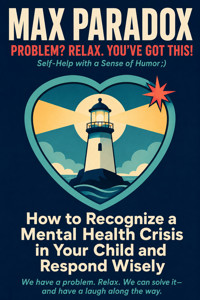
Uzyskaj dostęp do tej i ponad 240000 książek od 14,99 zł miesięcznie
- Wydawca: ALL-IN Rafał Płonkowski
- Kategoria: Poradniki
- Język: angielski
Your child shuts the bedroom door.
They stop seeing friends. Their sleep changes. School suddenly becomes impossible. They say they are "fine," but absolutely nothing about the situation feels fine.
So what are you supposed to do?
Ignore it and risk missing something serious?
Panic and turn the house into a twenty-four-hour surveillance operation?
Search the internet until you have personally diagnosed seventeen psychiatric conditions before breakfast?
There is a better option.
How to Recognize a Mental Health Crisis in Your Child and Respond Wisely is a practical, compassionate guide for parents who need to understand the difference between ordinary distress and a situation that requires professional or emergency help.
Without turning you into an amateur psychiatrist, this book explains how to notice meaningful changes in your child's mood, behavior, sleep, school functioning, relationships, self-care, and language - and, more importantly, what to do with that information.
You will learn how to ask direct questions about suicide and self-harm without making the conversation more frightening, how to respond when your child says something alarming, how to handle treatment refusal, and how to make the next hour safer when immediate risk may be present.
The book also covers the situations that make parenting through a mental health crisis especially complicated: school refusal, online pressure, cyberbullying, substance use, trauma, abuse, family disagreement, sibling needs, relapse warning signs, medication management, privacy, and the difficult process of gradually returning independence after a serious crisis.
Most importantly, this is not a book built around vague advice such as "be supportive," "communicate more," or "trust your instincts."
You will get practical frameworks, sample conversations, warning signs, action plans, Plan B options, and clear distinctions between situations that can be monitored, situations that deserve professional assessment, and situations that require urgent intervention.
And because frightened parents are still human beings, the book does all this without sounding like a hospital brochure written by a committee.
Max Paradox combines serious, evidence-informed guidance with observational humor about the realities of parenting: closed bedroom doors, one-word answers, phones that apparently contain the entire known universe, family arguments conducted at precisely the worst possible moment, and the parental brain's ability to move from "They seem quiet" to "We need an international crisis team" in approximately eight seconds.
This book will not promise that you can prevent every crisis.
It will help you become much clearer about what you can do: notice sooner, ask better questions, respond more calmly, protect safety, involve the right professionals, support recovery, and know when uncertainty itself is a reason to get help.
You do not need to know everything.
You need to know what to do next.
This publication was prepared with the assistance of tools that support the creative process, including artificial intelligence-based solutions. The final concept, structure, and editing belong to the author.
Ebooka przeczytasz w aplikacjach Legimi na:
Liczba stron: 212
Rok wydania: 2026
Odsłuch ebooka (TTS) dostepny w abonamencie „ebooki+audiobooki bez limitu” w aplikacjach Legimi na:
Podobne




















INTRO
It is 11:47 p.m., and your child is in their room with the door closed. They skipped dinner, barely answered when you asked what was wrong, and said, “Nothing,” in the particular tone that makes “nothing” sound like it may involve seventeen separate disasters. You are standing in the hallway holding a mug you forgot to drink from, trying to decide whether this is normal adolescent misery, a bad day, a friendship explosion, exhaustion, anxiety, depression, or something genuinely dangerous.
Naturally, you consult the internet.
Three searches later, you have diagnosed six conditions, joined a parenting forum where strangers are arguing in capital letters, and discovered that apparently every behavior your child has displayed since preschool may be significant. Sleeping too much is concerning. Sleeping too little is concerning. Eating more may mean something. Eating less may mean something. Being irritable matters. Being unusually cheerful can apparently matter too. At this point, you begin to suspect that breathing with an unusual level of commitment should also be monitored.
This is not helping.
The hardest part of recognizing a mental health crisis in your child is not that parents do not care enough. Usually, the problem is the opposite. You care so much that your internal alarm system has approximately two settings: “They’re probably fine” and “WE NEED TO REORGANIZE THE ENTIRE FAMILY BY MIDNIGHT.” Neither is especially useful when what you actually need is calm observation, good judgment, and the ability to respond without making your child feel as though a tactical response unit has entered the kitchen.
Children and teenagers can be difficult to read even when everything is basically okay. They retreat. They change moods. They say things like “I don’t know” despite having recently completed a twelve-minute monologue about why the family Wi-Fi is an insult to human dignity. They may cry over something that seems small, shrug at something that seems enormous, sleep until noon, suddenly hate a hobby they adored three months ago, or communicate mainly through noises previously associated with injured livestock.
Development is not a tidy process.
A mental health crisis, however, is more than ordinary moodiness, one terrible afternoon, or a bedroom floor that now appears to have its own ecosystem. It is a situation in which a young person’s emotions, thoughts, behavior, or ability to cope have become so overwhelmed that their safety, functioning, or connection with reality may be seriously affected. That can include suicidal thoughts or behavior, self-harm, severe panic or agitation, extreme hopelessness, dangerous impulsivity, threats of harm, a major loss of functioning, or experiences that suggest the child may not be perceiving reality normally.
That list is serious because the subject is serious. It is not a checklist for diagnosing your child at the breakfast table.
You are not expected to become a psychiatrist because you bought a book. You are also not expected to know, with courtroom-level certainty, whether every worrying sign represents a temporary struggle or a clinical emergency. Your job is different: notice meaningful changes, ask direct questions, take concerning answers seriously, reduce immediate danger, and bring in professional help when the situation exceeds what a parent can safely manage alone.
That sounds straightforward when written calmly on a page.
It feels considerably less straightforward when the person you love says, “Leave me alone.”
Parents often hesitate because they are afraid of overreacting. Nobody wants to turn one miserable Tuesday into a family summit with printed agendas and a guest appearance by three specialists. You may worry that asking about suicide will somehow put the idea into your child’s head, that involving a professional will damage trust, or that taking a statement seriously will make the situation “more dramatic.” You may also convince yourself that your child is just tired, stressed, hormonal, angry about school, upset over a breakup, or participating in the ancient teenage tradition of looking at parents as though we personally invented inconvenience.
Sometimes those explanations are correct.
Sometimes they become the story adults tell themselves because the alternative is frightening.
The opposite mistake happens too. A parent notices one symptom, panics, and begins observing the child like airport security examining an unattended suitcase. Every closed door becomes suspicious. Every quiet meal becomes evidence. The child says, “Can I have some privacy?” and the parent hears, “Clearly, the situation has escalated.” Soon nobody feels safe enough to speak naturally because every sentence is being mentally entered into a spreadsheet called POSSIBLE WARNING SIGNS.
This book is about finding the space between dismissal and panic.
You will learn how to distinguish ordinary distress from patterns that deserve closer attention, how to recognize warning signs that require urgent action, and how to ask difficult questions without performing a five-minute verbal warm-up first. We will look at what to do when your child says something frightening, what to do when they refuse to talk, how to listen without immediately correcting, lecturing, interrogating, or solving the wrong problem, and how to decide when home support is enough and when professional or emergency help is needed.
You will also learn something many loving parents discover the hard way: good intentions can produce remarkably unhelpful sentences.
“Other kids have it worse.”
“You have everything you need.”
“Why didn’t you tell me?”
“Just try not to think about it.”
These statements usually come from panic, not cruelty. A frightened parent wants to make pain smaller, restore perspective, find a reason, fix the situation, and preferably have everyone feeling better before dinner gets cold. Unfortunately, emotional crises do not operate on the same schedule as pasta.
A wiser response often begins with doing less, not more: staying present, lowering the emotional temperature, asking plainly what is happening, and listening long enough to hear the answer you were not expecting. It means being willing to ask, directly and calmly, whether your child is thinking about hurting themselves or ending their life when there is reason for concern. Asking does not create suicidal thoughts. Avoiding the question does not create safety.
And when immediate danger is present, this is not the moment for perfect parenting technique. If your child has attempted suicide, has a plan or intent to seriously harm themselves or someone else, cannot stay safe, is severely disoriented, or is experiencing another acute psychiatric emergency, seek emergency professional help immediately. In the United States, that can include calling or texting 988 for crisis support or calling 911 when there is immediate life-threatening danger; elsewhere, use the appropriate local emergency or crisis service. Stay with the child when it is safe to do so, and do not leave them alone with access to obvious means of serious harm while urgent help is being arranged.
You do not need to prove that the situation is “bad enough” before taking safety seriously.
Throughout this book, we will keep returning to one principle: your child does not need you to be perfectly calm, perfectly informed, or perfectly eloquent. They need you to be steady enough to notice, brave enough to ask, humble enough to listen, and wise enough to get help when help is needed.
You may still say the wrong thing occasionally. Congratulations. You remain a parent.
The goal is not to eliminate every difficult emotion from your child’s life. That would be impossible, and frankly adolescence would file an immediate objection. The goal is to recognize when ordinary struggle is becoming something more dangerous, respond in a way that protects both safety and connection, and know what your next step should be even when your own brain is shouting twenty contradictory instructions at once.
You do not have to solve everything in one conversation.
You do have to know when not to wait.
Chapter 1 - Is This a Crisis or a Terrible Tuesday?
Your child comes home, drops their backpack beside the door, walks past you without saying hello, and disappears into their room.
You hear the lock click.
Excellent.
Nothing sends a parent’s imagination into orbit faster than a closed bedroom door combined with incomplete information. Within ninety seconds, your brain has assembled a panel of experts who do not exist.
Maybe they failed a test.
Maybe someone bullied them.
Maybe they were dumped.
Maybe they are depressed.
Maybe something happened online.
Maybe drugs.
Maybe—
Meanwhile, your child may simply be furious because somebody ate the snack they were saving.
This is the first problem parents face when trying to recognize a mental health crisis: behavior rarely arrives with a label attached.
There is no dashboard.
No warning light appears above your child’s head saying:
NORMAL ADOLESCENT DISTRESS — PLEASE CHECK AGAIN TOMORROW.
Nor does a pleasant automated voice announce:
THIS SITUATION HAS NOW EXCEEDED ORDINARY MOODINESS. PROFESSIONAL ASSISTANCE IS RECOMMENDED.
You have to interpret what you are seeing while emotionally involved, often frightened, and possibly operating on six hours of sleep.
So we need a better system than guessing.
The first distinction is between distress and crisis.
Distress is part of being human. Children and teenagers can feel devastated by friendship problems, academic pressure, embarrassment, rejection, family conflict, social exclusion, body-image worries, uncertainty about the future, or events that adults may underestimate because we have forgotten how enormous life felt at fifteen.
A child can cry hard and still not be in a mental health crisis.
A teenager can slam a door and still not be in a mental health crisis.
They can say, “My life is ruined,” because a relationship ended at 4:17 p.m., and by 8:30 they may be eating cereal and watching videos as civilization slowly reconstructs itself.
Intensity matters, but intensity alone is not enough.
What matters more is the combination of safety, functioning, duration, change, and the child’s ability to regain control.
A crisis is more likely when the young person seems unable to stay safe, unable to function at a basic level, dramatically different from their usual self, severely overwhelmed, or disconnected from reality. You are not trying to diagnose the reason. You are trying to decide how urgently the situation needs attention.
Think less like a detective searching for a perfect explanation and more like an air-traffic controller asking one question:
How much danger is in the system right now?
That shift matters.
Parents often become stuck on why.
“Why are you doing this?”
“What happened?”
“Is this because of school?”
“Is someone bullying you?”
“Is this because I took your phone?”
Understanding why is useful. In an urgent situation, however, safety comes first. If your child says they intend to seriously hurt themselves tonight, you do not need to complete a twelve-part investigation into the emotional origins before acting.
The origin story can wait.
Batman did not build the Batcave during the robbery.
Start with four practical questions.
First: Is there immediate danger?
That includes situations in which your child has attempted to seriously harm themselves, says they intend to do so soon, has access to a method they plan to use, is threatening serious harm to someone else, is dangerously out of control, or is so confused or disconnected from reality that you cannot reasonably keep them safe.
Immediate danger requires immediate help.
Do not leave the child alone merely because they demand privacy. Reduce access to obvious means of serious harm when you can do so safely, and contact emergency or crisis services appropriate to where you live. If transporting the child yourself would be unsafe because of severe agitation, violence, medical instability, or another acute danger, use emergency services rather than attempting a family road trip through a psychiatric emergency.
Nobody receives bonus parenting points for handling a dangerous situation without assistance.
Second: Has basic functioning changed significantly?
Look at the ordinary machinery of daily life: sleeping, eating, attending school, getting out of bed, bathing, interacting, concentrating, leaving the house, participating in previously normal activities, and carrying out basic responsibilities.
One bad day tells you very little.
A meaningful deterioration tells you more.
For example, suppose your teenager normally enjoys school, sees friends twice a week, argues about chores with impressive consistency, and spends Saturday mornings playing soccer. Over several weeks, they stop going to practice, repeatedly miss school, barely speak to friends, sleep most of the day, stay awake much of the night, and describe everything as pointless.
That pattern deserves attention.
The important word is pattern.
Parents understandably focus on dramatic moments because dramatic moments are highly visible. A slammed door creates more emotional noise than three quiet weeks of withdrawal. Yet the quieter pattern may tell you considerably more.
Mental health problems often show themselves through change.
That brings us to the third question: Is this different from your child’s normal?
There is no universal behavior chart that works equally well for every child.
A naturally quiet twelve-year-old does not become clinically concerning merely because they prefer reading to attending a birthday party containing twenty-three sugar-powered humans and a karaoke machine.
A naturally energetic child may move, talk, interrupt, and generate minor household weather systems without being in crisis.
You need a baseline.
Ask yourself:
What is normal for this child?
What has changed?
How much?
How quickly?
And in how many parts of life?
This prevents two common mistakes.
The first is treating personality as pathology.
The second is explaining away a major behavioral change because each individual piece seems ordinary.
Sleeping late can be ordinary.
Irritability can be ordinary.
Avoiding friends occasionally can be ordinary.
Losing interest in everything, sleeping fourteen hours, missing school, barely eating, and saying life feels pointless is not simply five ordinary things standing politely beside each other.
Context changes the picture.
Fourth: Can your child recover from the emotional state with normal support?
Children become overwhelmed. That is not automatically dangerous. The useful question is what happens next.
Imagine your fourteen-year-old receives a cruel message from a friend and has an intense emotional reaction. They cry, shout that everyone hates them, refuse dinner, and spend an hour in their room. Later, they let you sit nearby. They talk a little. They drink something. They sleep. The next morning they are still hurt but able to attend school and begin dealing with the situation.
That is significant distress.
Now imagine the same event is followed by increasingly hopeless statements, self-harm, refusal to eat or drink, complete withdrawal, repeated statements about wanting to die, or behavior suggesting they cannot keep themselves safe.
The same trigger has produced a very different level of concern.
Do not judge the seriousness of the crisis by whether the cause seems serious enough to you.
This is crucial.
Adults have a terrible habit of measuring young people’s pain using adult units.
“A breakup? You’re sixteen.”
“School stress? Wait until you have a mortgage.”
“Friend drama? You’ll have different friends in college.”
All technically possible.
All emotionally useless.
The nervous system does not consult your résumé before deciding how distressed to become.
Your child’s pain can be disproportionate to the event and still be real. In fact, disproportionate reactions may be one of the reasons you need to pay closer attention.
So what should you actually do when you are uncertain?
Use the three-level approach.
Level one is distress that appears manageable.
Your child is upset, but they remain safe, reasonably connected, and able to function. You stay available, listen, keep routines relatively stable, and observe whether the situation improves.
You do not need to transform the evening into a clinical symposium.
You can say:
“You seem really upset. I’m here if you want to talk. You don’t have to explain everything right now.”
Then remain available.
Not available in the way parents sometimes define available, which means standing outside the bedroom door every seven minutes asking, “Ready to talk yet?”
Actual available.
Level two is significant concern.
You notice persistent withdrawal, substantial changes in sleep or appetite, sharp drops in functioning, escalating anxiety, repeated hopelessness, self-harm, disturbing statements, major behavioral changes, or something else that tells you this is no longer a routine rough patch.
Now you move beyond observation.
Talk directly with your child. Contact an appropriate health or mental health professional for assessment. Depending on the situation, that may begin with the child’s pediatrician or primary care clinician, a licensed mental health professional, school-based support, or a local mental health service.
Do not spend six weeks collecting additional evidence because you are afraid of being dramatic.
You are not prosecuting a case.
You are checking on your child.
Level three is acute danger.
Your child may seriously harm themselves or another person, has made an attempt, has clear intent and access to a method, is severely disoriented, is experiencing dangerous psychotic symptoms, or otherwise cannot be kept safely at home without immediate professional intervention.
Act now.
This is where parents sometimes become strangely concerned about politeness.
“What if they get angry if I call someone?”
They may.
“What if they never forgive me?”
They probably will be very upset in the moment.
“What if I am overreacting?”
In a genuine safety emergency, your job is not to win the evening’s Most Popular Parent competition.
Safety outranks popularity.
There is another reason this three-level model helps: it reduces panic.
Without a framework, every sign becomes either nothing or catastrophe. With a framework, you can say, “This looks like distress I can support and observe,” or, “This has crossed into something that deserves professional assessment,” or, “This may be an immediate safety emergency.”
That is much more useful than:
I HAVE A BAD FEELING AND HAVE NOW READ 46 INTERNET ARTICLES.
One caution: your child does not have to look visibly devastated to be at risk.
Some young people conceal distress extremely well. They may continue going to school, joking with friends, getting good grades, or posting ordinary photos while privately struggling with severe hopelessness or suicidal thoughts. Improvement in mood is also not automatically proof that danger has passed, especially if there have already been serious warning signs.
This is why direct conversation matters.
If you are worried about suicide, ask clearly.
“Have you been thinking about killing yourself?”
Or:
“Have you been thinking about suicide?”
The wording may feel frighteningly direct.
That is the point.
Do not replace it with:
“You wouldn’t do anything stupid, would you?”
That sentence contains pressure, shame, and a preferred answer all before your child has said a word.
You need information, not reassurance extracted under emotional customs inspection.
If they say yes, stay calm enough to continue. Ask whether they have thought about how or when, whether they have access to what they would use, and whether they feel they can stay safe right now. The more immediate and specific the danger appears, the more urgently professional intervention is needed.
If you are uncertain how serious the answer is, err toward obtaining qualified help.
You do not need certainty before making a phone call.
The practical action for this chapter is simple: establish your child’s baseline now, before the next frightening evening.
Take five minutes and think through:
What is normal for their sleep, appetite, mood, social contact, school functioning, and activities?
What meaningful changes have you noticed recently?
Are those changes happening in one area or several?
Is your child still able to function?
Is there anything suggesting immediate danger?
You are not creating a surveillance file.
Do not open a spreadsheet called CHILD PSYCHIATRIC STATUS and start assigning conditional formatting.
You are learning what normal looks like so you can recognize when normal has moved.
If your child is already struggling and you cannot confidently determine the level of risk, that is your Plan B: stop trying to solve the uncertainty alone. Speak with a qualified professional and describe exactly what you have observed.
Not your diagnosis.
Your observations.
“She has missed six days of school in two weeks, stopped seeing her friends, sleeps most afternoons, and yesterday said she wishes she could disappear.”
That information is useful.
“I think she has depression because Google says—”
Less useful.
Your job is not to name the condition.
Your job is to notice the change and respond to the level of danger.
That is enough for now.
Chapter 2 - Watch the Change, Not the Drama
At 7:12 on Wednesday morning, your teenager announces that they are absolutely not going to school.
You ask why.
“They know.”
“Who?”
“Everyone.”
“Knows what?”
“Forget it.”
Then they pull the blanket over their head with the finality of someone ending diplomatic relations between two countries.
This is a difficult moment for a parent because you have approximately nine minutes before everyone is supposed to leave the house, one shoe is missing, someone needs lunch money, and your brain is being asked to determine whether “everyone knows” refers to a mildly embarrassing classroom incident or the collapse of your child’s entire social world.
Timing, as usual, has excellent comedic instincts.
When mental health concerns begin, parents often search for one unmistakable sign.
The sign.
The one behavior that proves something serious is happening.
Real life is rarely that cooperative.
Most mental health difficulties appear as clusters and changes over time. You may see shifts in mood, behavior, relationships, sleep, appetite, concentration, school performance, self-care, physical complaints, risk-taking, or the way your child talks about themselves and the future.
None of these automatically proves a disorder.
Together, however, they can tell you that something has changed enough to deserve attention.
The key skill is pattern recognition.
Not amateur diagnosis.
Pattern recognition.
Suppose your daughter becomes irritable for three evenings.
Possibilities include stress, lack of sleep, conflict with a friend, menstrual symptoms, a difficult assignment, illness, disappointment, being thirteen, or the continued existence of parents.
You do not know yet.
Now suppose the irritability lasts for weeks. She also stops drawing, which she normally loves. She avoids friends, sleeps badly, complains that school is pointless, struggles to get out of bed, and repeatedly says she is a burden.
The picture has changed.
No individual symptom has magical diagnostic powers. The combination, persistence, severity, and impact are what make you pay attention.
A useful way to observe change is across six areas.
The first is mood.
Look for persistent sadness, irritability, emotional numbness, extreme anxiety, unusual anger, hopelessness, excessive guilt, or emotional reactions that seem far more intense than your child’s usual pattern.
Remember that depression in young people does not always look like quiet sadness accompanied by staring artistically out of a rainy window.
It may look like irritability.
It may look like, “Leave me alone.”
It may look like nothing is fun anymore.
It may look like a child who seems exhausted by everything.
This is one reason parents can miss it. They are waiting for sadness and receiving hostility.
The hostility is not proof of depression. It is a reason to look at the larger pattern.
The second area is behavior.
Has your child become much more withdrawn? Are they suddenly reckless? Are there new episodes of aggression, running away, substance use, dangerous online behavior, self-harm, or impulsive acts that are very unlike them?
Behavior is communication, but it is not always clear communication.
Sometimes the message appears to be:
“I hate you and this family.”
The actual message may be:
“I am overwhelmed and have no idea how to explain what is happening inside me, so unfortunately you are receiving the theatrical version.”
This does not mean harmful behavior should be ignored.
You can maintain boundaries and remain curious at the same time.
“You cannot throw things at your brother. And I also want to understand why you have been so overwhelmed lately.”
Both sentences can exist in the same household.
Mental health awareness does not require eliminating every rule until the home resembles a very understanding airport lounge.
The third area is physical functioning.
Sleep matters.
Appetite matters.
Energy matters.
Frequent unexplained physical complaints may matter, especially when they accompany emotional or functional changes.
Again, look for difference rather than perfection.
Teenagers have unusual sleep patterns even under ordinary circumstances. Asking a sixteen-year-old to wake happily at 6:30 a.m. may violate several international treaties.
The question is whether the pattern has meaningfully shifted.
A child who normally sleeps eight hours but is now sleeping twelve or thirteen and still cannot function deserves closer attention. So does one who is barely sleeping for several nights, particularly if the reduced sleep comes with unusually high energy, extreme agitation, grandiose behavior, severe impulsivity, or other marked changes.
Do not diagnose the pattern yourself.
Do notice it.
The fourth area is school and concentration.
A sudden fall in grades can be relevant, but grades are only one signal.
Watch for difficulty concentrating, frequent absences, inability to complete work, repeated visits to the nurse, panic about attending school, or a child who previously managed normal demands and now cannot.
Be careful with interpretation.
Parents sometimes turn academic decline into a moral verdict with astonishing speed.
“You’re not trying.”
Maybe.
Or perhaps your child is so anxious they reread the same paragraph six times and remember none of it.
Perhaps they are sleeping three hours.
Perhaps they are being bullied.
Perhaps they are depressed.
Perhaps attention problems have become more obvious as school demands increased.
Perhaps there is another explanation entirely.
The useful response is not:
“You need to get your grades back up.”
The useful first response is:
“I’ve noticed school has become much harder for you lately. What feels hardest right now?”
Grades are data.
They are not a personality test.
The fifth area is relationships.