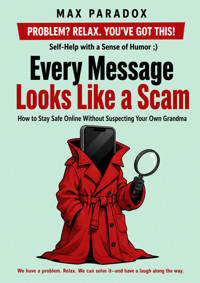
Every Message Looks Like a Scam - How to Stay Safe Online Without Suspecting Your Own Grandma ebook
Max Paradox
Uzyskaj dostęp do tej i ponad 240000 książek od 14,99 zł miesięcznie
- Wydawca: ALL-IN Rafał Płonkowski
- Kategoria: Biznes, rozwój, prawo•Biznes, rozwój
- Język: angielski
Every text looks suspicious. Every email has a link. Your bank wants you to verify something, your package has apparently entered a crisis, and someone claiming to be your child suddenly has a new phone number and urgently needs money.
Welcome to modern online life, where being cautious is sensible-but suspecting every notification of criminal intent is exhausting.
Every Message Looks Like a Scam is a practical, funny guide to staying safer online without turning yourself into a full-time digital detective. Max Paradox shows you how to stop guessing whether messages “look real” and instead use simple habits that work even when a scam is polished, personalized, and convincing.
You will learn how to:
recognize the pressure tactics scammers use;
judge messages by the risk of the requested action;
handle suspicious links without playing URL detective;
verify bank, family, work, and account messages through trusted channels;
protect passwords, authentication codes, and important accounts;
respond to unusual payment requests and changed banking details;
handle fake support calls and remote-access requests;
verify urgent messages from family members, even when the voice sounds familiar;
know what to do when you cannot immediately verify a request;
react quickly if you already clicked, paid, shared a code, or granted access;
build a simple security system that still works when you are tired, distracted, or busy.
The method is deliberately uncomplicated. You do not need to memorize hundreds of scams or become an expert in phishing domains, deepfakes, browser certificates, and mysterious email headers. Instead, you will learn a repeatable process:
Stop. Leave. Verify.
Stop before the sensitive action. Leave the channel creating the pressure. Verify through an independent route you already trust.
Along the way, you will meet fake delivery notices, suspicious invoices, “urgent” bosses, helpful strangers, fake tech support, compromised accounts, desperate relatives, and more gift-card emergencies than any functioning economy should reasonably contain.
The result is not paranoia.
It is calm competence.
You will know when to slow down, when to ignore something, when to check elsewhere, when to call someone, and what to do if the mistake has already happened.
Because the goal is not to trust everything online.
The goal is not to fear everything either.
The goal is to make good decisions without treating every message from Grandma like evidence in an international cybercrime investigation.
This publication was prepared with the assistance of tools that support the creative process, including artificial intelligence-based solutions. The final concept, structure, and editing belong to the author.
Ebooka przeczytasz w aplikacjach Legimi na:
Liczba stron: 197
Rok wydania: 2026
Odsłuch ebooka (TTS) dostepny w abonamencie „ebooki+audiobooki bez limitu” w aplikacjach Legimi na:
Podobne



















INTRO
Your phone buzzes.
“Hi! Your package could not be delivered. Please confirm your address here.”
You stare at the message.
You are, in fact, waiting for a package.
Suspicious.
You look at the sender. Some random number. Very suspicious. The link contains the name of a delivery company, except there is an extra letter hiding in the middle like a criminal wearing a fake mustache. Extremely suspicious.
You delete the message.
Thirty seconds later another one arrives.
“Hey, it’s Mom. I changed my number.”
Now we have a situation.
You call your mother. Her phone rings on the kitchen counter while she answers your call from exactly the same number she has had since approximately the invention of electricity.
Scam.
Excellent. You have successfully defended the perimeter.
Then your bank emails you about a new statement. Scam? Your streaming service says your payment method expires next month. Scam? A coworker sends you a shared document. Scam? Your cousin messages, “Look at this photo of you.” Absolutely scam. Nobody has ever introduced a photograph with words that reassuring.
At some point, online safety stops feeling like safety and starts feeling like living in a small digital bunker where every notification is examined under a lamp.
“Who sent you?”
“Why are you here?”
“Where were you on Tuesday?”
The message would like to remind you that your dentist appointment is at 3:30.
This is the strange problem we have created for ourselves. Online scams really are everywhere. Phishing emails, fake delivery notices, account alerts, cloned websites, impersonation messages, fake invoices, romance scams, marketplace scams, investment nonsense, support-agent impersonators, and urgent messages from people who have apparently changed both their phone number and personality overnight.
Being cautious is rational.
Being suspicious of literally everything is exhausting.
And unfortunately, the internet does not provide a neat visual distinction. Legitimate messages do not arrive wearing a white hat while scams enter accompanied by sinister violin music. Sometimes the fake message looks polished, professional, and perfectly ordinary. Sometimes the real message looks like it was written in a basement during a power outage.
This is inconvenient.
A genuine bank email may contain awkward wording. A real delivery company may use a link you do not recognize. Your actual employer may send a terrible-looking automated login notification. Meanwhile, a scammer can copy logos, colors, formatting, names, and language so well that the message looks more professional than the company it is impersonating.
The old advice—“just look for spelling mistakes”—has aged about as well as “never get into a stranger’s car,” now that millions of people routinely summon strangers in cars using an app.
The problem is not that you are foolish. The problem is that you are being asked to make dozens of tiny trust decisions in an environment specifically designed to make those decisions difficult.
You receive a message. You have three seconds before curiosity, fear, urgency, greed, politeness, or habit takes over.
“Your account will be suspended.”
Click.
“Someone tried to log in.”
Click.
“You have an unpaid toll.”
Click.
“Your refund is waiting.”
Click.
“Is this you in this video?”
Click.
Congratulations. Your nervous system is now operating customer support for the entire internet.
Scammers understand something important about human beings: we are much easier to manipulate when we are rushed. A message does not need to convince you for twenty minutes. It only needs to make clicking feel slightly easier than thinking.
That is why so many scams contain urgency. Pay now. Verify now. Respond immediately. Your account is at risk. Your package is disappearing into a mysterious postal dimension. Your boss needs gift cards before lunch for reasons that will definitely survive a reasonable follow-up question.
Urgency narrows attention. Fear makes us want certainty. Familiar names lower our guard. Small amounts feel harmless. Authority makes us hesitate to challenge the request.
And sometimes politeness finishes the job.
A stranger messages, “Sorry to bother you, is this Sarah?”
You are not Sarah.
A reasonable response would be to ignore it.
Instead, part of your brain says, Well, I should tell them. Otherwise they may spend the whole evening looking for Sarah.
Sarah will survive.
This book is not going to teach you that every unexpected message is dangerous. That approach technically reduces some risk in the same way never leaving your house reduces the risk of being hit by a bus. It also creates several new problems, including becoming the person who calls their bank to verify whether the bank’s phone number is really the bank’s phone number.
The goal is not maximum suspicion.
The goal is better verification.
Those are very different things.
Suspicion says, “Everything might be fake.”
Verification says, “I do not need to guess.”
That shift is the foundation of everything we are going to do.
You do not need to become a cybersecurity expert. You do not need to memorize fifty kinds of phishing attacks, inspect email headers for recreation, or spend your evenings studying domain registration records while your family quietly moves dinner to another room.
You need a small set of reliable habits that work even when the scam is convincing.
You need to know when not to click.
You need to know how to verify a message through a separate route instead of using the contact information the message conveniently provides.
You need to recognize the psychological buttons scammers press: urgency, fear, authority, curiosity, scarcity, embarrassment, and the powerful human desire to make an annoying notification disappear.
You need to know what to do when a message seems legitimate but something feels off.
And, importantly, you need to know what to do if you already clicked.
Because “never make a mistake” is not a safety strategy.
It is a fantasy written by someone who has never tried to use the internet while tired, distracted, carrying groceries, answering work messages, and wondering why the cat is making that noise.
We are going to build something more useful: a simple decision process that helps you separate normal communication from situations that deserve more checking. We will look at links, payments, passwords, one-time codes, account warnings, family impersonation, fake support messages, marketplace conversations, suspicious calls, and the increasingly weird world of messages that may sound exactly like someone you know.
The aim is not to turn you into the digital equivalent of a border guard interrogating your grandmother because she sent “Happy birthday” without an emoji.
The aim is to make scams boring.
Not harmless. Not nonexistent.
Boring.
A suspicious message arrives. You know what to check. You check it. You verify through a trusted route when necessary. You continue with your day.
No panic.
No detective board with red string.
No forty-minute investigation into whether FedEx has secretly changed its logo.
You will still occasionally receive a message that makes you narrow your eyes at the screen.
Good.
A little caution is useful.
We are simply going to teach that caution some manners.
By the end of this book, you should not trust everything online. That would be a terrible outcome and possibly the shortest cybersecurity career in history.
You should know when trust is reasonable, when verification is necessary, what steps to take, and how to act without letting every text message trigger a small internal fraud investigation.
Your grandmother may still send unusual messages.
That does not automatically make her a cybercriminal.
Although if she asks for $2,000 in cryptocurrency because she is “stuck at the airport,” perhaps give Grandma a call.
Next input according to the master flow is simply continue.
Chapter 1 - Why Everything Suddenly Looks Suspicious
You open your inbox and see a message from a company you actually use.
“Your account requires attention.”
Excellent.
Nothing improves a Tuesday morning like a vague digital threat.
You recognize the logo. The sender name looks right. The colors are right. There is even a polite footer explaining how seriously the company takes your security, which is comforting in roughly the same way as a restaurant displaying a large sign saying WE DEFINITELY WASH THE FORKS.
You hover over the button.
Maybe it is real.
Maybe it is fake.
Maybe clicking it will take you to your account.
Maybe clicking it will result in a man named Viktor buying three laptops with your credit card before you have finished your coffee.
So you close the email.
Then you reopen it.
Then you search the company name online.
Then you compare the sender address.
Then you search: “Is email from companyname-security-alert.com legit?”
Fifteen minutes later, you have found six forum discussions, three conflicting answers, an article from 2019, and one person on Reddit who appears convinced that the entire company is a front operated by an intelligence agency.
The email was real.
You have survived.
You have also spent fifteen minutes authenticating a notification about a $9.99 subscription.
This is the first important thing to understand: when scams become common enough, the cost is not limited to people who get scammed. Everyone starts paying a smaller tax in attention.
Every message requires a tiny decision.
Safe or unsafe?
Real or fake?
Ignore or act?
Click or do not click?
That decision used to be mostly automatic. A friend sent you a link, so you opened it. Your bank contacted you, so you read the message. A retailer sent a receipt, so you glanced at it and moved on.
Now your brain has learned a new rule:
Unexpected communication may be hostile.
That rule is not irrational. It is simply incomplete.
If your only safety rule is “unexpected equals dangerous,” ordinary life becomes difficult very quickly. Doctors call unexpectedly. Delivery services text from unfamiliar numbers. Companies change email systems. Friends send links with no explanation because apparently typing “this reminded me of you” has become physically impossible.
So your brain develops a second rule:
Maybe everything is dangerous.
Wonderful. We have upgraded anxiety into a security product.
The result is something like digital hypervigilance. You are scanning normal communication for threats because enough genuine threats exist to make the scanning feel justified. The scanning itself is useful up to a point. Beyond that point, it stops improving safety and starts creating confusion.
The problem is that suspicion feels productive.
You are doing something.
You are being careful.
You are not one of those people who clicks things.
You are a sophisticated citizen of the modern world, squinting at an email address while whispering, “Interesting.”
Unfortunately, suspicion without a method does not reliably produce good decisions. It produces more suspicion.
Imagine trying to decide whether food is safe by repeatedly staring at it.
You inspect the sandwich.
Looks normal.
But would a dangerous sandwich also look normal?
Possibly.
You inspect harder.
At some point, you need a better system than eye contact.
The same is true online.
The Scam Problem Has Changed
Older scam advice was pleasantly simple because many older scams were pleasantly terrible.
You received an email in strange formatting from a royal person experiencing a temporary banking inconvenience. The solution involved transferring you millions of dollars if you could first send a modest processing fee.
It was not subtle.
The sender sometimes appeared to have learned English from a microwave instruction manual.
Today, plenty of crude scams still exist. But they now share the internet with messages that are cleaner, more personalized, better timed, and easier to mistake for legitimate communication.
Scammers can imitate branding. They can use information that is publicly available. They can know your name, your employer, your job title, or where you recently shopped. They can create websites that look convincing for the few minutes they need them to look convincing.
None of this means you should assume every scammer possesses elite technical powers.
Many do not.
A large part of online fraud still depends on something far less glamorous:
getting you to cooperate.
The attacker does not always need to “hack” your account in the movie sense of the word. Sometimes they simply need you to enter your password into the wrong website, send money to the wrong person, approve the wrong login, reveal a code, or install something you should not install.
The sophisticated computer system in this operation is frequently you.
Do not take that personally. Humans are extremely useful pieces of infrastructure.
We can recognize context, make decisions, authorize payments, reset passwords, and override warning messages. Computers spend billions of dollars trying to imitate abilities you perform while eating cereal.
That is why scams target behavior.
The message is often just the opening move.
Your Brain Does Not Judge Messages Like a Computer
You might imagine that you evaluate suspicious messages by calmly reviewing evidence.
Sender.
Domain.
Request.
Context.
Risk.
Decision.
Very impressive.
In real life, you often evaluate them while standing in an elevator, waiting for pasta to boil, listening to someone tell you a story, and trying to remember whether you already paid the electric bill.
This matters because context changes judgment.
A fake invoice is easier to dismiss when you are relaxed and expecting nothing.
The same invoice becomes more convincing when you spent the morning paying invoices.
A fake password warning is easier to question at 2:00 p.m.
At 11:47 p.m., after you have already turned off the light, “Your account has been compromised” feels like an emergency personally scheduled to destroy your sleep.
Your brain does not like unresolved threats.
It especially does not like threats involving money, access, reputation, or someone you care about.
So a suspicious message can create a powerful urge to settle the question immediately.
You want to know.
You want the problem gone.
You want to click the button, see what is happening, and restore reality to its previous boring condition.
That urge is one of the reasons bad messages work.
Not stupidity.
Urgency plus uncertainty.
A very ordinary human combination.
Familiarity Is Not Proof
Suppose a message appears to come from someone you know.
Your boss.
Your sister.
Your landlord.
A coworker.
A company you use every week.
Your guard drops because your brain is not evaluating a random message anymore. It is evaluating a familiar identity.
That identity carries history.
Your sister has texted you thousands of times. Your brain does not begin every new conversation with:
“Please provide three forms of identification.”
It uses the relationship itself as evidence.
Normally, that is efficient. Civilization would become difficult if every family group chat required identity verification.
But this creates an obvious opportunity. If someone can convincingly borrow a familiar identity, even briefly, they also borrow some of the trust attached to it.
This does not require perfect imitation.
People often explain away inconsistencies themselves.
The writing style is strange?
Maybe he is busy.
Different number?
Maybe she changed phones.
Odd request?
Maybe something happened.
Does not want to talk on the phone?
Maybe reception is bad.
Humans are excellent at helping confusing stories make sense.
We call this interpretation.
Scammers call it free labor.
The lesson is not “never trust familiar names.” The lesson is that familiarity is one signal, not proof.
A displayed name is not identity.
A logo is not identity.
A profile picture is not identity.
A message knowing your first name is definitely not identity. Your first name has been entered into enough databases to qualify for frequent-flyer status.
Your Own Expectations Can Fool You
One of the strongest reasons a scam feels believable is timing.
If you are not expecting a package, a delivery message seems odd.
If you ordered four things yesterday because free shipping became a moral obligation at $50, the same message feels completely plausible.
If you recently applied for jobs, recruiter messages receive more attention.
If you recently traveled, airline and hotel messages make sense.
If you recently had a medical appointment, health-related messages fit the pattern.
Scammers do not always need to know what you are doing. Volume can do the work.
Send enough delivery messages and some recipients will be waiting for deliveries.
Send enough tax-themed messages during tax season and some recipients will already be thinking about taxes.
Send enough payment warnings and eventually you reach someone who just had a card declined at a gas station and is now emotionally ready to believe everything has collapsed.
Coincidence can impersonate intelligence.
That is worth remembering.
A message matching something happening in your life does not automatically mean the sender knows anything about you.
Sometimes they threw a dart into a crowd.
You happened to be standing where it landed.
Fear Is Not the Only Button
People often imagine scams work mainly because victims become frightened.
Fear is certainly useful.
But it is only one button.
Curiosity works beautifully.
“Is this you?”
“What do you think of this?”
“Did you see what happened?”
Greed works.
“You qualify for a refund.”
“You won.”
“Exclusive investment opportunity.”
Convenience works.
“Confirm with one click.”
“Update your details here.”
“Sign in to continue.”
Helpfulness works.
“Can you do me a quick favor?”
Politeness works.
“Sorry to bother you.”
Authority works.
“This is the fraud department.”
Embarrassment works.
“We detected unusual content associated with your account.”
Scarcity works.
“Final notice.”
And one of the strongest buttons is simple administrative irritation.
You receive a message saying your payment failed.
You do not panic.
You are annoyed.
You click because you want one fewer thing on your list.
This is not dramatic enough for a cybersecurity documentary, but it is extremely human.
A remarkable amount of risk enters our lives through the door marked, “Fine, let me just deal with this.”
The Goal Is Not Better Guessing
Here is where people often get stuck.
They try to become better at visually detecting scams.
They study wording. Fonts. Logos. Grammar. Sender names. Link shapes. Tiny differences in design.
Some of that is useful.
None of it should be your entire defense.
Because if your safety depends on every fake message looking fake, you have created a system that fails the moment someone produces a good fake.
That is the wrong competition.
You do not want to become the world champion of spotting suspicious pixels.
You want a process that still works when the message looks convincing.
This changes the central question.
Instead of:
“Does this look real?”
ask:
“Does this message require me to do something risky?”
That is much more useful.
A message becomes more important to verify when it asks you to:
enter a password;
share a verification code;
send money;
change payment details;
install software;
open an unexpected attachment;
provide personal information;
approve a login;
move a conversation to an unusual channel;
act quickly because something bad will happen if you do not.
Notice what is missing from that list.
Ugly fonts.
A weird comma.
A logo that looks slightly too blue.
Those things can raise suspicion, but the requested action tells you far more about the potential risk.
A badly written newsletter is mostly annoying.
A beautifully designed request for your banking credentials is dangerous.
Design quality is not the same thing as safety.
The internet would be much easier if evil had poor typography.
It has unfortunately discovered Canva.
Give Suspicion a Job
Suspicion should not be your final decision.
It should be a signal to slow down.
That is its job.
You do not need to answer every uncertainty instantly. You also do not need to investigate every strange message like a federal case.
For now, practice one small change.
When a message makes you uneasy, do not ask yourself to decide immediately whether it is real.
Instead, identify what it wants from you.
Does it want you to read something?
Click something?
Log in?
Pay?
Call?
Reply?
Send a code?
Install an app?
Give information?
The more sensitive the requested action, the less you should rely on appearance alone.
This turns vague suspicion into a useful question.
And useful questions are calmer than panic.
Your action after this chapter is simple: for the next few suspicious messages you receive, ignore the design for ten seconds and identify the requested action first.
Not “Does this look fake?”
“What does this want me to do?”
That question will not solve every scam.
It will, however, stop your security strategy from depending on whether the criminal remembered to use spell-check.
Chapter 2 - The Message Wants You to Hurry
At 4:26 p.m. on Friday, you receive a text.
“Fraud detected on your account. Verify immediately to prevent restriction.”
Excellent timing.
Your brain has already packed for the weekend.
You were planning to finish one small thing, close the laptop, and spend the next two days behaving like a person whose existence is not organized around passwords.
Instead, your financial life has apparently caught fire.
There is a link.
The message looks plausible.
You tap it.
Not because you carefully concluded that it was safe.
Because the word “immediately” grabbed the steering wheel.
This is one of the most important patterns in online scams: the message does not merely give you information. It tries to control the speed of your decision.
That distinction matters.
A legitimate company may genuinely need you to act.
A real problem may genuinely be urgent.
But scammers benefit enormously when you feel you do not have time to verify anything.
The less time you believe you have, the more likely you are to follow the path already prepared for you.
Conveniently, the message has prepared everything.
Here is the link.
Here is the number.
Here is the payment method.
Here is the helpful representative.
Please remain inside the small reality we have built for you.
Urgency Is a Decision Shortcut
Suppose someone emails:
“We noticed unusual activity. Please review your account when convenient.”
You might think:
Okay. I will open the app later.
Now compare:
“URGENT: Your account will be permanently closed within 30 minutes unless you verify now.”
Different emotional weather.
The second message creates a countdown.
Your brain shifts from evaluating the claim to avoiding the threatened consequence.
That is exactly what urgency does.
You stop asking:
“Is this true?”
and start asking:
“How do I stop this?”
The message is happy to provide the answer.
Click here.
The scammer does not need you to believe every detail. They need you to believe that delaying is more dangerous than acting.
That is a much easier sale.
Urgency also reduces your willingness to use independent routes. If you believe your account will disappear in fifteen minutes, opening the official app feels slower than clicking the enormous VERIFY NOW button already glowing in front of you.
This is why artificial deadlines deserve special attention.
Not automatic disbelief.
Attention.
Real organizations sometimes use deadlines. Your electricity provider does not consider due dates an abstract philosophical concept. Airlines close check-in. Banks may contact customers about suspicious transactions. Work emergencies occasionally occur, although some offices define “emergency” as “the spreadsheet needs a different shade of green.”
The question is not whether urgency exists.
The question is whether urgency is being used to prevent verification.
Watch for the Pressure Stack
A particularly effective suspicious message does not use one pressure tactic.
It stacks several.
Authority:
“This is your bank.”
Fear:
“Fraudulent activity has been detected.”
Urgency:
“Immediate action required.”
Consequence:
“Failure to verify will result in suspension.”
Convenience:
“Use the link below.”
Now the message has built a small psychological slide.
You do not need to make a decision.
Just sit down.
Gravity will handle the rest.
Other stacks use different ingredients.
Your “manager” writes:
“I’m in a meeting. Need a quick favor. Can’t talk. Please buy gift cards and send me the codes ASAP.”
Authority.
Secrecy.
Urgency.
Unusual payment.
Blocked verification.
That combination deserves more suspicion than any single element alone.
Or perhaps a “family member” contacts you from a new number: