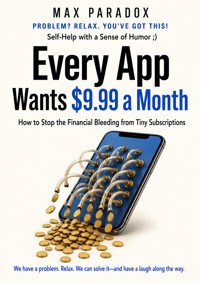
Every App Wants $9.99 a Month - How to Stop the Financial Bleeding from Tiny Subscriptions ebook
Max Paradox
Uzyskaj dostęp do tej i ponad 240000 książek od 14,99 zł miesięcznie
- Wydawca: ALL-IN Rafał Płonkowski
- Kategoria: Literatura popularnonaukowa•Nauki humanistyczne
- Język: angielski
Your bank account is not being destroyed by one dramatic purchase.
It is being quietly nibbled to death by $4.99, $7.99, $9.99, and $14.99 charges that somehow multiplied while nobody was looking.
A streaming service here. A fitness app there. Extra cloud storage. A premium productivity tool. A free trial that stopped being free sometime during a season you no longer remember.
Every App Wants $9.99 a Month is a practical, funny guide to getting subscription spending back under control without canceling everything enjoyable and moving into a cabin where entertainment consists of watching squirrels argue.
Max Paradox shows you how to identify what you are really paying for, calculate the true annual cost of tiny monthly charges, find duplicate services, stop forgotten trials, avoid subscription traps, and decide which apps genuinely deserve a permanent place in your budget.
You will learn how to:
build a complete subscription inventory without creating a financial spreadsheet empire;
tell the difference between useful subscriptions and abandoned ambitions;
evaluate annual plans, bundles, discounts, and premium tiers;
use subscription ceilings and active slots to stop new apps from quietly replacing the ones you canceled;
rotate streaming, seasonal, travel, work, and hobby services instead of paying year-round;
create renewal reminders before annual charges ambush your bank account;
use a 30-day audit for subscriptions you are unsure about;
decide when a paid service is genuinely better than the free alternative;
prevent subscription creep from returning six months later.
This is not a book about becoming obsessed with every dollar.
It is about making recurring spending intentional.
Keep the services that save time, solve real problems, entertain you, protect important data, or genuinely improve your life.
Cancel the ones that are simply charging rent for a version of you who planned to learn Italian in 2024.
Practical methods. Clear rules. Minimum-effort solutions. Plenty of jokes about the strange modern experience of discovering that your meditation app has been creating financial stress.
Because the goal is not to spend nothing.
The goal is to stop paying for things you no longer choose.
This publication was prepared with the assistance of tools that support the creative process, including artificial intelligence-based solutions. The final concept, structure, and editing belong to the author.
Ebooka przeczytasz w aplikacjach Legimi na:
Liczba stron: 185
Rok wydania: 2026
Odsłuch ebooka (TTS) dostepny w abonamencie „ebooki+audiobooki bez limitu” w aplikacjach Legimi na:
Podobne




















INTRO
You are standing in the kitchen, drinking coffee, when your phone announces that another subscription has renewed.
$9.99.
You stare at the notification.
What is this one?
You tap it and discover that six months ago you subscribed to an app that promised to improve your sleep by playing scientifically optimized rain noises. Apparently you have been paying nearly ten dollars a month for digital weather while continuing to sleep exactly like a raccoon trapped inside a recycling bin.
You decide to cancel it.
Then another thought arrives.
Wait. Didn’t I already cancel this?
Excellent question.
Your bank account has no comment.
Tiny subscriptions are one of the strangest financial inventions of modern life because almost none of them feel expensive. Ten dollars is not a financial crisis. Five dollars is barely a sandwich. Three dollars feels so harmless that your brain practically waves it through customs without checking the luggage.
Then the subscriptions begin reproducing.
One streaming service becomes three because one has the show you like, another has the movie someone mentioned at work, and the third has apparently been charging you since a free trial during an administration you barely remember. You have cloud storage, music, fitness, photo editing, meditation, language learning, password management, premium news, premium weather, premium notes, premium recipes, premium breathing, and an app that will organize your other apps if society completely collapses.
Individually, none of them seems serious.
Together, they have formed a small government inside your checking account.
The genius of the subscription model is that it turns a purchase into background noise. If an app asked you every month, “Would you like to hand us $9.99 again today?” you might occasionally say no. But it doesn’t ask. It quietly takes the money while you are doing important things such as unloading the dishwasher, joining a meeting, or watching a video about why actors from the 1990s suddenly look completely different.
Your decision happened once.
The payment happens forever.
Or at least until your credit card expires and half the internet begins sending you emotionally charged emails.
“Your payment method needs attention.”
No, Spotify. My payment method needs a vacation.
This book is not about becoming the kind of person who tracks every penny in a seventeen-tab spreadsheet and feels a small electric thrill when groceries come in thirty-seven cents under budget. If that is already you, congratulations. Please enjoy your formulas responsibly.
This is for the rest of us.
The people who are perfectly capable of understanding that $9.99 multiplied by twelve is roughly $120, yet somehow treat $9.99 per month as a completely different species of mathematics. The people who would hesitate before spending $120 on an app today but will happily pay $9.99 twelve times because the money leaves in polite little pieces.
That is the first trick.
A subscription is not priced the way your brain experiences it.
You see $6.99.
Your bank account sees $83.88 a year.
You see $14.99.
Your bank account sees $179.88.
You see “only $2.99.”
Your bank account sees another tiny creature moving into the basement and refusing to leave.
None of this means subscriptions are bad. Some are excellent. Some save money. Some save time. Some provide genuine entertainment or make work easier. Paying monthly for something you regularly use and value can be entirely sensible.
The problem begins when you stop choosing.
Maybe you signed up for a free trial because you needed one document converted from PDF. Perhaps you subscribed to a fitness app during the annual January ceremony in which millions of people briefly become athletes. Maybe you added extra cloud storage because your phone warned you seventeen times that it was full and eventually wore you down like a toddler asking for candy.
Some subscriptions were deliberate.
Others simply survived.
That survival is surprisingly easy because cancellation has friction. Signing up usually takes twelve seconds, Face ID, and the emotional discipline of a Labrador seeing someone open a bag of treats. Canceling may require opening settings, locating the correct menu, remembering a password, answering why you are leaving, rejecting a discount, rejecting another discount, confirming that you are absolutely certain, and occasionally proving that you have no personal grudge against the company’s founder.
Businesses understand something important about human behavior: people are busy.
They also forget things.
This is extremely convenient when your revenue depends on someone forgetting.
You may also keep subscriptions because of what economists call sunk costs, although normal people call it, “Well, I’ve already paid for it.”
You paid for a language app for eight months, so canceling now feels like admitting you are not going to become fluent in Italian. The fact that you have completed four lessons and one involved identifying a horse does not affect this emotional calculation.
You are not canceling software.
You are canceling imaginary future you.
Future you exercises five times a week. Future you reads international newspapers. Future you meditates every morning and knows exactly where every photo is stored. Future you watches award-winning documentaries instead of spending forty-five minutes choosing one and then watching the same sitcom again.
Future you is doing very well.
Present you is funding the operation.
There is another reason tiny subscriptions are difficult to control: they rarely create enough pain individually to trigger action. If your rent suddenly increased by $400, you would notice. If one company charged you $300 unexpectedly, you would investigate. But eight services quietly extracting $4.99, $7.99, $9.99, and $12.99 can continue for months because each charge looks too small to deserve a meeting.
Your finances are not always damaged by one dramatic mistake.
Sometimes they leak.
A little here.
A little there.
Nothing looks alarming until you total it and discover you have been spending enough each year to buy something you actually remember choosing.
That is what we are going to fix.
Not by declaring war on every subscription. Not by canceling everything, living in a cabin, and receiving entertainment exclusively from squirrels. And not by replacing forty subscriptions with a budgeting app that costs $11.99 a month, because even irony has limits.
You will learn how to identify what you are really paying for, distinguish useful subscriptions from financial wallpaper, stop free trials from becoming long-term relationships, judge annual versus monthly plans properly, reduce duplicate services, create rules for new subscriptions, and make sure the problem does not quietly rebuild itself three months later.
More importantly, you will learn how to do this without turning subscription management into a new hobby.
Because that would be very on-brand for us.
The goal is not to become suspicious every time something costs five dollars. The goal is to bring choice back into the process. If you pay for something, you should know why. You should use it enough to justify the cost. And when it stops earning its place in your life, it should leave.
Politely.
Firmly.
Without receiving another $9.99 on the way out.
This INTRO follows the supplied series brief and approved book identity exactly.
Wklejony tekst
Tekst
Chapter 1 - The Ten-Dollar Illusion
You open your banking app because you want to check one thing. Maybe your paycheck arrived. Maybe you want to confirm whether the grocery store charged you twice. Maybe you are simply participating in the modern ritual of opening your balance, staring at it for six seconds, and closing the app as if you have completed meaningful financial management.
Then you start scrolling.
$9.99.
$6.99.
$12.99.
$4.99.
$2.99.
Nothing dramatic. No mysterious $800 charge from a casino in another country. No refrigerator purchased in your sleep. Just a neat little parade of subscriptions marching through your account with the confidence of people who know security will not stop them.
You recognize most of them.
Probably.
One is your music service. Fine. You use that every day.
One is cloud storage. Also fine, although you are not entirely sure what is actually in the cloud. Photos, apparently. Documents. Possibly seventeen screenshots of parking spots.
Then there is a charge for an app you vaguely remember installing.
You tap it.
Ah.
The meditation app.
You have meditated twice.
One session lasted seven minutes.
Financially, you are currently paying roughly forty dollars per minute of inner peace.
This is how the subscription problem hides. A single small charge rarely feels important enough to trigger action. Your brain is built to notice large, immediate costs far more easily than small, repeated ones. If someone asked you to hand over $120 right now for a year of an app you barely use, you would probably stop and think.
“Do I really need this?”
But $9.99 today?
Sure.
That is barely money.
Until it happens twelve times.
The monthly price is not fake, of course. You really are paying $9.99 this month. The trick is that the monthly number encourages you to think locally instead of annually. It frames the decision as a tiny present expense rather than a recurring commitment.
Businesses know this.
That is why pricing pages rarely lead with:
“THIS WILL COST YOU $119.88 EVERY YEAR UNTIL YOU REMEMBER TO CANCEL.”
That headline lacks charm.
Instead, you get:
“Only $9.99/month.”
The word “only” is doing heavy emotional labor.
It suggests that the amount is too small to deserve serious analysis. It belongs in the same mental category as coffee, parking, or adding guacamole. The subscription does not feel like a contract with your future income. It feels like buying yourself a small convenience today.
Then six months pass.
Future income would like representation.
The first step in controlling subscriptions is therefore extremely simple: stop evaluating them by the monthly number alone.
Convert them.
Every monthly subscription should have an annual shadow price in your head.
$4.99 becomes about $60 a year.
$7.99 becomes about $96.
$9.99 becomes about $120.
$14.99 becomes about $180.
$24.99 becomes about $300.
You do not need to calculate it down to the penny every time. This is not an IRS audit. Multiply by twelve and round.
The purpose is not mathematical precision.
It is emotional accuracy.
Because your brain reacts differently to “$12.99 a month” and “about $156 a year.”
Same subscription.
Different feeling.
Suddenly the question changes from:
“Can I afford thirteen dollars?”
to:
“Would I deliberately spend around $156 a year on this?”
That is a much better question.
And sometimes the answer will still be yes.
Good.
Keep it.
The goal is not to make every subscription defend itself in front of a hostile congressional committee. It is to make the cost visible enough that you can choose deliberately.
A subscription can be worth $300 a year if it gives you $300 or more in value.
It can be a terrible deal at $30 a year if you never use it.
Price alone tells you very little.
Usage changes everything.
Suppose you pay $11 a month for music and listen every day during commuting, cooking, exercising, cleaning, and pretending to clean while standing in the kitchen looking at your phone. That subscription probably earns its place.
Now suppose you pay $7 a month for a premium recipe app because you once wanted to learn how to make sourdough.
You opened it three times.
You never made sourdough.
Your starter died before it legally became a starter.
That subscription is not providing recipes.
It is charging rent for an abandoned ambition.
This matters because people often defend subscriptions with the wrong question.
“Is seven dollars a lot?”
That is irrelevant.
The useful questions are:
Do I actually use this?
How often?
What would I lose if I canceled it?
Is there a free or cheaper alternative?
Would I subscribe again today at the current price?
That last question is especially powerful.
Imagine the subscription disappeared overnight.
No drama. No cancellation process. No guilt. Gone.
Would you go to the website today, take out your card, and sign up again?
If yes, excellent. You probably value it.
If your answer is, “Well… maybe someday I might want it,” congratulations. You have discovered one of the most expensive phrases in personal finance.
“Maybe someday.”
Maybe someday you will return to that online course platform.
Maybe someday you will start editing videos professionally.
Maybe someday you will use the premium travel app.
Maybe someday you will finally complete your twelve-week posture program.
Maybe someday you will become the person your subscriptions think you are.
Meanwhile, the payments are happening today.
This is where guilt enters the picture. People often keep subscriptions because canceling feels like admitting failure. If you cancel the fitness app, perhaps that means you are giving up on fitness. If you cancel the language app, perhaps you are admitting that Spanish is not happening this year.
No.
You are canceling billing.
Your goals are allowed to survive without direct debit.
You can exercise without a subscription. You can learn a language later. You can subscribe again when you actually need the service. Canceling access is not the same as canceling your identity.
This sounds obvious when written down.
That is because many expensive things sound ridiculous once they are forced to stand under proper lighting.
Another trap is what I call subscription camouflage.
You notice individual charges but never group them.
Streaming: $15.
Music: $11.
Cloud storage: $3.
News: $10.
Meditation: $8.
Fitness: $20.
Photo editing: $10.
Password manager: $5.
Productivity app: $9.
AI tool: $20.
Suddenly your “few small subscriptions” are costing more than a utility bill.
This is why your first practical exercise is not cancellation.
It is inventory.
Open your bank and credit-card statements and look back at least two or three months. App-store subscriptions should also be checked separately because they may not be obvious from the merchant name.
Write down every recurring digital service.
Do not decide yet.
Just list:
service name;
monthly or annual cost;
renewal frequency;
last time you remember using it.
That final column will become uncomfortable.
Good.
Discomfort is cheaper than recurring billing.
You may find services you forgot entirely. You may find duplicates. You may discover that one streaming platform quietly increased its price while you were busy living your life. You may find annual subscriptions that do not appear every month and therefore have achieved financial invisibility.
Annual billing deserves special suspicion because it disappears for eleven months and then arrives like an old acquaintance asking why you stopped returning calls.
“Oh right. You.”
This is also why looking at only one month is not enough. Some subscriptions renew quarterly or yearly. Others may have changed billing dates. Search your email for words like “subscription,” “renewal,” “receipt,” “membership,” and “trial ending.”
Your inbox may reveal an entire underground economy.
Do not spend three hours making the spreadsheet beautiful.
That would be a very sophisticated way to avoid canceling anything.
A basic note works.
If you have fifteen subscriptions, the inventory might take twenty minutes. If you have forty-seven, I have both sympathy and questions.
Once the list exists, calculate your approximate monthly total and annual total.
This is the moment when people usually say something highly technical such as:
“What?”
A person who believed they were spending “maybe forty bucks” may discover the actual number is $123 a month.
That is $1,476 a year.
Now the problem has a shape.
This matters because vague spending is hard to change. Specific spending is much easier.
You cannot reduce “random little charges.”
You can reduce $1,476.
You can decide whether $1,476 is giving you enough entertainment, convenience, education, storage, productivity, or joy to justify itself.
Maybe it is.
Probably not all of it.
Do not immediately cancel everything in a burst of financial enthusiasm. Extreme cleanup feels satisfying, but it often creates rebound subscriptions later. You cancel six streaming services, feel heroic, then realize you actually used two of them, resubscribe, and somehow add another service during the process because it had an excellent documentary about shipwrecks.
We are not doing a purge.
We are doing triage.
For today, the action is simpler.
Find the total.
That number is your baseline.
Once you know it, the subscriptions stop hiding behind individually harmless prices. They become one category competing for your money.
And categories are easier to manage than tiny invisible vampires.
Your minimum version, if your energy level is approximately potato, is this:
Check only your last thirty days of bank and card transactions.
Circle or note every recurring digital charge.
Add them up.
Done.
You do not need to cancel anything today.
You only need to stop saying, “It’s just $9.99.”
Because it is almost never just $9.99.
It is $9.99 with ambitions.
Chapter 2 - You Are Paying for People You Used to Be
Three years ago, you downloaded a photo-editing app because you had plans.
Serious plans.
You were going to take better pictures, organize your library, learn color correction, and possibly become the sort of person who says things like “the highlights are clipping” without immediately feeling fraudulent.
You bought the premium version.
For a while, you used it.
Then life happened.
The app is still charging you.
Your photography career, meanwhile, appears to be focused primarily on receipts, pets, food, and taking pictures of things in stores so you can “remember them later.”
You are not alone.
One of the biggest reasons subscriptions survive is that they become attached to identities, projects, habits, and ambitions that are no longer current.
The subscription remains active after the person who needed it has moved on.
This creates a strange financial museum.
There is your meditation phase.
Your running phase.
Your “I should read more serious news” phase.
Your “I am learning Japanese” phase.
Your “I will cook everything from scratch” phase.
Your “I should probably back up my backups” phase.
Each phase may have left behind a monthly charge.
You have souvenirs.
Except normal souvenirs do not invoice you every thirty days.
This is more than forgetfulness. People naturally treat future possibilities as if they have value today. You keep access because access preserves an option.
“I might use it.”
That sounds reasonable.
Sometimes it is.
But there is a hidden cost to keeping every possibility open.
Imagine you pay $12 a month for a design tool you use twice a year because you might need it unexpectedly.
That is $144 annually to preserve the possibility of instant access.
If the tool allows you to subscribe again in sixty seconds, you are paying $144 to avoid a future inconvenience roughly equal to finding your password.
An impressive luxury.
The same logic applies to streaming services.
“I might want to watch something on there.”
Of course.
You might also want sushi next Thursday. This does not require establishing a permanent monthly sushi membership today.
Access has become psychologically confused with ownership.
If you cancel, you feel you are losing something.
But most subscriptions are not disappearing from the planet. They are simply waiting behind a login screen.
You can come back.
This is important because subscription companies benefit enormously from what psychologists call status quo bias: once something is set up, people tend to leave it alone.
Doing nothing feels easier than making a change.
Even when doing nothing costs money.
Think about how many subscription decisions you make actively each year.
Probably very few.
Most subscriptions renew because you did not intervene.
That means the default is spending.
This is the opposite of how normal shopping works. If you want a new pair of shoes next month, you have to decide to buy them again. Your old shoe purchase does not automatically renew on the fifteenth.
Imagine if it did.
“Good news. Another pair of beige sneakers is arriving tomorrow.”
“But I don’t need them.”
“You selected Continuous Footwear in 2023.”
Subscriptions reverse the burden of decision. Instead of choosing to buy, you must choose to stop buying.
This makes old subscriptions unusually sticky.
The solution is to evaluate subscriptions based on your current life, not your historical intentions.
Look at your inventory from Chapter 1.
For each item, ask:
“Which version of me subscribed to this?”
That question is not philosophical. Please do not light a candle.
You are trying to identify the original purpose.
Maybe you subscribed to a project-management tool while freelancing.
You no longer freelance.
Maybe you paid for extra cloud storage during a temporary work project.
The project ended.
Maybe you subscribed to sports streaming for one season.
The season ended seven months ago.
Maybe you joined a premium meal-planning service because you wanted to cook five nights a week.
Your current meal plan appears to be “what can I make without going back to the store?”
No judgment.
We are just updating the database.
A subscription is justified by current usefulness, not historical sincerity.
You genuinely wanted that habit.
You genuinely intended to use that tool.
You genuinely thought you would watch all those documentaries.
None of that requires continuing payment after reality changes.
This is where sunk-cost thinking causes trouble.
People often say:
“I already paid for six months, so I should keep using it.”
No.
The six months are gone.
Continuing to pay does not recover them.
If you paid $80 for a service you barely used, the correct response is not to spend another $80 so the original $80 feels less lonely.
Money is not a rescue animal.
Past spending should influence future decisions only when it changes future value. Usually it does not.
Consider an annual course subscription.
You paid $150.
You completed two lessons.
Eight months later, you feel guilty canceling because you “should finish the courses.”
But if renewal is approaching, there are actually two separate questions:
Did you get enough value from the last year?
Will the next year be worth another $150?
The first answer may be no.
That does not force the second answer to become yes.
A bad purchase does not improve through repetition.
Sometimes keeping a subscription even makes the guilt worse. Every time you see the charge, it reminds you of something you believe you should be doing.
Your fitness app becomes a $19.99 monthly message saying:
“Still not exercising, huh?”
Very motivational.
Canceling can actually remove psychological clutter.
You stop maintaining fictional obligations.
This is why the next step is to divide your subscription list into three categories.
Category one: ACTIVE.