Uzyskaj dostęp do tej i ponad 240000 książek od 14,99 zł miesięcznie
- Wydawca: ALL-IN Rafał Płonkowski
- Kategoria: Poradniki•Styl życia
- Język: angielski
Why does the United States keep talking about Greenland?
And why does it keep insisting it doesn’t want it?
This book is not about conquest.
It’s not about secret deals.
And it’s definitely not about planting flags in the ice.
It’s about something far more American.
Options.
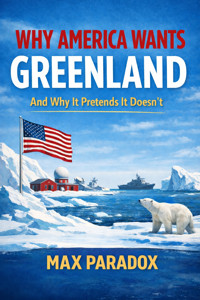
In Why America Wants Greenland (And Why It Pretends It Doesn’t), this sharp, satirical nonfiction explores how a frozen island became a recurring topic in serious meetings, policy papers, and strategic conversations - all while everyone politely insists nothing unusual is happening.
Blending real-world events, recent geopolitical developments, and a distinctly American sense of irony, the book explains:
why Greenland keeps appearing on maps that matter,
how climate change turns ice into strategy,
why shipping lanes, rare earths, and “defensive” infrastructure suddenly feel urgent,
and how influence works best when no one calls it influence.
Written in a calm, deadpan tone that lets the absurdity speak for itself, this book doesn’t accuse, attack, or moralize. Instead, it gently explains how perfectly reasonable decisions - repeated over time - can quietly reshape global priorities.
If you enjoy political satire that makes you laugh first and think second,
if you like your geopolitics factual but approachable,
and if you’ve ever wondered how “just in case” became a foreign policy philosophy -
this book is for you.
America doesn’t want Greenland.
It just doesn’t want to be surprised.
This publication was prepared using tools that support the creative process, including solutions based on artificial intelligence. The final concept, structure, and editing are the work of the author.
Ebooka przeczytasz w aplikacjach Legimi na:
Liczba stron: 71
Rok wydania: 2026
Odsłuch ebooka (TTS) dostepny w abonamencie „ebooki+audiobooki bez limitu” w aplikacjach Legimi na:
Podobne




















CHAPTER ONE - We Tried to Buy It Once. As a Joke. Probably.
America does not want Greenland.
This is important.We should say this clearly, calmly, and preferably several times, just to make sure everyone hears it.
America does not want Greenland.
America simply noticed Greenland.Briefly.Casually.In the same way you might notice a very large, very cold house listed online with the description: “Needs some work. Strategic location. Motivated seller.”
And then, completely unrelated to that observation, America asked a perfectly normal question:
“So… how much would it cost?”
This was, of course, a joke.
Probably.
The Joke That Wouldn’t Melt
In 2019, the United States expressed interest in purchasing Greenland.
This sentence alone sounds like satire.Which is unfortunate, because it is also a fact.
The proposal was treated exactly as a joke should be treated:
Denmark laughed.
Greenland laughed.
The internet laughed.
America clarified it was
“just an idea.”
Which is exactly what people say when they absolutely mean it, but are checking the room first.
Because here’s the thing about jokes:If you have to explain that it was a joke, it probably wasn’t.
And if you stop joking only after everyone else starts staring at you in silence, it was definitely not a joke.
We Buy Things. That’s Kind of Our Thing.
To understand why this happened, you need to understand America.
America is not a country that conquers territory anymore.That would be rude.
America acquires things.
We acquire:
companies,
startups,
distressed assets,
influence,
and occasionally entire industries.
If something is valuable, underutilized, and currently owned by someone else, America does not see a problem.America sees an opportunity.
Greenland is:
enormous,
sparsely populated,
strategically located,
and mostly ice.
Which means, in American terms, it is:
a fixer-upper,
with great potential,
and terrible heating costs.
Naturally, we were curious.
A Brief History of Buying the World
This would not have been America’s first real estate transaction.
The country itself was essentially assembled through a series of purchases, misunderstandings, and optimistic assumptions.
We bought:
Louisiana (which turned out to be much larger than advertised),
Alaska (which everyone mocked until it became extremely useful),
and several islands we remember only when we need a military base.
Buying land is not aggressive.Buying land is entrepreneurial.
It’s conquest without the awkward uniforms.
So when Greenland appeared on the radar, the American brain did what it always does:
“Could we buy this?”“Should we buy this?”“If we don’t buy this, will someone else?”
And most importantly:
“Would it look bad if we asked?”
Greenland Is Very Big, Which Is Suspicious
Greenland is the world’s largest island.
This alone is unsettling.
Large things that are mostly empty make Americans nervous.They feel unfinished.
An empty continent? That’s a project.An empty island? That’s an invitation.
Greenland is roughly three times the size of Texas.
Which immediately raises a question no American can ignore:
“Why isn’t anyone using all that space?”
This is not a moral question.It is not even a political one.
It is a zoning issue.
“We’re Not Interested” (But We’re Looking)
Officially, the United States maintains that it has no interest in acquiring Greenland.
Unofficially, it has:
military installations,
economic assessments,
strategic analyses,
and PowerPoint presentations with titles like
“Arctic Opportunities: A Forward-Looking Framework.”
These presentations always include maps.
Maps are very important.
Maps allow you to point at places and say things like:
“This is critical.”
“This could be a problem.”
“We need options.”
America loves options.
We may not take them.We may never use them.But we want them available.
Preferably in a folder labeled “Just In Case.”
The Thing About Just in Case
America does not prepare for what will happen.
America prepares for what might happen, if something else happens first, and then goes wrong.
Greenland fits perfectly into this logic.
What if shipping routes change?
What if resources become critical?
What if someone else shows interest?
What if China does literally anything?
Suddenly, Greenland is not just ice.
It is:
a backup plan,
a strategic buffer,
a very large “what if.”
And America is very good at turning “what if” into “we should probably do something.”
Nobody Panics Like a Superpower
The idea of buying Greenland did not come from desperation.
It came from confidence.
Only a country absolutely sure of its position in the world would look at a foreign territory and think:
“Let’s just ask.”
This is not arrogance.This is habit.
America has spent decades being the default solution to global problems.
Eventually, you start assuming everything is solvable with:
enough money,
enough influence,
and a strongly worded memo.
Greenland was simply another variable.
A cold one.
Everyone Reacted Exactly as Expected
Denmark said no.
Greenland said no.
The world said, “Wait, seriously?”
America said, “Relax. It was a joke.”
And then everyone moved on.
Which is how you know this story is not over.
Because America does not forget ideas.
America archives them.
Ideas Don’t Go Away. They Wait.
Somewhere, right now, there is a document titled something like:
“Greenland: Long-Term Strategic Considerations”
It is not dramatic.It is not conspiratorial.It is incredibly boring.
Which makes it dangerous.
Because boring documents shape the world far more effectively than loud speeches.
They sit quietly.They get updated.They wait for the moment when the idea becomes reasonable.
And then suddenly, nobody remembers where it started.
This Book Is Not About Buying Greenland
Let’s be clear.
This book is not about buying Greenland.
This book is about:
why the idea made sense,
why it still does,
and why everyone involved pretends it doesn’t.
America does not want Greenland.
America just wants to make sure that if Greenland ever becomes important, complicated, or contested…
America is already there.
Just in case.
CHAPTER TWO - Why Greenland Keeps Showing Up in Serious Meetings
There is a moment in every serious meeting when someone clears their throat and says something that changes the temperature of the room.
In meetings about healthcare, this moment usually involves budgets.In meetings about education, it involves test scores.In meetings about national security, it involves maps.
And in a surprising number of American meetings over the last few years, that moment has involved Greenland.
Not loudly.Not dramatically.
Just casually.
“Well,” someone says, pointing at a screen, “there’s also Greenland.”
No one laughs.Which is how you know it’s serious.
Serious meetings are not where jokes live.
Serious meetings are where:
people speak slowly,
slides have too much text,
and no one is allowed to say “this feels insane.”
So when Greenland appears in a serious meeting, it is not because someone thought it would be funny.
It is because someone thought it would be necessary.
Greenland does not burst into the room.
It doesn’t kick down the door or demand attention.
It just… appears.
Usually on slide 14.
Slide 14 is where things stop being theoretical.
The first slides are optimistic.The middle slides are technical.Slide 14 is where someone says, “Okay, but what if this doesn’t go well?”
That’s where Greenland lives.
The people in these meetings are not cartoon villains.
They are analysts, advisors, consultants, and experts with titles like:
Senior Arctic Policy Fellow,
Strategic Resource Analyst,
Deputy Assistant Something for Emerging Regions.
These people do not wake up wanting to dominate the Arctic.
They wake up wanting to finish the meeting on time.
Which is why Greenland keeps coming up.
Because Greenland answers questions before they are fully asked.
Greenland shows up when someone says:
“What if shipping routes change?”
“What if ice melts faster than expected?”
“What if access becomes limited?”
“What if someone else gets there first?”
Greenland does not interrupt.
Greenland just sits there on the map, being large, quiet, and inconveniently important.
America is a country that plans for scenarios.
Not because it expects them to happen.
But because it is deeply uncomfortable not being prepared.
There is a particular American fear that goes something like this:
“What if something big happens… and we didn’t think about it?”