Uzyskaj dostęp do tej i ponad 240000 książek od 14,99 zł miesięcznie
- Wydawca: ALL-IN Rafał Płonkowski
- Kategoria: Poradniki•Styl życia
- Język: angielski
Building a house is supposed to be a dream.
Freedom.
Space.
Control.
This book is about what actually happens instead.
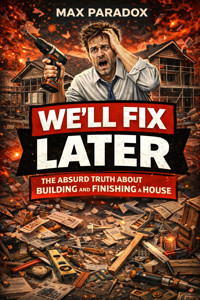
We’ll Fix It Later is a sharp, painfully accurate satirical nonfiction book about the modern obsession with building and finishing a “perfect” home-and the quiet madness that comes with it.
From budgets that evaporate on contact with reality, through walls that never feel straight, contractors who speak fluent uncertainty, and rooms that only make sense after you’ve stopped caring, this book captures the emotional, financial, and psychological absurdity of the entire process.
This is not a guide.
This is not advice.
This is not motivation.
It is an honest, ironic, and deeply relatable observation of what it means to build a house while slowly realizing that control is an illusion and “finished” is a myth.
Perfect for:
• homeowners
• future builders
• anyone who has ever said “it’s probably fine” and meant “I’m too tired to argue”
If you’ve built a house, you’ll recognize yourself on every page.
If you’re about to-this book won’t save you.
But it will make you laugh when nothing else does.
This publication was prepared using tools that support the creative process, including solutions based on artificial intelligence. The final concept, structure, and editing are the work of the author.
Ebooka przeczytasz w aplikacjach Legimi na:
Liczba stron: 94
Rok wydania: 2026
Odsłuch ebooka (TTS) dostepny w abonamencie „ebooki+audiobooki bez limitu” w aplikacjach Legimi na:
Podobne



















INTRO
Everyone who decides to build or finish a house believes, for a brief and dangerous moment, that they are a rational person making a rational decision.
They have done “research.”They have watched videos.They have talked to someone who knows someone who built a house once and survived.
This gives them confidence.
The kind of confidence usually seen right before a chair breaks.
Building a house does not begin with concrete or bricks.It begins with optimism.
Optimism is the first material delivered to the site.It is invisible.It is unmeasured.It is wildly overused.
You tell yourself it will take “about a year.”You say this calmly.You even say it out loud.
• You believe timelines are suggestions, not jokes.• You assume professionals will coordinate with other professionals.• You trust that words like “finished” and “almost finished” mean something.
At this stage, the house does not yet exist.But the budget is already dead.
There is a strange emotional arc to building a house.It starts with excitement.Moves quickly into confusion.Then settles into a long, quiet panic.
At no point does it return to excitement.
You learn new words.Not useful words.Very specific words.
Words that sound official.Words that feel expensive.Words no one explains twice.
• “Standard” means “this will cost extra.”• “Custom” means “you will regret this choice.”• “We’ll see” means “no.”
Every decision feels permanent.Every decision is made while tired.Often while standing in a muddy hole, staring at something that looks wrong but is apparently correct.
You nod a lot.
Nodding becomes a survival skill.
The house slowly grows.Not in a straight line.More like a series of emotional jump scares.
One day there are walls.Another day something is missing that was definitely there yesterday.No one seems concerned.
You are told not to worry.You are told this often.Usually right before you should absolutely worry.
• “This is normal.”• “Everyone goes through this.”• “It will look different when it’s done.”
“It” is never defined.
Finishing the house is when things become personal.
Structural mistakes are abstract.Paint colors are not.
Suddenly, you are responsible for choosing between things that look identical but apparently represent wildly different life philosophies.
Warm white.Neutral white.Slightly offended white.
• You will choose wrong.• You will realize this immediately.• You will be told it’s already too late.
At some point, you stop asking how long things will take.You start asking if things will happen at all.
Your relationship with time changes.Weeks become theoretical.Months become flexible.“Soon” becomes a threat.
And yet, you continue.
You keep going because stopping is not an option.Stopping would require admitting something.
That this was never about building a house.It was about discovering how much chaos you can tolerate while still calling it a plan.
By the end, you will have a house.You will also have stories.
Not good stories.Accurate ones.
Stories that begin with confidence.And end with laughter that sounds suspiciously like exhaustion.
This book is not here to help you build a house.
It is here to sit next to you on the floor, surrounded by samples, invoices, and unanswered messages, and quietly say:
• You are not imagining this.• It really is this absurd.• And yes, everyone lies about how it went.
Chapter 1 - The Decision That Felt Like Freedom
The decision to build or finish a house never arrives loudly.
It does not kick the door open.It does not announce consequences.
It arrives casually.Usually in the evening.Often on a couch.
You are relaxed.This is important.
Relaxed people make terrible long-term decisions.
Someone says it out loud for the first time.Not dramatically.Almost experimentally.
“Maybe we should build a house.”
The sentence hangs in the air.Nothing bad happens.
This is how it wins.
At first, it feels like freedom.Like adulthood reaching its final form.
No landlord.No neighbors through thin walls.No asking permission to drill holes.
• You imagine silence.• You imagine space.• You imagine a version of yourself who owns tools.
You do not imagine paperwork.
The idea grows quickly.Suspiciously quickly.
Within days, you are “just looking.”Looking at plots.Looking at inspiration photos.Looking at houses that belong to people who clearly finished theirs.
These people are smiling.
You assume this means something.
The house, at this stage, exists only in your head.And it is perfect.
Every room makes sense.Every socket is exactly where it should be.Nothing creaks.Nothing leaks.
• You have already mentally placed furniture you do not yet own.• You have opinions about light you have never seen.• You are emotionally attached to a building that does not exist.
This attachment feels reasonable.
Then come the conversations.
Friends who built a house will react strangely.They will pause before answering.
There is always a pause.
They will say things like, “Well… it depends.”Or, “I mean… it’s worth it.”Or, “Would I do it again? That’s a different question.”
You ignore the tone.
Tone is for later.
People who have not built a house are much more encouraging.They are enthusiastic.They are confident.
They have opinions.
• “It’s an investment.”• “At least you’re doing it your way.”• “Renting is just throwing money away.”
No one defines “your way.”
At some point, the decision hardens.It becomes official.
You tell people you’re building a house.
This changes how they look at you.
You are now perceived as responsible.Stable.Someone who knows things.
You do not correct them.
Inside, a quiet shift happens.
The idea stops being exciting.It starts being inevitable.
You begin to justify it to yourself using math.Not accurate math.Comfortable math.
You compare rent to a mortgage.You ignore everything in between.
• You forget about delays.• You forget about stress.• You forget about the part where nothing goes as planned.
The spreadsheet looks fine.
Spreadsheets are excellent liars.
Then comes the first professional.
Architect.Designer.Builder.Someone with confidence in their voice.
They ask questions you did not expect.
They use words that sound familiar but mean something else now.
They talk about possibilities.
Possibilities are dangerous.
You nod.You agree.You say things like “Sure” and “That makes sense.”
You are still optimistic enough to believe this is collaboration.
The budget appears for the first time.
It is theoretical.Flexible.Optimistic.
It is presented as a starting point.
• “This is just an estimate.”• “We’ll adjust as we go.”• “You can always change things later.”
Later becomes a recurring theme.
You leave the meeting energized and slightly uneasy.
This is also important.
Unease is your last warning sign.
Soon, the house starts to consume conversations.Every conversation.
You talk about it with people who did not ask.You think about it while doing unrelated things.
You begin sentences with, “When the house is done…”
• You are planning a future that depends on dozens of strangers being competent.• You are calm about this.• This calm is temporary.
The decision now feels irreversible.
Not because contracts were signed.But because you have told too many people.
Social commitment is stronger than logic.
You cannot go back to renting now.You have an identity to maintain.
You start learning.
Not by choice.By exposure.
You learn about permits.You learn about waiting.You learn that “approved” does not mean “soon.”
Time stretches.
Nothing happens.But everything feels urgent.
This is the early phase of the build.Where reality has not yet made contact.
It is the most peaceful moment you will have.
You still believe effort equals progress.You still believe questions have answers.You still believe decisions lead to clarity.
They do not.
But for now, you are standing at the edge of something that still feels clean.
You have made the decision.You feel brave.You feel grown up.
• You do not yet know how often you will question this moment.• You do not yet know how small this decision will feel later.• You do not yet know that this was the easy part.
For now, it feels like freedom.
And that is enough to keep you going.
For now.
Chapter 2 - Budget, the First Fiction
The budget is the first thing you create that immediately stops being true.
It usually starts as a number.A clean number.A round number.
You like round numbers.They feel intentional.
You say it out loud with confidence.
“This is our budget.”
Nothing reacts.
No alarms.No laughter from the universe.
This silence feels like approval.
The budget, at this stage, is not a calculation.It is a mood.
It represents how much you feel comfortable spending, not how much things cost.
These are very different numbers.
You build the budget with hope.You remove things you don’t like.You keep things you assume are included.
• You assume walls come with walls.• You assume floors include floors.• You assume electricity understands electricity.
The budget agrees with you.Because it has no voice yet.
Then professionals enter the room.
They look at your budget the way adults look at a child’s drawing of a house.
Politely.Carefully.With concern they will not verbalize.
They say things like, “Okay, let’s see what we can do.”This is not encouragement.
This is preparation.
They begin to add numbers.Small numbers at first.Reasonable numbers.
Numbers that sound harmless.
Then they explain categories.
Categories you did not know existed.Categories that feel optional until they aren’t.
• “Installation.”• “Finishing.”• “Adjustment.”• “Unexpected.”
“Unexpected” is always present.It is never small.
Your budget starts to move.Not dramatically.Just enough to be annoying.
You accept this calmly.
Because it’s still close.Still manageable.Still theoretical.
You tell yourself this is normal.
You hear this word often.
Normal is the word used to explain everything that is not okay.
The first real budget shock arrives quietly.In an email.With a PDF attached.
The PDF is long.The total is bold.
You scroll past details.You go straight to the number.
Your body reacts before your brain does.
A slight pause.A tightness.A need to sit down.
• You tell yourself it must include everything.• You assume later costs will be smaller.• You decide not to ask too many questions.
Asking questions feels like inviting bad news.
You begin to learn a crucial rule.
Every choice has two prices.
The one you see.And the one you discover later.
Cheaper options appear.They look attractive.They promise savings.
They come with explanations.
• “It’s basically the same.”• “You won’t notice the difference.”• “Most people choose this.”
Most people is not a real person.Most people do not live in your house.
You choose the cheaper option.You feel responsible.
This feeling will not last.
The budget becomes a living thing.It grows.It adapts.
It absorbs phrases like “while we’re at it.”