


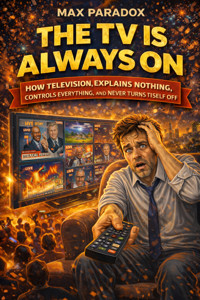
The TV Is Always On - How Television Explains Nothing, Controls Everything, and Never Turns Itself Off ebook
Max Paradox
Uzyskaj dostęp do tej i ponad 240000 książek od 14,99 zł miesięcznie
- Wydawca: ALL-IN Rafał Płonkowski
- Kategoria: Poradniki•Styl życia
- Język: angielski
You don’t really watch television anymore.
You just know what it says.
The TV is Always On is a sharp, satirical observation of modern television as a background force that never shuts up, never explains anything, and somehow still decides what matters.
This is not a book about shows.
It’s about formats, habits, noise, urgency, experts, breaking news, reruns, panels, alerts, smiles, apologies, and silence - all working together to keep you watching without remembering why.
Written in the unmistakable Max Paradox style, this book dissects television as a ritual, a piece of furniture, a source of authority, and a professional filler of time.
• No advice
• No media theory lectures
• No “just turn it off” optimism
Only sharp observations, dark humor, and uncomfortable recognition.
If you’ve ever looked up from the couch and wondered where the evening went -
this book already knows the answer.
This publication was prepared using tools that support the creative process, including solutions based on artificial intelligence. The final concept, structure, and editing are the work of the author.
Ebooka przeczytasz w aplikacjach Legimi na:
Liczba stron: 86
Rok wydania: 2026
Odsłuch ebooka (TTS) dostepny w abonamencie „ebooki+audiobooki bez limitu” w aplikacjach Legimi na:
Podobne

















INTRO - The Television Is On. Nobody Is Watching. Everyone Is Involved.
Television was never meant to be watched.That was just a rumor.
Television was meant to be on.
On in the background.On during dinner.On while people talk about things that have nothing to do with it.On while nobody listens, but everyone somehow knows what’s going on.
Television is not a medium.It’s an atmosphere.
A glowing rectangle that reassures you that silence has been defeated.That something is happening somewhere.That adults are in charge of the world, or at least pretending very convincingly.
People say they don’t watch television anymore.They say it proudly.Like a personality trait.
And yet:
• They know what the news “is saying lately.”• They know which politician looked tired.• They know someone “got exposed.”• They know something is “concerning.”
Television teaches knowledge without effort.You don’t have to focus.You don’t have to agree.You don’t even have to look.
You just have to be in the same room.
This book is not about TV shows.It’s not about channels.It’s not about nostalgia.
It’s about the absurd ritual of letting a glowing box explain reality to people who already feel confused.It’s about anchors who talk like nothing has ever happened before, even when everything has.It’s about breaking news that keeps breaking until it becomes furniture.
No advice.No solutions.No “turn it off at the end.”
Because it will still be on.
CHAPTER 1 - The TV Is Always On, Even When It’s Off
A television that is turned off is not actually off.It’s resting.
Waiting.Watching you.
A black screen doesn’t mean peace.It means readiness.
Readiness for:
• a special report,• an urgent update,• a shocking revelation that will be forgotten by tomorrow morning,• a rerun of something nobody remembers watching the first time.
People don’t watch television anymore.They coexist with it.
They eat while tragedies unfold.They scroll their phones while someone cries on a talk show.They fall asleep to a documentary that promises answers and delivers background noise.
Television doesn’t demand attention.It only asks for electricity and quiet acceptance.
The strangest thing about television is how much you know without ever watching it.
You don’t watch the news.But you know the world is “tense.”
You don’t watch political shows.But you know everyone is “divided.”
You don’t watch morning TV.But you know:
• someone cooked something fast,• someone tested a product you don’t need,• someone smiled like rent depended on it.
Television knowledge spreads through osmosis.No eye contact required.
The remote control is the most powerful object in the house.And it is used with absolutely no intention.
Click.Click.Click.
Not to choose.To avoid silence.
Silence is uncomfortable.Thoughts are inconvenient.Television fills the space between meals and sleep.
Television taught us that everything has a format.
• Disaster fits into twelve minutes plus commercials.• War needs a logo.• Human suffering works best with a scrolling ticker.• Truth should be summarized before the break.
If something doesn’t fit into the schedule, it probably wasn’t that important.
Television organizes chaos by pretending it knows what comes next.
“And now…”“Coming up…”“After a short break…”
These are the most optimistic phrases ever invented.
• “Short break” is a lie.• “Coming up” means nothing.• “Now” means “please don’t change the channel.”
Television doesn’t explain reality.It soothes it.
Even when it shows panic.Even when it shows collapse.
Because if chaos is on TV, then:
• someone filmed it,• someone edited it,• someone is calmly talking over it.
The most disturbing events are the ones that aren’t on television.Because then no one tells you how to feel.
Television is a professional interpreter of reality.It translates confusion into confidence.
The anchor looks at the camera like they know something.They rarely do.But they look convincing.
• Confident posture.• Serious tone.• The promise that adults are handling it.
Television turns opinions into facts simply by saying them slowly.
A sentence said on TV feels heavier than the same sentence said by a friend.Even if the friend knows more.
Especially if the friend knows more.
Television never admits uncertainty.It just replaces it with panels.
If nobody knows what’s happening:
• invite three people,• make them disagree,• call it a discussion.
Nothing calms uncertainty like watching experts argue without reaching conclusions.
Television is the only place where everything is urgent and nothing changes.
Breaking news breaks hourly.Exclusive stories repeat daily.Shocking revelations age instantly.
Yesterday’s emergency is today’s background noise.
And still, the TV stays on.
Like a domestic witness.Always present.Always ready to testify.Never responsible for the outcome.
It stands in the center of the room.Facing the couch.Demanding nothing.
Like an altar nobody believes in anymore.But everyone feels uneasy when it goes dark.
CHAPTER 2 - News That Say Everything and Explain Nothing
News is not about information.Information would require effort.
News is about movement.
A constant sense that something is happening.Somewhere.To someone.Possibly near you.Probably bad.
The purpose of the news is not to explain the world.It is to keep the world feeling unfinished.
That way, you come back.
Every news program begins with urgency.
Not because something urgent happened.But because urgency is the default tone.
If nothing is urgent today, the news will find something that could become urgent if you imagine it hard enough.
• Weather that might change its mind.• Markets that are “reacting.”• Experts who are “concerned.”• Situations that are “developing.”
Developing is a beautiful word.It means nothing.But it sounds responsible.
The news never says “we don’t know.”It says “it’s too early to tell.”
Which means the same thing.But with better lighting.
News anchors speak in sentences that sound complete but explain nothing.
They say things like:
• “This raises serious questions.”• “Many are asking what comes next.”• “The situation remains unclear.”
These sentences contain no information.But they feel informative.
Because they end confidently.
The news assumes you have no memory.
Yesterday’s headline is never referenced again.It simply evaporates.
• Yesterday was a crisis.• Today is a different crisis.• Tomorrow will be a new one.
There is no follow-up.There is no resolution.
Only continuity of tone.
The news doesn’t tell stories.It presents moments.
Moments without beginnings.Moments without endings.Moments carefully trimmed to fit between advertisements.
You are not supposed to understand what happened.You are supposed to feel updated.
That feeling is enough.
The news teaches emotional multitasking.
You are expected to care deeply for twelve seconds.Then move on.
• Outrage.• Sadness.• Fear.• Commercial break.• Weather.
By the time you process one tragedy, another one is already waiting.
The news respects your short attention span.And quietly trains it to be shorter.
Experts appear on screen to explain things.They rarely explain anything.
They explain that things are complex.
Complexity is the shield.
If something goes wrong:
• It’s complicated.• There are many factors.• It’s too early to assess.
If something goes right:
• It’s historic.• It’s unprecedented.• It’s a turning point.
Every outcome is framed as important.None are framed as understandable.
Panels are the news equivalent of furniture.
They fill space.
If nobody knows what’s happening:
• add more people,• make them disagree,• let them talk over each other.
Confusion looks better when it’s symmetrical.
Each panelist has a role.
• One is alarmed.• One is skeptical.• One is neutral but nods a lot.• One talks too long and gets cut off.
No one reaches a conclusion.Because conclusions end segments.
The news avoids conclusions the way it avoids silence.
Silence would imply thinking.Thinking is dangerous.
Graphics appear to simplify things.They do the opposite.
Arrows point everywhere.Maps glow aggressively.Charts move even when nothing changes.
The message is clear:
Something is happening.Don’t ask what.
Breaking News is the most abused phrase in human communication.
It once meant something had just occurred.Now it means:
• this is happening again,• we’re still talking about it,• please keep watching.
Breaking News rarely breaks.It lingers.
It sits there.Pulsing.Waiting to be replaced by newer breaking news.
The ticker at the bottom of the screen exists to make sure your brain never rests.
Even if you stop listening, you are still reading.
Even if you stop reading, you are still aware that information is passing you by.
The fear is subtle.
What if you miss something?
What if the thing you missed is the thing everyone else knows?
The news exploits this fear gently.Professionally.Hourly.
Good news does not survive this system.
Good news has no tension.No urgency.No need for updates.
Bad news is renewable.It can be refreshed.Reframed.Reheated.
• “New details emerge.”• “Sources now say.”• “What we’re learning.”
Learning is another generous word.
What you are actually learning is how to stay anxious without panicking.
The news is careful not to overwhelm you completely.
That would cause you to turn it off.
Instead, it keeps you at a steady level of concern.
Concern is manageable.Concern keeps you watching.
Anchors speak as if they are holding reality together with tone alone.
Calm voice.Serious face.Perfect posture.
The world might be collapsing.But the desk is stable.
This creates trust.
If the anchor isn’t panicking, neither should you.Even if everything sounds bad.
Especially if everything sounds bad.
The news creates the illusion of participation.
You are not involved.But you are informed.
You are not responsible.But you are aware.
Awareness feels like action.It is not.
The news gives you opinions without asking you to think.
It tells you what matters today.And quietly removes what mattered yesterday.
By the time you question one narrative, another one is already replacing it.
The news doesn’t lie all the time.That would be too obvious.
It selects.
Selection is quieter.More elegant.
• What to show.• What to repeat.





