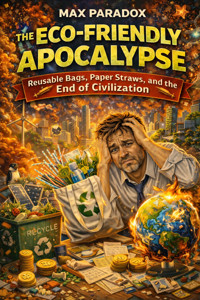
The Eco-friendly Apocalypse - Reusable Bags, Paper Straws, and the End of Civilization ebook
Max Paradox
Uzyskaj dostęp do tej i ponad 240000 książek od 14,99 zł miesięcznie
- Wydawca: ALL-IN Rafał Płonkowski
- Kategoria: Poradniki•Styl życia
- Język: angielski
The world is ending.
Politely.
There are no meteors. No fire. No dramatic speeches.
Just reusable bags you forgot at home, paper straws dissolving mid-sip, and a quiet sense that everything is somehow your fault.
The Eco-Friendly Apocalypse is a sharp, absurd, laugh-out-loud satirical look at modern environmentalism - not climate change itself, but the strange rituals, guilt systems, habits, performances, and lifestyle theater built around it.
This is not a book about saving the planet.
It’s a book about:
feeling responsible for global systems you don’t control
optimizing your existence into smaller and smaller sins
apologizing before enjoying anything
believing someone else is definitely in charge
and learning to live anyway
Written in the unmistakable Max Paradox voice - dry, observational, tired, funny - this book doesn’t preach, doesn’t motivate, and doesn’t offer solutions.
It simply observes the absurdity.
Perfect for readers who:
care about the planet but are exhausted by the discourse
laugh at paper straws while still using them
recycle, feel guilty, forget the cup, and move on
want humor instead of lectures
No advice.
No optimism.
No happy ending.
Just recognition - and relief.
This publication was prepared using tools that support the creative process, including solutions based on artificial intelligence. The final concept, structure, and editing are the work of the author.
Ebooka przeczytasz w aplikacjach Legimi na:
Liczba stron: 103
Rok wydania: 2026
Odsłuch ebooka (TTS) dostepny w abonamencie „ebooki+audiobooki bez limitu” w aplikacjach Legimi na:
Podobne
















INTRODUCTION - Welcome to the Eco-Friendly Apocalypse
The world is ending.But in a very polite way.
There are no meteors.No fire from the sky.No dramatic speeches delivered from rooftops.
Instead, there is a gentle reminder to bring your own bag.
Civilization is collapsing slowly, sustainably, and with excellent branding.
The apocalypse no longer arrives screaming.It arrives whispering through recycled paper leaflets, printed twice by mistake, explaining why printing them was a necessary evil.
We were promised flying cars.We got paper straws that dissolve before the drink reaches your mouth.
And somehow, this feels like progress.
The Eco-Friendly Apocalypse is not loud.It does not kick doors open.
It politely knocks.Waits.Then leaves a passive-aggressive note saying it tried to save the planet, but you were unavailable.
You find that note later, folded neatly next to your reusable coffee cup that you forgot in the car again.
At some point, ecology stopped being about nature.
It became about behavior.And guilt.And performance.
Mostly performance.
You are no longer asked whether the planet is dying.That part is assumed.
The only question left is whether you personally killed it today.
With your shower.Your email.Your lunch choice.Your existence.
Modern ecology has a simple structure:
• The planet is fragile.• You are careless.• The solution is a lifestyle adjustment that costs slightly more.
This system is elegant.Efficient.And emotionally exhausting.
You are told that small changes matter.
• Turning off the light matters.• Separating trash matters.• Choosing the correct lid for your takeaway cup matters.
Meanwhile, entire oceans are being filled with plastic at industrial speed, but it would be rude to mention that right now because you used the wrong bin.
We have replaced scale with symbolism.
The modern ecological victory is not saving forests.It is remembering your tote bag.
Forests are abstract.Bags are personal.
And personal responsibility is easier to market than structural responsibility.
This book is not here to deny climate change.That would be boring.
This book is here to observe the strange theater that grew around it.
The rituals.The habits.The silent competitions.
The feeling that everyone is pretending to understand what they are doing, while secretly hoping someone else is in charge.
At some point, ecology became a social language.
You signal who you are by what you refuse.
• You refuse plastic.• You refuse meat.• You refuse straws.• You refuse to enjoy anything without apologizing first.
Your personality is now a set of exclusions.
You don’t say what you like.You say what you would never do.
The Eco-Friendly Apocalypse is fueled by good intentions.
Which makes it even more dangerous.
Nobody wakes up wanting to destroy the planet.They wake up wanting to feel like they are not the problem.
And that ishere things get complicated.
Every generation gets its own apocalypse.
Ours is carefully sorted into categories.
• Paper.• Glass.• Plastic.• Organic waste.• Moral waste.
And somehow, the moral waste always ends up being the largest container.
You are constantly reminded that the future depends on you.
Which is strange, because nobody asked if you wanted that job.
You didn’t apply.You didn’t sign anything.
You were just born into a world where forgetting to rinse a yogurt cup feels like a personal failure.
There is a special kind of anxiety that comes from believing your coffee choice is connected to melting ice caps.
Not logically.Emotionally.
You know it makes no sense.But you still hesitate.
And hesitation is the real product.
This book is written for people who:
• Separate trash while feeling vaguely stupid about it.• Feel guilty even when doing everything right.• Have argued with a bin.• Have stared at packaging longer than at their own reflection.
People who want the planet to survive, but are deeply confused about why it feels like a personality test.
The Eco-Friendly Apocalypse is not about trees.
It is about humans trying to be good inside systems that reward performance over impact.
It is about how saving the world became a lifestyle brand with a logo, a font, and a subscription model.
You will not find solutions here.
There are plenty of those already.Usually printed on compostable paper, shipped worldwide.
You will find observations.
And recognition.
And the quiet relief of realizing you are not the only one who thinks something feels off.
We will talk about:
• Paper straws that taste like regret.• Reusable bags multiplying faster than rabbits.• Eco labels nobody understands.• Corporate sustainability reports written by people who fly business class to explain them.• The strange belief that if everyone feels responsible, no one actually has to be.
But we will not fix anything.
Fixing is exhausting.
Observing is honest.
This is not a book against ecology.
It is a book against pretending.
Against the idea that complex global systems can be solved through individual shame and better shopping habits.
Against the silent agreement that if we look busy enough, someone else will handle the real problem.
The Eco-Friendly Apocalypse is already here.
It smells like bamboo.Sounds like a conference.And comes with a free reusable pen that stops working immediately.
Welcome.
Chapter 1 - The Age of the Paper Straw
The end of the world did not begin with fire.It began with a straw that gave up halfway through a drink.
At first, nobody noticed.People were too busy congratulating themselves.
The paper straw arrived quietly, wrapped in optimism and a thin layer of moral superiority. It looked harmless. Almost cute. Like something a well-meaning committee would invent after six meetings and a PowerPoint.
This was progress.This was responsibility.This was the future, slightly soggy.
Plastic straws were declared evil overnight. Not gradually. Not carefully. One day they existed. The next day they were spoken about in the same tone as asbestos and war crimes.
Nobody missed them publicly.
Missing them felt suspicious.
So we nodded.We accepted the paper straw.We put it in our drinks and pretended not to notice what was happening.
The first sip was always fine. That was part of the design. The system needed hope. A brief moment where you thought, “Okay, maybe this works.”
Then the texture changed.
Not dramatically. Subtly. The straw softened in a way that felt personal, like disappointment. It bent slightly, as if reconsidering its life choices. You adjusted your angle. You drank faster, not because you were thirsty, but because the straw was clearly on a schedule.
Paper straws do not fail suddenly.They fade.
They collapse slowly, forcing you to stay present with the consequences of your ethics.
By the time you reached the bottom of the cup, the straw had turned into a damp suggestion. You were no longer drinking through it. You were negotiating with it.
This was considered acceptable.
This was considered a fair trade for saving the planet.
Nobody could explain how this specific discomfort helped anything, but explanation was no longer required. Feeling bad was enough.
The paper straw was never about function.It was about proof.
Proof that you cared.Proof that you noticed.Proof that you were willing to suffer just a little for the greater good.
If the straw worked perfectly, it would defeat the point.
Environmental responsibility, as it turns out, must be mildly unpleasant to feel authentic.
Soon, paper straws appeared everywhere. Coffee shops. Airports. Restaurants that still served food wrapped in enough plastic to survive a nuclear winter.
The straw was the apology.
Yes, everything else is still terrible, but look at this one small thing we fixed.
And we did look. We looked closely, because it was right there, dissolving in our mouths.
Nobody talked about the factories.Nobody talked about shipping.Nobody talked about scale.
We talked about straws.
This was a brilliant move.
It took a massive, abstract problem and reduced it to something intimate and unavoidable. Climate change was overwhelming. A bad straw was manageable.
You could feel it.You could endure it.You could feel good about enduring it.
Corporations understood this immediately. They did not need to change systems. They needed to change accessories.
A paper straw costs very little.A paper straw is visible.A paper straw shifts the conversation away from everything else.
Instead of asking where the cup came from, you were busy fighting the straw.
The straw became the focus of your moral energy.
People began defending paper straws aggressively. Not because they loved them, but because admitting they were bad created an uncomfortable gap.
If the straw was bad, what else was performative?
So people said things like, “You get used to it,” and “It’s really not that bad,” and “It’s a small price to pay.”
These sentences were not about straws. They were about identity.
Accepting the straw meant accepting the logic behind it.
That logic was simple.
Discomfort equals virtue.Comfort equals suspicion.Questioning equals selfishness.
Once this logic settled in, it spread easily.
Lids became worse.Packaging became uglier.Products became proudly inconvenient.
Anything too comfortable started to feel unethical.
Brown paper appeared everywhere. Minimal ink. Rough textures. A leaf icon, usually in the corner, quietly judging you.
The leaf icon became more powerful than facts. No one knew what it meant exactly, but it felt official. Scientific. Moral.
The paper straw also changed how people behaved socially.
You were no longer allowed to complain.
Complaining meant you didn’t care.Complaining meant you were part of the problem.
So you smiled. You struggled silently. You drank faster than you wanted. You accepted that your beverage had a time limit now.
Children grew up believing drinks were temporary experiences, not to be enjoyed slowly.
The paper straw trained you.
It prepared you for future sacrifices. Smaller comforts. More rules. More signs explaining why something was worse now and why that was actually good.
It taught you that doing less felt like doing something.
Eventually, the straw failed completely. It collapsed into a wet spiral and floated uselessly in the cup.
And something interesting happened.
You didn’t blame the system.You blamed yourself.
You thought you drank too slowly.You thought you should have planned better.
This was the real success.
The paper straw did not save the planet.It taught you how to accept blame politely.
And that is how the Eco-Friendly Apocalypse truly began.
Not with fire.Not with floods.
But with a soggy straw and a quiet agreement not to ask bigger questions.
Chapter 2 - The Reusable Bag That Multiplies
The reusable bag was supposed to be the end of the problem.A simple object. A simple habit. One small change that fixed everything.
This was optimistic.
The first reusable bag entered your life with ceremony. You bought it deliberately. You paid extra. You told yourself this bag would live with you forever. This was not just a bag. This was commitment.
You forgot it at home the next day.
This was not failure. This was phase one.
Because groceries still needed to get home. And plastic bags were now morally radioactive. Asking for one felt like admitting you kicked a seal on the way in.
So you bought another reusable bag.
This one was thicker. More durable. Slightly smug.
You now owned two reusable bags and remembered none of them when it mattered.
The system assumed a version of you that did not exist. A calm, prepared version of you who always planned ahead, remembered objects, and entered stores with purpose.
The real version of you entered the store thinking about work, dinner, and whether you left the stove on. Bags were not part of this mental load.
Reusable bags began to appear in very specific places.In the trunk of your car, but only when you walked to the store.In a drawer that was now exclusively a bag drawer.Inside other reusable bags, like a self-replicating organism.
The number of bags grew quietly. You did not notice until it was too late.
At some point, you owned more bags than groceries.