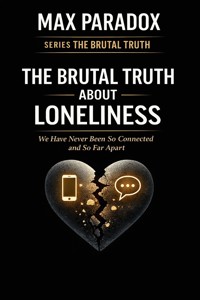
The Brutal Truth About Loneliness - We Have Never Been So Connected and So Far Apart ebook
Max Paradox
Uzyskaj dostęp do tej i ponad 240000 książek od 14,99 zł miesięcznie
- Wydawca: ALL-IN Rafał Płonkowski
- Kategoria: Biznes, rozwój, prawo•Biznes, rozwój
- Język: angielski
In a world where everyone is always connected, loneliness should no longer exist.
We can message anyone instantly.
We can see what our friends are doing in real time.
We can join conversations, communities, and digital spaces at any hour of the day.
And yet something strange has happened.
Loneliness has not disappeared.
It has simply changed its form.
The Brutal Truth About Loneliness is not a self-help guide, a motivational book, or a collection of comforting advice. It is a sharp, psychological dissection of the quiet mechanisms that shape modern relationships and slowly create emotional distance between people.
This book explores a disturbing paradox of modern life: people communicate constantly, but rarely reveal themselves.
Through thirty-five psychological mechanisms, the book exposes how loneliness grows in environments that appear socially active. It examines patterns such as emotional editing, passive disconnection, attention migration, stimulation substitution, silent comparison, expectation deflation, and emotional minimalism.
Each mechanism reveals a subtle behavioral pattern people repeat every day without realizing how it reshapes their relationships.
The result is rarely dramatic isolation.
The result is something far more complex.
A life surrounded by conversations, messages, and social activity that never quite reach the emotional depth required for genuine connection.
The book moves through realistic situations that feel disturbingly familiar: late-night scrolling through other people's lives, conversations that remain polite instead of honest, friendships that fade without conflict, group gatherings where someone feels quietly peripheral, and relationships where people protect their roles instead of revealing their uncertainty.
At the center of the analysis lies a difficult insight.
Modern loneliness does not always come from being alone.
It often grows inside relationships that function perfectly on the surface while quietly removing vulnerability, curiosity, and emotional friction.
The book explores how fragmented attention weakens listening, how limited emotional vocabulary prevents people from expressing what they truly feel, and how stimulation gradually replaces connection. It reveals why people adapt to shrinking expectations, celebrate independence that may actually be emotional adaptation, and remain trapped in social roles that prevent others from truly seeing them.
Throughout the chapters, readers will recognize moments from their own lives.
The message you meant to answer later but never did.
The conversation that stayed comfortable instead of becoming honest.
The invitation that sounded warm but never turned into a meeting.
The moment you almost said something real and stopped.
These small moments accumulate quietly.
They shape the emotional structure of modern life.
Rather than offering solutions, this book acts as a brutally honest diagnosis of everyday social behavior. It reveals how many habits that seem harmless or practical gradually weaken emotional closeness.
The most unsettling discovery is not how loneliness appears in other people.
It is how easily we recognize ourselves inside these patterns.
This book is for readers who sense that something about modern connection has changed. For those who feel that communication has become constant while understanding has become rare.
And for those willing to confront a difficult truth.
Loneliness is not always created by the absence of people.
Sometimes it grows quietly in the middle of conversation.
This publication was prepared using tools that support the creative process, including solutions based on artificial intelligence. The final concept, structure, and editing are the work of the author.
Ebooka przeczytasz w aplikacjach Legimi na:
Liczba stron: 186
Rok wydania: 2026
Odsłuch ebooka (TTS) dostepny w abonamencie „ebooki+audiobooki bez limitu” w aplikacjach Legimi na:
Podobne




















INTRO
At two in the morning the phone screen glows like a small artificial moon in the dark room. A thumb scrolls through photos of other people's lives: dinners, couples smiling on balconies, friends gathered around birthday cakes, sunsets photographed from hotel terraces. Notifications appear and disappear with quiet efficiency. Messages arrive instantly. Reactions accumulate. Hearts, thumbs, short comments written with effortless speed. Technically, the person holding the phone is connected to hundreds of people at this exact moment. Yet the room remains silent, the air still, and the strange sensation of distance lingers in the chest like a quiet pressure that refuses to dissolve.
Loneliness has never looked this connected.
For most of human history loneliness meant physical separation. A person alone in a forest. A traveler far from home. A widow in a quiet village. Distance was measurable. If no one stood near you, if no voices reached your ears, you were alone. The condition was visible and understandable. Communities formed precisely to prevent it. Families gathered around tables, neighbors visited unannounced, streets carried noise and human presence. Loneliness was not an invisible psychological fog. It was a practical absence of people.
Modern loneliness operates under entirely different rules.
Today a person can exchange messages with fifteen people before breakfast and still feel as if no one truly knows what is happening in their life. A group chat can explode with jokes and memes while the person reading them feels strangely excluded from the emotional reality behind the laughter. A video call can simulate presence, yet the moment the screen turns black the room becomes quiet again, and the silence feels even heavier because it follows the illusion of company.
The paradox is subtle but brutal. The more efficient our connection technologies become, the more carefully people learn to perform social presence without revealing emotional reality.
This performance begins early. A teenager posts a photograph with friends and receives dozens of reactions within minutes. The number itself feels like validation. Yet none of the reactions answer a simple human question: Who actually understands me? Numbers replace closeness because numbers are measurable, immediate, and easy to compare. Emotional understanding, on the other hand, requires patience, vulnerability, awkward conversations, and sometimes disagreement. Digital culture favors the fast currency of visibility over the slow currency of emotional intimacy.
The result is a peculiar social ecosystem where people appear constantly surrounded yet internally unsupported.
Consider the subtle rituals that structure everyday communication. Messages begin with polite enthusiasm. Reactions arrive quickly. Conversations move lightly from topic to topic. But certain subjects rarely appear: confusion, resentment, quiet fear, the strange emptiness that appears on Sunday evenings when the weekend noise fades. These topics remain outside the acceptable script. They slow the rhythm of interaction. They demand attention rather than reaction. And attention is the rarest resource in the modern social economy.
Loneliness therefore does not always arise from the absence of people. It often emerges from the absence of psychological permission.
A person may technically know many individuals and still feel that none of them are safe places for emotional honesty. Every relationship carries an invisible contract about what may and may not be revealed. Some friends are suitable for humor but not vulnerability. Some colleagues are useful for networking but not personal truth. Some family members offer loyalty but not understanding. The result is a carefully segmented emotional life where different fragments of the self are distributed across different relationships.
No one receives the full picture.
When this segmentation becomes habitual, people begin to perform a version of themselves that fits smoothly into every social environment while quietly hiding the parts that feel too complicated, too heavy, or too uncertain. The performance works. Conversations remain pleasant. Social images remain intact. Yet the internal experience slowly transforms. A person begins to suspect that if others knew the full emotional landscape behind the performance, the social harmony might collapse.
And so the performance s.
The modern individual therefore becomes both actor and audience in a carefully managed narrative of connection. Photos prove activity. Messages prove responsiveness. Stories prove participation in the flow of life. Each signal reassures others that everything is normal. The irony is that these signals often reassure the sender as well. If the performance s smoothly, perhaps the loneliness will remain manageable.
But loneliness rarely disappears through performance.
It adapts. It hides. It becomes quieter and more sophisticated.
A person may spend an evening with friends, laugh sincerely, return home satisfied, and then suddenly feel an unexpected drop in emotional temperature once the door closes behind them. The evening was pleasant. Nothing negative occurred. Yet the moment of solitude reveals something that the social gathering temporarily concealed: the subtle difference between being socially active and being deeply understood.
The difference is rarely discussed openly.
Partly because loneliness carries an uncomfortable stigma. Admitting loneliness sounds like confessing social failure. It suggests that something is wrong with one's relationships, personality, or life structure. In reality loneliness often appears precisely in lives that look socially successful. The person with many acquaintances may struggle more intensely with loneliness than someone with a small circle of emotionally honest relationships.
Visibility and intimacy follow different rules.
The digital age amplified this distinction in ways that few people anticipated. Platforms designed to increase communication simultaneously created an environment where identity itself became a curated object. Profiles display the most coherent version of a person. Photos highlight meaningful moments. Status updates compress complex experiences into brief narratives that fit comfortably within the attention span of scrolling audiences.
Over time the public version of the self becomes smoother than the private one.
The smoother the public identity becomes, the harder it feels to reveal the unscripted emotional reality underneath. The distance between the two versions grows quietly but persistently. A person scrolling through their own profile may even begin to experience a strange form of self-alienation. The life presented there is accurate in fragments, yet it does not fully capture the complicated emotional texture of everyday existence.
Loneliness thrives in that gap.
This does not mean technology created loneliness. Human beings have always experienced isolation, misunderstanding, and emotional distance. What changed is the architecture surrounding these experiences. In previous eras loneliness was often visible. Someone physically separated from the community could be recognized and approached. Today loneliness can exist in the center of intense digital interaction without leaving obvious traces.
A person can respond to messages, attend gatherings, maintain friendships, and still feel that no one truly witnesses the internal landscape of their life.
The psychological mechanisms behind this phenomenon are subtle and often self-reinforcing. People protect their identities, manage impressions, avoid vulnerability, compare themselves with carefully curated images of others, and slowly build emotional walls that feel socially necessary but personally exhausting. Each small decision makes sense individually. Together they create a system where loneliness becomes structurally embedded in everyday social behavior.
And the most intriguing part is this: many people participating in this system are simultaneously searching for the very emotional closeness the system quietly prevents.
The search appears in late-night conversations that suddenly become honest after hours of superficial interaction. It appears in unexpected confessions between friends who rarely discuss personal fears. It appears in quiet moments when someone writes a long message, deletes half of it, and sends a safer version instead.
Every deletion is a small negotiation between authenticity and social safety.
Loneliness therefore cannot be reduced to the absence of people. It is better understood as a gap between the emotional truth a person carries and the version of that truth they feel allowed to reveal. When the gap becomes wide enough, even a crowded life can feel strangely empty.
You can share everything and still feel unseen.
You can speak constantly and still feel unheard.
You can be surrounded by people who like you and still suspect that none of them truly know you.
The modern world made connection faster, easier, and more abundant. But it also introduced a new psychological challenge: maintaining authentic emotional presence within systems designed for rapid, simplified interaction.
And once that challenge becomes visible, a more uncomfortable question emerges.
What if loneliness today is not simply a personal feeling but a collective social habit?
What if millions of people are performing connection while privately experiencing distance?
And what if the very strategies designed to protect relationships are quietly preventing the closeness those relationships promise?
The mechanisms behind this quiet contradiction are complex, layered, and surprisingly familiar.
Once you begin to notice them, you start seeing them everywhere.
Chapter 1 - The Performance of Being Social
The message arrives on Friday afternoon: "We should meet soon. It's been too long." The reply appears quickly, almost automatically: "Absolutely. Let's do something next week." Both people mean the sentence when they write it. Both feel a brief warmth of reconnection. Yet both also know, somewhere in the quiet corners of their mind, that this ritual sentence has already been exchanged three times in the last six months. The conversation moves forward anyway. It is not exactly dishonest. It is simply part of the social choreography people learn when maintaining the appearance of connection becomes easier than creating the reality of it.
This ritual is rarely recognized as a performance because it feels normal. Two people acknowledge each other's presence in their lives. They confirm mutual goodwill. They promise future contact. On the surface nothing is false. But the psychological function of the exchange is different from the literal meaning of the words. The message is less about planning a meeting and more about maintaining the narrative that the relationship is still active. A small symbolic gesture replaces the emotional effort required to sustain genuine closeness.
The modern social landscape is filled with these gestures. A person sends a birthday message to someone they have not spoken to all year. A reaction appears under a photograph posted by a distant acquaintance. A brief "How are you?" travels across a messaging app, often followed by the automatic response "Good, just busy." Each interaction contributes to the impression of an active social network. Yet the emotional depth of these exchanges is often minimal. They function as signals rather than conversations.
One evening a woman sits in a crowded restaurant with six friends. Laughter moves easily around the table. Stories overlap. Phones occasionally appear as someone checks a notification or shows a photo. From the outside the scene represents social success. No one sitting nearby would describe the group as lonely. Yet the woman listening to the conversation notices something peculiar. The topics move quickly but rarely descend beneath the comfortable surface. Work anecdotes, travel plans, mild complaints about daily inconveniences. The rhythm is pleasant but strangely repetitive.
She considers mentioning the anxiety that has been quietly building in her chest during the past few weeks. She imagines explaining how the feeling appears suddenly at night, how the sense of uncertainty about the future has become heavier than usual. The thought remains in her mind for a moment. Then someone across the table begins describing a disastrous online date, and the group bursts into laughter again. The moment passes. She laughs too. The conversation s.
Nothing dramatic occurred. Yet something important did not occur either.
The performance of being social often succeeds precisely because it feels comfortable. Deep emotional honesty can disrupt the rhythm of friendly gatherings. It slows the conversation. It introduces ambiguity and vulnerability into spaces designed for easy interaction. Many people therefore develop a subtle instinct to protect social harmony by avoiding topics that might complicate the atmosphere.
You believe you are protecting the mood of the group - but often you are protecting the simplicity of the interaction.
The psychological mechanism behind this behavior is surprisingly rational. Human beings are highly sensitive to social friction. A conversation that becomes emotionally heavy can create awkward pauses, uncertain responses, or the quiet fear of saying the wrong thing. To prevent these uncomfortable moments people unconsciously maintain a conversational altitude where topics remain safe and universally manageable.
The cost of this altitude becomes visible only later.
A man returns home after an evening with colleagues. The gathering was enjoyable. They shared drinks, joked about workplace politics, exchanged stories about their children. Yet while brushing his teeth before bed he suddenly feels a faint emotional emptiness. He tries to identify the cause. The evening contained no conflict, no tension, no disappointment. And yet something about the experience feels incomplete, as if an invisible layer of human connection remained untouched.
Most social interactions are optimized for pleasantness rather than understanding.
This optimization gradually trains people to separate their emotional reality from their social presence. They bring a curated version of themselves into public spaces: humorous anecdotes instead of personal fears, mild complaints instead of deeper frustrations, interesting stories instead of vulnerable truths. The selection process becomes automatic. Over time individuals may even forget how much emotional material they leave outside the conversation.
You are surrounded by people who enjoy your company - but they are enjoying a version of you carefully designed for smooth interaction.
The performance works because everyone participates in it simultaneously. Each person at the table contributes their own curated fragments while quietly protecting the parts of themselves that feel too complicated for casual conversation. The group therefore experiences genuine friendliness without necessarily experiencing genuine emotional closeness.
A young man scrolls through his contact list one Sunday afternoon. Hundreds of names appear on the screen: colleagues, former classmates, distant relatives, people he met at conferences or social events. The number itself creates a subtle impression of abundance. He is not isolated. His social network is extensive. Yet when he considers sending a message about the strange dissatisfaction he has been feeling recently, the list suddenly appears much smaller.
Who exactly would understand?
The question is not rhetorical. It reveals the difference between social presence and emotional access. Many people in his contact list would gladly respond to a casual greeting or a humorous meme. Fewer would feel comfortable engaging with uncertainty, confusion, or vulnerability. The young man recognizes this distinction instinctively, even if he has never articulated it explicitly.
And so he closes the messaging app.
Most loneliness does not begin with the absence of people. It begins with the absence of safe emotional access within existing relationships.
The performance of being social quietly reinforces this dynamic. Each time individuals present the smooth version of themselves, they unintentionally teach others what kind of interaction the relationship supports. If every conversation remains light and entertaining, the relationship gradually becomes structured around that expectation. Introducing emotional complexity later can feel like violating an unspoken agreement.
The strange irony is that many people secretly wish someone else would break this agreement first.
They wait for a friend to say something honest. They hope a colleague might admit uncertainty. They imagine that a moment of shared vulnerability could transform the texture of the relationship. Yet because everyone is waiting for someone else to take the risk, the performance s uninterrupted.
Loneliness thrives inside well-maintained social harmony.
A woman receives dozens of reactions under a photograph she posted online. Friends comment enthusiastically. Acquaintances add brief compliments. Notifications appear throughout the day. Each signal confirms that people are paying attention. Yet when she sits alone later that evening, the emotional resonance of those interactions feels surprisingly thin.
Visibility is not the same as recognition.
People can see your life without seeing your internal world.
People can react to your presence without understanding your experience.
People can enjoy your company without knowing what you carry when you leave the room.
These sentences sound uncomfortable because they reveal a truth most individuals recognize privately but rarely discuss openly.
"Loneliness is not the absence of people. It is the absence of being known."
"Most conversations are designed to maintain relationships, not to deepen them."
"The person who laughs the loudest at the table may simply be protecting the quietest parts of their life."
These observations circulate silently inside many minds, yet they seldom appear in everyday dialogue. The performance s because it is efficient, predictable, and socially rewarded.
But the emotional consequences accumulate slowly.
When individuals repeatedly separate their internal reality from their social presence, they begin to experience a peculiar psychological distance from their own relationships. Friends remain friendly, gatherings remain enjoyable, conversations remain lively. Yet a quiet question begins to appear after these interactions: Did anyone actually see me today?
The question is subtle but powerful.
And once a person begins noticing that gap between social activity and emotional recognition, another mechanism becomes visible beneath the performance.
Because the next layer of loneliness is not about acting social.
It is about protecting the story you tell about your life.
Chapter 2 - Narrative Self-Defense
The message sits on the screen longer than necessary. Three grey dots appear, disappear, appear again. Finally the reply arrives: "Everything is fine. Just a busy week." The person reading the message senses that the answer is incomplete, but accepts it anyway. The conversation moves on to lighter topics. The moment passes quietly, almost politely. What just happened was not exactly a lie. It was something more common and far more socially acceptable: the protection of a personal narrative.
Narrative self-defense is one of the most sophisticated psychological mechanisms sustaining modern loneliness. It occurs when people defend the story they tell about their life even when the story no longer matches their emotional reality. The mechanism operates quietly because the narrative itself is rarely fully conscious. Individuals build these stories gradually through small explanations offered to friends, family, colleagues, and eventually to themselves. Over time the narrative becomes a stable identity structure that feels necessary to maintain.
A man describes his life to acquaintances with confident clarity. Work is demanding but rewarding. The relationship is stable. Plans for the future are developing. The explanation is not false in a factual sense. Yet the emotional texture beneath these sentences contains more complexity than the narrative allows. Some evenings feel strangely empty. Certain conversations with his partner end with unresolved tension. The career path that once felt exciting now carries subtle fatigue.
The narrative does not include these details.
Narrative self-defense begins with a reasonable instinct. Human beings want their lives to make sense. Chaos, contradiction, and uncertainty are psychologically uncomfortable states. To stabilize identity, people construct stories that organize events into a coherent explanation. These stories help individuals move forward with confidence. They allow a person to answer simple questions like "How are things going?" without pausing for a full psychological analysis.
The story becomes a social tool.
But once the story is repeated often enough, it begins to shape what can and cannot be revealed.
A woman sits with a close friend at a café on a quiet afternoon. The friend asks gently how her marriage is going. For a brief moment she considers answering honestly. She could describe the growing emotional distance she has been feeling during the past year. She could admit that conversations with her husband increasingly resemble logistical briefings rather than emotional exchanges. The thought appears clearly in her mind.
Then another thought replaces it.
Everyone believes her marriage is stable.
The narrative surrounding her relationship has been carefully maintained for years. Family members admire the couple. Friends occasionally describe them as an example of long-term compatibility. Even she herself has repeated this description many times. To suddenly reveal uncertainty would not simply introduce new information. It would disrupt an entire identity structure.
So she smiles and says, "We're good. Just the usual routines."
Narrative self-defense protects identity stability at the cost of emotional transparency.
You believe you are protecting your privacy - but often you are protecting the story you told yesterday.
This mechanism becomes particularly powerful in environments where social comparison is constant. Digital platforms amplify the pressure to maintain coherent life narratives because public profiles operate as ongoing autobiographies. Each photograph, update, or announcement reinforces a version of the self that others gradually accept as reality.
Once that version stabilizes, deviation becomes psychologically expensive.
Imagine a man who has built a public identity around professional success and independence. His posts highlight business achievements, travel experiences, and moments of confident autonomy. Friends respond with admiration. Colleagues interpret the signals as evidence of momentum. The narrative solidifies: he is thriving.
Yet internally he feels a quiet sense of disconnection that has been difficult to explain. Long flights feel increasingly empty. Hotel rooms begin to resemble temporary waiting spaces rather than signs of freedom. The excitement of constant movement has slowly transformed into a subtle exhaustion.
The narrative he created cannot easily accommodate this shift.
Admitting dissatisfaction would not simply reveal a temporary mood. It would challenge the identity he has spent years constructing in front of others. And so the narrative remains intact. Posts to appear. Messages remain upbeat. The internal experience remains largely private.
Loneliness often hides inside successful narratives.
A similar process unfolds in friendships. A group of friends may maintain a shared narrative about their dynamic: they are supportive, humorous, loyal to one another. The narrative contains genuine truth. Yet over time certain emotional topics quietly disappear from conversation because they do not fit the group identity. One friend begins struggling with anxiety. Another quietly questions career choices. A third experiences growing distance in a relationship.
Each individual senses that introducing these complexities might disrupt the established rhythm of the group.
And so the group s laughing together.
The psychological elegance of narrative self-defense lies in its ability to feel socially responsible. People often justify the mechanism by framing it as emotional consideration for others. Why burden friends with personal doubts? Why complicate gatherings with heavy topics? Why disturb the positive atmosphere of relationships that appear to be working well?
You believe you are protecting others from your problems - but often you are protecting yourself from their reactions.
Because reactions are unpredictable.
If the narrative breaks, the responses of others cannot be controlled. Some may offer sympathy. Some may express confusion. Some may reinterpret past events in ways that feel uncomfortable. The stability of social perception becomes uncertain. Maintaining the narrative therefore feels safer than testing how relationships respond to the full emotional truth.