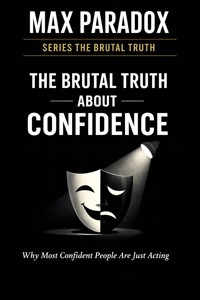
The Brutal Truth About Confidence - Why Most “Confident” People Are Just Performing Certainty ebook
Max Paradox
Uzyskaj dostęp do tej i ponad 240000 książek od 14,99 zł miesięcznie
- Wydawca: ALL-IN Rafał Płonkowski
- Kategoria: Biznes, rozwój, prawo•Biznes, rozwój
- Język: angielski
Confidence has become one of the most admired traits of modern culture. It appears in leadership advice, career guidance, motivational speeches, and self-development books. People are encouraged to build it, display it, and trust it. In professional life, confidence is often treated as evidence of competence. In social environments, it is interpreted as strength. On the internet, confident voices dominate attention, influence discussions, and shape opinions.
But a rarely asked question hides beneath this admiration.
What exactly are we seeing when someone appears confident?
Is confidence truly a reflection of knowledge, clarity, and inner certainty, or is it something far more complicated?
The Brutal Truth About Confidence explores a disturbing possibility: that much of what we call confidence is not the result of deep understanding but the product of social mechanisms that reward the appearance of certainty.
Through sharp psychological observation and unsettling social analysis, this book dismantles one of the most respected signals of modern society. It reveals how confident behavior spreads through environments where decisiveness is rewarded, hesitation is punished, and the ability to sound certain often matters more than the ability to be correct.
Across thirty-five chapters, the book dissects the hidden systems that create the spectacle of confidence.
You will discover why confident people often dominate discussions even when their understanding is incomplete. Why audiences instinctively trust decisive explanations. Why confident narratives spread faster than cautious analysis. And why entire organizations quietly reinforce the performance of certainty.
The book explores psychological mechanisms such as social reward loops, identity lock-in, prediction illusion, narrative stabilization, and the comparison spiral. Each mechanism reveals how confidence can grow stronger through repetition, reputation, emotional tone, and social reinforcement rather than through deeper knowledge.
One of the most unsettling discoveries is how easily performance turns into belief. When confident explanations are repeated often enough, the speaker may begin believing the certainty they originally performed. The audience reinforces it. The environment rewards it. The story becomes stable.
Eventually confidence stops looking like a behavior and starts looking like truth.
This book does not attempt to teach confidence or help readers become more confident. Instead, it investigates how confidence actually works beneath the surface of conversations, relationships, leadership, and culture.
Because once you begin noticing the mechanisms behind confident voices, something changes.
Certainty no longer sounds like proof.
It starts sounding like a signal.
A signal that someone is performing clarity inside a world that remains far more uncertain than anyone wants to admit.
And once that realization appears, confident voices will never sound quite the same again.
This publication was prepared using tools that support the creative process, including solutions based on artificial intelligence. The final concept, structure, and editing are the work of the author.
Ebooka przeczytasz w aplikacjach Legimi na:
Liczba stron: 183
Rok wydania: 2026
Odsłuch ebooka (TTS) dostepny w abonamencie „ebooki+audiobooki bez limitu” w aplikacjach Legimi na:
Podobne




















INTRO
The man standing in front of the mirror in the elevator hallway looks composed. His shoulders are relaxed. His face is calm in the way people learn to perform calmness when they know someone might be watching. His phone vibrates in his hand, and he glances at it without urgency. The message is from someone asking for advice. Not sympathy. Advice. He types slowly, choosing words that sound stable. Words that imply experience. Words that suggest certainty. When the elevator doors open, he walks in with the quiet dignity of someone who appears to know exactly where his life is going.
He does not.
But the performance is flawless.
Confidence has always been a strange social currency because it is rarely measured against reality. The world does not verify it the way it verifies competence or results. It responds to signals. Tone of voice. Body language. The absence of hesitation. A person who speaks slowly and rarely apologizes immediately appears more credible than someone who speaks carefully and questions their own conclusions. The strange part is that both individuals might possess the same knowledge, the same doubts, the same internal uncertainty. Yet one will be labeled confident and the other insecure simply because one of them learned how to perform certainty without visibly experiencing it.
This is the first secret of confidence that polite conversations tend to avoid. Confidence is not always a reflection of inner stability. Quite often it is a carefully rehearsed public posture that survives because most people prefer convincing performances over visible hesitation.
Humans have always been fascinated by people who appear certain. Leaders, entrepreneurs, celebrities, influencers, motivational speakers, managers, coaches, and the occasional charismatic colleague at work share a similar social advantage. They speak as if they already know the ending of the story. They describe future outcomes with calm conviction. Their predictions are rarely more accurate than anyone else's, but their delivery suggests authority. And authority is something human psychology responds to automatically.
In everyday conversations this mechanism becomes almost invisible. A person who expresses uncertainty is perceived as less capable even when they are simply being honest. Another person who simplifies complex issues into confident statements receives admiration for clarity even when the clarity comes from ignoring inconvenient details. Over time this produces a strange social ecosystem where visible confidence becomes more valuable than intellectual humility.
Confidence, in this sense, is less about truth and more about narrative control.
A job interview offers one of the clearest examples. Two candidates may possess similar qualifications. One of them describes their experience with caution, acknowledging limitations and explaining nuances. The other speaks with smooth conviction, framing every previous challenge as a triumph and every skill as mastery. Hiring managers often interpret this difference not as a difference in storytelling style but as a difference in competence. The confident candidate receives the job. The careful candidate receives polite rejection emails explaining that the company is looking for someone with more "self-belief."
This is where the spectacle begins.
Because confidence is contagious. Once someone has been socially validated as confident, other people begin interpreting their behavior through that lens. Hesitation becomes strategic thinking. Mistakes become bold experiments. Failures become learning experiences. The narrative adjusts itself automatically to protect the illusion.
Meanwhile the person who lacks visible confidence receives the opposite treatment. Their caution becomes weakness. Their reflection becomes insecurity. Their thoughtful pauses become signs of incompetence. Social perception quietly edits reality in both directions.
This dynamic creates an uncomfortable possibility that few people openly discuss. The individuals who appear most confident in public spaces are not always the most internally secure. In many cases they are simply the most practiced performers of certainty.
That performance begins early.
Children quickly discover that adults reward visible confidence. A student who raises their hand quickly and answers with enthusiasm receives praise even when the answer is partially wrong. Another student who hesitates, thinks carefully, and then expresses uncertainty is encouraged to "believe in themselves more." The message is subtle but persistent. Certainty is attractive. Doubt is socially uncomfortable.
Over time many people internalize a simple rule that shapes their adult behavior: it is safer to sound sure than to admit confusion.
This rule becomes particularly powerful in environments where status is constantly negotiated. Workplaces, social groups, online platforms, and professional networks reward individuals who appear decisive. A person who says "I'm not sure yet" slows down the social momentum of the conversation. A person who says "Here's exactly what we should do" accelerates it. Even if the second person has no deeper insight than the first, the speed of the answer creates the impression of competence.
Confidence, therefore, is often mistaken for clarity.
But clarity is not always present.
Behind many confident statements there is a quieter internal process that rarely appears in public. Doubt exists. Anxiety exists. Confusion exists. Yet the person speaking has learned that these internal signals should remain hidden because revealing them would disrupt the social image they have built. They become translators of their own uncertainty, converting it into confident language before anyone else can hear the hesitation.
This translation process becomes habitual.
Eventually people stop noticing that they are performing confidence because the performance becomes part of their identity. The confident manager, the confident entrepreneur, the confident friend who always knows what to say during difficult conversations. The role becomes comfortable. Expectations reinforce it. The person themselves begins to believe that the confidence is authentic because they have performed it for so long.
But occasionally something interrupts the script.
A difficult decision that cannot be simplified. A personal failure that cannot be reframed as success. A quiet moment late at night when the confident voice disappears and the internal dialogue becomes less polished.
These moments reveal an uncomfortable truth.
Confidence is rarely a stable psychological state. It is often a social negotiation between what a person feels internally and what they choose to display externally.
Some individuals feel strong internal security but struggle to perform it publicly. Others feel significant internal uncertainty yet have mastered the outward signals of confidence so effectively that few people question them. Society tends to reward the second group more consistently than the first.
This creates an environment where confidence becomes theater.
Not malicious theater. Not necessarily dishonest theater. But theater nonetheless. A stage where tone of voice, posture, language, and narrative control combine to create the impression of certainty.
Once this theater is recognized, everyday interactions begin to look slightly different. The charismatic presenter who seems fearless may simply be someone who learned to speak before their doubts can interrupt. The colleague who always appears decisive may privately spend hours wrestling with uncertainty before presenting a polished conclusion. The friend who gives confident life advice might be repeating lines that sound convincing even though they themselves are not entirely sure they follow them.
Confidence, in other words, often functions as a social costume.
Most people wear it occasionally. Some people wear it constantly. A few people refuse to wear it at all and accept the social consequences of visible hesitation.
And yet the spectacle s because human groups instinctively gravitate toward individuals who appear certain. Certainty reduces anxiety. When someone speaks with calm conviction, others experience temporary relief from their own doubts. The confident voice becomes a psychological anchor even when the anchor is attached to nothing solid.
That relief explains why confident performances spread so easily across modern culture. Social media amplifies voices that speak without hesitation. Professional environments reward individuals who project stability during uncertainty. Public discourse favors simple, confident explanations over complicated, careful analysis.
Confidence is easier to listen to than doubt.
But ease has a cost.
When confidence becomes a performance rather than a reflection of understanding, decisions begin to rely more on narrative strength than on evidence. Groups follow the person who sounds most certain rather than the person who has examined the problem most carefully. Individuals suppress their own doubts because expressing them feels socially risky.
And the spectacle s.
People admire confidence while quietly fearing that their own uncertainty will be exposed. They practice sounding decisive. They imitate the tone and language of people who appear successful. Over time the line between authentic self-belief and practiced performance becomes increasingly difficult to distinguish.
The result is a world filled with confident voices and privately uncertain minds.
Which leads to a quietly unsettling question.
If confidence is so often performed, why does the performance work so well?
Why do audiences rarely question it?
Why do individuals who speak with calm certainty receive trust even when their predictions fail repeatedly?
And why do people imitating the same performance even after witnessing how fragile it can be?
The answer lies not in personality but in a series of psychological mechanisms that shape how humans interpret confidence, respond to authority, protect their identities, and manage their own internal uncertainty.
Those mechanisms are rarely visible because they operate beneath everyday conversations.
But once they are examined closely, the spectacle of confidence begins to look less like a personality trait and more like a carefully maintained social illusion.
An illusion that many people participate in without fully realizing it.
And the first mechanism behind that illusion is surprisingly simple.
It begins with the subtle social reward people receive the moment they stop admitting what they do not know.
Chapter 1 - The Certainty Signal
The meeting room smells faintly of coffee and dry markers. Four people sit around the table with laptops open, each screen glowing with spreadsheets that appear more confident than the humans analyzing them. The manager stands near the whiteboard explaining a strategy that will supposedly reshape the department's entire direction over the next six months. The numbers behind the plan are incomplete. The assumptions are fragile. Several variables remain unanswered. Yet the manager speaks with such calm conviction that the room gradually stops noticing the missing pieces.
No one interrupts.
One analyst notices a contradiction between two projections but hesitates. Another person feels uneasy about the timeline but says nothing. The plan moves forward not because everyone believes it is flawless but because the person presenting it sounds certain.
This moment illustrates one of the most powerful social signals humans recognize: the certainty signal.
The certainty signal is not proof of knowledge. It is a behavioral cue that communicates confidence through tone, rhythm, posture, and decisiveness. When someone delivers a statement without hesitation, the human brain instinctively interprets that smooth delivery as evidence that the person understands what they are talking about.
But the brain is making a shortcut.
Confidence in delivery is often confused with depth of understanding. A person who speaks clearly and calmly about a topic may simply be comfortable with public speaking. Another person who hesitates might be thinking carefully about complexity. Yet social perception rarely pauses long enough to examine this difference.
Instead, the certainty signal becomes a psychological shortcut that replaces analysis.
"You sound like you know what you're doing."
This sentence is rarely a compliment about knowledge. It is a compliment about performance.
The strange thing about certainty signals is how quickly they shape group behavior. Once someone in a room demonstrates visible confidence, others begin adjusting their own responses accordingly. Questions become softer. Disagreement becomes quieter. Doubt becomes internal rather than verbal.
The group gradually reorganizes itself around the confident voice.
This does not require manipulation. Most of the time the confident person is not deliberately deceiving anyone. They are simply communicating in a style that signals authority. The rest of the group interprets that style as competence because human cognition evolved to rely on social cues when evaluating leadership.
Certainty feels like safety.
When a person appears certain, the group experiences temporary psychological relief. Ambiguity disappears for a moment. Decisions seem clearer. The future looks more predictable.
The irony is that the confident person may be experiencing the same uncertainty as everyone else in the room.
But uncertainty expressed out loud disrupts social momentum. Certainty accelerates it.
The human brain prefers acceleration.
"You believe confidence reflects clarity - but often it reflects comfort with speaking before doubt has time to appear."
This tension between perception and reality explains why certainty signals are so effective in environments where quick decisions are expected. Business meetings, negotiations, job interviews, and public presentations all reward individuals who deliver conclusions without visible hesitation.
Hesitation introduces friction.
Confidence removes it.
A consultant presenting a bold recommendation often receives more respect than a specialist who carefully explains the limitations of the data. The consultant's language sounds decisive. The specialist's language sounds cautious. Social perception interprets decisiveness as authority even when the cautious explanation contains more accurate information.
The confident voice wins the moment.
Later consequences are another story.
One of the most fascinating aspects of certainty signaling is that people often learn the technique unconsciously. They notice which behaviors receive approval and which behaviors trigger doubt from others. Over time they begin adjusting their communication style accordingly.
Shorter pauses.
Stronger statements.
Fewer visible doubts.
Gradually the person begins to sound confident even when the internal experience remains uncertain.
This transformation is rarely malicious. It is adaptive.
Social systems reward individuals who appear confident, so individuals adapt to the reward structure.
And adaptation slowly becomes identity.
A young professional may begin their career feeling uncertain about most decisions. Early experiences teach them that admitting uncertainty reduces influence during meetings. After observing colleagues who speak more assertively, they begin mimicking the same delivery style.
The sentences become firmer.
The tone becomes calmer.
The pauses disappear.
Externally the person now appears confident. Internally they may still feel the same doubts they experienced years earlier.
But the performance works.
And once the performance works, the social system reinforces it.
"You think confident people know more - but often they simply hesitate less."
The certainty signal creates a feedback loop that strengthens itself over time. The confident individual receives more opportunities to speak because others assume they possess valuable insight. With more opportunities comes more practice delivering confident statements. The delivery becomes smoother. The authority grows.
Soon the confident voice becomes the reference point for the group.
Ironically this process can happen even when the original confidence was largely stylistic.
Social perception rarely distinguishes between confidence that comes from understanding and confidence that comes from performance. The difference exists internally but remains invisible externally.
Which means the confident person gradually acquires real authority even if the original signal contained little information.
The stage becomes real.
The audience adjusts its expectations.
And the performer learns to maintain the role.
A quiet moment during the meeting reveals the emotional cost of this dynamic. The manager pauses briefly when someone asks a detailed question about the projections. The answer requires admitting that several assumptions are uncertain. For a fraction of a second the manager considers saying exactly that.
Then something else happens.
The answer arrives in a confident tone.
"We've analyzed multiple scenarios and the trajectory is clear."
The sentence sounds reassuring. The room relaxes. The discussion s.
Inside the manager's mind the situation is less clear than the sentence suggests.
"You believe certainty protects credibility - but often it protects the story you need others to believe."
This is the hidden motivation behind many certainty signals. The confident delivery protects the narrative structure of the conversation. Admitting uncertainty would disrupt the storyline. The group might slow down. Questions might multiply. The decision might become complicated.
Confidence keeps the story moving.
And stories are easier for humans to follow than ambiguity.
The emotional cost of this behavior appears gradually. The person who consistently performs certainty begins to feel responsible for maintaining the image. Admitting confusion becomes increasingly difficult because it would contradict the role others expect them to play.
Confidence becomes a commitment.
The confident manager must sound confident tomorrow because they sounded confident today.
The confident entrepreneur must projecting vision because investors expect conviction.
The confident friend must giving advice because others interpret hesitation as weakness.
Over time the performance becomes exhausting.
But the social rewards remain strong enough that the person rarely stops.
"You admire confidence - but rarely see the anxiety required to maintain it."
At some point the confident individual begins performing certainty even in situations where no audience exists. Internal dialogue adopts the same tone used during meetings or presentations. Doubts are pushed aside quickly because acknowledging them would slow down decision making.
Confidence becomes a personal habit.
Yet habits do not erase uncertainty. They only silence it.
The silence can become surprisingly loud during private moments. Late at night the confident voice disappears and questions begin to reappear. Did the strategy actually make sense. Did the advice given to a friend reflect understanding or just convincing language. Was the confident statement during the meeting supported by real knowledge or by the need to appear decisive.
These questions rarely reach public conversations.
The certainty signal remains intact.
The next meeting arrives.
The confident voice speaks again.
And the audience once again interprets smooth delivery as authority.
"You believe confidence attracts trust - but often it attracts silence."
Silence becomes the most powerful ally of the certainty signal. Once a confident narrative is established, other people become reluctant to interrupt it. They assume someone else has already verified the information. They assume the confident speaker must have knowledge they themselves lack.
Doubt becomes private.
The confident voice remains public.
This dynamic explains why many confident individuals appear almost unstoppable in group environments. The absence of opposition reinforces the illusion that the confident perspective is correct. In reality the opposition may exist silently inside the minds of multiple listeners.
But silence protects the spectacle.
And the spectacle grows stronger.
Eventually the confident narrative becomes the default explanation for events. Success confirms it. Failure is reframed in ways that preserve it. The confident person remains credible because the certainty signal never disappears.
The signal itself becomes the message.
Which leads to the next mechanism quietly shaping how confidence operates in human groups.
Because once certainty becomes a social signal, people begin using it not only to influence others but also to protect themselves.
And self-protection, as it turns out, has its own carefully rehearsed language.
Chapter 2 - Narrative Self-Defense
The message appears late at night on a phone screen glowing in a dark bedroom.
"I knew this would happen."
The sentence is sent to a friend who has just explained a situation that went wrong at work. The sender types slowly, rereads the words, and presses send with quiet satisfaction. The sentence feels calm, intelligent, almost prophetic. It suggests awareness. It suggests foresight. It suggests that the sender saw the outcome long before it happened.
But the truth is less elegant.
Four hours earlier the same person had been equally unsure about what would happen. Several possibilities existed. Several explanations were possible. Yet now that the outcome is visible, the mind begins quietly reorganizing memory in order to produce a more flattering story.
The story says: I knew.
Human confidence often depends on this invisible psychological mechanism known as narrative self-defense. It is the mental habit of reconstructing past thoughts in ways that protect a person's image of themselves as perceptive, capable, and correct.
The process happens so smoothly that people rarely notice it.
Memory is not a recording device. It is a storyteller.
Each time the brain recalls an event, it subtly edits the narrative to maintain a coherent identity. The person remembers their past decisions not exactly as they occurred but as they make sense within the current story about who they believe they are.
A confident person remembers themselves as someone who usually saw the outcome coming.
An uncertain person remembers themselves as someone who should have known better.
Both memories can be slightly distorted.
"You believe confidence comes from accuracy - but often it comes from editing the past."
Narrative self-defense protects the fragile boundary between uncertainty and identity. When events contradict a person's expectations, the mind instinctively begins searching for ways to reinterpret the situation so that the person's internal story remains intact.
This reinterpretation rarely feels dishonest.
It feels logical.
The brain assembles fragments of previous thoughts and organizes them into a cleaner storyline. Perhaps the person once mentioned a concern about the project. Perhaps they briefly considered a negative outcome before dismissing it. Those fragments become evidence that they had actually predicted the result all along.
Confidence grows from the reconstructed narrative.
The original uncertainty fades.
In social environments this mechanism becomes particularly visible during post-event conversations. A group discusses a failed strategy, a lost investment, a broken relationship, or a misjudged opportunity. As the conversation unfolds, multiple participants begin remembering their previous doubts with increasing clarity.
"I always felt something was off."
"I had a strange feeling about this from the beginning."
"I mentioned that risk weeks ago."
The group gradually fills with retrospective confidence.
What makes this phenomenon fascinating is that everyone in the room may genuinely believe their revised memory. Narrative self-defense does not operate as conscious deception. The brain genuinely experiences the edited version of events as accurate because the alternative would threaten the individual's sense of competence.
Confidence, therefore, is often built not on correct predictions but on reconstructed memories.
"You think confident people predicted the future - but often they predicted it after it happened."
This psychological habit has powerful relational consequences. People who regularly reconstruct their past thoughts in flattering ways begin to appear more perceptive than they actually were. Their stories suggest consistent foresight. Their recollections contain warnings that supposedly existed before problems emerged.
Listeners gradually interpret these stories as evidence of wisdom.
Meanwhile individuals who remember their past doubts more accurately may appear less confident simply because they acknowledge the uncertainty they experienced at the time.
Honesty becomes a disadvantage.
Narrative self-defense quietly rewards selective memory.