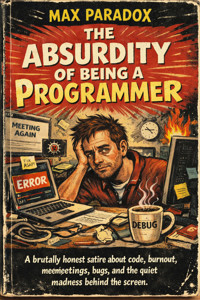
The Absurdity of Being a Programmer - A brutally honest satire about code, burnout, meetings, bugs, and the quiet madness behind the screen ebook
Max Paradox
Uzyskaj dostęp do tej i ponad 240000 książek od 14,99 zł miesięcznie
- Wydawca: ALL-IN Rafał Płonkowski
- Kategoria: Poradniki•Styl życia
- Język: angielski
Programming is supposed to be logical.
Predictable.
Clean.
It isn’t.
This book is a sharp, ironic, and painfully accurate look at what it actually means to work as a programmer, IT specialist, or software developer in the modern world.
Not the conference version.
Not the LinkedIn version.
The real one.
Inside, you’ll find:
• endless meetings about code that nobody opens
• systems held together by assumptions and hope
• bugs that aren’t personal, but feel like they are
• deadlines that are suggestions
• automation that creates more work
• burnout that arrives quietly
• experience that looks like caution
• and a career spent explaining why things take time
This is not a guide.
It won’t make you a better programmer.
It won’t teach you a new language.
It will do something more dangerous.
It will make you feel seen.
Written in a dry, observant, and tired-but-still-caring voice, The Absurdity of Being a Programmer is a satirical nonfiction book for anyone who has ever stared at a screen wondering why everything works except when it matters.
If you’ve ever thought:
“Is it just me?”
This book answers:
“No. It’s the job.”
This publication was prepared using tools that support the creative process, including solutions based on artificial intelligence. The final concept, structure, and editing are the work of the author.
Ebooka przeczytasz w aplikacjach Legimi na:
Liczba stron: 118
Rok wydania: 2026
Odsłuch ebooka (TTS) dostepny w abonamencie „ebooki+audiobooki bez limitu” w aplikacjach Legimi na:
Podobne




















INTRO
Every profession claims it is misunderstood.Programming is the only one that proves it daily.
From the outside, being an IT specialist looks like a controlled, almost meditative experience. A person sits quietly in front of a screen. Coffee appears regularly. Nothing explodes. Nobody screams. Money arrives anyway. It looks like the closest thing modern civilization has to cheating the system.
From the inside, it feels like living in a house where the walls rearrange themselves at night and then blame you for not remembering yesterday’s layout.
You were told this was about logic.You discovered it was about vibes.
You were promised clarity.You learned to survive ambiguity instead.
You entered a field where precision is worshipped, yet everything works “for reasons we’ll investigate later.”
• The code compiles, but nobody knows why.• The code fails, and it is definitely your fault.• The same code did both, five minutes apart.
This is a book about that space between expectation and reality.Not the heroic version of programming shown in conference talks.Not the LinkedIn version with pastel diagrams and confident smiles.But the quiet, absurd middle, where most developers actually live.
Here, productivity is measured in coffee refills.Progress is defined as “nothing got worse.”And success often means the system didn’t notice you today.
Programming is not about writing code.It is about negotiating with systems that remember everything except why they exist.
You inherit projects with names like “final_v3_fixed_REAL.”You open files last modified by someone who has since changed careers, countries, or personalities.You read comments that confidently explain behavior that no longer happens.
• Someone once knew what this did.• That person no longer answers messages.• You are now that person.
There is a special kind of exhaustion that comes from solving problems that technically shouldn’t exist.Bugs that vanish when observed.Errors that politely wait until Friday evening.Features that work perfectly, except in production, for emotional reasons.
You learn new languages constantly.Not because you want to.But because the industry wakes up every year and decides yesterday’s tools are now “legacy.”
• You just mastered something.• It is already a bad career choice.• There is a conference about its replacement.
The job demands total focus while actively punishing confidence.Every solution feels temporary.Every certainty comes with a silent expiration date.
You are expected to be logical, fast, creative, precise, flexible, and calm.Preferably before lunch.
And yet, despite everything, people keep coming back.Not because it’s easy.But because somewhere between frustration and flow, there are moments when things align.
A function behaves.A system responds.A problem dissolves instead of multiplying.
Those moments are brief.They do not last.They are enough.
This book does not explain how to become a better programmer.It will not teach best practices.It will not optimize your workflow or fix your posture.
It will simply sit next to you, nod occasionally, and say:
• Yes, this is strange.• No, you are not imagining it.• Everyone else is pretending harder.
If you have ever stared at a screen waiting for meaning to appear.If you have ever whispered “why” to a machine that refused to answer.If you have ever fixed something by changing nothing.
You are in the right place.
Chapter 1 - Everyone Thinks You Fix Printers
At some point, someone decided that “working with computers” is a single skill.
It didn’t matter whether you design distributed systems, optimize databases, or quietly prevent civilization from collapsing at 3 a.m.In the public imagination, you became The Computer Person.
Which means one thing.
You fix printers now.
It starts innocently.A family gathering.A friendly tone.A sentence that sounds harmless.
“So… you work in IT, right?”
You already know what’s coming.Your body knows it before your brain does.Your shoulders tense.Your soul attempts to disconnect.
• This is not a conversation.• This is a support ticket without a ticket number.• Payment will be gratitude and confusion.
Nobody ever asks what you actually do.They ask what their device is doing wrong.
Their laptop is “slow.”Their phone is “acting weird.”Their Wi-Fi “just doesn’t feel the same anymore.”
Details will not be provided.
• It was working yesterday.• Nothing was changed.• Except everything.
You try to explain that software development and hardware troubleshooting are different disciplines.They nod politely.Then they hand you a cable.
In their mind, computers are magic boxes.You are a wizard.Wizards fix all magic boxes.
It doesn’t help that sometimes you actually can fix it.Not because it’s your job.But because the bar is low and the problem is usually fear.
You restart the device.You wait.It works.
The room goes quiet.
• You are now dangerous.• Expectations have been updated.• This will happen again.
From that moment on, your identity shifts.You are no longer a person who writes code.You are technical support with a personality.
Someone’s email won’t send.Someone’s TV remote stopped responding emotionally.Someone forgot their password and wants you to “hack it.”
They say “hack” the way people say “microwave.”
• They assume it’s quick.• They assume it’s legal.• They assume you enjoy it.
You explain that hacking is not a thing you casually do for relatives.They laugh, because they think you’re joking.
Movies did this.TV shows did this.Some guy once fixed a printer and ruined everything for the rest of you.
On screen, the computer expert types fast.Green text scrolls.Problems collapse in seconds.
In reality, most fixes involve waiting.Waiting for updates.Waiting for logs.Waiting for someone else to admit they touched something.
• The most powerful command is “restart.”• The second most powerful is “wait.”• Neither looks impressive.
Your job becomes a paradox.
If things work, nobody knows what you do.If things break, everyone assumes it’s your fault.
You are judged by outcomes you cannot fully control,in systems you did not design,using requirements written by people who fear computers but trust them with everything.
And still, people believe you have universal answers.
They ask you which laptop to buy.You ask what they need it for.They say “normal stuff.”
• Normal does not exist.• Normal is a lie people tell before buying the wrong thing.• You will be blamed later.
You try to explain trade-offs.They want a simple recommendation.
Fast.Cheap.Light.Powerful.Reliable.
All at once.
You suggest something reasonable.They buy something else.It breaks.
They call you.
Because now it’s personal.
At work, this misunderstanding continues, just dressed better.
Management sees “developer” and hears “fixes problems.”All problems.Especially the vague ones.
“The system feels slow.”“The user experience is off.”“Customers are confused.”
You ask for specifics.They provide confidence.
• It should be obvious.• Other teams manage somehow.• Can you just look into it?
You look into it.You find five unrelated issues and one philosophical disagreement about reality.
You explain.They nod.They ask when it will be done.
Deadlines appear before understanding does.
Meanwhile, your actual work remains invisible.
Hours of thinking look like nothing.Staring at a screen looks like procrastination.Deleting code looks like failure.
• You removed 500 lines.• The system improved.• Nobody claps.
What people see is the keyboard.They assume productivity is proportional to typing speed.
If you are quiet, they worry.If you type a lot, they interrupt.
You are expected to be instantly available, because computers are fast.Your brain is also expected to match their expectations.
It does not.
Programming is slow.Not because you are bad.Because thinking is slow.
Understanding a problem takes time.Understanding why it exists takes longer.Understanding why it was allowed to exist takes meetings.
But none of this fits the stereotype.
The stereotype says you are good with machines.Machines are predictable.Therefore, you should be predictable too.
You are not.
You forget things.You misread documentation.You make mistakes that only exist because everything else almost works.
And yet, somehow, the myth persists.
That you are a person who “just knows.”That solutions appear when you touch the keyboard.That all digital issues share the same root cause: you.
So you smile.You help.You restart the printer.
And later, alone, you return to your actual work.
The place where nothing is obvious.Where certainty is temporary.Where fixing one thing quietly breaks three others.
This is the part nobody sees.
Chapter 2 - It Works on My Machine
There is no sentence more honest in programming.There is no sentence more useless.
“It works on my machine” is not an excuse.It is a confession.
It means the code behaves correctly in a very specific environment,under very specific conditions,maintained by a very specific person who has unknowingly curated reality to support it.
That person is you.
Your machine is not a computer.It is a carefully balanced ecosystem of past decisions, forgotten installs, half-updated dependencies, and silent compromises.
• Your machine remembers things you don’t.• Your machine forgives things production never will.• Your machine is emotionally attached to you.
You didn’t mean to build it this way.It happened slowly.
A library installed for one project stayed for another.An environment variable set “temporarily” became permanent.A warning was ignored because it didn’t feel important at the time.
Now everything works.Suspiciously well.
You run the code.Green lights.No errors.Confidence rises.
You push it.
Production rejects it like a bad organ transplant.
Suddenly, nothing works.Not a little wrong.Not subtly broken.Completely, aggressively, unmistakably wrong.
You are confused, but not surprised.
• Production is colder.• Production is judgmental.• Production remembers what you tried to forget.
This is when the investigation begins.
Logs are checked.Assumptions are questioned.Reality is reloaded.
You discover that production uses a slightly different version of something.Or a different operating system.Or a different interpretation of time.
Time, it turns out, is negotiable.
• Time zones exist.• They will hurt you.• You will pretend you understand them.
Dates behave differently under pressure.They shift.They drift.They betray you quietly.
Your machine knew what you meant.Production only knows what you said.
You add logging.You deploy again.You wait.
Waiting is an underrated skill in programming.
You wait for errors to appear.You wait for systems to restart.You wait for the universe to reveal which assumption was wrong.
While you wait, someone asks if it’s fixed yet.
You say you’re “looking into it,” which is true and meaningless.
The real problem is not the bug.It is the gap between environments.
Development.Staging.Production.
Three worlds.One codebase.Zero agreement.
They are supposed to be similar.They are never identical.
Someone once said they were “close enough.”That person no longer works here.
• Close enough is where bugs are born.• Close enough is where confidence goes to die.• Close enough is never close enough.
Your local setup is fast.Production is careful.
Your machine has permissions.Production has policies.
Your machine trusts you.Production does not trust anyone.
Especially not you.
You start comparing configurations.
Files differ by one line.Variables differ by one letter.A setting exists in one place and not the other.
This difference mattered.Of course it mattered.
Everything matters.
• Capitalization matters.• Whitespace matters.• The order of things matters, until it doesn’t, and then it matters again.
Eventually, you find it.
A missing variable.A path that assumes a folder exists.A dependency that was never declared because your machine already had it.
You fix it.You deploy.
It works.
Relief washes over you, briefly.
Because you know this was not the last time.
“It works on my machine” is a symptom of something deeper.A system too complex to fully replicate.An industry built on layers that don’t quite align.
We talk about environments like they are places.They are personalities.
Development is forgiving.Staging is anxious.Production is tired and angry.
Each reacts differently to the same input.
You try to standardize.You containerize.You document.
Documentation ages faster than code.
• It was accurate once.• It is misleading now.• It will betray someone later.
You write setup instructions that seem clear.Someone follows them.It doesn’t work.
They ask you for help.
You ask them what error they see.They send a screenshot.
It does not include the error.
They say they followed the steps “exactly.”They did not.
You help anyway.
Because you remember being on the other side.
You remember setting up a project for the first time.The silent panic.The unexplained failures.The realization that nobody fully understands this thing.
Not even you.
Especially not you.
Over time, you develop coping mechanisms.
You script setups.You automate checks.You build tools to make environments behave.
They help.They do not solve it.
There will always be a difference.A version mismatch.A subtle timing issue.
A thing that works everywhere except where it matters most.
And when it happens, someone will ask the question.
“Why didn’t you test this?”
You did test it.Extensively.On your machine.
They nod.They don’t understand.
They think testing means certainty.You know it means probability.
High probability.Never zero risk.
So you keep going.
You fix the bug.You add a test.You update the documentation.
You move on.
Until the next time the sentence appears, quietly, in your own head.
“It works on my machine.”
And for a brief, fragile moment,you believe that should be enough.
Chapter 3 - Debugging Is Just Structured Panic
Debugging is often described as a skill.This is optimistic.