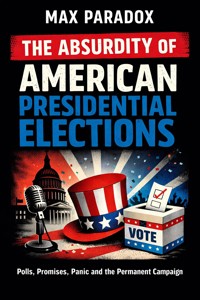
The Absurdity of American Presidential Elections - Polls, Promises, Panic and the Permanent Campaign ebook
Max Paradox
Uzyskaj dostęp do tej i ponad 240000 książek od 14,99 zł miesięcznie
- Wydawca: ALL-IN Rafał Płonkowski
- Kategoria: Poradniki•Styl życia
- Język: angielski
Every four years, America performs the same ritual.
It calls it democracy.
It feels like theater.
From the permanent campaign that never ends, to the debates that “change everything” (until they don’t), from swing states treated like royalty to voters who just want it all to stop - this book dissects the beautiful, chaotic spectacle of U.S. presidential elections.
With sharp observation, dry humor, and unapologetic irony, The Absurdity of American Presidential Elections explores:
• The myth of “this time is different”
• The emotional rollercoaster of polls and Election Night
• The culture wars that overshadow policy
• The international audience watching in suspense
• The voter who regrets, the voter who defends, and the voter who pretends
• The endless rumor cycle that begins before the last one even ends
This is not a political manifesto.
This is not a policy guide.
This is not a partisan argument.
It is a mirror.
A brutally honest, occasionally uncomfortable, often funny reflection of how modern democracy feels from the couch, the group chat, and the glowing map on Election Night.
If you’ve ever:
• Refreshed results at 2 a.m.
• Argued in a comment section
• Muted political keywords
• Whispered, “Please let this end”
• Or declared, “This is the most important election of our lifetime”
- this book was written for you.
Because the absurdity isn’t accidental.
It’s structural.
And somehow, despite everything, it keeps working.
This publication was prepared using tools that support the creative process, including solutions based on artificial intelligence. The final concept, structure, and editing are the work of the author.
Ebooka przeczytasz w aplikacjach Legimi na:
Liczba stron: 113
Rok wydania: 2026
Odsłuch ebooka (TTS) dostepny w abonamencie „ebooki+audiobooki bez limitu” w aplikacjach Legimi na:
Podobne












INTRO
America does not hold presidential elections.
America performs them.
Every four years, the country pauses whatever it was pretending to fix and commits to a months-long theatrical event involving flags, slogans, polls, hats, debates, scandals, counter-scandals, and a national agreement to act surprised by things everyone already knew.
The election is not about choosing a president.It is about choosing a narrative you can tolerate for the next four years.
This is why the campaign starts early.Not because democracy needs time.But because fatigue needs preparation.
At first, it feels distant.A headline here.A poll there.A candidate you recognize from a previous election, a previous scandal, or a previous apology tour.
You scroll past it.You still believe you have time.
Then slowly, gently, like background noise you can no longer locate, the election enters your life.
• Someone on television starts explaining what America “really wants.”• Someone else explains why that explanation is dangerous.• A third person explains why both of them are lying.• A fourth person sells supplements during the commercial break.
This is when you realize the election is no longer approaching.It has arrived and moved in without asking.
Presidential elections in the United States are often described as historic.Every single one of them.Without exception.
Each time, the stakes are higher than ever before.Each time, democracy itself is apparently hanging by a thread so thin it could snap during a poorly phrased tweet.
And yet, the process remains comfortingly familiar.
There will be promises that cannot be kept.There will be fears that must be exaggerated.There will be slogans short enough to fit on a hat and vague enough to mean anything.
The candidates will speak constantly while saying very little.The voters will listen selectively while feeling deeply informed.
Everyone will agree that the system is broken.No one will agree on which part.Everyone will continue participating anyway.
• You will hear that this is the most important election of your lifetime.• You will hear this even if you are eighteen.• You will hear this even if you are eighty.• You will hear it again in four years.
The absurdity does not lie in the fact that people care.Caring is reasonable.
The absurdity lies in the rituals that have grown around caring.
The debates that resemble competitive interruptions.The polls that fluctuate by decimals and trigger emotional breakdowns.The analysis of facial expressions, tone shifts, hand gestures, and pauses that allegedly reveal the fate of the nation.
At some point, the election becomes less about governance and more about endurance.
Who can last longer without apologizing.Who can survive the latest revelation.Who can look normal while being watched by millions of people actively searching for proof that they are not.
• You will be told that everything is clear.• You will feel more confused than ever.• You will be blamed for that confusion.
This book is not here to explain the American presidential election system.That would require diagrams, patience, and optimism.
This book is here to look at it the way most people actually experience it.From the couch.From the phone.From the strange emotional space between caring deeply and wanting it all to stop.
It will not offer solutions.It will not defend sides.It will not pretend that clarity is coming.
It will simply observe the spectacle as it unfolds.The language.The rituals.The habits that repeat themselves every four years with such confidence that everyone acts as if this time will be different.
You already know how this works.
• You will choose.• You will argue.• You will wait.• You will be told what your choice means.• You will be told you chose wrong.
And then, eventually, mercifully, the election will end.
At least until the next one begins.
Chapter 1 – The Permanent Campaign
The American presidential election does not begin.
It simply becomes louder.
Officially, there is a timeline.Primaries.Conventions.Debates.Election Day.
Unofficially, the campaign starts the moment the previous one ends.
A newly elected president gives an inauguration speech about unity, healing, and moving forward.
Within weeks, someone is already discussing their reelection strategy.
• The victory speech becomes the opening act of the next race.• The applause becomes polling data.• The handshake becomes a potential attack ad.
There is no pause.There is no recovery period.There is only momentum.
The permanent campaign is not a strategy.It is a condition.
Candidates fundraise before they declare.They declare before anyone asks.They travel before anyone listens.
They smile at diners in states that suddenly matter.They pretend to enjoy coffee they did not order.They nod thoughtfully while a farmer explains something that will be summarized later as “concerns about the economy.”
• They have always cared about this state.• They have always cared about this issue.• They have always cared about you.
You have simply never noticed before.
The media treats the early phase like a weather forecast.
“Storm clouds forming over the Midwest.”“Momentum building in suburban districts.”“A slight shift among independent voters.”
Politics becomes meteorology.
You are not watching people compete.You are watching pressure systems collide.
The strange part is that everyone knows it is too early.
Too early to predict.Too early to panic.Too early to declare anything inevitable.
And yet, inevitability is declared daily.
• This candidate is unstoppable.• This candidate is finished.• This debate changed everything.• Nothing has changed at all.
Both statements will appear on the same day.
Campaigns hire strategists who speak in sentences that sound like spreadsheets.
“We need to optimize message penetration in high-turnout suburban clusters.”
Translation:We need to say something simple, loudly, repeatedly.
But saying something simple is risky.
So they complicate it.
They build task forces.They commission studies.They workshop slogans.
Then they end up with a phrase that sounds like it was designed by committee because it was.
The permanent campaign also creates a strange emotional fatigue.
You are asked to care urgently about something that will not be decided for months.
You are asked to react instantly to things that will be forgotten tomorrow.
• You must have an opinion immediately.• You must defend it passionately.• You must update it hourly.
The campaign never sleeps.
There is always a rally somewhere.A speech somewhere.A scandal somewhere.
If nothing dramatic happens, someone will reinterpret something old as if it just did.
A comment from five years ago resurfaces.A photograph from college reappears.A joke is dissected like a policy proposal.
Time in a presidential campaign is not linear.
It is circular.
Everything can return.Everything can be reframed.Everything can be weaponized.
Meanwhile, voters attempt to live normal lives.
They go to work.They pay bills.They try to remember passwords.
But the campaign follows them.
On the television in the waiting room.On the podcast during the commute.In the notification they did not ask for.
• You cannot avoid it.• You can only pretend you are above it.• You will still talk about it at dinner.
The permanent campaign also blurs the line between governance and performance.
Policy announcements feel like campaign speeches.Press conferences feel like rehearsals.Every decision feels slightly choreographed.
Because it is.
Every word is weighed not only for truth, but for reaction.
How will it poll?How will it trend?How will it clip into fifteen seconds of outrage?
The president is never just governing.They are always auditioning.
And the challengers are never just criticizing.They are always positioning.
Even silence becomes strategic.
• If you speak, you risk offense.• If you stay silent, you confirm suspicion.• If you clarify, you extend the story.
The permanent campaign rewards stamina over substance.
Who can endure endless travel.Who can withstand endless criticism.Who can maintain the same smile after the hundredth identical question.
By the time Election Day arrives, the country is exhausted.
Not from voting.From watching.
From anticipating.From arguing.
And when the votes are finally counted, when the winner is declared and the loser gives a speech about the will of the people, there is a brief, delicate illusion of closure.
It lasts approximately one news cycle.
Then someone asks the inevitable question.
“What does this mean for the next election?”
• The analysis begins immediately.• The speculation resumes instantly.• The campaign continues seamlessly.
Because in America, the presidential election is not an event.
It is a climate.
And you are living in it.
Chapter 2 – The Primary Circus
The presidential election begins quietly.
With twenty-seven people announcing they are seriously considering running.
They do this in carefully produced videos where they walk confidently through factories, cornfields, classrooms, or symbolic American landscapes that imply relatability.
They speak directly into the camera.
They mention their family.They mention hard work.They mention the future.
They do not mention the polling numbers.
Not yet.
The primary season is democracy’s talent show.
Except the judges are confused.The audience is tired.And half the contestants are performing for a job they don’t actually expect to get.
At first, the field is crowded.
Governors.Senators.Business leaders.Outsiders.Professional outsiders who have been inside for decades.
• Everyone is the only one who can fix it.• Everyone is the only one who understands the people.• Everyone is somehow both an outsider and deeply experienced.
It is impressive.
The primaries are supposed to narrow the field.
In reality, they create characters.
There is the serious one.The angry one.The calm one.The unpredictable one.The one whose entire personality is based on saying what others are afraid to say.
You are told to evaluate them on policy.
You evaluate them on tone.
Because tone is easier.
Policies are long.Tone fits in a clip.
Debates arrive.
They are introduced as essential conversations about the nation’s future.
They quickly become competitive interruption tournaments.
• Someone exceeds their speaking time.• Someone demands equal time.• Someone delivers a rehearsed line that will be replayed for days.• Someone else stares into the distance while calculating whether that line just ended their career.
Moderators attempt control.
They fail gracefully.
The candidates are not there to answer questions.
They are there to produce moments.
Moments go viral.Moments trend.Moments fundraise.
A well-timed insult can outperform a detailed tax proposal.
A raised eyebrow can generate more engagement than a healthcare plan.
You begin to suspect that the primary process is less about leadership and more about survivability.
Who can endure scrutiny.Who can survive a bad headline.Who can recover from a microphone that was accidentally left on.
The media covers it like sports.
“Momentum shift.”“Breakout performance.”“Disappointing showing.”
There are maps.There are charts.There are color-coded graphics that imply precision.
Meanwhile, voters in early states suddenly become national celebrities.
Iowa.New Hampshire.A diner in a town you have never heard of becomes the center of the political universe.
• A handshake in a small café is analyzed like a treaty.• A crowd size becomes symbolic of destiny.• A snowstorm is interpreted as voter enthusiasm.
You are told that these early results matter enormously.
You are also told that they do not predict anything.
Both statements are delivered with confidence.
Candidates begin dropping out.
They suspend campaigns.They thank supporters.They promise to continue the fight in different ways.
Some endorse.Some negotiate.Some disappear.
The field shrinks.
The rhetoric sharpens.
It is no longer about introducing yourself.
It is about differentiating yourself.
Subtlety evaporates.
• You are not just better.• You are the only viable option.• The alternative is catastrophic.
Primary voters are passionate.
They are engaged.They are convinced.
They believe their candidate represents authenticity.
They believe the others represent compromise.
Authenticity becomes currency.
It is measured not by consistency, but by intensity.
If you shout it loudly enough, it must be real.
Social media amplifies everything.
A mispronounced word becomes a meme.A poorly timed laugh becomes suspicious.A handshake that lasts one second too long becomes symbolic of weakness.
You watch people analyze body language like amateur psychologists.
“This pause indicates uncertainty.”“That smile suggests arrogance.”
You begin to wonder if anyone is actually listening to the words.
Then comes the consolidation.
Two candidates remain.
Sometimes three, technically.
But two.
The party divides itself into factions that insist they are unified.
• They all want victory.• They all disagree on how to achieve it.• They all insist their disagreement is principled, not personal.
Eventually, a nominee emerges.
There is a speech about unity.
There are references to shared values.
There is applause that sounds slightly relieved.
The primary circus packs up its tents.
The stage is reset.
The party presents a single face to the nation.
And everyone pretends the months of internal conflict were simply healthy debate.
But you remember.
You remember the attacks.You remember the accusations.You remember the certainty that the other candidate was unfit.
Now they are allies.
Now they are friends.
Now they have always respected each other.
• Politics moves quickly.• Memory moves slowly.• The internet never forgets.
The primary season ends not with clarity, but with momentum.
One candidate stands.
One narrative solidifies.
And the country exhales briefly before inhaling for the general election.
Because the circus was only the rehearsal.
The real performance is about to begin.