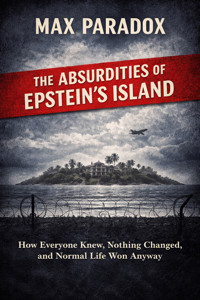
The Absurdities of Epstein’s Island - How Everyone Knew, Nothing Changed, and Normal Life Won Anyway ebook
Max Paradox
Uzyskaj dostęp do tej i ponad 240000 książek od 14,99 zł miesięcznie
- Wydawca: ALL-IN Rafał Płonkowski
- Kategoria: Poradniki•Styl życia
- Język: angielski
Everyone knew.
No one acted.
Life went on.
The Absurdities of Epstein’s Island is a sharp, unsettling satirical nonfiction book that dissects what happened after the headlines-when outrage cooled, questions softened, and accountability quietly evaporated.
This is not an investigation.
It is not a theory.
It is not a verdict.
It is an observation of how modern power survives exposure.
Through dry humor, precise irony, and uncomfortable clarity, the book explores how institutions absorb scandal, how language neutralizes responsibility, and how society learns to remember without demanding change. Each chapter examines a familiar mechanism: silence disguised as professionalism, concern replacing action, boredom outperforming outrage, and “everyone knew” becoming the perfect excuse.
Written in a tired, observant voice that refuses to comfort, this book does not tell readers what to think.
It shows them what already happened-slowly, politely, and in plain sight.
If you ever felt that something deeply wrong occurred and yet nothing truly followed, this book explains why that feeling was correct.
This publication was prepared using tools that support the creative process, including solutions based on artificial intelligence. The final concept, structure, and editing are the work of the author.
Ebooka przeczytasz w aplikacjach Legimi na:
Liczba stron: 130
Rok wydania: 2026
Odsłuch ebooka (TTS) dostepny w abonamencie „ebooki+audiobooki bez limitu” w aplikacjach Legimi na:
Podobne




















INTRO
There are places that exist more in headlines than on maps.Places that feel imaginary, even when satellites insist they are real.Places that become symbols not because anyone planned it that way, but because denial needed a location.
Epstein’s island is one of those places.
Not because of what happened there.Everyone already knows that something happened.What makes it absurd is everything that happened around it, after it, and instead of it.
The island became a kind of intellectual escape room.Everyone walked in.Very few wanted to solve it.Most preferred to admire the furniture and argue about who left the lights on.
This book is not about secrets.Secrets are boring once everyone knows them.This book is about the choreography of pretending not to know what we already know.
Because what followed the story was more fascinating than the story itself.
• The sudden outbreak of collective amnesia among very specific people.• The synchronized shock of individuals who had already rehearsed their surprise.• The magical transformation of proximity into coincidence.
The island didn’t expose crime.It exposed habits.
It exposed how power learns to speak softly when it is cornered.It exposed how institutions master the art of being concerned without being involved.It exposed how seriousness can be performed while responsibility quietly exits through a side door.
The most remarkable thing was not the accusations.It was the vocabulary.
Words like allegedly stretched to their breaking point.Words like unrelated worked overtime.Words like tragic appeared exactly where explanation should have been.
The island became a mirror that nobody wanted to look into directly, so everyone discussed the frame.
Media outlets spoke in tones usually reserved for natural disasters.As if this were weather.As if accountability could not survive high humidity.
Meanwhile, the public was invited to participate in a ritual:
Be shocked.Be briefly outraged.Be distracted by something else.
Preferably something loud.Preferably something divisive.Preferably something that requires choosing sides unrelated to facts.
• You were encouraged to focus on personalities, not systems.• You were encouraged to argue about timing, not patterns.• You were encouraged to treat silence as complexity instead of strategy.
No one said, “This is normal.”They didn’t have to.
Normal announced itself through repetition.
The island was reduced to a punchline, a meme, a vague reference dropped into conversations like a knowing wink.Knowledge became aesthetic.Outrage became optional.
And yet, the discomfort lingered.
Because deep down, everyone sensed it.
This wasn’t a story about one man.It wasn’t even about one island.
It was about how reality behaves when it collides with money, prestige, and the shared agreement to look away politely.
• How questions are softened until they no longer bruise.• How explanations are delayed until they expire.• How conclusions are replaced by exhaustion.
This book does not offer closure.Closure is a luxury product.
What it offers instead is a slow walk through the absurdity of how an entire world learned something disturbing and then carefully decided how not to metabolize it.
Not with denial.With professionalism.
And that might be the strangest part of all.
Chapter 1 – The Island That Was Supposed to Stay a Metaphor
At first, it was just an island.
A geographic inconvenience with good lighting and terrible timing.A place that looked suspiciously like a stock photo for privacy, except nobody was supposed to notice who kept showing up in the background.
The problem was never that the island existed.The problem was that it refused to remain abstract.
Because power prefers metaphors.Metaphors are safe.Metaphors do not require subpoenas.
An island, however, is inconveniently physical.
It has coordinates.It has a runway.It has boats that arrive and leave.It has records, which is already asking for too much.
From the beginning, everyone treated the island like a rumor that accidentally learned how to tan.
Media coverage approached it carefully, the way adults approach a glass table with a crack in it.You can acknowledge it exists.You cannot lean on it.And you definitely don’t ask who sat on it last.
Instead, the island was framed as complicated.
• Complicated enough to delay conclusions indefinitely.• Complicated enough to require endless panels of experts saying very little.• Complicated enough to make silence feel responsible.
“Complicated” became the adult version of “let’s talk about something else.”
The public noticed the pattern immediately.Not consciously.Not articulately.
But instinctively.
Every time the island appeared, the conversation drifted sideways.
Not forward.Never forward.
Sideways into speculation.Sideways into tone policing.Sideways into arguments about whether curiosity itself was appropriate.
• Asking questions was labeled obsession.• Remembering details was labeled conspiracy.• Expecting answers was labeled naïveté.
The island was real, but curiosity about it was treated like a personality flaw.
Which was impressive.
Because curiosity is usually celebrated.Unless it aims upward.Unless it wanders into gated communities of influence.Unless it asks questions without invitations.
Then curiosity becomes rude.
Then curiosity becomes dangerous.
Then curiosity must be managed.
The island wasn’t denied.It was administratively minimized.
Reports spoke about it the way companies speak about internal scandals.
“We are aware.”“We are reviewing.”“We take this seriously.”
Nothing says seriousness like repeating it three times and doing nothing else.
The island slowly transitioned from place to symbol, and then from symbol to inconvenience.
A nuisance in the narrative.A recurring glitch in the illusion of order.
And glitches must be patched.
So the story was fragmented.
One article here.One update there.A timeline that never quite connected itself.
• Dates appeared without context.• Names appeared without verbs.• Outcomes appeared without processes.
It was journalism as mood lighting.
Enough illumination to prove something is there.Not enough to show what it is doing.
Meanwhile, people began to notice something else.
The way proximity behaved strangely around the island.
Everyone had been near it.No one had been involved.
Flights happened, but accountability did not board.Photos existed, but meaning refused to pose.
It was as if reality had adopted corporate language.
• Attendance did not imply endorsement.• Presence did not imply knowledge.• Repetition did not imply pattern.
The island became a masterclass in plausible separation.
Not denial.That would be crude.
This was strategic distance.
Close enough to benefit.Far enough to escape.
And the public was invited to respect this geometry.
To understand that islands are strange places.That things get confusing there.That memory behaves differently near water.
Which was comforting.
Because if geography can absolve behavior, then no one needs to feel uncomfortable for long.
The island was never treated as a crime scene.It was treated as a weather event.
Unfortunate.Unpredictable.Already over.
You don’t investigate storms.You rebuild and move on.
• You don’t ask why the clouds gathered.• You don’t ask who kept flying into it.• You don’t ask why the forecast was ignored.
You express sympathy and change the channel.
And eventually, the island settled into its final role.
A reference.
Something mentioned briefly, followed by a pause, followed by a topic change.
A conversational speed bump.
“Oh, that island.”“Yes, terrible.”“Anyway…”
This is how discomfort is digested.
Not with answers.With etiquette.
With the unspoken rule that some subjects are inappropriate not because they are false, but because they are awkward.
The island violated decorum.
It made powerful people look small.It made explanations feel thin.It made coincidence sweat.
So it had to be reframed.
As old news.As background noise.As something everyone already knew, which somehow meant no one needed to talk about it anymore.
• Awareness replaced accountability.• Familiarity replaced resolution.• Fatigue replaced outrage.
And that is where the island truly succeeded.
Not as a secret.Not as a scandal.
But as a lesson.
A lesson in how reality can be absorbed without being processed.How truth can circulate without landing.How an entire culture can look directly at something and still decide not to see it.
The island didn’t disappear.
It just learned how to behave quietly.
And that, in the end, was exactly what everyone needed.
Chapter 2 – Everyone Was There, No One Arrived
The guest list was the most impressive thing about the island.
Not because it was public.Because it was plausible.
A rotating cast of relevance.A parade of importance that looked accidental only if you squinted politely.
At some point, the phrase “many powerful people” stopped sounding vague and started sounding intentional.
Because vagueness is protection.
Lists are dangerous.Lists invite counting.Counting invites patterns.Patterns invite questions.
So instead, there were fragments.
A name here.A photo there.A memory that appeared briefly and then developed amnesia.
• Someone stopped by once.• Someone else flew over but didn’t land.• Someone waved from the dock of plausible deniability.
Everyone had a story, and every story had a distance built into it.
The island didn’t have visitors.It had degrees of removal.
People were present without being present.They were adjacent without touching.They were included without participating.
It was social Schrödinger’s cat.
You could be there and not there at the same time, depending on who was asking.
And who was asking mattered a lot.
When journalists asked, proximity was minimized.When friends asked, it was exaggerated.When nobody asked, it was forgotten entirely.
Memory became a flexible asset.
• Recollections adjusted themselves mid-sentence.• Timelines softened under gentle pressure.• Certainty evaporated in the presence of follow-up questions.
Everyone remembered meeting him.No one remembered why.
They remembered conversations.They forgot contexts.
They remembered dinners.They forgot invitations.
It was like listening to people describe a party while insisting it wasn’t a party.
Just a coincidence with drinks.
Just networking that accidentally included an island.
Just travel that somehow kept looping back to the same coordinates.
And whenever the word “why” appeared, it was treated as impolite.
As if curiosity itself had poor manners.
Because asking why implies intention.And intention is harder to deny than presence.
Presence can be accidental.Intention suggests planning.
Planning suggests awareness.
Awareness is expensive.
So instead, everyone leaned into the most comforting narrative available:
They didn’t know.They couldn’t have known.No one could have known.
The island was framed as unknowable by design.
A mystery wrapped in non-disclosure agreements and weather excuses.
• Boats came and went without logs.• Flights appeared without passengers.• Relationships existed without definitions.
It was logistics as poetry.
And poetry is wonderfully resistant to prosecution.
The public noticed something else, too.
How explanations improved with repetition.
The more times a denial was delivered, the smoother it became.The pauses shortened.The eye contact stabilized.
Rehearsal has that effect.
What started as awkward confusion matured into confident distance.
“I don’t recall” evolved into “that’s not accurate.”“I was there once” evolved into “I barely knew him.”“I barely knew him” evolved into “everyone knew him.”
Blame was diluted through popularity.
If everyone knew him, then knowing him meant nothing.If knowing him meant nothing, then proximity lost meaning.If proximity lost meaning, then questions lost urgency.
It was brilliant.
The island became a social loophole.
A place where association expired on arrival.
And the public was asked to accept this logic politely.
To understand that power works differently.That elites occupy a different spatial reality.That consequences must pass through several layers of approval before becoming real.
• Gravity applies selectively.• Memory has VIP access.• Accountability waits in line and eventually gives up.
What made it stranger was how normal it all sounded.
The explanations were delivered calmly.Without anger.Without defensiveness.
Just tired professionalism.
As if everyone involved had already agreed that this conversation was boring.
And boredom is powerful.
Boredom ends stories faster than outrage ever could.
Because outrage demands response.Boredom demands distraction.
So attention shifted.
To side stories.To peripheral scandals.To debates about tone, timing, and whether discussing this was “helpful.”
Helpfulness became the new standard.
• Was this conversation constructive?• Was it respectful?• Was it fair to speculate?
Fairness was redefined as silence.
Meanwhile, the island remained stubbornly literal.
It did not float away.It did not become metaphorical enough.
It sat there, sunlit and inconvenient, holding more meaning than anyone wanted to process.
And the guest list hovered over it like an unfinished sentence.
Everyone was there.No one arrived.
Everyone knew something.No one knew enough.
Everyone left with plausible deniability and a tan.
And that was the real scandal.
Not that people went to the island.But that going there seemed to come with a return ticket from responsibility.
The island didn’t expose crimes.
It exposed a rule:
If enough important people orbit the same space, that space becomes exempt from interpretation.
Facts become optional.Questions become rude.Memory becomes negotiable.
And the public is expected to accept this not because it makes sense, but because it is presented calmly.
Calm is persuasive.
Calm sounds like authority.Calm sounds like resolution.
Even when nothing has been resolved.
By the time the guest list faded into the background noise of half-remembered names, the lesson was complete.
Presence means nothing.Association is cosmetic.And arrival is a word reserved for people without lawyers.
The island taught everyone how to be nearby without ever showing up.
Chapter 3 – The Art of Knowing Without Knowing
There is a very specific skill required to survive proximity to scandal.
It is not ignorance.Ignorance is too honest.
The real skill is knowing just enough to claim distance while benefiting from closeness.
This is not accidental.It is trained.
From the first uncomfortable question, a reflex activates.
Not panic.Not confusion.
Calibration.
How much did I know?When did I know it?And how can I phrase this so that knowledge becomes atmospheric instead of actionable?
The island produced experts in this craft.
People who could speak for ten minutes without producing a sentence that could survive transcription.
People who could acknowledge concern while evacuating responsibility mid-paragraph.
People who mastered the tone of someone who understands seriousness without being implicated by it.
• They frowned at the correct moments.• They sighed in places where outrage was expected.• They expressed disappointment without specifying in whom.
Disappointment is wonderfully vague.
You can be disappointed at events.You can be disappointed by revelations.You can be disappointed in general.
Disappointment never requires follow-up.
Knowing, on the other hand, is dangerous.
Knowing implies awareness.Awareness implies choice.Choice implies agency.
So knowledge had to be reclassified.
Not as information.But as background noise.
Everyone knew something, but not enough to matter.
And crucially, not enough to act.
This produced a strange conversational pattern.
People spoke confidently about what they didn’t know.
“I was shocked.”“I had no idea.”“Like everyone else, I learned from the news.”
The repetition was comforting.
If everyone learned at the same time, then no one learned early.If no one learned early, then no one ignored warning signs.If no one ignored warning signs, then nothing could have been prevented.
It was retroactive innocence.
The past was rewritten as a foggy place where clarity simply wasn’t available.
• Red flags became “unclear signals.”• Rumors became “unsubstantiated chatter.”