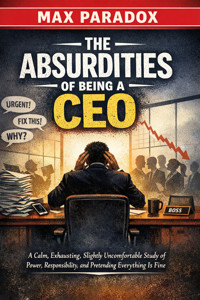
The Absurdities of Being a CEO - A Calm, Exhausting, Slightly Uncomfortable Study of Power, Responsibility, and Pretending Everything Is Fine ebook
Max Paradox
Uzyskaj dostęp do tej i ponad 240000 książek od 14,99 zł miesięcznie
- Wydawca: ALL-IN Rafał Płonkowski
- Kategoria: Poradniki•Styl życia
- Język: angielski
What does it actually feel like to be a CEO?
Not the version from podcasts.
Not the keynote version.
Not the one with confidence, certainty, and perfect answers.
This book is a sharp, observant, and often uncomfortably accurate satire of executive life-from the inside. It follows the quiet transformation that happens when a person becomes “leadership,” and slowly stops being treated like a person at all.
Written in short, precise prose with dry humor and surgical honesty, The Absurdities of Being a CEO explores meetings where decisions disappear, confidence that is mostly fatigue standing upright, authority that isolates, and power that turns into emotional labor.
This is not a guide.
This is not motivation.
This is not advice.
It is recognition.
If you are a CEO, founder, executive, or senior leader, you will feel seen-possibly too seen.
If you are not, you will finally understand why people at the top sound the way they do.
A book for anyone who has ever carried responsibility quietly and wondered when it became normal.
This publication was prepared using tools that support the creative process, including solutions based on artificial intelligence. The final concept, structure, and editing are the work of the author.
Ebooka przeczytasz w aplikacjach Legimi na:
Liczba stron: 105
Rok wydania: 2026
Odsłuch ebooka (TTS) dostepny w abonamencie „ebooki+audiobooki bez limitu” w aplikacjach Legimi na:
Podobne



















INTRO
There is a moment when someone becomes a CEO.
It is usually quiet.No choir.No thunder.No one claps.
Most of the time it happens in a calendar invite.
You open it.You read it twice.You pretend you understand what just happened.
From that point on, you are no longer a person with opinions.You are a role with expectations.
You still wake up tired.You still forget passwords.You still wonder why meetings exist.
But now your exhaustion has a title.
Being a CEO is often described as leadership, vision, courage, and responsibility.This description usually comes from people who are not CEOs.Or from CEOs who are currently on stage, holding a microphone, and lying professionally.
The reality is quieter.Weirder.More administrative.
You don’t run the company.You host it.
You host problems.You host emotions.You host decisions no one wants to own.
• You are expected to know everything without asking questions.• You are expected to ask questions without revealing you don’t know anything.• You are expected to decide quickly after a discussion that was designed to avoid decisions.
At some point, you realize that being a CEO means translating chaos into sentences that sound intentional.
You don’t say “We don’t know.”You say “We’re exploring options.”
You don’t say “This failed.”You say “There were learnings.”
You don’t say “I’m exhausted.”You say “It’s a challenging but exciting time.”
The role slowly eats your normal reactions.
You stop reacting like a human.You start reacting like a PowerPoint slide.
People look at you differently.Not because you changed.Because now everything you say might mean something.
A joke becomes a signal.Silence becomes a strategy.A raised eyebrow becomes a roadmap.
• You cannot be tired, only busy.• You cannot be wrong, only early.• You cannot be confused, only considering.
The absurdity doesn’t come from power.It comes from distance.
You are close enough to feel responsible for everything.Far enough to never fully touch the consequences.
You approve budgets you will never personally feel.You cancel projects people emotionally married.You talk about “culture” while eating alone between meetings.
Being a CEO means constantly explaining reality while slowly losing contact with it.
You speak in summaries.You think in risks.You sleep in fragments.
Everyone assumes you have answers.You mostly have phrasing.
• You learn to sound calm while internally recalculating everything.• You learn to nod while disagreeing strategically.• You learn that confidence is often just fatigue standing upright.
This book is not about how to be a better CEO.It wouldn’t work anyway.
This book is about the strange, quiet, often ridiculous experience of being one.
About the meetings that should not exist.About the decisions that happen before the discussion.About the authority that feels heavier than it looks.
It is about pretending the system is rational while surviving inside it.
If you have ever been a CEO, you will recognize yourself and feel slightly exposed.If you have never been one, you will finally understand why they sound the way they do.
Not wiser.Just tired.
And very, very practiced at pretending this all makes sense.
Say the word.
Chapter 1 – The Title Changes Everything
The moment your title changes, nothing changes.
And yet everything does.
You still sit at the same desk.You still drink the same coffee.You still open the same inbox that already hated you yesterday.
But now your name carries weight it didn’t ask for.
The word “CEO” attaches itself to your email signature and immediately starts behaving like a personality.People respond differently.Sometimes slower.Sometimes faster.Sometimes with a strange, polite enthusiasm that feels rehearsed.
You haven’t gained authority.You’ve gained interpretation.
Every sentence you write now exists in multiple versions at once.
There is what you meant.There is what they heard.There is what they forwarded.
• A casual “Let’s talk later” becomes a scheduling emergency.• A neutral “Okay” becomes approval.• A joke becomes a rumor.
You learn this very quickly.Usually by accident.
Someone thanks you for a decision you don’t remember making.Someone apologizes for something you didn’t notice.Someone looks relieved just because you nodded.
You start to realize the title doesn’t give you power.It gives other people anxiety.
And anxiety is loud.
Meetings change first.
Not in content.In posture.
People sit up straighter.They bring slides.They over-explain things they used to say in one sentence.
The same data.More words.
• People stop saying “I think” and start saying “We believe.”• People stop saying “This might be a problem” and start saying “This is an opportunity.”• People stop disagreeing and start “adding context.”
The room becomes softer.Less honest.More careful.
You miss the old conversations.You can’t say that.
Because now, when you speak, the room listens differently.
Not attentively.Cautiously.
You notice it when you pause.
Silence stretches.People wait.
Not because they need more information.Because they’re checking if this is the part where something important happens.
Sometimes nothing happens.That confuses them.
The title creates expectations you didn’t agree to.
You are suddenly supposed to be decisive at all times.Even when the situation is undecidable.
Especially then.
• You are expected to have a vision even when there are no clear options.• You are expected to be confident even when the data disagrees with itself.• You are expected to look calm while quietly questioning all recent life choices.
The hardest part is not making decisions.
It’s being watched while making them.
Before, a wrong call was a mistake.Now it’s a signal.
A signal about strategy.A signal about values.A signal about who you are as a person.
You become careful without noticing.
You choose words like stepping stones.You avoid absolutes.You postpone certainty.
Not because you’re afraid.Because you’ve learned how easily meaning spreads.
You also learn something else.
People don’t want you to be right.They want you to be reassuring.
They don’t ask, “Is this correct?”They ask, “Are we safe?”
So you learn to sound stable.
Even when you aren’t.
• You nod slowly, as if the situation is familiar.• You say “That makes sense” while still processing it.• You buy time with phrases that sound like direction.
At some point, someone will ask you a question you cannot answer.
This is inevitable.
You will feel the room lean in.
This is when you discover the true power of the title.
Not knowledge.Not authority.
Delay.
You say things like:
“We’ll need to look into this.”“Let’s align on that.”“I want to think about the implications.”
And miraculously, the moment passes.
The room relaxes.People write notes.
No one asks again.
You didn’t answer the question.You absorbed it.
This becomes a pattern.
The title allows you to move uncertainty around without resolving it.
You don’t eliminate problems.You reschedule them.
This works surprisingly well.
Until it doesn’t.
Outside the meeting room, the title keeps working.
People assume you’re busy.They assume you’re important.They assume you know what’s going on.
Sometimes all three are false.
But correcting them would take time.
And time is now your most defended resource.
• You skip conversations you would have enjoyed.• You shorten explanations you should have finished.• You prioritize clarity for others over honesty with yourself.
You start to notice that the title follows you home.
Not physically.Mentally.
You replay conversations.You rephrase sentences.You wonder how something you said might be interpreted tomorrow.
You weren’t like this before.
Before, words were words.Now they’re artifacts.
You didn’t become more powerful.You became more visible.
And visibility is exhausting.
Being a CEO doesn’t mean people listen more.It means they listen differently.
They listen for direction.They listen for reassurance.They listen for permission.
Sometimes you wish they would just listen.
But that would require forgetting the title.
And once it’s there, it never really leaves.
Even when you’re quiet, it’s speaking for you.
Chapter 2 – Meetings Are Where Decisions Go to Disappear
Meetings are not for deciding things.
They are for proving that thinking happened.
As a CEO, you will attend many meetings.Some will have agendas.Most will have intentions.
Very few will have outcomes.
At first, you think this is a coincidence.Then you realize it is a system.
Meetings exist to protect people from responsibility.
They are soft rooms where uncertainty can be shared without ownership.
• If everyone was present, no one decided.• If notes were taken, memory becomes negotiable.• If time ran out, reality can wait.
The meeting starts the same way every time.
Someone says, “Let’s give everyone a few minutes to join.”This sentence alone delays progress by exactly the amount of time the meeting was scheduled for.
You look at faces in little rectangles.Some are muted.Some are frozen.Some are present only in name.
The meeting continues anyway.
Slides appear.
Not because they help.Because slides look like effort.
• The slide deck is always longer than the attention span.• The most important slide appears after everyone is tired.• The conclusion slide asks a question it doesn’t want answered.
People speak carefully.
They narrate their own slides.They apologize for things that are not their fault.They explain context no one asked for.
You notice how often people say “just quickly” before speaking for ten minutes.
As a CEO, you are expected to guide the meeting.
This usually means letting it happen.
You intervene gently.You redirect softly.You summarize vaguely.
Not because you agree.Because stopping the meeting would require clarity.
Clarity is dangerous.
If you say, “This doesn’t matter,” someone will be offended.If you say, “This matters,” someone will panic.
So you say nothing specific.
• You thank people for their input.• You appreciate the discussion.• You suggest taking it offline.
Offline is where ideas go to rest.
Meetings are full of phrases that sound useful but do nothing.
“Let’s align.”“Let’s circle back.”“Let’s double-click on that.”
No one knows what these mean.Everyone uses them anyway.
You begin to understand that meetings are performances.
Each participant plays a role.
Someone is the expert.Someone is the skeptic.Someone is “just here to listen.”
You are the closer.
Not because you close things.Because you end the meeting.
At some point, a decision floats near the surface.
It is visible.It is fragile.
The room reacts immediately.
Someone raises a risk.Someone asks for more data.Someone suggests a pilot.
The decision sinks again.
• Risks are mentioned to avoid action.• Data is requested to delay commitment.• Pilots are suggested to postpone accountability.
You learn to recognize the moment when nothing more will happen.
The energy drops.The questions repeat.People start glancing at the clock.
This is your cue.
You summarize what was “discussed.”You outline “next steps.”You assign vague ownership.
Everyone nods.
The meeting ends.
Nothing has changed.
After enough meetings, you stop expecting outcomes.
You start measuring success differently.
Did no one panic?Did no one quit?Did no one email you immediately after?
Then it was a good meeting.
You also learn something uncomfortable.
Decisions rarely happen in meetings.
They happen before.Or after.Or not at all.
Meetings are the ritual that makes decisions socially acceptable.
They are where responsibility is distributed thin enough to dissolve.
• If it fails, the group decided.• If it works, leadership led.• If nothing happens, alignment is blamed.
As a CEO, you could end this.
You could demand clarity.You could force decisions.You could cancel meetings.
You imagine this briefly.
Then you remember that meetings are how the organization breathes.
Remove them too quickly, and panic sets in.
People don’t want fewer meetings.They want meetings that justify their presence.
You attend meetings you don’t need.You schedule meetings you don’t want.
Because meetings create the illusion of control.
And illusion is cheaper than certainty.
At some point, you stop asking why the meeting exists.
You ask only one thing.
How long is it scheduled for.
Chapter 3 – Everyone Thinks You’re Confident
People often describe CEOs as confident.