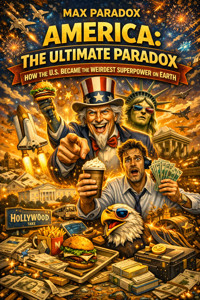
The Absurd Empire - A Laughing Explanation of Why the USA Is the Biggest Power on Earth ebook
Max Paradox
Uzyskaj dostęp do tej i ponad 240000 książek od 14,99 zł miesięcznie
- Wydawca: ALL-IN Rafał Płonkowski
- Kategoria: Poradniki•Styl życia
- Język: angielski
Why the USA Is the Greatest Power by Max Paradox is a satirical field guide to the most influential, contradictory, and relentlessly productive superpower on Earth.
This isn’t a textbook and it isn’t a sermon. It’s a comedy built on real-world mechanics: how the U.S. projects power through money, media, technology, alliances, immigration, culture, and the strange national talent for turning crises into fuel. One page you’ll watch the dollar operate like a global “default setting.” The next you’ll see Hollywood doing diplomacy, Big Tech acting as infrastructure, and a political culture capable of inventing tomorrow while arguing about whether tomorrow is real.
Across 35 punchy chapters plus a closing manifesto, Max Paradox explains American dominance the way America itself often works: loud, sharp, absurd, and weirdly effective. You’ll laugh, you’ll wince, and you’ll come away with a clearer picture of why people can resent the U.S. and still run their lives on systems it helped design.
If you enjoy geopolitics, current affairs, and cultural critique-served with sarcasm and surprising clarity-this book is for you.
This publication was prepared using tools that support the creative process, including solutions based on artificial intelligence. The final concept, structure, and editing are the work of the author.
Ebooka przeczytasz w aplikacjach Legimi na:
Liczba stron: 124
Rok wydania: 2026
Odsłuch ebooka (TTS) dostepny w abonamencie „ebooki+audiobooki bez limitu” w aplikacjach Legimi na:
Podobne



















INTRODUCTION: Please Take This Book Extremely Unseriously
If you are holding this book, congratulations: you have already participated in American power.
Not because a drone flew overhead and scanned your forehead for snack preferences (although give it time). Not because a bald eagle personally handed it to you while whispering, “Freedom, but make it hardcover.” No. You participated because the United States is so influential that even thinking about it pulls you into its gravitational field-like a black hole made of branding, confidence, and very expensive coffee.
This book is not here to explain geopolitics in the normal way.
Normal books use facts, charts, and serious faces. They cite treaties. They mention “strategic interests” and then look away as if embarrassed by how vague that sounds. This book will do something more honest: it will explain American power through its absurdities-the contradictions that somehow function as fuel.
Because here’s the uncomfortable truth: the USA is not only powerful despite being weird. The USA is powerful because it is weird.
It’s powerful because it treats reality as a negotiable starting point. It’s powerful because it can turn breakfast into a cultural export. It’s powerful because it can sell you a lifestyle where your identity is 30% personality and 70% subscription services.
But satire is tricky. You don’t want to merely throw tomatoes at a country and call it comedy. That’s not satire; that’s a farmers’ market with opinions. Good satire is a funhouse mirror: it distorts, but it also reveals. The joke lands because the audience recognizes the face.
So we will exaggerate-but lovingly. We will mock-but with precision. We will laugh-preferably loud enough that the neighbors wonder if you’re watching stand-up or reading a book, and then you’ll get to say, smugly, “I’m reading,” which is a power move in any nation.
A few promises before we begin:
This is not an anti-American book.
It’s a pro-laughter book. America is simply the largest available target, like a parade balloon shaped like a concept.
We will not pretend the USA is perfect.
Perfection is not the brand. The brand is
audacity
.
We will not pretend the USA is uniquely ridiculous.
Every country is ridiculous. America is just better at exporting it in 4K.
We will explain how the USA became the biggest power on Earth
using the only truly global language: absurdity.
You may already have your own theory: the military, the economy, the technology, the geography, the alliances, the history, the timing.
All correct.
But incomplete.
Because the secret sauce isn’t only steel and money. It’s mythology-industrial-scale, mass-produced, aggressively marketed mythology. It’s the ability to say, with a straight face, “We’re just a regular country,” while simultaneously putting flags on the moon, flags on the burgers, and flags on the feelings.
It’s a nation that can stage a revolution over tea and then spend the next two centuries turning beverages into identity politics.
It’s a nation that can argue about freedom while signing thirty-seven forms to renew a parking permit.
It’s a nation that can build a spaceship, lose the TV remote, and then solve both problems by ordering a new remote online with same-day delivery.
The United States is a paradox engine. It runs on contradiction, optimism, and the stubborn refusal to be normal. That is why it is powerful. Also: aircraft carriers. But let’s not spoil the punchlines.
Now open the curtain. Step into the funhouse.
Try not to trip over the confidence.
CHAPTER - 1: Confidence-The National Sport (Second Place Is Also Confidence)
If power were a physical substance, like oil or gold, America would have discovered a new deposit by accident while looking for a way to make nachos louder. But power isn’t just material. It’s psychological. It’s social. It’s the ability to convince other people that your version of reality is the default settings of the planet.
And the United States achieved that in the most American way possible:
By believing it first.
American confidence is not a personality trait. It is an ecosystem. You can observe it in the wild, where it performs elaborate mating rituals like “pitching a startup idea at a stranger” and “calling your side hobby a brand.”
In many countries, confidence is earned. You study. You train. You gain experience. You become competent. Then, if you’re lucky, you allow yourself a modest amount of confidence, like a small dessert after a responsible meal.
In America, confidence is issued at birth like a complimentary tote bag.
A newborn enters the world screaming, and the doctor says, “Strong lungs. Leadership material.”
The parents nod solemnly. “He’s already networking.”
This confidence is how the USA can do impossible things-because it attempts them before anyone has time to explain why they won’t work. The American mind often treats “that’s impossible” as a customer review, not a diagnosis.
Impossible? Okay. But how impossible? Like ‘need funding’ impossible, or ‘need a better vibe’ impossible?
This attitude infects everything.
The Confidence Economy
America doesn’t just export products. It exports a feeling: the sensation that you, too, could become wildly successful if you simply optimize your morning routine and stop being poor. This is not a joke. This is an entire industry.
There are books, seminars, podcasts, influencers, and men named Brad who will look you in the eye and say, “The only thing between you and greatness is your mindset,” while charging you $799 for the privilege of hearing them say it.
And it works-because the USA is a nation where confidence is a form of currency.
You can be underqualified, unprepared, and mildly confused, and still walk into a room as if you own it. In some cultures, this would be considered shameful. In America, it is considered entrepreneurial.
The world often misunderstands this. People say, “Americans are arrogant.”
No.
Arrogance is a personality flaw. American confidence is a renewable resource.
Arrogance is a peacock. American confidence is a factory that mass-produces peacocks and then sells them motivational calendars.
The Main Character Doctrine
The USA is powerful because it behaves like the main character of the global story.
Main characters do not wait for permission. Main characters do not accept “no” as a complete sentence. Main characters have theme music and a complex relationship with consequences.
This is why American foreign policy sometimes feels like a movie where the hero runs into a room, kicks down a door, shouts, “Everyone’s welcome!” and then realizes they entered the wrong building-but refuses to apologize because the moment was cinematic.
But the main character doctrine isn’t just in politics. It’s in daily life.
Consider the American approach to customer service.
In many countries, the customer is a human being who needs assistance. In America, the customer is a demigod who must be appeased, feared, and occasionally offered a coupon to prevent weather-related catastrophes.
The customer strides into the store, radiating destiny, and declares:
“I would like to speak to the manager.”
The manager emerges like a reluctant priest.
This is not just entitlement; it is cultural training. Americans grow up practicing influence in small ways-returning a toaster they bought in 2009 because it “stopped sparking right,” negotiating with a cable company like it’s the Treaty of Versailles, ordering coffee in a manner so customized it sounds like software configuration.
“Hi, can I get a large, iced, half-sweet, oat, vanilla, extra-foam, no-foam, double-blended, left-handed latte?”
The barista, a warrior, nods.
The customer pays $8, receives a cup containing their identity, and walks out feeling geopolitically significant.
Multiply that by 330 million people and you have a population trained to believe their preferences matter. And when a population believes its preferences matter, it becomes very difficult to ignore.
That, my friends, is power.
Confidence as an Export
People sometimes ask: How did American culture spread so far?
Simple: America delivered it with confidence and snacks.
You can sell almost anything if you present it as inevitable. The United States doesn’t say, “Here is our music.” It says, “This is the soundtrack.” It doesn’t say, “Here is our fast food.” It says, “This is what food looks like when it has dreams.”
It doesn’t ask, “Would you like a streaming service?” It says, “You already have three. One more won’t hurt.”
American culture arrives with a smile that implies you’ve always wanted it. Even if you didn’t. Especially if you didn’t.
This is the stealth genius of American power: it makes its exports feel like self-discovery.
“You don’t have to wear sneakers,” America says, gently. “You get to.”
“And you don’t have to watch our superhero movie,” it continues, soothingly. “But if you don’t, you will not understand the memes, and you will be socially exiled from the internet, which is now where your soul lives.”
The Great American Contradiction (Premium Edition)
Now, confidence alone doesn’t build an empire. It builds a talent show. To become the biggest power on Earth, you need confidence plus something else: the ability to institutionalize your contradictions.
America is, simultaneously:
obsessed with freedom and addicted to paperwork,
anti-elite and fascinated by billionaires,
individualistic and deeply in love with team jerseys,
suspicious of government and emotionally attached to the postal service,
allergic to nuance and somehow capable of producing entire universities.
This shouldn’t work.
Yet it does-because confidence acts like duct tape. It holds together a machine that by all logic should rattle apart. You can hear the rattling, sure. But the machine keeps moving. Often very fast. Sometimes into a wall. Then it reverses, says it meant to do that, and sells the wall as a learning experience.
The American narrative is not, “We are consistent.” The American narrative is, “We are trying things.”
This is why America can fail publicly and still look powerful. Failure doesn’t reduce confidence; it becomes content.
A product collapses? Rebrand. A company implodes? Documentary. A politician embarrasses themselves? Podcast tour. A billionaire launches a rocket that looks like a midlife crisis in metal form? Meme it, merch it, monetize it.
In America, even mistakes are scalable.
Confidence and the Military (A Brief, Loud Intermission)
Yes, yes-let’s acknowledge the obvious: the USA has the biggest military budget on Earth, advanced technology, global bases, alliances, and a navy that can show up anywhere and politely ask the ocean to move aside.
But here’s the satire-friendly truth: military strength is also psychological.
A lot of power comes from the belief that you can project power. And America believes that so hard it sometimes projects power into situations that were previously minding their own business.
It’s like walking into a room and announcing, “I’m in charge,” and then half the room shrugs and says, “Sure, fine,” because you said it like you had a clipboard.
The clipboard is the hidden weapon of the American empire.
That, and spreadsheets.
The Final Ingredient: Selling Hope Like It’s a Product
There’s one more reason confidence fuels American power: it creates hope.
Hope is not merely emotion. Hope is energy. Hope makes people move, work, migrate, invest, invent. Hope turns hardship into narrative.
The “American Dream” is a concept so powerful it functions like a magnet. Even when the dream is bruised, delayed, or sold in monthly installments, the idea persists: that tomorrow can be better, and you personally might be the reason.
You can mock it (and we will), but you can’t deny it: the dream is a marketing campaign for the future.
And when a nation sells the future better than anyone else, it attracts talent, money, attention, and risk. That’s not just culture. That’s infrastructure.
Confidence is the engine oil of the American machine.
It lubricates friction. It reduces doubt. It makes the gears spin faster than they probably should.
And sometimes the machine overheats and catches fire.
America calls that “innovation.”
CHAPTER - 2: Geography-Two Oceans and a Giant “Do Not Disturb” Sign
If you want to become the biggest power on Earth, there is a cheat code nobody likes to admit: be hard to mess with.
The United States began the game with two enormous natural moats: the Atlantic and the Pacific. These are not just oceans. These are liquid security systems. They are nature’s way of saying, “If someone wants to fight you, they should really think about the shipping costs.”
Countries with lots of neighbors develop diplomacy like a survival skill. Countries with oceans develop something else: the ability to ignore drama until it becomes profitable.
This is an underrated form of power.
When trouble happens far away, you get options. You can intervene. You can not intervene. You can intervene a little, then leave, then come back with a different slogan. You can watch, comment, sanction, negotiate, or simply send a strongly worded statement and go back to inventing new kinds of cereal.
Geography gives America time. And time, in geopolitics, is basically money with patience.
A Continent Disguised as a Country
Then there’s the size of the place.
The United States isn’t just large. It’s large in a way that makes other countries feel like they were designed by someone who ran out of space in the notebook.
In Europe, “a long drive” is four hours and at least two languages. In America, four hours is “just across the state,” and you may still be in the same weather system arguing with the same radio station.
Americans don’t say “I’m traveling.” They say “I’m driving.” And then they drive into the horizon like cowboys chasing a Starbucks.
This matters, because internal scale creates internal self-sufficiency. America has:
farmland that can feed armies and also personal feelings,
rivers that move goods like nature invented logistics,
mountains that provide drama and minerals,
plains that produce enough corn to make economists nervous.
And in case you’re wondering why corn matters: in America, corn is not food. Corn is a policy. Corn is a religion. Corn is a suspiciously versatile substance that becomes fuel, syrup, snacks, and probably at least one kind of shoe.
When you have that much land and that many resources, you gain a peculiar freedom: the freedom to treat the outside world as optional-right up until you decide it’s essential.
The Border Situation: Friendly North, Spicy South
America’s neighbors also contribute to its strategic comfort.
To the north: Canada, a country so polite it could apologize for winning a war it never started. Canada is essentially America’s upstairs neighbor who always shovels their driveway and occasionally lends you a ladder. This is not an insult; this is geopolitical luxury.