Uzyskaj dostęp do tej i ponad 240000 książek od 14,99 zł miesięcznie
- Wydawca: ALL-IN Rafał Płonkowski
- Kategoria: Poradniki•Styl życia
- Język: angielski
TikTok was supposed to be entertainment.
It became influence.
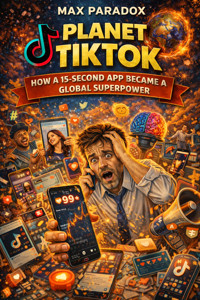
Planet TikTok is a sharp, darkly funny satirical nonfiction book about a world where culture, politics, morality, identity, and meaning are decided not by institutions-but by viral trends.
In this book, TikTok is treated exactly like what it has quietly become:
a global superpower that governs through attention, outrage, emotion, and endless scrolling.
No advice.
No motivation.
No “how to fix it.”
Just brutal observation of how:
• opinions are formed in fifteen seconds,
• outrage replaces thinking,
• therapy becomes content,
• identity becomes a format,
• and reality becomes optional.
Written in a dry, ironic, slightly exhausted tone, Planet TikTok doesn’t argue with the reader.
It assumes you already feel this way.
It just says it out loud.
If you’ve ever:
• felt informed but strangely empty,
• scrolled instead of thinking,
• reacted instead of deciding,
• or sensed that something is deeply off but hard to explain-
this book already knows you.
This publication was prepared using tools that support the creative process, including solutions based on artificial intelligence. The final concept, structure, and editing are the work of the author.
Ebooka przeczytasz w aplikacjach Legimi na:
Liczba stron: 130
Rok wydania: 2026
Odsłuch ebooka (TTS) dostepny w abonamencie „ebooki+audiobooki bez limitu” w aplikacjach Legimi na:
Podobne







INTRO
TikTok was supposed to be a video app.That was the plan.
A place for dances nobody rehearsed, jokes nobody remembered, and advice nobody asked for.A harmless loop of faces, music, and people pointing at text that would disappear in three seconds anyway.
Then it accidentally became everything else.
At some point, we stopped checking the news.We started waiting for it to appear between a recipe for pasta made of cottage cheese and a man explaining geopolitics while brushing his teeth.
Governments still hold meetings.Experts still publish reports.Elections still happen.
But none of that really matters until TikTok decides how it feels about it.
You don’t ask what happened anymore.You ask how it’s trending.
Because if something doesn’t go viral, it didn’t really occur.And if it did go viral, it probably means the opposite of what actually happened.
This is how Planet TikTok was born.
A superpower without borders.A parliament without chairs.A political system where decisions are made based on vibes, filters, and how aggressively someone nods at the camera.
On Planet TikTok, policies are not debated.They are stitched.
Laws are not written.They are summarized in fifteen seconds by someone who starts with “Okay but nobody is talking about this.”
Wars are not analyzed.They are ranked.
Public health is decided by:• a woman whispering into a microphone,• a man who “did his own research” in the comments,• and a teenager who discovered a conspiracy between skincare brands and the moon.
You already live there.You just haven’t updated your address.
Every day, Planet TikTok tells you:• what to fear,• what to cancel,• what to buy,• what to suddenly remember you’ve always hated.
And you listen.Not because you believe it.But because everyone else is watching too.
That’s the trick.
TikTok doesn’t need you to agree.It only needs you to stay.
Stay long enough to:• absorb the tone,• memorize the posture,• learn when to look outraged,• and when to pretend something is “not that deep.”
On Planet TikTok, nuance is suspicious.Silence is guilt.Context is optional.
Everything must be immediate.Everything must be emotional.Everything must fit between two ads for a product that “literally changed my life.”
And slowly, without a single official announcement, TikTok stopped being entertainment.
It became a decision-making engine.
What you eat.What you believe.Who deserves sympathy this week.Who needs to be deported, forgiven, unfollowed, or adopted by the algorithm.
Planet TikTok doesn’t ask for credentials.It asks for engagement.
And it rewards:• confidence over competence,• volume over accuracy,• relatability over reality.
If you speak calmly, you are boring.If you hesitate, you are lying.If you explain too much, you are hiding something.
But if you shout while pointing at captions?
Congratulations.You are now an authority.
This book is not here to explain TikTok.TikTok does not need help.
This book is here to observe what happens when a civilization quietly agrees to outsource thinking to an app that auto-plays the next opinion before the previous one finishes.
No solutions.No warnings.No hope.
Just a tour of Planet TikTok.
You already bought the ticket.You just kept scrolling.
Chapter 1 - The Algorithm Knows You Better Than You Do
The algorithm does not sleep.It watches.
Not in a dramatic way.Not with red eyes or secret servers humming ominously in the dark.
It watches politely.Casually.Like someone pretending not to listen while memorizing everything you say.
You think you opened TikTok to relax.The algorithm knows you opened it to feel something.
It already noticed:• how long you paused on that video,• how fast you scrolled past the happy couple,• how you rewatched the one where someone failed publicly.
You didn’t tap like.You didn’t comment.You barely breathed.
That was enough.
The algorithm doesn’t need your opinions.It needs your hesitation.
Every micro-delay is a confession.
You stopped for half a second longer on a video about burnout.Now it thinks you are tired.
You watched two clips about moving abroad.Now it thinks you are unhappy.
You lingered on a video titled “Things nobody tells you about your thirties.”Now it knows your age better than your friends do.
You could explain yourself.You won’t.
Planet TikTok doesn’t require accuracy.It requires patterns.
And patterns don’t care about your intentions.
You didn’t want to see political content.You just didn’t scroll fast enough.
You didn’t want to join a debate.You just watched someone point at text with aggressive confidence.
You didn’t want to radicalize.You just stayed.
So the algorithm adjusted.
It always adjusts.
Slowly at first.Politely.
It tests you with:• a harmless take,• a slightly stronger opinion,• a video that says “hear me out.”
You don’t agree.You don’t disagree.
You watch.
That’s consent.
On Planet TikTok, silence is data.
The algorithm does not care what is true.Truth does not retain attention.
What it cares about is:• what keeps you watching,• what makes you angry but not enough to leave,• what feels like discovery instead of repetition.
Which is why it shows you things you already believe,but slightly louder.
And then things you almost believe,but slightly angrier.
And finally things you would never say out loud,but secretly enjoy seeing someone else scream.
The algorithm is not trying to convince you.It is trying to keep you comfortable inside your own reactions.
That’s why it feeds you:• confirmation disguised as rebellion,• outrage packaged as courage,• recycled ideas pretending to be forbidden truths.
You feel informed.You feel awake.
You feel like you’re seeing what others refuse to see.
That feeling is intentional.
Because once you feel smarter than “most people,”you stop questioning the source.
The algorithm becomes invisible.
You don’t say “TikTok thinks.”You say “people are starting to realize.”
You don’t say “I saw a video.”You say “everyone is talking about this.”
On Planet TikTok, “everyone” means:• your For You page,• the same opinion repeated by different faces,• a loop so tight it feels like consensus.
The algorithm builds a room around youand slowly removes the doors.
Not aggressively.Comfortably.
It learns which tone works on you.
If you respond to humor, it jokes.If you respond to fear, it whispers warnings.If you respond to anger, it raises its voice.
And if you respond to exhaustion?
It shows you people who look just as tired as you are.
People who say:• “I don’t even care anymore,”• “this is just how it is,”• “I’m done pretending.”
You feel understood.
That’s dangerous.
Because once the algorithm understands you,it can lead you anywhere.
Not because it wants to control you.But because control is efficient.
Planet TikTok doesn’t need ideology.It needs engagement metrics.
And engagement is highest when:• you feel attacked,• you feel validated,• you feel like leaving would mean missing something important.
So the algorithm gently convinces youthat every scroll matters.
That if you look away,you’ll fall behind.
Behind on:• the latest outrage,• the newest moral position,• the correct emotion for today.
You don’t want to be uninformed.You don’t want to be “part of the problem.”
So you stay.
You watch another video.Then another.
Each one shorter.Each one sharper.
Complexity disappears.
Everything becomes:• good or evil,• woke or stupid,• truth or manipulation.
There is no room for “I’m not sure.”
Uncertainty doesn’t perform well.
The algorithm knows that too.
It doesn’t show you people thinking.It shows you people concluding.
Firmly.Confidently.With subtitles.
And eventually, without realizing when it happened,you stop forming opinions.
You select from a menu.
You choose:• which outrage fits your mood,• which explanation feels easiest,• which villain looks correct today.
You feel autonomous.
The algorithm smiles quietly.
Because you don’t need to be controlledif you are predictable.
And by now?
You are.
Chapter 2 - Politics in Fifteen Seconds or Less
Politics used to be boring.That was its only defense.
Long sentences.Long meetings.People explaining things nobody fully understood but everyone pretended were important.
Planet TikTok fixed that.
Now politics fits perfectly between two dances and a skincare routine.
You no longer need context.You need a hook.
If a political idea cannot be explained while someone points at captions,it is considered suspicious.
If it cannot be delivered with background music,it is probably propaganda.
On Planet TikTok, policies are not debated.They are introduced.
Someone starts with:• “Nobody is talking about this,”• “This is why they’re scared of you knowing,”• “I might get banned for saying this.”
Instant credibility.
Facts are optional.Confidence is mandatory.
The best political arguments are now delivered:• in a kitchen,• inside a car,• or while holding a coffee like it’s evidence.
The setting matters more than the substance.
A person speaking calmly at a desk looks untrustworthy.A person shouting in a hoodie feels authentic.
This is not accidental.
TikTok politics is not about ideas.It’s about posture.
You don’t ask:“Is this correct?”
You ask:“Do I like how this person looks while saying it?”
Does their anger match yours?Does their exhaustion feel familiar?Do they nod at the right moments?
If yes, you agree.
If no, they are clearly funded by someone.
On Planet TikTok, voting is not a civic duty.It is a vibe check.
You don’t vote for something.You vote against a feeling.
Against:• being talked down to,• being ignored,• being told to “do your own research” by someone who just did theirs on TikTok.
Political alignment is now based on:• facial expressions,• tone of voice,• and whether the creator uses words like “literally” or “actually.”
TikTok has replaced political partieswith aesthetics.
You’re not left-wing or right-wing anymore.You’re:• sarcastic left,• calm conservative,• angry neutral,• exhausted centrist who “just wants everyone to shut up.”
Every ideology gets filtered.
Some get a warm tone and soft lighting.Others get harsh cuts and aggressive zooms.
The algorithm knows which one works on you.
That’s why the same topic appears in your feedwith different emotions.
One version makes you furious.Another makes you laugh.Another makes you feel morally superior.
You think you are choosing your stance.
You are choosing a mood.
On Planet TikTok, political discourse follows simple rules:• If it’s longer than thirty seconds, it’s manipulation.• If it uses nuance, it’s hiding something.• If it admits uncertainty, it’s weak.
Strong opinions win.Quiet complexity loses.
This is why political TikTok loves absolutes.
Everything is:• “always,”• “never,”• “everyone,”• “no one.”
It simplifies the world into a formatthat can be scrolled past without thinking.
And once politics becomes entertainment,it has to compete.
Your attention span is limited.Outrage performs better than policy.
So creators escalate.
If yesterday’s take was calm,today’s must be furious.
If yesterday’s villain was bad,today’s must be evil.
If yesterday’s demand was reform,today’s is cancellation.
TikTok politics doesn’t evolve.It intensifies.
You are not informed.You are stimulated.
That’s why political TikToks often end with:• “Follow for part two,”• “Stitch this if you disagree,”• “They don’t want you to see this.”
The goal is not resolution.The goal is retention.
Planet TikTok cannot afford conclusions.
A solved problem is bad for engagement.
So everything stays unresolved.
Always urgent.Always breaking.Always one video away from clarity that never arrives.
And you participate.
You stitch.You duet.You comment.
Not because you believe it will change anything,but because not responding feels like losing.
Silence looks like agreement with the wrong side.
On Planet TikTok, neutrality is betrayal.
If you don’t post,your algorithmic absence is noted.
You are either visible or irrelevant.
So politics becomes personal.
Not because it affects your life,but because it affects your feed.
You feel politically activewithout ever leaving your couch.
You argue with strangersyou will never meet.
You adopt opinionsyou would never defend offline.
Because offline requires effort.
Online requires timing.
The best political arguments on TikTok are not correct.They are shareable.
They fit neatly into:• captions,• screenshots,• reposts with added outrage.
They don’t demand thought.They demand reaction.
And the faster the reaction,the better it performs.
Planet TikTok rewards immediacy.
Thinking too long looks suspicious.
Pausing before responding feels like losing control of the narrative.
So everyone speaks instantly.
With certainty.With confidence.With zero room to back out later.
Tomorrow, the opinion may change.
That’s fine.
TikTok has a short memory.
What matters is how it feltfor those fifteen seconds.
And for fifteen seconds,you felt right.
Chapter 3 - Experts With Ring Lights
Experts used to be boring too.That was the point.
They spoke slowly.They hesitated.They said things like “it depends” and “we’re still researching.”
Planet TikTok found this unacceptable.
On Planet TikTok, expertise must be confident, fast, and well-lit.
If you cannot explain a complex topic while staring directly into a ring light,you are not an expert.You are suspicious.
Real experts take years to understand something.TikTok experts take one afternoon and a strong opinion.
That’s more efficient.
You can recognize a TikTok expert immediately.
They start with:• “As someone who actually studied this,”• “I’ve been in this field for years,”• “Trust me, nobody else is telling you this.”
No credentials appear.No context follows.
But the confidence is flawless.
On Planet TikTok, authority is not earned.It is performed.
The algorithm does not ask for diplomas.It asks for posture.
Did they lean in?Did they lower their voice for emphasis?Did they pause before saying something obvious?
Congratulations.They sound legitimate.
TikTok experts explain everything.
Economics.Psychology.Medicine.Geopolitics.Your childhood trauma.
Usually in the same week.
Because once you are an expert,you are an expert in everything.
Specialization looks like limitation.Generalization looks brave.
And bravery performs well.
The most trusted TikTok experts share a few key traits:• they speak without notes,• they never correct themselves,• they never say “I don’t know.”
Uncertainty does not go viral.
Confidence does.
Even when it’s wrong.Especially when it’s wrong.
Because wrong information with confidencetravels faster than truth with footnotes.
Truth needs time.TikTok does not offer time.
Everything must fit between:• an intro hook,• a dramatic claim,• and a call to follow for more.
Nuance gets cut in editing.
If a fact needs explanation,it’s too expensive.
So TikTok experts simplify.
Not carefully.Aggressively.
They take a complicated realityand flatten it until it fits the screen.
Then they add subtitles.
This is how you learn that:• doctors are lying,• scientists are hiding something,• economists are all paid,• and only this one creator sees clearly.
Planet TikTok loves lone truth-tellers.
Someone standing against:• “the system,”• “the narrative,”• “what they want you to believe.”
It doesn’t matter who they are.They are flexible.
Sometimes they are governments.Sometimes corporations.Sometimes “mainstream experts,”which just means people who don’t shout.
The quieter the real expert,the louder the TikTok expert must be.
And the louder they are,the more you trust them.