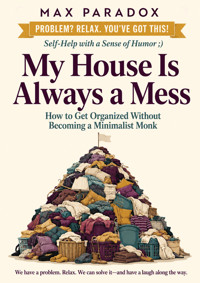
My House Is Always a Mess - How to Get Organized Without Becoming a Minimalist Monk ebook
Max Paradox
Uzyskaj dostęp do tej i ponad 240000 książek od 14,99 zł miesięcznie
- Wydawca: ALL-IN Rafał Płonkowski
- Kategoria: Biznes, rozwój, prawo•Biznes, rozwój
- Język: angielski
Your house is not messy because you lack character, discipline, or a mysterious organizing gene that everyone else received at adulthood orientation.
More likely, your stuff has terrible systems.
Keys land wherever your hand stops. Clothes live on “the chair.” Mail forms an administrative colony on the kitchen counter. Storage bins multiply while the actual mess remains strangely confident. And every few months you decide that this time you are going to organize the entire house in one heroic weekend.
By Saturday afternoon, the bedroom is covered in the contents of the closet and you are sitting on the floor holding an unidentified cable.
My House Is Always a Mess is a practical, funny guide to getting your home under control without throwing away everything you own, becoming obsessed with matching containers, or dedicating your weekends to household administration.
Max Paradox explains why clutter keeps returning and, more importantly, what to do about it. You will learn how to spot the real causes behind repeat mess, create low-friction homes for everyday objects, control overflowing categories, reduce incoming clutter, handle paperwork and temporary items, simplify laundry and shared spaces, and build reset routines that still work when your energy level is approximately potato.
You will also learn why buying organizers before organizing usually creates more objects to organize, why empty space is useful, how to stop surfaces from becoming permanent parking lots, what to do when a system collapses after a busy week, and how to maintain order without constantly starting over.
This is not a minimalist manifesto.
You may keep the books, hobbies, sentimental objects, kitchen equipment, waffle maker, extra blankets, and ridiculous mug you genuinely love. The goal is not to own almost nothing. The goal is to make what you own easier to find, use, return, and live with.
Inside, you will find practical rules, minimum-effort versions for bad days, realistic Plan B options, simple capacity limits, easy reset methods, and concrete “instead of this, do this” solutions designed for normal people with jobs, families, errands, tired evenings, and absolutely no desire to alphabetize their spice rack recreationally.
By the end, you will know how to make your home easier to reset, easier to move through, and much less capable of turning five misplaced objects into forty-seven.
Because an organized home does not need to look ready for a photo shoot.
It needs to work on Wednesday.
This publication was prepared with the assistance of tools that support the creative process, including artificial intelligence-based solutions. The final concept, structure, and editing belong to the author.
Ebooka przeczytasz w aplikacjach Legimi na:
Liczba stron: 245
Rok wydania: 2026
Odsłuch ebooka (TTS) dostepny w abonamencie „ebooki+audiobooki bez limitu” w aplikacjach Legimi na:
Podobne




















INTRO
There is a chair in your house that is no longer a chair.
Technically, it still has four legs, a backrest, and the general qualifications required by the furniture industry. But nobody has sat on it for weeks because it is currently employed as a wardrobe. On it are two sweaters, a pair of jeans that are not dirty enough to wash but apparently too emotionally complicated to put away, a reusable shopping bag, three pieces of mail, and an object you picked up from the floor because you were “going upstairs anyway.”
You did go upstairs.
The object did not.
Meanwhile, the kitchen counter has developed its own civilization. There are keys, receipts, a charger that fits something but nobody knows what, vitamins you intended to start taking in March, and one mysterious screw. You cannot throw away the screw because the moment you do, your house will collapse and an engineer will arrive to say, “If only you still had that one screw.”
So you keep it.
For structural safety.
If your house is always a mess, you have probably tried to fix this before. Perhaps many times. You bought storage boxes. You watched videos featuring people who own twelve possessions and somehow live in homes containing no visible electrical cables. You downloaded a cleaning schedule. You created categories. You labeled things. You may even have experienced that dangerous burst of organizational enthusiasm in which you emptied an entire closet onto the bedroom floor at 9:40 p.m. because you had suddenly decided to “finally sort everything out.”
At 11:15 p.m., you were sitting in the middle of forty-seven objects wondering why you had attacked yourself.
This is one of the great traps of getting organized: we often imagine the solution as a dramatic transformation. Today, chaos. Tomorrow, a peaceful beige home where every cotton swab has a designated jurisdiction. We assume organized people possess some mysterious internal quality that makes them enjoy folding fitted sheets and immediately returning scissors to the exact drawer from which they came.
They do not.
Some of them are simply better at making the easy thing easier than the messy thing.
That difference matters, because most homes do not become chaotic because their owners are lazy, irresponsible, or morally opposed to drawers. They become chaotic because daily life produces objects faster than the household system can absorb them. Groceries enter. Packages arrive. Laundry multiplies with the confidence of an invasive species. Paper appears from schools, offices, doctors, banks, delivery boxes, and companies that apparently believe every human being requires seventeen instruction manuals.
Then there are the temporary objects.
Temporary objects are especially dangerous because “temporary” is one of the most optimistic words in the English language. You put something on the counter “for now.” You place the bag near the door “until later.” You leave the clean laundry in the basket because you will put it away “in a minute.”
Three days later, the basket is part of the interior design.
The problem is not that you do not understand cleanliness. You know that dirty dishes belong in the dishwasher. You are familiar with the advanced concept that socks should eventually reach a drawer. The difficulty is the gap between knowing where something should go and having a realistic system that makes it easy to put it there when you are tired, busy, distracted, carrying groceries, answering a message, or wondering why the dog is suddenly eating cardboard.
Most organizing advice quietly assumes that you are organizing your house while feeling rested, motivated, and suspiciously enthusiastic about containers.
Real life usually happens at 6:37 p.m.
You walk through the door carrying groceries, your phone is ringing, something needs to go in the freezer immediately, somebody wants dinner, and you have discovered that one of the grocery bags contains a yogurt with the structural integrity of a water balloon. At that moment, the elegant rule that says “everything should have a place” is less useful than it sounded on Instagram.
Yes, everything should have a place.
The place should also be somewhere a tired human being will actually use.
That is what this book is about.
We are not going to turn your home into a minimalist monastery where you own one wooden spoon, two identical shirts, and a single decorative stone that represents gratitude. If minimalism appeals to you, excellent. If you would rather keep your waffle maker, eighteen books you have not read yet, sentimental birthday cards, holiday decorations, spare cables, camping equipment, and the bread machine you remain emotionally convinced you will use again someday, also excellent.
You do not need to own almost nothing.
You need the things you own to stop forming independent governments throughout the house.
There is also an important distinction between cleaning and organizing. Cleaning removes dirt. Organizing decides what happens to stuff. You can clean a cluttered room and still have a cluttered room, only now the clutter is dust-free and feeling extremely confident. You can also organize a dirty kitchen perfectly, although this produces the unusual achievement of knowing exactly where every greasy object belongs.
We will deal mainly with the second problem: how your home handles possessions, daily movement, incoming stuff, unfinished tasks, storage, laundry, surfaces, paperwork, and all the tiny decisions that create either manageable order or a slow-moving landslide.
And we will do it without requiring you to spend every Saturday performing household administration.
Because the best organizing system is not the one that looks impressive immediately after you create it. It is the one that still works on Wednesday evening when nobody feels like organizing anything.
That means we will look at why clutter keeps returning, why certain storage solutions secretly create more work, why “I’ll deal with it later” becomes a permanent decorating style, and why some rooms seem to attract objects the way airport carpets attract terrible patterns. More importantly, we will build practical ways to reduce friction: better landing zones, simpler categories, realistic limits, short reset routines, and rules that function even when motivation has left the building.
You will not be asked to become a different species of person.
This is useful because you have already tried being the imaginary version of yourself who always folds laundry immediately.
That person is unreliable.
Instead, we will design around the person who actually lives in your house: you. The person who sometimes walks past an empty glass three times before finally carrying it to the kitchen. The person who opens a cabinet, sees that it is full, and quietly closes it again as if both parties have agreed not to discuss what happened. The person who buys another storage basket because the previous storage baskets are currently storing things that should probably leave the house.
No judgment.
Some of my finest organizational failures have begun with the purchase of an attractive container.
Containers are dangerous because they provide the sensation of solving a problem before any actual problem has been solved. You can own forty matching bins and still have no idea what is inside them. At that point, you have not eliminated chaos.
You have franchised it.
By the end of this book, the goal is not perfection. Perfection is expensive, exhausting, and usually photographed before anybody has cooked dinner. The goal is a home that is easier to reset, easier to use, and less capable of turning five misplaced objects into forty-seven.
You should know where to begin when a room feels overwhelming. You should know what deserves storage and what is merely occupying expensive indoor real estate. You should know how to create simple homes for everyday objects, how to prevent surfaces from becoming parking lots, and how to recover when everything falls apart after a busy week.
Because it will sometimes fall apart.
That is normal.
A useful system does not prevent life from happening. It helps you recover after life happens.
So no, you do not need to throw away ninety percent of your belongings, thank each T-shirt for its service, or spend your weekend standing in front of three identical plastic organizers wondering which one best expresses your values.
We are going to make your house easier to manage.
Not sacred.
Not empty.
Not ready for a photo shoot at all times.
Just organized enough that when you need the scissors, your first thought is not:
“Well. This could be anywhere.”
Chapter 1 - Your House Is Not Messy for the Reason You Think
You come home, put your keys on the counter, drop the mail beside them, place a shopping bag on the floor, take off your jacket, and leave your shoes near the door because you are definitely going to move all of this in a minute.
Then life continues.
You answer a message. You put something in the refrigerator. You remember that the washing machine finished forty minutes ago. You go upstairs. On the way, you notice a mug on the coffee table and carry it to the kitchen, where you discover another mug in the sink and somehow forget why you entered the kitchen in the first place.
Twenty minutes later, the keys are still on the counter.
So is the mail.
The shopping bag has now been promoted to permanent flooring.
When this happens every day, it is easy to conclude that you are simply bad at keeping things organized. Maybe you are naturally messy. Maybe you lack discipline. Maybe everyone else received some secret adult training in which they learned how to return objects to their proper places immediately after using them.
They did not.
Most household mess is not a personality trait. It is usually the visible result of hundreds of tiny decisions being delayed, complicated, or assigned to systems that do not match how you actually live.
That is much better news.
A personality trait feels permanent. A bad system can be changed.
The first thing to understand is that clutter is rarely created by one dramatic event. Your living room does not wake up one morning and announce, “Today I become a disaster.” Chaos accumulates in small installments: one jacket on a chair, one package on the table, one stack of papers near the printer, one pair of shoes beside the door.
No single object looks like a problem.
Together, they hold a conference.
A messy home is often full of what we might call unresolved objects. These are things waiting for a decision.
The shirt on the chair is waiting for you to decide whether it is clean enough to wear again. The package is waiting to be opened. The batteries are waiting to be tested. The papers are waiting to be filed, signed, paid, scanned, shredded, or stared at periodically with increasing concern.
Every object represents unfinished business.
That is why clutter is mentally tiring even when you are not consciously looking at it. Your brain keeps noticing tiny reminders: deal with this, move that, decide about this, remember that. None of these tasks is individually important, but collectively they create the feeling that your house is quietly assigning homework.
And your house is a terrible teacher.
It never gives clear deadlines.
One of the most useful shifts you can make is to stop asking, “Why am I so messy?” and start asking, “Where are decisions getting stuck?”
Walk through a typical cluttered area and look at what is actually there.
Maybe the dining table contains unopened mail, a laptop, a child’s school papers, two charging cables, and a bag containing something that needs to be returned to a store. These are not random objects. They are five different tasks living on one piece of furniture.
The table has become your administrative department.
Unfortunately, it also needs to serve dinner.
This is why simply “tidying up” often fails. You move the papers somewhere else, stack the cables, carry the bag into another room, and enjoy a brief moment of visual success.
The table is clear.
Victory.
Three days later, everything is back because nothing about the underlying process changed.
The mail still enters the house without a decision point. Returns still have no designated waiting place. School paperwork still lands wherever the first available flat surface happens to be. Cables are still treated like migratory wildlife.
You cleaned the evidence.
You did not solve the case.
The same thing happens with clothes. People often think their bedroom is messy because they own too many clothes or are too lazy to put them away. Sometimes that is true. Very often the real problem is more specific.
There are no good categories for clothes that are not fully clean but not dirty enough to wash.
So they go on the chair.
Or the bench.
Or the treadmill you once bought because you were becoming “a person who exercises at home.”
The treadmill has accepted its new role.
It is now fabric storage with handlebars.
If you do not create a realistic place for the way you actually behave, your behavior will create one for you.
This is one of the central rules of the entire book:
Your home already has systems.
They may simply be terrible.
The pile of shoes by the front door is a system. The stack of mail beside the toaster is a system. The basket of random cables is a system. The chair covered in clothes is definitely a system, although the chair may disagree.
Mess is often an improvised organization method.
That means your job is not to introduce order from nothing. Your job is to notice the existing system, understand why it formed, and replace it with something easier.
Suppose every member of the household drops shoes near the entrance. You can repeatedly tell everyone to carry shoes to individual closets. You can make speeches. You can create a laminated rule sheet. You can become the regional director of footwear compliance.
Or you can accept that shoes naturally come off near the entrance and put practical storage there.
The second solution requires less moral development.
That is usually a good sign.
Good organization does not begin with the question, “What would an extremely disciplined person do?”
It begins with:
“What keeps happening here?”
If jackets always land on dining chairs, maybe the coat closet is too far away, too full, or annoying to use. If clean laundry stays in baskets, maybe your folding routine is too complicated. If the kitchen counter collects documents, maybe you need a tiny paper station exactly where paperwork naturally appears.
Do not fight gravity, traffic patterns, and tired people at the same time.
You will lose.
Another common cause of mess is friction.
Friction means that putting something away takes slightly more effort than leaving it out.
That difference can be incredibly small. A storage box has a lid. A cabinet shelf is too high. A drawer is overfilled. The vacuum cleaner is behind three other objects. The recycling bin is in the garage. The laundry hamper is in the bedroom, but clothes tend to come off in the bathroom.
None of these obstacles is dramatic.
That is why they are dangerous.
Imagine you use a phone charger every evening. If the charger has a permanent place beside the couch, returning it takes two seconds. If its official home is inside a zipped electronics pouch inside a drawer across the room, the charger will never go there.
Not because you are irresponsible.
Because you are a human being, not a museum employee.
The easier an action is, the more likely it becomes the default.
This principle is more powerful than motivation.
Motivation is unreliable. It arrives suddenly on Sunday afternoon and convinces you that this is the weekend you will organize the garage. Then it disappears after you open the first box and discover thirty instruction manuals, four paint samples, and a Christmas decoration missing one leg.
Friction stays.
If the correct action is easy, you can do it while tired. If the correct action is annoying, you need energy every single time.
That is expensive.
Another problem is hidden capacity.
Many homes look as if they have a storage problem when they actually have a volume problem.
A drawer is not disorganized because the socks are poorly aligned. The drawer is disorganized because it contains enough socks to open a small retail operation.
A kitchen cabinet does not need a better shelf divider if it contains seventeen travel mugs and only two people live in the house.
Sometimes organization fails because the amount of stuff exceeds the space available for it.
There is no storage hack capable of changing basic geometry.
This does not mean you need to become a minimalist monk. It means containers have limits, rooms have limits, drawers have limits, and your home should not be required to perform spatial miracles every day.
A useful rule is simple:
If a category cannot be returned to its home without pushing, balancing, compressing, rearranging, or using language normally reserved for assembling furniture, the category is too full.
Do not organize an overflow problem.
Reduce it.
This might mean removing things you no longer use. It might mean relocating rarely used items. It might mean admitting that six nearly identical spatulas are not all essential members of the family.
One of them knows what it did.
There is also a timing problem.
Some households rely on delayed decisions.
“I’ll put it away later.”
“I’ll sort that this weekend.”
“I’ll decide what to do with these papers.”
“I’ll deal with the closet when I have more time.”
Later is a legitimate scheduling concept.
It is also where objects go to retire.
The danger is not postponing one task. The danger is postponing hundreds of tiny tasks without creating a time when they actually get resolved.
If everything becomes a future task, your house becomes a storage facility for your future self.
Future you already has enough problems.
Stop shipping them boxes.
The practical solution is to identify the main sources of repeat clutter.
Do not begin with the entire house. That is too vague and too dramatic.
Pick one area that repeatedly becomes messy.
Then ask four questions:
What objects keep appearing here?
Why do they land here?
What decision is being delayed?
What would make the correct action easier?
Take the kitchen counter.
You discover that the clutter is mostly mail, keys, receipts, medication, and items waiting to go upstairs. Now you know you do not have one problem called “mess.”
You have five small systems that do not work.
That is much easier.
For keys, install a hook or use a bowl where they naturally land.
For mail, create one small incoming-paper tray and process it regularly.
For receipts, decide whether you actually need them. Most can leave immediately.
For medication, create a safe, sensible location that matches when you take it.
For things going upstairs, use a temporary carry basket if that genuinely helps—but give it a rule. It must be emptied once a day or every time someone goes upstairs.
Otherwise you have simply purchased a decorative container for procrastination.
Which is still procrastination.
Just more coordinated.
Notice what we are doing here. We are not asking you to “be more organized.” That instruction is useless because it describes a result, not an action.
We are changing specific behaviors at specific points.
This is how order becomes sustainable.
You do not need to remember to be an organized person every day. You need a house where common objects have obvious, low-friction destinations.
That is a much smaller job.
If your first reaction is, “Fine, but my whole house is messy,” resist the urge to attack everything at once. Choose the area that causes the most irritation or creates the biggest daily inconvenience.
Maybe it is the entrance because you can never find keys.
Maybe it is the bedroom because clothing has formed geological layers.
Maybe it is the kitchen because preparing food requires relocating twelve unrelated items.
Start there.
One zone.
One repeated mess.
One system.
Your minimum viable solution today is this:
Choose one clutter magnet and remove ten items from it.
Do not simply relocate them to another pile. Decide what each one needs:
trash, donation, permanent home, action, or temporary waiting place with a clear purpose.
Then make one improvement that reduces friction.
Add the hook.
Move the hamper.
Clear the drawer.
Put the recycling bin where recycling actually happens.
Do not reorganize the entire planet.
You are fixing one traffic jam.
Once you begin seeing clutter as information rather than evidence of personal failure, the problem becomes much easier to solve. Every pile tells you something. Every repeatedly messy surface is showing you where your current system is too hard, too vague, too full, or missing entirely.
Your house is not judging you.
It is leaving clues.
Unfortunately, most of them are on the dining table.
Chapter 2 - Stop Organizing Your Fantasy Life
There is a strange person living in your house.
This person drinks water immediately after waking up, puts laundry away while it is still warm, opens mail the day it arrives, cleans kitchen equipment immediately after using it, and has never once placed something on the stairs with the intention of taking it upstairs later.
You have designed several household systems for this person.
The problem is that this person does not exist.
Fantasy You is incredibly organized.
Fantasy You has matching containers. Fantasy You enjoys weekly planning. Fantasy You returns every object to its designated home immediately after use. Fantasy You does not own a drawer containing a screwdriver, birthday candles, old batteries, three types of tape, a takeout menu from a restaurant that closed in 2022, and a key nobody recognizes.
Real You owns that drawer.
Real You is busy.
This chapter is about one of the biggest reasons organizing systems collapse: they are designed for the person we wish we were instead of the person who actually has to use them.
You can see this most clearly in beautifully organized spaces that become messy almost immediately.
Imagine you completely reorganize a closet. Every item is separated into precise categories. Shirts are folded vertically. Accessories have dedicated boxes. Seasonal items are labeled. Everything looks magnificent.
You take a photo.
Possibly several.
For twelve minutes, you are the ruler of space and matter.
Then normal life returns.
You take out a sweater. The sweater beside it falls over. You need a belt but the belt box is under another box. You wear a shirt for two hours and decide it is not dirty enough for laundry. There is no category for “worn briefly but acceptable,” so it goes on the chair.
Within two weeks, the closet looks familiar again.
You may conclude that you failed.
But perhaps the system failed you.
A good system should work under normal conditions, not only during its grand opening.
This means organization must account for tiredness, speed, distraction, imperfect habits, and the fact that sometimes you will choose the easiest available option even when you know a better one exists.
Especially then.
The first question to ask is:
What do I actually do?
Not:
What should I do?
Suppose you regularly drop your bag beside the kitchen table when you come home. You could decide that from now on the bag must be stored in the hall closet.
Excellent.
Where is the hall closet?
Across the house.
Is there space inside it?
Technically, yes, if you first relocate the vacuum cleaner, two winter coats, a folding chair, and a bag containing gift wrap.
Are you going to do that every evening?
Of course not.
The bag will return to the kitchen table, and you will once again believe you have a discipline problem.
You do not.
You have assigned a daily object to an inconvenient home.
Move the home closer to the behavior.
Maybe the bag gets a hook near the kitchen. Maybe it sits on a shelf near the entrance. Maybe you create a basket beside the table if that is genuinely where it belongs.
The correct storage location is often where you naturally use or remove the item, not where furniture tradition says it should go.
This principle can feel almost too simple, which is why people ignore it and purchase complicated organizers instead.
Complicated organizers are more exciting.
They have compartments.
Humans love compartments.
We imagine that once we own twelve compartments, our behavior will immediately become twelve times more responsible.
Then we create labels such as:
ADAPTERS
CHARGERS
CABLES
TECH ACCESSORIES
MISC. ELECTRONICS
and spend the next six months putting everything in MISC. ELECTRONICS because life is short.
Overcategorizing is one form of fantasy organization.
The system is too precise for the amount of effort you are willing to give it.
If every object requires a small administrative hearing before it can be put away, you will eventually stop putting things away.
This is why broad categories often work better.
Instead of six different boxes for electronic accessories, maybe you need two:
Cables and Chargers.
Other Tech.
Done.
Your home is not an archive for a national museum.
Nobody is auditing your HDMI cables.
Another fantasy is the perfect routine.
Perhaps you created a cleaning schedule with a task assigned to every day.
Monday: bathrooms.
Tuesday: floors.
Wednesday: kitchen cabinets.
Thursday: dusting.
Friday: laundry.
Saturday: deep clean.
Sunday: collapse peacefully while wondering why your hobby is now maintenance.
Schedules can help, but only if they fit your actual life.
If Tuesday is always your busiest workday, Tuesday should not also be “clean all floors day” simply because a printable planner said so.
A system that repeatedly loses to your schedule is not a system.
It is a suggestion.
A realistic routine should fit the week you already have.
Maybe Friday evening is terrible for cleaning because by then your energy level is somewhere between “do not speak to me” and “dinner can be crackers.”
Fine.
Do not put important maintenance there.
Maybe Sunday morning works. Maybe Wednesday evening works. Maybe ten minutes on several days is better than one giant session.
The goal is not to imitate someone else’s schedule.
The goal is to reduce household chaos.
Those are different objectives.
Another fantasy-life trap is building systems around ideal frequency.
You imagine you will process paperwork daily.
You will not.
Maybe once a week is enough.
You imagine you will immediately put away every grocery item, wash reusable bags, update the shopping list, and reorganize the pantry at the same time.
That sounds wonderful.
You are buying bananas, not launching a supply-chain transformation.
Use the smallest routine that reliably controls the mess.
That phrase matters:
reliably controls.
You do not need a perfect system.
You need a system that prevents chaos from growing faster than you can reset it.
For example, if papers accumulate on the counter, your minimum system might be one tray.
Everything important goes there.
Once a week, you sit down for fifteen minutes and process it.
Pay.
File.
Scan.
Respond.
Recycle.
Shred.
That system is not elegant enough to earn a million views online.
It is elegant enough to stop losing medical bills under pizza coupons.
I will take that victory.
Your fantasy life can also distort what you keep.
Many homes contain objects belonging to Future You.
Future You bakes sourdough.
Future You camps.
Future You hosts formal dinners.
Future You repairs furniture.
Future You wears those pants again.
Future You has a suspiciously active schedule.
There is nothing wrong with keeping things for realistic future use. The problem begins when your storage space is full of equipment for identities you do not actually live.
A bread maker you use twice a month is useful.
A bread maker you used once in 2019 and now keep because you are “getting back into homemade bread” is paying very cheap rent.
In your kitchen.
Future identities consume current space.
That does not mean you should throw everything away. It means you should evaluate what your home is being asked to store.
Ask:
Is this part of my real life?
Or is this part of an imaginary life I occasionally admire?
The difference is often visible.
Real-life objects show signs of use.
Fantasy-life objects are pristine.
You own watercolor paints.
Beautiful.
When did you last paint?
“Recently.”
How recently?
“During the Obama administration.”
Interesting.
Again, this is not an argument for aggressive minimalism. You are allowed to keep hobbies, sentimental items, backup supplies, aspirational equipment, and things you simply like.
But choose consciously.
Do not let Fantasy You fill every cabinet and then force Real You to balance a frying pan on top of a waffle maker every morning.
Storage space is not free.
Even when you already own the house.
Every object uses physical space, visual space, and mental space. It must be stored, moved, cleaned around, remembered, or eventually decided about.
That is the hidden cost.
One of the easiest ways to design for real life is to study where things already pile up.
Suppose clean laundry always sits on the bed because putting it away requires folding every shirt perfectly.
Maybe you do not need to fold every shirt perfectly.
Revolutionary.
Perhaps underwear, pajamas, gym clothes, and casual shirts can be stored more simply. Perhaps some categories can be placed in bins or drawers without perfect folding. Perhaps your current method is optimized for appearance rather than speed.
If the method is beautiful but nobody follows it, beauty has become the problem.
The same applies to kitchen storage.
If the plates are in a cabinet near the dishwasher, great.