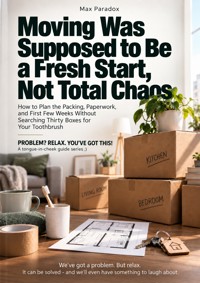
Moving Was Supposed to Be a Fresh Start, Not Total Chaos - How to Plan the Packing, Paperwork, and First Few Weeks Without Searching Thirty Boxes for Your Toothbrush ebook
Max Paradox
29,99 zł
19,90 zł
Najniższa cena z 30 dni przed obniżką: 29,99 zł
19,90 zł
Najniższa cena z 30 dni przed obniżką: 29,99 zł
Dowiedz się więcej.
- Wydawca: ALL-IN Rafał Płonkowski
- Kategoria: Poradniki•Styl życia
- Język: angielski
What happens when an ordinary part of life becomes so complicated, repetitive, or emotionally loaded that it starts running the whole day? Moving Was Supposed to Be a Fresh Start, Not Total Chaos is a practical, empathetic guide for readers who want useful answers without judgment, perfectionism, or a second full-time job devoted to self-improvement.
Max Paradox turns a frustrating real-life problem into manageable decisions and repeatable routines. The book does not promise an instant transformation. It shows how to understand what is actually going wrong, choose a realistic minimum, communicate clearly, and build a system that still works on a busy or difficult week.
The first part of the book explores BEFORE YOU TOUCH THE FIRST BOX; PACKING, OR WHY "MISCELLANEOUS" IS NOT A SYSTEM; PAPERWORK, OR YOU MAY BE MOVING, BUT YOUR ADDRESS NEEDS ITS OWN RELOCATION PLAN; MOVING DAY, OR PLEASE STOP PACKING NOW; THE FIRST FEW WEEKS, OR YOU DO NOT HAVE TO UNPACK YOUR ENTIRE LIFE BY SUNDAY; NEW PLACE, NEW RULES, OR DO NOT RECREATE YOUR OLD CHAOS IN A NICER HOME; PEOPLE, NERVES, AND MOVING, OR WHY "I'M JUST ASKING" SOUNDS LIKE AN ATTACK THIS WEEK. Each topic is handled through concrete examples, sensible boundaries, and small actions that can be tested immediately instead of admired in a notebook and forgotten by Tuesday.
The middle chapters move through THE MOVE IS OVER, OR HOW TO AVOID SAYING A YEAR FROM NOW, "I THINK WE'RE STILL UNPACKING"; WHAT TO DO WHEN THINGS GO WRONG, OR WHY PLAN B IS NOT AN ADMISSION OF FAILURE; WHEN MOVING GETS EXPENSIVE FASTER THAN EXPECTED, OR HOW NOT TO BUY A WHOLE NEW LIFE IN ONE WEEKEND; HOW TO TURN THE NEW PLACE INTO HOME, OR WHY THE LAST BOX DOES NOT CONTAIN MAGIC; THE HARDER VERSION OF MOVING, OR WHAT CHANGES WHEN YOU ADD CHILDREN, PETS, REMOTE WORK, AND LONG DISTANCES; THE FINAL-WEEK CHECKLIST, OR THE POINT WHERE WE STOP SAYING "WE STILL HAVE PLENTY OF TIME"; THE MINIMUM PLAN, OR IF YOU REMEMBER ONLY FOURTEEN THINGS, MAKE THEM THESE. They help the reader separate urgency from habit, responsibility from guilt, and a useful standard from an impossible one. The goal is not to control every detail, but to make the next decision easier and more reliable.
The final part covers WHEN THE NEW PLACE DOES NOT WORK THE WAY YOU IMAGINED; HOW NOT TO RETURN TO YOUR OLD CLUTTER AFTER THREE MONTHS; THE FINAL CHAPTER, OR MOVING IS NOT A TEST OF WHETHER YOU ARE A PROPER ADULT; WHEN THE MOVE STARTS BEFORE MOVING DAY, OR HOW NOT TO LEAVE EVERYTHING UNTIL THE FINAL WEEK; MOVING WITHOUT GUILT, OR WHY YOU DO NOT HAVE TO TAKE EVERYTHING JUST BECAUSE YOU ALREADY OWN IT; AFTER THE MOVE, OR HOW TO CLOSE THE PROJECT AND FINALLY STOP THINKING ABOUT IT. By the end, the reader has a clear way to review what works, repair what does not, and continue without starting over whenever life becomes messy again.
Written in a warm, direct, lightly humorous style, this is a guide for people who value practical progress over motivational slogans. It respects different circumstances and capacities, avoids blaming, and keeps the advice focused on choices the reader can actually make.
If you are tired of carrying the same problem around and would like a calm plan that fits real life, Moving Was Supposed to Be a Fresh Start, Not Total Chaos will help you move from vague frustration to specific, workable next steps.
This publication was prepared with the use of tools supporting the creative process, including solutions based on artificial intelligence. The final concept, structure, and editing belong to the author.
Ebooka przeczytasz w aplikacjach Legimi lub dowolnej aplikacji obsługującej format:
Liczba stron: 137
Rok wydania: 2026
Podobne




















Max Paradox
Moving Was Supposed to Be a Fresh Start, Not Total Chaos
How to Plan the Packing, Paperwork, and First Few Weeks Without Searching Thirty Boxes for Your Toothbrush
ALL-IN Rafał Płonkowski
2026
ISBN 9788384832806
INTRO
Moving has an excellent marketing department. In theory, it means a fresh start, a new space, a better layout, new possibilities, and that wonderful moment when you close the door of your old home, take a deep breath, and think, "Right. Things will be different now." What the advertisement never shows is the bag full of cables whose purpose is no longer known to any living human, five boxes labeled "miscellaneous," or the moment at 11:40 p.m. when you discover that your bedding is probably somewhere underneath the kettle, tax documents, and Christmas decorations.
A fresh start very quickly turns out to be your old life packed into boxes.
Moving is one of those projects that looks logistically simple until you actually begin. All you have to do is pack your things, move them from point A to point B, and unpack them. Sounds reasonable. So does saying that renovating is mostly about painting walls, raising a dog is mainly about feeding it, and running a company is basically answering a few emails.
The problem is that you are not moving only your belongings. You are moving your daily habits, documents, clothes, equipment, deadlines, commitments, bills, Wi-Fi passwords, pasta supplies, the charger you use every day, and twenty-seven objects you never use but are suddenly wondering whether you might need someday.
Then come the questions. When should you book the movers? When should you cancel the internet? What happens with the electricity? Do you need to change your address at the bank? Where should you keep important documents? What gets packed last? What gets unpacked first? How do you label boxes so that three days later you are not opening six different ones marked "kitchen" in search of a single teaspoon?
And then the big day arrives. Someone asks where the keys are. Someone else wants to know where to put a box.
The phone rings. The moving van is outside. The shelving unit fits in the elevator, but no human being does.
And suddenly you are the project manager of an initiative called "My Entire Life Is Changing Address," despite the fact that your only relevant qualification is that you once successfully transported a suitcase from a hotel to an airport.
This book will not turn moving into an experience comparable to a week on the beach. We are not going to be that shameless. It can, however, make the whole process feel less like a rescue operation organized by people who met ten minutes ago.
You do not need a perfect system. You need a good-enough plan, a few simple rules, and the understanding that moving is not one task. It is a series of smaller projects that need to happen in the right order.
First, you make decisions. Then you reduce the number of things. Next, you pack.
At the same time, you deal with paperwork. Then comes transportation. Finally, you try to build a normal life in the new place before you begin treating the television box as a permanent coffee table.
The biggest mistake is that most people start with boxes.
They buy tape, cartons, bubble wrap, and a black marker. They feel productive because professional-looking materials are appearing around them. Then they spend two weeks moving objects from one place to another until, three days before the move, Operation "Put Everything Wherever It Fits" officially begins.
We are going to start earlier. With a plan.
Not a plan that looks like the construction schedule for an international airport. Just a simple system that answers four questions: what needs to happen, who is doing it, when it needs to be finished, and where the information about that task is stored.
That alone can reduce the chaos significantly.
We are also not going to pretend that every move looks the same. A student leaving a rented room has a different experience from a family with children, a couple moving in together, or someone leaving a house after fifteen years surrounded by possessions that begin every conversation with, "Don't throw that away because..."
The principles, however, are similar. The earlier you make decisions, the less you have to do at the last minute. The less you move, the less you pack.
The better you label things, the less you search. The more you prepare before moving day, the fewer decisions you need to make when your brain is already running at the temperature of a laptop rendering an 8K video. And if one evening you still end up eating pizza on the floor between twelve boxes, that does not mean anything has gone wrong.
That is simply the official moving ritual. The real problem begins when, three weeks later, you are still sitting on the same box because you have no idea where you packed the chairs.
Chapter 1 - BEFORE YOU TOUCH THE FIRST BOX
The most tempting way to begin a move is by doing something that looks like moving. Boxes. Tape.
Marker. Folding cartons. The first label: "KITCHEN."
You instantly feel as if the situation is under control. Unfortunately, the feeling is similar to buying a new notebook before starting a major project. The notebook looks excellent. The project still has no plan.
Before you start packing, work out what is actually going to happen. This is not only about the moving date. You need a timeline covering at least a few weeks before that day and the first period after you arrive.
The simplest plan can have four stages: Stage 1: decisions and reduction. What you are taking, selling, giving away, and throwing out. Stage 2: logistics and paperwork. Transport, contracts, utilities, internet, addresses, documents, and keys.
Stage 3: packing and moving day. Packing order, labels, priorities, and transportation. Stage 4: getting life running in the new place. Bed, bathroom, kitchen, internet, basic shopping, and gradual unpacking.
This can be a piece of paper, a spreadsheet, or a simple list on your phone. You do not need project-management software capable of producing a Gantt chart for your socks. You need one place where the information will not disappear.
Moving day is not the beginning of the project
If you are moving on June 30, the project does not begin on June 28.
This may sound obvious until you realize that this is exactly how a surprising number of moves are handled. For several weeks, everyone knows that "we need to start packing," but nobody defines what "need to" actually means.
As a result, one week before the deadline, you discover that no moving company has been booked, the internet provider requires a month's notice, some furniture will not fit through the door, and the basement contains an independent civilization of objects nobody has seen since 2018.
Set the target date, then work backward from it.
Four to six weeks before the move is a good time to review your belongings, arrange transport, and list the paperwork. Three to four weeks beforehand, you can start packing things you rarely use. Two weeks before, most administrative tasks should already be underway. The final week should be for finishing things, not discovering that you also have an attic.
If you have less time, do not panic. Compress the stages, but keep the order. The worst system is no system.
One master list
It is extremely easy to create five separate lists during a move. One is on the refrigerator. Another is on your phone.
The third is buried in a message sent to your partner. The fourth is somewhere in a notebook. The fifth exists only inside the head of the person currently saying, "I told you about that."
Instead, create one master list. It does not have to be beautiful. It has to be complete.
Divide it into a few categories: tasks for the old place, preparation for the new place, transportation, paperwork, packing, purchases, and moving-day tasks. Add a deadline and one responsible person to each task. That last part matters more than it seems.
"We need to call the internet company" is not a task. "Adam calls the internet provider by Wednesday" is a task. "We need to buy boxes" is not a task.
"Ola orders forty boxes by Friday" is a task. When nobody owns a task, it often has plenty of spectators.
Do not move rubbish
Moving is an excellent moment to ask yourself a question you may have successfully avoided for several years: "Do I really want to transport this?"
Every object you take requires work. It has to be lifted, assessed, packed, labeled, carried, transported, carried again, unpacked, and given a place. Even if the object itself is worth almost nothing, moving it may require a surprising amount of energy.
So reduce first, pack second.
Do not, however, turn this into an extreme minimalism marathon in which, at two o'clock on Saturday afternoon, you decide that from now on you will own seven shirts and one wooden bowl. Moving already contains enough decisions.
Four categories are enough: Take. Sell. Give away.
Throw out. If you spend five minutes wondering whether something might be useful someday, you have probably just found an item you have not used in a very long time.
There are exceptions, of course. Documents, sentimental objects, seasonal equipment, and things used rarely but for a clear purpose. Skis can sit unused for nine months and still make sense. Seven chargers for phones you no longer own have a slightly weaker legal defense.
Check the new place before packing the old one
One of the more absurd moving scenarios involves carefully transporting a piece of furniture across town, carrying it up four floors, and discovering that it is two centimeters too wide. So measure the new place. Doors.
Hallways. Elevator. Stairs.
Spaces for the largest furniture.
Also check where the sockets, connections, shut-off valves, washing machine, dishwasher, and refrigerator spaces are. It sounds boring, but five minutes with a tape measure is considerably more entertaining than thirty minutes rotating a sofa vertically while using vocabulary unsuitable for a practical guide.
If you are using a moving company, give them information about floors, elevators, parking access, and unusual items in advance. A piano, large aquarium, and safe are not details the driver should discover on arrival.
Create a chaos budget
Moves almost always produce small expenses nobody planned. Extra boxes. Tape.
Bags. Cleaning supplies. Transport surcharges.
A new extension cord. A missing shelf. Takeout for two days because the kitchen technically exists but nobody knows where anything is.
Build a margin into the budget. Not because everything will go wrong, but because small expenses add up quickly. It is useful to create a separate "moving" category instead of scattering the expenses across your normal household budget. That makes it easier to see what the whole process actually cost and where the extras appeared.
You do not need to track every roll of tape. But it is useful to know whether the move cost roughly two thousand or two thousand plus a mysterious extra fifteen hundred that disappeared somewhere between the hardware store and the food delivery app.
Agree on decision rules
If you are moving with someone, agree on a few simple rules in advance. What are you selling? What can be thrown away without consultation?
Which things require a joint decision? What is the budget for new furniture and equipment? Who makes decisions about transportation?
Who handles the paperwork?
This may sound formal, but it is much better to have that conversation over coffee than over an open box while holding a figurine one person wants to throw away and the other has suddenly discovered is "an extremely important keepsake."
The phrase "Do whatever you think is best" is particularly dangerous. In normal life, it suggests flexibility. During a move, it often means, "Make the decision yourself, but remember that I reserve the right to conduct a detailed review afterward."
Take photos
Before unplugging electronics, take a picture of the cables. Before dismantling furniture, photograph how it is assembled. Before leaving a rented property, photograph the condition of the rooms.
Before packing valuable items, document them. Your phone is one of the best moving tools available, yet most people use it mainly to call someone and ask, "Where are you?"
Photos can save a remarkable amount of time. Especially three days later, when you are holding two identical cables and trying to determine which one belonged to the router and which one belonged to a device whose name you do not even know.
The first success: you know what is going to happen
At the end of the first stage, your home should not yet be full of boxes. You should have something better. A plan.
You know when the transport is happening. You know what you are taking. You know which paperwork needs attention. You know who owns each task. You know which things require preparation in advance.
It may not look spectacular. There is no Instagram photo. There is no impressive wall of perfectly sealed boxes.
But you have just completed the most valuable part of the move. You turned chaos into a list of things to do. And a list of things to do is much less frightening than chaos because you can cross things off.
Chapter 2 - PACKING, OR WHY "MISCELLANEOUS" IS NOT A SYSTEM
Eventually, however, you do have to touch the boxes. And that is where the real sport begins. Packing looks harmless for the first half hour. You assemble a box, put in a few books, tape it shut, label it, and feel like an employee at an extremely efficient logistics center.
Three hours later, you are sitting on the floor with a charger, three candles, a washing machine manual, one glove, and a ceramic chicken, trying to decide which room this collection belongs to. That is when the "MISCELLANEOUS" box appears. It is a natural reaction.
And the beginning of trouble.
Pack for the destination
The most important rule is simple: Do not pack according to where an item is now. Pack according to where it will go.
If your mugs currently live in the living room but will be in the kitchen in the new place, the box should say "KITCHEN," not "LIVING ROOM." If documents are currently stored in a bedroom drawer but will end up in the office, pack them as "OFFICE."
That way, anyone carrying boxes immediately knows where they belong. It is a small change that can save hundreds of unnecessary steps.
Colors are faster than reading
If you have more than a few rooms, use a simple color system. Kitchen - red. Living room - blue.
Bedroom - green. Bathroom - yellow. The actual colors do not matter. Consistency does.
Put a colored sticker or piece of tape on each box. At the new place, put the matching color on the relevant room door. The person carrying the box does not have to decipher your handwriting while climbing stairs with fifteen kilograms of books.
They see green. They go to the green room. Logistics does not have to be beautiful. It has to work.
Number the boxes
Every box should have a number. Not because you are planning a forensic investigation into missing cutlery. The number simply allows you to create a basic contents list.
For example: K12 - kitchen - pots, pans, bowls. B04 - bedroom - bedding, blankets. O07 - office - archived documents, cables, printer.
You do not have to list every single item. A few words are enough. When you later need a laptop charger, it is much easier to check the list than open nine boxes labeled "office."
Numbering has another benefit. If you are using movers, it becomes easier to check whether every box arrived. You do not need to count every book.
Counting boxes is exciting enough.
Never write only "MISCELLANEOUS"
"Miscellaneous" feels perfectly logical while you are packing. The problem begins when you unpack. What is inside the miscellaneous box?
Miscellaneous things. Where do they belong? In miscellaneous places.
Do you have to open the box? Yes. Will half the items still have nowhere obvious to go afterward?
Of course. If you genuinely have a mixed collection within one category, make the label more specific. "Office - small accessories."
"Kitchen - pantry supplies." "Bathroom - spare toiletries." "Living room - decorations."