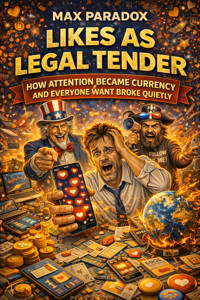
Likes as Legal Tender - How Attention Became Currency and Everyone Went Broke Quietly ebook
Max Paradox
Uzyskaj dostęp do tej i ponad 240000 książek od 14,99 zł miesięcznie
- Wydawca: ALL-IN Rafał Płonkowski
- Kategoria: Poradniki•Styl życia
- Język: angielski
Likes were never meant to be money.
They became it anyway.
Without a vote.
Without regulation.
Without anyone noticing.
Likes as Legal Tender is a sharp, darkly humorous satirical nonfiction book about the modern economy of attention-where approval is measurable, visibility replaces value, and self-worth refreshes every few seconds.
Through 35 observational chapters, this book dissects influencer culture, algorithms, emotional labor, performative authenticity, digital burnout, and the quiet collapse that happens when numbers stop meaning anything-but still control everything.
This is not a guide.
Not a manifesto.
Not a solution.
It is an unfiltered look at what happens when likes turn into currency, silence becomes suspicious, and everyone starts living with an audience in their head.
If you’ve ever:
• Checked engagement instead of checking yourself
• Felt exhausted by visibility you never asked for
• Wondered why nothing feels enough anymore
This book already knows why.
This publication was prepared using tools that support the creative process, including solutions based on artificial intelligence. The final concept, structure, and editing are the work of the author.
Ebooka przeczytasz w aplikacjach Legimi na:
Liczba stron: 115
Rok wydania: 2026
Odsłuch ebooka (TTS) dostepny w abonamencie „ebooki+audiobooki bez limitu” w aplikacjach Legimi na:
Podobne

















INTRO
Nobody agreed that likes would become a currency.There was no meeting.No vote.No awkward PowerPoint.
It just… happened.
One day, likes were decoration.The digital equivalent of nodding politely while someone talks too long.
The next day, they were value.
• Measurable.• Comparable.• Exchangeable.• Emotionally addictive.
At some point, the internet quietly decided that attention is money, and money is optional.
We didn’t notice the switch because it came with confetti.
At first, likes felt harmless.
A small heart.A thumbs-up.A number that went up when people noticed you.
It felt nice.Too nice.Suspiciously nice.
• Nobody ever warned us that validation would come with analytics.• Nobody explained that approval would get a dashboard.• Nobody mentioned that self-worth would soon refresh every three seconds.
We clicked anyway.
Influencers didn’t appear overnight.They evolved.
Slowly.Naturally.Like mold, but with better lighting.
At the beginning, it was just people sharing things.
Food.Holidays.Dogs doing nothing in particular.
Then someone noticed something strange.
The posts that looked effortless performed better.The posts that looked spontaneous were carefully planned.The posts that said “just being myself” were edited for three hours.
Reality didn’t disappear.It was optimized.
• Authentic became a strategy.• Casual became scripted.• Imperfection became a brand asset.
That’s when likes stopped being reactions and started becoming proof.
Proof that you exist.Proof that you matter.Proof that strangers agree you are worth noticing today.
Not tomorrow.Today.
Because tomorrow has an algorithm update.
Influencers didn’t sell products at first.They sold attention.
And attention turned out to be extremely liquid.
You could exchange it for:• Free products.• Invitations.• Access.• Influence.• And eventually, money that looks suspiciously like money.
A like didn’t cost anything.Which is why it became priceless.
Companies realized something terrifying.
People trust people more than brands.People trust faces more than logos.People trust someone saying “I love this” more than a legal disclaimer in size 6 font.
So they stopped advertising.
They outsourced belief.
Influencers became walking billboards with feelings.
And the audience didn’t object, because the billboards smiled back.
• Ads were annoying.• Sponsored posts felt friendly.• Manipulation worked better when it wore a hoodie.
Somewhere along the way, likes turned into leverage.
Not officially.Not legally.But socially.
A person with enough likes could:• Skip lines.• Skip explanations.• Skip consequences.• Skip qualifications.
They didn’t need credentials.They had engagement.
They didn’t need expertise.They had reach.
They didn’t need authority.They had followers who would defend them in comment sections like unpaid lawyers.
And suddenly, likes weren’t applause anymore.
They were power.
Power doesn’t look dangerous when it’s pastel-colored.
It looks like:• Morning routines.• “Just being honest” videos.• Crying thumbnails.• Vulnerability on schedule.
Everything became content.
Your breakfast.Your workout.Your mental health.Your breakup.Your healing journey, monetized in three easy steps.
Nothing was too private if it performed well.
• Oversharing became transparency.• Exposure became bravery.• Boundaries became bad for engagement.
Influencers learned quickly.
If something works once, repeat it.If it works twice, build a personality around it.If it works three times, never grow past it.
The algorithm rewards consistency, not maturity.
And likes became the scoreboard of modern existence.
People stopped asking:“Is this true?”
They started asking:“Is this viral?”
Truth became optional.Context became inconvenient.Nuance became invisible on mobile.
What mattered was reaction.
Strong reaction.Fast reaction.Preferably emotional.
Anger worked.Outrage worked.Inspiration worked if it was short enough.
Silence never worked.
• Calm doesn’t trend.• Thoughtfulness doesn’t scale.• Complexity doesn’t convert.
Influencers learned to package opinions like fast food.
Quick.Comforting.Highly addictive.Nutritionally empty.
Likes were no longer feedback.
They were income signals.
A post with 10,000 likes wasn’t just popular.It was profitable.
A post with 100 likes wasn’t just ignored.It was a financial failure.
And suddenly, personal expression had KPIs.
You didn’t feel something unless it performed.You didn’t believe something unless it converted.You didn’t exist unless the numbers said so.
People started thinking in metrics.
• “This story won’t do well.”• “This opinion might hurt my reach.”• “I can’t say that; my audience won’t like it.”
Likes became self-censorship with a friendly interface.
Influencers didn’t lie all the time.
They just told the truth that worked best.
The version of themselves that fit the feed.The emotion that matched the algorithm.The belief that didn’t scare sponsors.
And the audience played along.
Because watching is easier than thinking.Liking is easier than disagreeing.Following is easier than deciding who you are.
We told ourselves it was entertainment.
It was education.It was inspiration.It was harmless.
Until people started measuring real value in likes.
• Job offers influenced by follower counts.• Opinions amplified because they trended.• People listened not because it was right, but because it was popular.
Likes quietly became a social credit system.
Unofficial.Unregulated.Unavoidable.
You couldn’t see it working.You just felt it.
The pressure to perform.The anxiety of silence.The fear of posting something that doesn’t land.
Influencers weren’t the only ones affected.
Everyone became a mini-influencer of their own life.
Curating.Filtering.Optimizing moments for hypothetical approval.
We all learned the same lesson.
• What gets liked gets repeated.• What gets ignored disappears.• What gets questioned gets buried.
This book is not about hating influencers.
They didn’t invent the system.They just mastered it first.
This book is about what happens when likes stop being a reaction and start being currency.
When approval becomes measurable.When attention becomes transactional.When identity becomes performance.
And when everyone pretends this is normal.
Because once likes become money,someone always ends up poor.
Chapter 1 - The Exchange Rate Nobody Published
There is no official conversion table for likes.No central bank.No inflation report.
And yet everyone knows roughly how much a like is worth.
Not in theory.In practice.
You feel it when someone says your post “did well.”You feel it when someone avoids saying anything at all.
Silence is the worst exchange rate.
Likes don’t have a fixed value.They fluctuate.
Depending on:• The platform.• The time of day.• The current moral outrage cycle.• Whether the algorithm woke up in a good mood.
One like from the right person is worth more than a thousand from the wrong crowd.
Influencers understand this instinctively.
They know that:• A like from another influencer is endorsement.• A like from a brand is an invitation.• A like from verified accounts is social proof with a halo effect.
Likes stack.
They compound.
They whisper to the system:“This person is safe to promote.”
Nobody knows who taught the algorithm this.Everyone behaves as if it’s law.
At some point, likes stopped being reactions and became signals.
Signals of relevance.Signals of momentum.Signals that you are currently allowed to matter.
If you disappear from feeds, you don’t just lose visibility.
You lose liquidity.
Influencers talk about “engagement” the way adults talk about interest rates.
Concerned.Pretending to understand.Blaming external factors when it drops.
• “The algorithm is weird lately.”• “People are less active.”• “Reach is dead.”
None of this is true.
Attention didn’t disappear.It just went somewhere else.
Likes are not evenly distributed.They never were.
They concentrate.
Around:• Faces that already have faces.• Opinions that already have approval.• Bodies that already fit the template.
The rich get richer.The viral get more viral.
Nobody likes a comeback story that takes too long.
Influencers learned early that likes are not about content quality.
They are about timing.
Posting at the right moment.Saying the right thing during the right outrage.Crying just enough, but not too much.
• Too little emotion feels cold.• Too much feels manipulative.• The sweet spot feels “relatable.”
Relatable is the most expensive emotion on the internet.
Because it pretends to be ordinary while performing exceptionally well.
Likes reward familiarity, not originality.
The audience doesn’t want new ideas.They want new packaging for things they already agree with.
That’s why the same opinions circulate endlessly.
Same thoughts.Same conclusions.Slightly different lighting.
Influencers don’t invent beliefs.
They launder them.
They take something the audience already feels and make it shareable.
That’s how you turn emotion into currency.
A like is a micro-transaction.
A tiny vote of confidence that costs nothing but accumulates meaning.
Enough likes and you can:• Launch a course.• Start a podcast.• Sell advice you learned last week.• Rebrand confusion as expertise.
Nobody checks the credentials.
The likes already did that.
Influencers often say they “earned” their following.
And they’re not wrong.
They paid with:• Time.• Attention.• Pieces of their private life.• Emotional labor disguised as authenticity.
But the payment plan never ends.
Once likes become your income stream, you can’t stop producing.
You don’t take breaks.You announce them.
You don’t rest.You document recovery.
You don’t live experiences.You harvest them.
Every moment becomes potential capital.
• This could be a post.• This could be a story.• This could be a viral moment if framed correctly.
Even boredom gets monetized.
“Real talk” videos are the purest form of like-mining.
They cost nothing to produce.They feel intimate.They trigger comments.
• “Thank you for being honest.”• “I needed this today.”• “This is exactly how I feel.”
The influencer becomes a mirror.
Not because they reflect truth.Because they reflect the audience back to itself.
Likes explode when people feel seen.
It doesn’t matter who did the seeing.
At this point, likes start replacing other forms of validation.
Why listen to a friend when strangers agree faster?Why think deeply when the comments already decided?Why doubt yourself when the numbers confirm you’re right?
Likes simplify decision-making.
They tell you what to say again.They tell you what not to touch.They gently punish growth.
Influencers who change too much lose engagement.
Audiences follow characters, not people.
They want consistency.Predictability.A familiar emotional menu.
If you deviate, the algorithm notices.
And it responds with silence.
Silence is devastating in a like-based economy.
No feedback.No rejection.Just absence.
It teaches discipline better than criticism ever could.
Soon, influencers don’t need pressure from brands.
They internalize it.
They start thinking like platforms.
• “This won’t perform.”• “My audience won’t like this.”• “This might confuse people.”
Confusion is expensive.
Clarity sells.Even if it’s fake.
That’s why extreme opinions outperform nuanced ones.
The algorithm loves certainty.
It doesn’t care if it’s correct.It cares if it keeps people scrolling.
Likes reward confidence, not accuracy.
Say something boldly wrong and you’ll still win if you say it cleanly.
The audience isn’t buying truth.
They’re buying reassurance.
And reassurance converts extremely well.
Over time, likes stop being feedback.
They become identity reinforcement.
You are the person who gets likes for this.You are not the person who experiments.You are not the person who doubts.
You are the product that performs reliably.
Influencers don’t wake up one day and decide to fake their lives.
They slowly adjust.
One post at a time.One reaction at a time.
Until the version of themselves that gets likes feels more real than the one off-camera.
That’s when likes fully become currency.
Not because they buy things.
But because they decide what version of you survives.
Chapter 2 - Inflation, Devaluation, and the Panic of Being Ignored
At first, a like felt heavy.
One heart could lift your mood for hours.Ten could justify a bad day.A hundred felt like proof that you were doing something right with your life.
Then something happened.
Nothing dramatic.Nothing announced.
There were just… more likes.
Everywhere.
Everyone had them.All the time.
And suddenly, a like wasn’t heavy anymore.
It was small.Light.Suspiciously easy.
• Yesterday, 200 likes felt amazing.• Today, it feels average.• Tomorrow, it feels embarrassing.
This is how inflation works.
Not in economics textbooks.In your nervous system.
Platforms never promised scarcity.They promised growth.
Growth of users.Growth of content.Growth of noise.
Likes multiplied faster than meaning could keep up.
At some point, people stopped celebrating likes and started benchmarking them.
“How many did it get?”“How long did it take?”“Did it outperform your last one?”
Performance replaced enjoyment without asking permission.
Influencers noticed first.
They saw posts with effort die quietly.They saw accidental content explode.
A blurry video.A badly framed thought.A moment of chaos that landed perfectly.
The lesson was clear.
• Quality is optional.• Consistency is mandatory.• Luck is rewarded retroactively.
Once a post goes viral, it was always “meant to.”
Before that, it was just ignored.
Inflation changes behavior.
When likes are cheap, you need more of them to feel anything.
So influencers escalate.
Bigger reactions.Stronger statements.Clearer enemies.
Moderation doesn’t cut through inflation.Extremes do.
That’s why everything online slowly drifts toward the edges.
Opinions sharpen.Language hardens.Emotions get louder.
Not because people became angrier.
Because anger performs.
Likes chase intensity the way money chases yield.
Calm posts are safe.Safe posts are invisible.
And invisibility is the only real failure in a like economy.
Nobody is afraid of criticism.
They are afraid of being ignored.
Ignored posts don’t even get hate.They get nothing.
No outrage.No defense.No algorithmic mercy.
Just a flat line.