


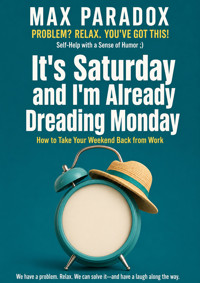
It's Saturday and I'm Already Dreading Monday - How to Take Your Weekend Back from Work ebook
Max Paradox
Uzyskaj dostęp do tej i ponad 240000 książek od 14,99 zł miesięcznie
- Wydawca: ALL-IN Rafał Płonkowski
- Kategoria: Biznes, rozwój, prawo•Biznes, rozwój
- Język: angielski
It is Saturday morning. You are technically off work.
Your laptop is closed. Nobody is asking you for anything. You have coffee, free time, and at least forty-eight hours before Monday becomes your problem.
So naturally, you start worrying about Monday.
You remember the meeting. Then the unfinished report. Then the inbox. Then the thing your manager might ask. Before long, Sunday evening has somehow arrived on Saturday afternoon, and your weekend has become a waiting room for work.
It's Saturday and I'm Already Dreading Monday is a practical, funny guide to stopping work from occupying time it does not actually own.
Max Paradox takes apart the habits that keep Monday alive all weekend: checking “just one” email, mentally rehearsing conversations, trying to get ahead on Sunday, treating every unfinished task like an emergency, overpreparing for meetings, and using worry as if it were a productivity tool.
Then the book replaces them with concrete methods you can actually use.
You will learn how to create a real Friday shutdown, separate genuine work problems from mental previews, contain Sunday preparation, handle unfinished tasks without carrying them around in your head, build a calmer Monday re-entry, set realistic availability rules, respond to weekend requests, and recognize when the problem is not your mindset but the job itself.
There are scripts for difficult boundary conversations, fallback methods for chaotic weeks, a practical dread protocol for Sunday evenings, and a simple weekend operating system that does not require waking at 5:00 a.m., buying a premium planner, or developing an emotional relationship with color-coded sticky notes.
This is not a book about convincing yourself that Mondays are wonderful.
They are Mondays.
The goal is more realistic: Saturday should feel like Saturday. Sunday should remain Sunday. And when Monday finally arrives, you should deal with it once-not begin living it two days early.
If your body leaves work Friday but your brain continues attending meetings all weekend, this book will help you close the office in your head, protect your free time, and return to work without using Sunday as unpaid emotional preparation.
Useful, direct, practical, and far funnier than your inbox deserves.
This publication was prepared with the assistance of tools that support the creative process, including artificial intelligence-based solutions. The final concept, structure, and editing belong to the author.
Ebooka przeczytasz w aplikacjach Legimi na:
Liczba stron: 196
Rok wydania: 2026
Odsłuch ebooka (TTS) dostepny w abonamencie „ebooki+audiobooki bez limitu” w aplikacjach Legimi na:
Podobne




















INTRO
It is Saturday morning. Technically, you are free.
No alarm. No commute. No meeting titled “Quick Sync” that lasts fifty-eight minutes and somehow creates three more meetings. You have coffee, comfortable clothes, and a perfectly respectable plan to enjoy yourself. Maybe breakfast somewhere nice. Maybe a walk. Maybe absolutely nothing, which, after the week you have had, sounds less like laziness and more like advanced medicine.
Then your brain clears its throat.
Monday.
Not even Monday morning. Just the concept of Monday. A distant event more than forty-eight hours away has entered your living room without knocking, sat down beside you, and started discussing deadlines.
You try to ignore it. You look outside. Nice weather. Great. Perhaps you should go somewhere. But first, a small thought arrives: that presentation is due Monday afternoon. You already prepared most of it. Mostly. Well, there is one section you should probably fix. Not now, obviously. It is Saturday. You are not working.
You are merely thinking about working.
Which is apparently completely different, except for the minor detail that it feels exactly like work and you are not getting paid for it.
By noon, Monday has upgraded from background irritation to regional weather system. You are still doing normal weekend things, but each one has acquired a faint corporate aftertaste. Lunch is lunch, but also “lunch before Sunday.” Saturday evening is no longer Saturday evening. It is “the last proper evening before the evening before work.”
This is an impressive achievement by the human brain.
It can ruin Monday before Monday arrives and then, for efficiency, begin ruining Sunday on Saturday.
If this sounds familiar, the problem is not simply that you dislike Mondays. Plenty of people dislike getting up early, answering emails, commuting through traffic, dealing with difficult customers, sitting through unnecessary meetings, or pretending to understand why a spreadsheet suddenly has six new tabs. That is normal. Work is allowed to contain things you would not voluntarily choose as weekend entertainment.
The deeper problem begins when work starts occupying time it does not actually own.
You leave the office, close the laptop, or log out for the week, but mentally you remain somewhere near your inbox. Your body is in the supermarket comparing pasta sauces. Your brain is in a conversation with your manager that has not happened yet. Your partner asks whether you want to order pizza, and part of you is calculating how unpleasant Tuesday might become if Monday’s meeting goes badly.
You are physically off work.
Work has chosen a remote-work arrangement inside your head.
And unlike most remote workers, it does not respect office hours.
This book is about taking that space back.
Not by pretending work does not matter. Not by chanting “live in the present” while your Sunday anxiety quietly sets fire to the curtains. Not by quitting your job tomorrow, moving into a cabin, and earning money by making handcrafted spoons unless that was already your life plan.
The goal is simpler and much more useful: work should take up the time, attention, and emotional energy it reasonably requires.
Not all available space.
There are several reasons weekend dread becomes so powerful. Sometimes the workload is genuinely too high. Sometimes the job is chaotic, poorly managed, or unpleasant. Sometimes your role has no clear boundaries, so there is always something else you could be doing. Sometimes nobody expects you to check messages on Saturday, but you check anyway because uncertainty makes you nervous.
And sometimes the problem is not Monday itself.
It is the mental trailer for Monday.
Your brain shows you selected scenes from the upcoming week: the awkward meeting, the difficult task, the unanswered email, the deadline, the conversation you have been avoiding. It does not show the boring bits where nothing terrible happens. Apparently anxiety’s editing department believes in drama.
Then something predictable occurs. You start using your weekend to prepare emotionally for work.
You think about Monday so you will feel more ready.
You check email so nothing can surprise you.
You make lists so your mind can relax.
You rehearse conversations so they will go smoothly.
You open the laptop “for ten minutes” so Monday will be easier.
Two hours later, Monday has become easier.
Saturday has filed a complaint.
The frustrating part is that many of these behaviors make sense in the moment. Checking one message genuinely can reduce uncertainty. Doing one small task may give you relief. Planning the week can help. The problem is not that these actions are always wrong. The problem is when they become the price of feeling temporarily safe.
Because the relief does not last.
You check your inbox and discover nothing urgent. Excellent. For twenty minutes, you feel better. Then you wonder whether something came in after you checked. You finish one task, which reminds you of two others. You prepare for Monday, which makes Tuesday visible.
Congratulations. You have unlocked more week.
That is why “just stop thinking about work” is useless advice. If you could stop thinking about it because someone told you to, you would already have done that sometime around the third Sunday evening you spent staring at the ceiling while mentally editing an email.
The solution is not to force your brain into silence.
The solution is to give it better rules.
You need a clear way to end the workweek instead of merely fleeing from it. You need boundaries that work even when nobody else enforces them. You need a method for separating a genuine weekend emergency from a thought wearing a tiny emergency hat. You need to know how to handle unfinished tasks, because there will always be unfinished tasks unless your job is “press one button every Friday and then the company disappears.”
You also need to understand what belongs to you and what belongs to the job.
That distinction matters more than it sounds.
If Monday feels bad because you have a difficult presentation, we can work with that. If Monday feels bad because your manager regularly sends messages at midnight and expects immediate replies, that requires a different strategy. If Sunday evening makes you anxious because you spend two days doing things you did not even want to do, then part of the problem may not be work at all. Your weekend may simply have become unpaid administration with snacks.
We are going to separate these problems instead of throwing all of them into one large emotional drawer labeled WORK STRESS.
That drawer is already full.
You will learn how to close the workweek properly, reduce anticipatory stress, stop accidentally converting Sunday into Monday’s waiting room, and make your free time feel like actual free time again. We will look at the habits that quietly keep work alive after hours, including “quick checks,” mental rehearsals, vague to-do lists, unfinished-task panic, and the beautiful fiction that worrying about a task is somehow part of completing it.
We will also deal with the harder cases.
What if your workload really is excessive?
What if your boss ignores boundaries?
What if you work remotely and your office is six feet from your couch?
What if you actually enjoy your job but still feel dread every Sunday?
What if you try all the sensible methods and your brain replies, “Interesting proposal. Rejected.”
There will be Plan Bs.
This is not a book about becoming a person who dances joyfully toward Monday morning while sunrise music plays in the background. That person may exist. Good for them. We wish them well.
The more realistic goal is this: on Saturday, you are on Saturday.
On Sunday, you are on Sunday.
And when Monday finally arrives, you deal with Monday once.
Not three days in advance.
Chapter 1 - Monday Starts Too Early
Saturday afternoon should not require a coping strategy.
You are standing in a grocery store holding two nearly identical jars of pasta sauce when your brain produces an important announcement: Monday is going to be awful. There is no new evidence. Nobody has emailed. Your manager has not materialized between the canned tomatoes and breakfast cereal. Monday is still comfortably in the future, minding its own business.
But your nervous system has begun the meeting without you.
You remember the unfinished report. Then the conversation you need to have. Then the project that seemed perfectly manageable on Friday at 4:17 p.m., when your brain was mainly interested in going home. Suddenly the weekend becomes less spacious. You are technically choosing pasta sauce, but emotionally you are already sitting under fluorescent office lighting.
The cheapest sauce wins because apparently we are now under pressure.
This is one of the central tricks behind weekend dread: your brain reacts not only to what is happening, but to what it predicts might happen. That ability is extremely useful. It helps you prepare for deadlines, remember appointments, pack an umbrella, and avoid discovering at the airport that your passport expired during the previous presidential administration.
The problem begins when prediction turns into premature experience.
You do not merely know that Monday is coming. You begin living part of it early.
A difficult meeting scheduled for Monday at 10:00 can therefore occupy Sunday at 6:00 p.m., Sunday at noon, and occasionally Saturday morning while you are trying to decide whether pancakes count as lunch. The meeting itself may last forty-five minutes. Your brain has purchased the extended edition.
This feels like preparation, but much of it is repetition without progress.
You imagine what your boss might ask.
You prepare an answer.
Then another possible question appears.
You prepare another answer.
Then your imaginary boss becomes more aggressive because apparently your internal casting director enjoys conflict.
Twenty minutes later, you have survived a meeting that has not happened, with dialogue nobody has spoken, regarding problems that may not exist.
You are exhausted.
Excellent rehearsal.
The difference between a problem and a preview
Weekend dread becomes easier to handle once you separate two things that feel similar but require different responses.
The first is a real work problem.
You have too much to do. A deadline is unreasonable. Your team is understaffed. Your manager regularly expects weekend availability. Monday contains a genuinely difficult event. Your job is unstable. A client is furious. The workload is so high that you could organize your tasks beautifully and still need three additional Tuesdays.
Those problems deserve action.
The second is a mental preview.
Nothing needs to be done right now, but your brain keeps presenting the upcoming workweek as if advance worrying will improve operational readiness.
This usually sounds responsible.
“I just want to be prepared.”
“I need to think it through.”
“I’ll feel better if I know what I’m walking into.”
Sometimes you will.
Often you will simply spend Sunday attending unpaid imaginary meetings.
The distinction matters because people often apply the wrong solution. They treat a structural work problem as if they merely need to relax, or they treat anticipatory anxiety as if it proves something is urgently wrong at work.
If your boss gives you three people’s workload, a breathing exercise is not workforce planning.
If your workload is reasonable but your mind starts Monday on Saturday, resigning may be an unnecessarily expensive relaxation technique.
Before fixing weekend dread, you need to know which problem you actually have.
The Three Monday Test
The simplest way to begin is to look at three recent Mondays.
Not the worst Monday of your life. Not the Monday when the server crashed, your car would not start, and someone scheduled a “brief catch-up” at 7:30 a.m. We are looking for ordinary Mondays.
Ask yourself:
What did I dread beforehand?
What actually happened?
Which feared problems were real?
Which disappeared, changed, or were easier than expected?
Which problems repeated every week?
You are not trying to prove that your worries are foolish. Some will be accurate. The goal is to separate recurring evidence from mental forecasting.
Imagine that for three Sundays you dreaded opening your inbox because you expected disaster.
Monday one: twelve ordinary messages, one annoying request.
Monday two: seven ordinary messages, no emergency.
Monday three: one genuinely difficult issue that took thirty minutes to resolve.
Your brain may remember this as, “See? Mondays are dangerous.”
The evidence says something more boring: “Occasionally there is an annoying problem.”
Brains dislike boring evidence. It performs badly in trailers.
Now imagine the opposite. Every Monday you arrive to dozens of weekend messages, urgent requests, missed deadlines, and a manager asking why something was not handled on Saturday.
That is not your imagination.
Your work environment is sending you a weekly invoice.
This test prevents two common mistakes: minimizing a genuinely bad situation and catastrophizing an ordinary one. Both keep you stuck because neither produces the correct response.
You cannot solve a workload problem with positive thinking.
You also cannot solve a thinking problem by reorganizing the entire company.
Usually.
Why Friday does not feel finished
Many people assume weekend dread begins on Sunday evening.
It often begins Friday afternoon.
You reach the end of the workweek with fifteen open loops. A half-written email. A decision you have not made. Three tasks labeled “next week,” which is less a plan than a geographical region. You close the laptop because the clock says work is over, but your brain receives no convincing evidence that anything has ended.
So it keeps the material active.
This is partly useful. Your mind does not want you to forget important unfinished tasks. If you leave work thinking, “I must remember the Anderson proposal, the budget numbers, the call with Jordan, the new forecast, and whatever that weird message from accounting meant,” your brain has a reasonable concern.
Its solution is to remind you repeatedly.
At dinner.
In the shower.
While watching a movie.
At 2:13 a.m., when apparently the optimal time to reconsider a project plan is while lying horizontally in darkness.
The problem is not simply unfinished work. Work is almost always unfinished. If you wait until everything is done before allowing yourself to relax, retirement may become your first available weekend.
The real issue is uncontained unfinished work.
Your brain needs somewhere credible to put it.
A vague promise such as “I’ll deal with that Monday” may not feel credible because Monday contains forty-seven other things. Your mind therefore keeps the task nearby, like someone refusing to check luggage because they are convinced the airline will lose it.
What helps is not finishing everything.
It is creating a believable re-entry point.
We will build a full end-of-week shutdown method later. For now, use a smaller version.
Before ending Friday, write three things:
What is unfinished?
What is the very next action?
When will I look at it again?
Not:
“Presentation.”
That is not a next action. That is a noun wearing business clothes.
Write:
“Presentation — rewrite opening slide — Monday, 9:15.”
Not:
“Client issue.”
Write:
“Client issue — call Chris and confirm revised date — Monday, 10:30.”
Not:
“Budget.”
Write:
“Budget — check Q3 travel line against finance report — Monday after team meeting.”
The difference seems almost embarrassingly small.
Good.
Useful systems are often less cinematic than people hope.
You are giving your brain a receipt: This has been captured. It has a next step. It has a time.
That reduces the need to keep reheating it all weekend.
Your brain is trying to protect you badly
It helps to understand something important about weekend dread: your mind is usually not trying to sabotage your free time.
It is trying to protect you from surprise.
That is why uncertainty is so powerful. An unpleasant task you understand can be easier to tolerate than a vague possibility you cannot measure.
Compare:
“On Monday I need to spend forty minutes correcting the pricing file.”
with:
“Monday is going to be a mess.”
The first sentence describes a task.
The second describes a climate.
Tasks can be scheduled.
Climates surround everything.
When your brain uses broad labels—awful week, terrible Monday, complete chaos, impossible workload—your first job is to make the fear smaller and more specific.
Ask:
What exactly am I expecting to happen?
Maybe the answer is:
“I think my manager will criticize the project.”
Good. Specific.
“I am behind on two tasks.”
Specific.
“I have six meetings and no time for actual work.”
Specific.
“I hate Mondays.”
Not specific.
That is a bumper sticker.
Once you identify the specific problem, ask a second question:
Does anything need to happen before Monday?
This question is crucial because weekend dread constantly pretends that thinking is action.
Suppose you have a difficult conversation Monday afternoon. Can you prepare anything useful now that genuinely reduces the problem? Perhaps yes. You might need five minutes to write down the three facts you want to remember.
Do that intentionally.
Then stop.
Do not spend another ninety minutes running imaginary courtroom scenes in which your coworker suddenly becomes a hostile attorney.
If nothing useful needs to happen before Monday, the problem has entered the category of future work.
Future work belongs in the future.
Revolutionary concept.
Stop asking, “How do I stop thinking about work?”
That question is often impossible to answer because thoughts are not browser tabs. You cannot always click the little X.
Try this instead:
“What will I do when work enters my head?”
That is controllable.
For example:
“I’ll write the thought down if it contains a real task.”
“I’ll check whether anything needs action before Monday.”
“If not, I’ll return to what I was doing.”
This is much more useful than trying to achieve perfect mental silence.
You are not trying to create a weekend during which the concept of employment never crosses your mind. You are trying to stop each work thought from becoming a twenty-minute documentary.
A thought appears:
Need to fix forecast.
Old pattern:
Forecast → deadline → manager → Monday → workload → career → perhaps I should become a park ranger.
New pattern:
“Fix forecast — Monday 9:30.”
Captured.
Back to your coffee.
The park rangers remain undisturbed.
The Sunday evening trap
One reason Monday dread grows is that people often leave the most unstructured part of the weekend until Sunday evening.
Saturday has plans. Sunday morning has errands. Then 5:00 p.m. arrives, and there is nothing between you and Monday except dinner, a shower, and the increasingly aggressive movement of time.
So you begin monitoring the countdown.
7:00 p.m.
Still weekend.
8:30 p.m.
Basically Monday adjacent.
10:00 p.m.
Why did civilization choose a five-day workweek?
The more closely you watch the end of the weekend, the faster it seems to disappear. Sunday becomes an airport departure lounge. You are not enjoying where you are because mentally you have already begun leaving.
For now, make one small change: give Sunday evening a purpose that is unrelated to preparing for work.
Not an ambitious purpose.
You do not need to become a person who hosts elegant dinner parties every Sunday while wearing linen.
Choose something repeatable and easy: a movie, a walk, cooking something you like, calling someone, reading, gaming, a favorite show, a bath, a specific restaurant, whatever fits your actual life.
The point is not distraction.
The point is ownership.
Sunday evening should contain something that belongs to Sunday.
Otherwise Monday will happily move in early.
Your first practical move
This week, do not attempt a total lifestyle redesign.
Just catch the moment Monday begins.
Maybe it is Saturday afternoon.
Maybe Sunday at breakfast.
Maybe Sunday at 6:40 p.m. when you suddenly remember the team meeting and feel your stomach sink.
When it happens, write down three lines:
What am I expecting?
Is it a real problem or a mental preview?
Does anything actually need action before Monday?
If yes, choose the smallest useful action and complete it deliberately.
If no, capture the thought and return it to Monday.
That is the first boundary.
Not between you and your employer.
Between Monday and the rest of the calendar.
Monday gets Monday.
It does not need a weekend expansion pack.
Chapter 2 - Your Weekend Has Been Annexed
You sit down Saturday morning with coffee and your phone.
This is already a dangerous combination, but civilization has accepted it.
You are not planning to work. You are merely checking the weather. Then you notice a work notification. You do not open it immediately because you have boundaries now.
You stare at it for eleven seconds.
Then you open it.
It is nothing dramatic. A coworker sent a message Friday night. They are not asking you to do anything. In fact, the message could easily wait until Monday.
Excellent.
Your brain now knows it exists.
You begin composing a reply in your head.
Maybe you should respond quickly so it is done.
No. Weekend.
But if you respond now, you will not think about it.
You respond.
Another message appears.
Twenty minutes later, you have performed enough work to feel annoyed but not enough to feel productive.
A perfect compromise.
This is how weekends get annexed. Usually there is no formal declaration. Nobody arrives at your door holding a company flag. Work simply takes small pieces.
Five minutes here.
One message there.
A quick thought during lunch.
A “tiny” Sunday task.
An inbox check before bed.
The individual pieces look harmless, which is why the pattern can continue for years.
Nobody says, “I would like to donate four hours of my weekend to low-grade occupational anxiety.”
People say, “I’ll just check one thing.”
The problem with tiny work
If you spend three hours working Saturday morning, at least everybody knows what happened.
You worked.
Maybe you needed to. Maybe the situation was temporary. Maybe you chose it because Monday would otherwise become impossible. You can evaluate that decision honestly.
Tiny work is more deceptive.
You glance at Slack while making breakfast.
You think about a customer while driving.
You reply to an email while standing in line.
You mentally reorganize your week during dinner.
You check Sunday night “just so there are no surprises.”
None of these moments feels substantial enough to count as work.
But your brain does not measure only minutes.
It measures interruption.
A thirty-second glance at a message can create fifteen minutes of mental activity. You read, “Can we discuss the Q4 numbers Monday?” and your brain does not respectfully close the file.
It says:
Which numbers?
Why?
Is something wrong?
Did I miss something?
Maybe the forecast is off.
I should check.
Do not check.
But what if—
And suddenly your Saturday breakfast includes Q4.
Q4 did not contribute anything to breakfast.
Work residue
When you switch from work to free time, your attention does not always switch instantly. Part of your mind can remain attached to what you were doing before.
This is especially likely when the task is unfinished, emotionally charged, ambiguous, or interrupted. You stop looking at the work, but the work continues processing in the background.
Think of it as residue.
You close the laptop at 5:30 but replay a conversation at 6:15.
You leave the office but mentally rewrite an email while cooking.
You finish the week but remain alert for messages because something might happen.
The problem with weekend checking is that it refreshes the residue.
Just as your mind begins to settle, you open the inbox.
Fresh coat.
This is why “I only checked for two minutes” can have a much larger effect than two minutes.
The message itself may be harmless. The mental reopening is not.
Imagine trying to let a muddy floor dry while walking across it every forty minutes.





