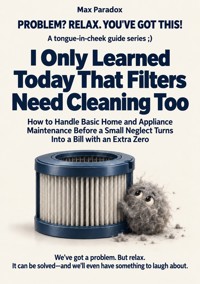
I Only Learned Today That Filters Need Cleaning Too - How to Handle Basic Home and Appliance Maintenance Before a Small Neglect Turns Into a Bill with an Extra Zero ebook
Max Paradox
29,99 zł
19,90 zł
Najniższa cena z 30 dni przed obniżką: 29,99 zł
19,90 zł
Najniższa cena z 30 dni przed obniżką: 29,99 zł
Dowiedz się więcej.
- Wydawca: ALL-IN Rafał Płonkowski
- Kategoria: Poradniki•Styl życia
- Język: angielski
The vacuum still works. It just sounds more ambitious than it used to. The dishwasher finishes eventually. The shower drain is technically draining. Everything is fine - until the repair bill arrives.
I Only Learned Today That Filters Need Cleaning Too is a practical, funny guide for people who want to look after their home and appliances without turning into a full-time maintenance technician. Max Paradox shows you how to notice small changes before they become bigger problems, understand what routine maintenance matters, and separate simple user care from jobs that belong with a qualified professional.
You will learn to deal with filters, drains, seals, ventilation, washing machines, dryers, kitchen appliances, windows, doors, basic electrical warning signs and recurring faults. The book offers simple ways to organize the tools you genuinely need, spot water and airflow problems earlier, keep useful records, decide whether an appliance is worth repairing and create reminders that help without turning your phone into an unpaid facilities manager.
Just as importantly, this is a guide to knowing when to stop. Some jobs are suitable for sensible DIY. Others involve electricity, gas, major plumbing, safety systems or technical diagnosis and deserve professional help. The goal is not a perfect home where nothing ever breaks, but noticing problems while they are still small and knowing what to do next.
This publication was prepared using tools that support the creative process, including artificial intelligence solutions. The final concept, structure and editing are the responsibility of the author.
Ebooka przeczytasz w aplikacjach Legimi lub dowolnej aplikacji obsługującej format:
Liczba stron: 214
Rok wydania: 2026
Podobne




















Max Paradox
I Only Learned Today That Filters Need Cleaning Too
How to Handle Basic Home and Appliance Maintenance Before a Small Neglect Turns Into a Bill with an Extra Zero
ALL-IN Rafał Płonkowski
2026
ISBN 9788384833025
Table of contents
Title page
INTRO
Chapter 1 - Homes Rarely Break All at Once
Chapter 2 - The Invisible Stuff Has a Schedule Too
Chapter 3 - "Still Working" Is Not a Maintenance Plan
Chapter 4 - The Internet Has a Screwdriver Problem
Chapter 5 - If You Have to Hunt for the Screwdriver, You Have Already Lost
Chapter 6 - More Cleaner Is Not More Clean
Chapter 7 - Calling a Professional Is Not a Defeat
Chapter 8 - If You Cannot Reach It, You Cannot Maintain It
Chapter 9 - One Walk-Through Beats Twenty Reminders
Chapter 10 - The Kitchen Is Working Even When You Are Just Making Toast
Chapter 11 - Bathrooms Do Not Dry Themselves
Chapter 12 - The Washing Machine Is Not a Magic Hole for Clothes
Chapter 13 - Windows and Doors Do Not Stay Perfectly Adjusted Forever
Chapter 14 - Electricity Is Extremely Useful Until You Stop Respecting It
Chapter 15 - When You Have No Bandwidth for Any of This
Chapter 16 - Repair It, Service It, or Let It Go
Chapter 17 - If the Problem Keeps Coming Back, It Is Telling You Something
Chapter 18 - Write It Down Once So You Do Not Rediscover Your Own House
Chapter 19 - Let the House Remember for You
Chapter 20 - Notice It Before the Bill Does
Landmarks
Cover
Title page
Table of contents
Start of content
INTRO
You notice it because the vacuum cleaner has started sounding like it is trying to leave the house.
Not metaphorically. It has developed a new, determined whine that suggests either mechanical distress or a very small jet engine trapped inside a plastic shell. It still works, technically. You push it over the same patch of carpet three times, watch a crumb remain exactly where it was, and think the thought that has launched millions of unnecessary purchases: Maybe I need a new one.
Then, because fate occasionally has a sense of timing, you open the filter compartment.
Inside is something that looks less like household dust and more like evidence collected from an archaeological dig.
There is fluff. Hair. Fine grey powder. A mysterious thread. Possibly part of a biscuit. Maybe the vacuum cleaner is not dying. Maybe it has simply been breathing through a pillow for six months.
This is how most people discover home maintenance: not through a carefully designed system, but by accident, usually while something is already behaving badly. Nobody hands you the keys to a home and says, “Congratulations. Here is a complete list of all the filters, seals, drains, vents, hoses, hinges, traps, batteries, moving parts, and tiny hidden compartments that will quietly require your attention until one of you moves out.” You get the keys, a utility bill, and perhaps a drawer containing three mystery screws. Good luck.
The strange thing is that homes rarely fail in a dramatic, cinematic way. Appliances do not gather the family in the living room and announce, “I regret to inform you that my drain pump has entered its final week of service.” A seal does not send a calendar invite called SMALL LEAK - OPTIONAL ATTENDANCE. Things simply get a little worse. The dishwasher takes longer. The extractor fan gets louder. The shower drain becomes philosophical about the concept of flow. A window needs more persuasion to close. The washing machine performs a spin cycle with the enthusiasm of a concrete mixer containing one shoe.
And because everything still works, you adapt.
That is the dangerous part.
Humans are spectacularly good at adapting to minor inconvenience. A drawer starts sticking, so you learn the correct angle. A door begins rubbing, so you lift it slightly with your foot. A faucet drips, so you turn it a bit harder. The dryer takes longer, so you run it again. None of these actions feels irrational. In the moment, they are efficient. You have solved the immediate problem without buying anything, calling anyone, or kneeling on the kitchen floor with a flashlight.
Unfortunately, temporary adaptations have a habit of becoming permanent procedures.
“That door works fine. You just have to pull it toward you, lift it slightly, turn the handle halfway, and think positive thoughts.”
At some point, that is not a door anymore. It is an escape room.
This book is about catching that point earlier.
Not absurdly early. You do not need to become the kind of person who spends Sunday morning whispering reassuringly to the washing machine while inspecting its hoses with a magnifying glass. You do not need a clipboard. You do not need overalls with your surname embroidered above the pocket. You do not need to know how every appliance works internally.
You need something much less dramatic: a basic sense of what needs routine attention, what changes are worth noticing, what you can safely do yourself, and when the correct tool is a phone call to someone qualified.
That distinction matters because home maintenance has terrible branding. Repair feels legitimate. Something is broken, therefore something must be done. Maintenance often feels optional because the thing is not broken yet. Cleaning a filter does not create a satisfying before-and-after moment unless the filter has reached the point where it could apply for independent housing. Checking for moisture under a sink is not exciting. Looking at a seal is not how most people imagined adulthood.
Yet these boring little actions are often where you have the most control.
The goal is not to eliminate breakdowns. You cannot. Parts wear out. Electronics fail. Pumps give up. Materials age. Sometimes an appliance has done absolutely nothing wrong for ten years and then one Tuesday morning decides it has fulfilled its purpose on Earth. That happens. Maintenance is not magic, and this book will not pretend otherwise.
What it can do is reduce the number of problems caused by neglect, delayed reactions, blocked airflow, built-up debris, unnoticed leaks, poor cleaning habits, improvised fixes, and the deeply human strategy of hoping a strange noise develops better manners on its own.
It also helps you separate three very different situations.
The first is routine care. Clean this. Empty that. Check the seal. Keep the vent clear. Replace the consumable when needed.
The second is a minor problem you can understand and handle safely with the correct instructions.
The third is the moment when continuing to poke, twist, reset, tighten, spray, or “just see what happens” stops being sensible.
That third category deserves respect. Electricity, gas, pressurized systems, serious leaks, overheating, damaged batteries, and anything involving safety devices are not opportunities to prove character. There is no prize for completing a repair yourself while visibly uncertain whether you should be touching the thing.
A professional is not the emergency button you press after exhausting all forms of amateur improvisation.
Sometimes calling one first is the competent option.
The other reason maintenance gets neglected is that it seems endless. Once you discover that filters exist, you begin seeing them everywhere. Vacuum filter. Extractor filter. Air purifier filter. Dryer filter. Coffee machine filter. Ventilation filter. Suddenly your home appears to be 40 percent filter by volume. You start to suspect there may be another one inside the sofa.
This is where people overreact.
They create twenty-seven reminders, buy three types of descaler, reorganize a cupboard, watch six videos about appliance care, and decide that from now on every first Saturday of the month will be Home Systems Maintenance Day.
The first Saturday is magnificent.
By the second month, you have plans.
By the third, the reminder appears while you are buying groceries, and you dismiss it with the speed of a trained professional.
A useful maintenance system has to survive normal life. It has to work when you are tired, busy, traveling, short on money, distracted, or simply not in the mood to develop a relationship with a washing machine gasket.
So we are not building a second job.
We are building a lighter way to notice things.
You will learn to recognize the small changes that matter. You will learn how to separate cleaning from repair, routine care from unnecessary fussing, and sensible DIY from the kind of confidence that usually appears ten minutes before someone says, “I probably should have turned that off first.”
You will also learn how to make the whole thing easier to maintain by reducing friction. Knowing where the right filter is. Keeping the correct part number. Understanding what a recurring problem is trying to tell you. Recording a repair once so you do not have to rediscover your own appliance history every time something goes wrong.
And most importantly, you will stop treating “still works” as the only standard that matters.
Because “still works” covers an enormous range of conditions.
A vacuum with a clogged filter still works.
A door that must be lifted still works.
A dishwasher that leaves water behind still works.
A washing machine with an occasional leak still works.
Until it does not.
You do not need to become paranoid about that sentence. You just need to hear the word “still.”
It usually means you have noticed something.
That is your moment.
Not to panic.
Not to buy a replacement.
Not to dismantle half the kitchen.
Just to look a little closer.
Sometimes you will discover a problem that needs a professional.
Sometimes you will discover that the appliance has reached the end of its reasonable life.
And sometimes you will find a filter so dirty that, after cleaning it, the machine suddenly works properly again and you spend the next thirty seconds feeling like an engineering genius.
Enjoy that feeling.
You earned at least part of it.
Chapter 1 - Homes Rarely Break All at Once
The kitchen cabinet under the sink has developed a personality. It no longer closes in the normal way. You have to push it gently, lift the left corner, and give it a final little nudge with your knee. This has been happening for four months, which means it is no longer considered a problem. It is now simply how the cabinet works. Visitors may struggle, but visitors lack training.
Across the room, the faucet has started making one small drip every few minutes. The dishwasher sounds slightly more dramatic during one part of its cycle. One window needs a firmer pull than it used to. The bathroom door brushes the floor when the weather is humid. Nothing is broken enough to demand attention, so everything gets promoted into a strange category called "normal now."
This is how homes usually deteriorate. Not with explosions, alarms, and a technician descending from the ceiling. Things change slowly enough that you adapt before you react.
That matters because adaptation is one of the great human talents and one of the worst possible maintenance systems. If a drawer sticks, you pull harder. If the shower drain slows down, you finish your shower standing in a shallow lake and tell yourself you should probably deal with that sometime. If the refrigerator door does not close properly, you start giving it an extra shove. Within weeks, you have built a complete operating procedure around a fault.
You are no longer using the appliance as designed.
You are managing its mood.
The first useful skill in home maintenance is therefore not fixing things. It is noticing that something has changed before the workaround becomes automatic.
Think of your home as having a baseline. Doors close a certain way. Appliances make familiar sounds. Water disappears at a certain speed. A washing machine takes roughly the same amount of time to finish the same program. A refrigerator cycles on and off in ways you barely notice. Once you know that baseline, a change becomes information.
Not proof of disaster.
Information.
A dishwasher taking ten minutes longer once may mean nothing interesting. The same dishwasher gradually extending every cycle while leaving dishes dirtier deserves attention. A refrigerator making one unfamiliar click does not require an emergency replacement. A refrigerator running almost constantly when it used to cycle normally deserves a closer look.
The difference is pattern.
The mistake many people make is waiting for certainty before doing anything.
"Maybe that's normal."
"It probably always made that sound."
"I think the water was always a little slow."
"I've definitely had to kick that door since we moved in."
Have you?
Or have you simply reached the stage where kicking the door feels as ordinary as turning the handle?
A useful way to catch early problems is to notice five kinds of change: sound, smell, time, temperature, and physical evidence. You do not need instruments. You need attention.
A new grinding noise is a change.
A warm power plug that used to stay cool is a change.
A musty smell where there was none before is a change.
A dryer taking twice as long is a change.
Water under an appliance is very much a change.
This does not mean each change has the same urgency. A squeaky wardrobe hinge and the smell of overheated plastic are not fellow members of one cheerful little category. One is annoying. The other may involve a safety issue and should be treated accordingly.
The goal is to learn the difference between "keep an eye on it," "deal with it soon," and "stop using this until it is checked."
That sounds obvious until real life happens.
You are making dinner. The extractor hood rattles. You think, "Interesting." Then the pasta boils over, somebody messages you, the smoke alarm briefly develops an opinion about garlic, and by the time you sit down, the extractor hood's rattle has been filed in the same part of your brain as a password you created in 2019.
Gone.
This is why noticing must lead to a next step.
Not necessarily a repair. Just a decision.
Suppose you find a small damp mark underneath the kitchen sink. The wrong reaction is to stare at it thoughtfully, touch one pipe, say "hmm," and close the cabinet. That is not investigation. That is a brief ceremony acknowledging the existence of moisture.
Instead, dry the area and establish when the water returns. Does it appear when you use the faucet? When the sink drains? When the dishwasher runs? Does it show up even when nothing is happening? The answer may not tell you exactly what is wrong, but it narrows the situation.
That is already useful.
If the leak is substantial, growing, or coming from somewhere you cannot safely assess, stop treating it as a curiosity. Shut off the relevant water supply if you know how to do that safely and call a qualified professional or building maintenance where appropriate. Water is extremely patient. It will continue going wherever gravity allows while you are deciding whether the problem looks serious enough.
Gravity has no customer service department.
Appliances deserve the same approach. Imagine the refrigerator seems warmer than usual. Before deciding the compressor is dying and spending the evening shopping for a model with a display large enough to watch television on, check the simple things the manufacturer expects users to check. Is the temperature setting correct? Are the doors closing fully? Is food blocking internal air vents? Is there obvious ice buildup where it should not be? Are required clearances around the appliance being respected?
The exact checks depend on the model. That is why the manual matters.
Yes, the manual.
That folded document nobody reads until something goes wrong.
Modern appliances are too varied for universal instructions to be reliable. Two machines can look almost identical and have different filters, cleaning procedures, warning systems, or user-serviceable parts. Your manufacturer's manual is not always exciting, but excitement is not what you need when deciding whether a component can be washed under a tap.
A lot of accidental damage begins with the phrase, "I assumed."
I assumed it was washable.
I assumed that panel came off.
I assumed this cleaner was fine.
I assumed the error would clear if I restarted it six times.
An assumption is cheap right up until it meets an expensive part.
This chapter is not asking you to develop technical anxiety. Constantly listening for tiny noises and inspecting every seal would make your home exhausting. You need a proportionate system.
A practical approach is to classify changes in three levels.
Green means normal operation. You do nothing.
Yellow means something has changed, but there is no immediate safety concern. You check the user manual, perform any appropriate user-level maintenance, observe the result, and decide whether further action is needed.
Red means potential danger or rapid damage: significant leaks, burning smells, smoke, sparking, visibly damaged electrical cables, unusual overheating, suspected gas problems, rapidly worsening structural damage, or anything else that makes continued use unsafe. Here, curiosity stops. Follow the manufacturer's safety guidance, isolate power or another supply if it can be done safely, and get qualified help.
This is not a technical standard. It is a thinking tool.
Its biggest advantage is that it protects you from both extremes.
Extreme one: ignoring everything.
Extreme two: treating every click as the opening scene of a disaster documentary.
Most maintenance lives in the middle.
Something changed.
Let's find out why.
The other reason small problems become large is that they disappear into what might be called the scenery effect. You notice a cracked bead of sealant the first day. Two weeks later, you barely see it. A loose cabinet handle is annoying for a while. Then your hand automatically grips it differently. A small stain near a pipe becomes part of the color palette.
Familiarity can make a fault nearly invisible.
One way around this is to occasionally look at your home as if you did not live there. Walk through a room without cleaning. You are not looking for dust on a shelf. You are looking for change.
Does anything look swollen from moisture?
Is a cable trapped somewhere it was not before?
Is a seal splitting?
Is an appliance sitting differently?
Is there a mark on a ceiling, wall, or floor that was not there previously?
Does anything feel loose?
Five minutes can be enough.
The important part is not turning the inspection into a three-hour maintenance festival. If every time you notice a loose screw you immediately fetch tools, remove three drawers, clean behind the cabinet, reorganize the shelf, and somehow end up labeling extension cords, you will stop inspecting anything.
Observe first.
Create the next step.
Repair later if appropriate.
This is especially useful if you share your home with other people, because household faults often fall into the world's least efficient management structure: everybody knows, nobody owns it.
"The bathroom tap is dripping."
"Yeah, I noticed."
"Me too."
"Someone should look at that."
Excellent meeting.
No actions.
Assign the next step.
"I'll check the manual tonight."
"I'll contact the landlord."
"I'll book a plumber tomorrow."
Now the problem has moved from observation to action.
If you rent, the exact responsibilities for maintenance and repair depend on your agreement and local law, so do not assume every job belongs automatically to you or the property owner. What you can usually do immediately is document the issue, report it promptly through an appropriate channel, and avoid making the damage worse where you can do so safely.
A small issue reported early is easier for everyone than a large issue accompanied by the sentence, "Actually, it's been doing that for six months."
There is also a money problem hiding inside delayed action. People often avoid looking at a small fault because they are afraid it will cost money. Understandable. But not looking does not freeze the fault at today's price.
Sometimes a small leak stays small.
Sometimes it damages a cabinet.
Sometimes a badly closing refrigerator door merely annoys you.
Sometimes it makes the appliance work harder for months.
Sometimes the strange noise is harmless.
Sometimes it is the early warning that lets you choose when to arrange a repair instead of having the appliance choose Friday night for you.
Early attention does not guarantee a cheap outcome.
It gives you more information and often more choices.
That matters.
The minimum version of this chapter requires no maintenance schedule and no tools. Pick three things in your home that have recently started behaving differently. Maybe a drawer, an appliance, a drain, a window, or a faucet. For each one, answer four questions: What changed? When did you first notice it? Under what conditions does it happen? What is the safest next step you can take?
Do not fix all three.
Just identify them correctly.
If you are too busy even for that, use Plan B: photograph the problem and add one sentence to your phone. "Bathroom faucet - slow drip after closing." "Dryer - cycle taking much longer." "Window - rubbing at lower corner." Set a real date to look at it or contact somebody.
A note is not a repair.
But it prevents a problem from becoming invisible again.
The skill you are building is simple: notice the gap between "working normally" and "broken."
That gap is where maintenance lives.
And it is a much nicer place to meet a problem than standing in the kitchen at 11:40 p.m. with a towel on the floor and the sudden realization that apparently you do own a main water shutoff.
You just have no idea where it is.
Chapter 2 - The Invisible Stuff Has a Schedule Too
There is a moment in adult life when you discover an object inside an appliance that has apparently been collecting dirt on your behalf for several years.
You remove it carefully.
You stare.
It stares back in the way only a rectangle of compacted lint can stare.
"Was I supposed to clean this?"
The appliance does not answer because, despite what smart-home advertising suggests, most machines remain refreshingly uninterested in conversation.
The answer is often yes.
Filters, screens, traps, seals, vents, drains, removable trays, lint collectors, and similar components are the backstage crew of a home. When they are doing their jobs properly, you barely know they exist. That is precisely why they get ignored. Nobody wakes up thinking, "What a beautiful morning. I wonder how my dishwasher filter is feeling."
Out of sight is not just out of mind.
Out of sight is where household maintenance goes to build up evidence.
The basic mechanism is simple. Many of these parts exist specifically to catch, block, separate, drain, or control something. A lint filter catches lint. A grease filter catches grease. A drain trap collects material or blocks sewer gases depending on the design. A seal keeps water, air, or dirt from going where it should not. A ventilation opening allows airflow.
If a part's job is to collect something, it eventually contains that thing.
This should not be shocking.
And yet, emotionally, it often is.
You open a dryer filter and think, "Good grief, where did all this come from?"
Your clothes.
They are slowly donating themselves.
The first rule with hidden maintenance items is not "clean everything." It is "identify what your specific equipment actually requires." Appliances vary too much for one universal cleaning routine. Some filters can be washed. Some should only be gently cleaned. Some must be replaced. Some contain materials that should not get wet at all. A reusable metal grease filter is not the same thing as a carbon filter, even if they both live inside an extractor hood and both seem to exist purely to make you feel guilty.
Before touching a hidden component for the first time, find the maintenance section of the manufacturer's instructions.
You do not need to read the entire manual.
You may safely skip the twenty-seven pages about connecting the appliance to a home network if your immediate question is "Can this filter go under running water?"
Look specifically for routine user maintenance. Manufacturers often explain which parts are removable, how they should be cleaned, whether they must dry completely, and when they should be replaced.
This matters because cleaning something incorrectly can be worse than not cleaning it for another day.
Consider a washable vacuum filter. Some models allow rinsing but require the filter to be completely dry before reinstallation. "Completely dry" does not mean "I shook it and no water came out." Moisture may remain deep inside the material long after the outside feels dry. Other filters should not be washed at all.
Same shape.
Different rules.
This is why internet advice beginning with "All you do is..." should make you slightly suspicious.
All you do with which model?
The same problem appears with extractor hoods. A removable metal grease filter may often be cleanable according to the manufacturer's method, while another filter used for odors may require replacement or a specific regeneration process. If you treat every filter as a washable object, eventually one of them will teach you a lesson involving an online order.
Hidden maintenance also includes drains, and drains are fascinating because they offer a perfect demonstration of human optimism.
Water begins draining a little more slowly.
You notice.
The next day it is slower.
You notice again.
After two weeks, you are standing ankle-deep in shower water thinking, "This is getting slightly inconvenient."
Slightly.
The drain has been submitting written complaints for fourteen days.