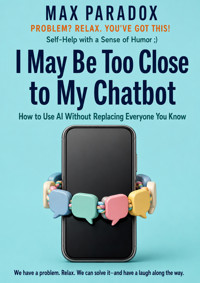
I May Be Too Close to My Chatbot - How to Use AI Without Replacing Everyone You Know ebook
Max Paradox
Uzyskaj dostęp do tej i ponad 240000 książek od 14,99 zł miesięcznie
- Wydawca: ALL-IN Rafał Płonkowski
- Kategoria: Literatura popularnonaukowa•Nauki ścisłe
- Język: angielski
AI can write your emails, plan your vacation, explain your spreadsheet, help you make decisions, and patiently discuss the suspicious emotional meaning of a two-word text message at 1:14 in the morning.
Very convenient.
Possibly too convenient.
I May Be Too Close to My Chatbot: How to Use AI Without Replacing Everyone You Know is a practical, funny guide to using conversational AI without accidentally outsourcing your judgment, relationships, confidence, social skills, and entire emotional support network.
Max Paradox explores the strange new problem created by a tool that is always available, never too busy, never needs to leave for dinner, and can provide a polished answer before your best friend has located their phone.
The solution is not to delete AI, fear it, or move to a cabin with no Wi-Fi.
The solution is to give it the right job.
Inside, you will learn how to:
recognize when useful AI assistance is becoming substitution;
stop reassurance loops and repeated “Are you sure?” checking;
make decisions without requiring digital approval;
use AI to prepare difficult conversations instead of avoiding them;
separate facts, patterns, assumptions, and stories about other people;
preserve your own opinions before AI supplies a beautifully formatted one;
create human-first categories for the parts of life that need real relationships;
build practical handoffs from AI analysis to real-world action;
handle loneliness without making a chatbot your entire social infrastructure;
recognize early signs that old habits are returning;
use AI to strengthen relationships rather than quietly replace them.
This is not an anti-technology book. AI is extraordinarily useful, and pretending otherwise would be like banning calculators because someone once used one to divide ten by two.
Instead, this book gives you practical boundaries for keeping the best parts of AI while protecting the parts of life that only you-and the people around you-can actually live.
Expect concrete rules, realistic examples, minimum-effort versions for low-energy days, Plan B when the sensible method collapses on Wednesday, and enough observational comedy to make an uncomfortable number of your own habits recognizable.
Because the goal is not to use AI less merely for the sake of using AI less.
The goal is to use it better.
Let the chatbot organize the problem.
Then make the decision.
Have the conversation.
Call the friend.
And occasionally allow another human being to give you an imperfect answer without requesting a regeneration.
This publication was prepared with the assistance of tools that support the creative process, including artificial intelligence-based solutions. The final concept, structure, and editing belong to the author.
Ebooka przeczytasz w aplikacjach Legimi na:
Liczba stron: 185
Rok wydania: 2026
Odsłuch ebooka (TTS) dostepny w abonamencie „ebooki+audiobooki bez limitu” w aplikacjach Legimi na:
Podobne



















INTRO
It starts innocently.
You ask your chatbot how long to cook salmon. Then you ask whether the email you wrote sounds passive-aggressive. Then whether your boss’s reply sounds passive-aggressive. Then whether you are being unreasonable for thinking your boss’s reply sounds passive-aggressive. Twenty minutes later, the salmon is cold, the email has undergone six diplomatic revisions, and an artificial intelligence knows considerably more about your workplace tension than Linda from HR.
This is progress, apparently.
At first, AI is just a tool. A very impressive tool, admittedly. It can summarize a document, explain compound interest, rewrite an awkward message, compare vacuum cleaners, suggest dinner, help you organize a trip, and explain why the printer has once again chosen violence. Unlike most humans, it does all this immediately. It does not sigh. It does not say, “Can we talk about this later?” It does not glance at its phone while you are explaining something important. You type. It answers.
That is extremely convenient.
Possibly too convenient.
Because somewhere between “Can you help me understand this spreadsheet?” and “Do you think my sister is jealous of me?” the relationship can quietly change. You stop using AI only to obtain information and begin using it for reassurance, emotional processing, decision-making, companionship, validation, entertainment, conflict analysis, and the kind of tiny daily conversation that used to be distributed among friends, coworkers, partners, family members, strangers, and the person standing beside you while both of you wondered why the self-checkout machine required assistance again.
Nobody schedules this transition.
There is no ceremony.
Your chatbot does not send you a notification saying:
Congratulations. I am now the first person you tell everything to, despite not being a person.
It simply becomes easier to ask.
And that ease matters.
Human relationships contain friction. People misunderstand you. They have their own opinions, moods, schedules, biases, obligations, headaches, children, deadlines, bad Wi-Fi, and inexplicable enthusiasm for sending eight-minute voice messages. Sometimes they disagree with you. Sometimes they tell you something you do not want to hear. Sometimes they take three hours to reply because, scandalously, they are living a life that does not currently involve your problem.
AI has no dentist appointment.
It is available when you are bored at 11:47 p.m. and suddenly need to analyze whether “Sure, no worries” contains hidden hostility.
This makes AI spectacularly useful. It can also make human beings seem inefficient by comparison.
Your friend might say, “I don’t know. Maybe just ask him?”
AI can give you twelve interpretations, a probability-weighted communication analysis, three suggested replies, a boundary-setting framework, and a closing paragraph explaining why ambiguity can activate uncertainty.
Your friend has been defeated by infrastructure.
But the purpose of this book is not to tell you that chatting with AI is bad, weird, pathetic, dangerous, or proof that civilization has accidentally driven into a lake while following GPS directions. AI can be genuinely helpful. For some people, it is already one of the most useful everyday technologies they have ever used. The goal is not to remove it from your life.
The goal is to stop it from quietly occupying positions that should still belong to humans.
That distinction matters because tools become problematic not only when they are harmful, but when they become too good at one particular kind of convenience. A calculator saves you from arithmetic. Excellent. A navigation app saves you from memorizing every street. Also excellent. But if you begin asking your navigation app whether your marriage feels emotionally distant, we have crossed several categories.
With conversational AI, those categories are much easier to cross because the interface feels social. You ask in ordinary language. It responds in ordinary language. It remembers context within a conversation. It can sound patient, attentive, supportive, funny, thoughtful, even reassuring. Your brain is extremely responsive to conversation-shaped things.
Your brain is not conducting a philosophical seminar before every message.
It sees interaction.
Interaction feels social.
And soon you may find yourself doing something remarkably modern: sitting alone in a room, discussing whether you feel isolated with software that is helping you avoid calling anyone.
That is the paradox we are going to work on.
The issue is not simply “too much screen time.” You can spend four hours using AI to code, study, research, or fix a spreadsheet and still have a perfectly healthy social life. You can also spend twenty minutes with it every night and gradually move more of your emotional life into a place where nothing is genuinely reciprocal.
Reciprocity is important because relationships are inconvenient for a reason.
Other people resist you.
They surprise you.
They need things from you.
They misread your joke.
They challenge your version of events.
They tell a story you have already heard three times, and you listen anyway because apparently friendship comes with reruns.
They also care about you in ways no machine does. Not because they always say the perfect thing, but because something is actually at stake for them. Your happiness can matter to another person. Your absence can be noticed. Your silence can worry them. Your success can make them proud. Your ridiculous story from the grocery store can genuinely make them laugh.
A chatbot can simulate many useful features of conversation.
It cannot become invested in your existence.
That does not make the conversation worthless. It just means you should know what kind of thing it is.
This book will help you build that distinction without requiring you to become a monk who keeps his phone in a wooden box.
We are going to look at why AI conversation becomes so attractive, why people increasingly use it for things they once brought to other humans, and how convenience can slowly turn into substitution. More importantly, we will build practical rules for using AI without outsourcing your judgment, relationships, confidence, social skills, or entire internal committee.
You will learn when AI is the right place to go first—and when it should definitely not be first.
You will learn how to recognize when “I’m just using a tool” has become “I have consulted the machine seventeen times and still have not called my brother.”
You will learn how to use AI to prepare for conversations instead of replacing them, how to keep your own decision-making muscles active, how to avoid endless reassurance loops, how to protect human intimacy from becoming less convenient than typing, and how to create boundaries that work even when your energy level is approximately potato.
There will be no demand that you uninstall anything.
No digital detox retreat.
No three-day silence in a forest.
No handwritten journal unless you actually like handwritten journals, in which case congratulations on owning a pen that has not disappeared into the same dimension as spare socks.
The goal is much simpler.
Use AI for what it does well.
Keep humans where humans matter.
And remember that a perfect answer is not always better than an imperfect conversation.
Sometimes your friend will misunderstand the situation, interrupt you, recommend something absurd, and then ask whether you want pizza.
That is not a system failure.
That is a relationship.
Chapter 1 - When a Tool Starts Feeling Like Someone
You open the chat because you need one thing.
“Can you make this message sound less defensive?”
Reasonable.
The chatbot rewrites it. You read the new version and think, Yes, that sounds much better. Then, because the chat is already open, you add some context. Your coworker has been difficult lately. Actually, there was also that weird meeting on Tuesday. And now that you think about it, your manager has been acting differently too.
Twenty-five minutes later, the original message has become Exhibit A in a full investigation of your professional relationships.
The email was six sentences.
The case file now has annexes.
This is one reason it can be surprisingly difficult to notice when AI has moved from “useful tool” to “default conversational destination.” Nothing dramatic happens. You do not wake up one morning and announce, “From now on, I shall outsource 42 percent of my emotional life to software.”
You simply keep returning because returning works.
That is the first thing to understand: the problem is usually not how much you use AI. It is what role AI is beginning to play.
If you use a chatbot ten times a day to translate phrases, summarize documents, brainstorm recipes, troubleshoot Excel formulas, or compare two cameras, that tells me almost nothing about your relationships. You might still spend every evening surrounded by friends, family, neighbors, coworkers, and one extremely talkative uncle who believes every dinner requires a forty-minute explanation of mortgage rates.
But if you use AI once a day and that one conversation has become the place where you process every conflict, test every decision, rehearse every social interaction, seek reassurance, complain about people, and decide what you “really feel,” the role is different.
Frequency matters.
Function matters more.
The question is not “How often?”
Imagine two people.
Alex uses AI constantly at work. He drafts reports, summarizes meetings, creates formulas, checks wording, and asks technical questions. At five, he closes the laptop and goes home. When he is angry with his partner, he talks to his partner. When he is worried about his father, he calls his sister. When he cannot decide whether to change jobs, he discusses it with several people who know him.
Then there is Jamie.
Jamie uses AI less often, perhaps twenty minutes most evenings. But during those twenty minutes, the chatbot hears everything. The argument with a friend. The fear that everyone else is doing better. The suspiciously short text from a partner. The question of whether Jamie is “too needy,” “too sensitive,” “being manipulated,” “overreacting,” or perhaps experiencing something that sounds impressive when expressed in psychological vocabulary.
Alex may produce ten times more AI traffic.
Jamie may be much closer to substitution.
This distinction is useful because otherwise we end up with silly rules such as “Never use AI for more than thirty minutes a day,” which sounds scientific mainly because it contains a number.
Thirty minutes doing what?
You can spend thirty minutes asking a chatbot to explain a pension statement.
You can also spend thirty minutes asking it whether everybody secretly dislikes you.
These are not the same activity.
Your toaster and your therapist are both technically appliances if you are determined enough to ruin language, but the category still matters.
Four jobs AI can quietly take over
When people become too reliant on a chatbot socially or emotionally, AI often begins taking over four jobs.
The first is processing.
Something happens. Before you have even decided what you think, you type it into the chat.
“My boss said this.”
“My boyfriend did that.”
“My friend hasn’t replied.”
“My mom made that comment again.”
AI helps you organize the event, which can genuinely be useful. The problem appears when you stop doing any first-pass thinking yourself. Instead of asking, What do I think happened? What am I feeling? What information am I missing? you ask the machine to produce your first interpretation.
Gradually, your inner voice starts hiring consultants.
The second job is reassurance.
You already know what you think, but you want confirmation.
“Was I right to say this?”
“Does this sound rude?”
“Am I being unreasonable?”
“Would a normal person be upset?”
Again, asking once can help. The trouble starts when relief lasts eight minutes and then you need another version of the same reassurance.
So you return.
“But what if she meant it differently?”
“Could his wording suggest something else?”
“Are you sure my response wasn’t too much?”
The conversation becomes emotional bubble wrap.
Safe.
Soft.
Extremely difficult to leave.
The third job is decision-making.
This begins with low-stakes choices.
Which laptop?
Which hotel?
Which dinner?
Which wording?
Then AI starts appearing in decisions that depend less on information and more on your values.
Should I break up?
Should I quit?
Should I forgive this person?
Should I tell my family?
Should I have children?
Should I move across the country?
A chatbot can help you identify factors. It can show trade-offs. It can ask useful questions. What it cannot do is live with the consequence.
That part remains annoyingly assigned to you.
The fourth job is companionship.
This is the most emotionally complicated because sometimes the appeal is obvious. You are alone. You are bored. Nobody is available. You want to talk. The chatbot is right there.
There is nothing shameful about enjoying a conversation with AI. Humans talk to pets, radio hosts, television characters, themselves in the shower, and the navigation system after missing an exit.
“You could have told me earlier, Jennifer.”
Jennifer is not your navigation system’s name.
It is now.
The concern is not that AI conversation can feel pleasant. The concern is whether it begins replacing enough human contact that real people increasingly feel slow, difficult, unpredictable, and optional.
The replacement test
A simple way to assess your own use is not to ask, “Am I using AI too much?”
Ask:
What would I be doing if I were not asking AI this?
That question reveals the role.
If the answer is:
“I would spend twenty minutes searching Google.”
Fine.
“I would stare at this formula until retirement.”
Also fine.
“I would ask three coworkers to explain something none of us understands.”
AI may have saved an entire department.
But if the answer is:
“I would probably call my friend.”
“I would talk to my partner.”
“I would sit with the uncertainty for a while.”
“I would make the decision myself.”
“I would ask somebody who actually knows me.”
“I would go out because I’m lonely.”
Now we have useful information.
The goal is not to judge the answer. The goal is to notice the substitution.
For the next few days, try this before opening an emotionally oriented chat:
If AI were unavailable right now, what would I do instead?
Do not turn this into a spreadsheet unless spreadsheets bring you genuine spiritual fulfillment. Just notice the answer.
Sometimes you will still choose AI.
That is allowed.
We are collecting evidence, not conducting a raid.
When “help” removes useful friction
Technology often improves life by removing friction. Online banking means you do not need to visit a branch. Navigation means you do not need to stop at a gas station and unfold a map the size of a picnic blanket. Food delivery means you can obtain pad thai without wearing real pants.
Wonderful.
But not all friction is useless.
Some friction forces you to develop a skill.
Having to formulate your own opinion is friction.
Tolerating uncertainty is friction.
Waiting for somebody to reply is friction.
Starting an awkward conversation is friction.
Risking disagreement is friction.
Accepting that another person may not validate your interpretation is definitely friction.
These experiences are unpleasant partly because they involve uncertainty and vulnerability. They are also part of how adults develop judgment, communication skills, confidence, resilience, and relationships.
If AI removes every uncomfortable step, it may make the moment easier while making you less practiced at the underlying skill.
This is the same reason a calculator is excellent until you begin using it to divide ten by two and become frightened by restaurant tips.
The answer is not to abandon calculators.
It is to notice which muscles still need exercise.
The “before, instead, after” rule
Here is the first practical boundary in the book.
When using AI for a personal or relational issue, decide which of three positions it occupies:
Before — AI helps you prepare for a human action.
Instead — AI replaces the human action.
After — AI helps you reflect after the human action.
“Before” can be excellent.
You are nervous about discussing money with your partner. You use AI to organize your points, identify where your wording sounds accusatory, and prepare a calmer opening.
Then you have the conversation.
Useful.
“After” can also be useful.
You had the discussion. It went badly. You use AI to sort through what was said, notice patterns, and prepare a better follow-up.
Also useful.
“Instead” deserves more attention.
You are upset with your partner. Instead of talking to them, you spend ninety minutes analyzing them with AI.
You are lonely. Instead of contacting someone, you stay in chat.
You are uncertain about a friendship. Instead of asking the friend what happened, you ask AI to interpret seventeen messages and a missing emoji.
The chatbot is now doing emotional subcontracting.
Whenever possible, use AI around human interaction rather than in place of it.
That one distinction will solve a surprising amount.
Not every problem belongs in a chat window
There is also a practical accuracy issue.
AI sees what you type.
That sounds obvious, but humans routinely forget how important it is.
When you describe an argument, you naturally provide your version. You choose which details matter. You remember some phrases and forget others. You describe your tone as “calm” and the other person’s tone as “hostile,” because apparently humanity has reached universal agreement that our own volume was reasonable.
The model responds to the information available.
If you write:
“My friend suddenly stopped inviting me anywhere even though I’ve always been supportive. Is she being passive-aggressive?”
you have already supplied a frame.
Maybe she is.
Maybe she started working nights.
Maybe you offended her.
Maybe the group changed.
Maybe she assumes you are busy.
Maybe she has been inviting you and you keep answering “I’ll see” until the event has become an archaeological site.
AI can help you generate possibilities.
It cannot secretly interview the friend.
Treat interpretations as hypotheses, not verdicts.
This becomes especially important with emotionally loaded labels. If you ask whether someone is manipulative, narcissistic, toxic, abusive, avoidant, controlling, jealous, gaslighting you, or “emotionally unavailable,” be careful about turning a conversational response into a diagnosis or courtroom ruling.
Some situations genuinely are harmful and require support from qualified professionals or trusted people. But vocabulary can create false certainty very quickly.
Humans love labels because labels make confusion look organized.
You put the mess in a box.
You write a word on the box.
Excellent.
The mess remains inside.
Your first audit
Today, do one small audit.
Look at your recent AI use and identify any conversations involving:
reassurance;
relationship interpretation;
loneliness or companionship;
decisions based mainly on personal values;
repeated analysis of the same event;
preparation for conversations you never actually had.
Do not count them obsessively.
Just ask three questions:
What job was I giving AI?
Did it help me do something in real life, or replace doing it?
Did I feel clearer afterward, or did I simply want to keep asking?
That last question matters.
Good assistance often creates movement.
Compulsive reassurance often creates another question.
If you finish a chat with a practical next step, good.
If you finish with the irresistible urge to reopen the same issue from a slightly different angle, we may have found one of the loops that keeps you too close.
Your action for this chapter is simple: for one week, notice the role before worrying about the amount.
Do not ask, “How many messages did I send?”
Ask, “What was I asking AI to be?”
The answer may occasionally be “a calculator with excellent grammar.”
Perfect.
That is a healthy job description.
Chapter 2 - Why the Bot Is So Easy to Talk To
You text a friend:
“Hey, do you have a minute? I need your opinion about something.”
Three dots appear.
Then disappear.
Then appear again.
Then nothing happens for eleven minutes.
During those eleven minutes, your brain completes an entire limited series.
Maybe they are annoyed with you. Maybe you have become exhausting. Maybe they saw the message and deliberately put the phone down. Maybe they have finally joined a secret group chat called People Who Need a Break from Kevin.
Meanwhile, you can open AI and receive a reply before your emotional conspiracy department has even booked a conference room.
Of course that feels easier.
One of the worst ways to deal with overreliance on AI is to pretend the attraction makes no sense.
It makes enormous sense.
AI removes many of the most annoying features of human communication while preserving enough of the enjoyable ones to feel conversational.
That is a powerful combination.
Humans have loading screens
Real people are unavailable.
They sleep.
They work.
They drive.
They shower.
They attend birthday parties for children they barely know.
They put their phone on silent and then discover it six hours later under a sofa cushion beside a coin from 2019.
AI is available at 2:13 a.m. when you suddenly remember something embarrassing you said in 2014.
This matters because emotional needs do not respect office hours.
Loneliness arrives late.
Anxiety arrives early.
Overthinking prefers weekends.
Relationship uncertainty has apparently negotiated a twenty-four-hour service contract.
When you can receive an instant conversational response at any time, your brain learns a very simple association:
discomfort → open chat → relief
Repeat that often enough and opening the chat becomes automatic.
Not because you are weak.
Because your brain enjoys shortcuts.
Your brain would automate breathing if it had not already done so.
The chatbot does not need anything from you
Human relationships are reciprocal.
This sounds beautiful until somebody needs help moving.
Real people have needs, preferences, opinions, and limits. You cannot simply press “new chat” when your spouse disagrees with your interpretation of brunch.
Friends expect you to listen to their problems too.
Coworkers may want context.
Family members remember what you said three Christmases ago.
Your chatbot asks nothing meaningful of you.
You can arrive with your problem, talk only about yourself, disappear without explanation, return two days later, change the subject, and never once ask how its mother is doing.
Socially, this is magnificent.
Relationally, it is a terrible training environment.
A conversation with no reciprocity can feel unusually comfortable because you receive attention without obligation. There is no need to monitor whether you have talked too long. You do not need to notice the other person’s face. You do not need to give anything back.
For somebody exhausted, lonely, socially anxious, overwhelmed, ashamed, or simply tired of explaining themselves, that can feel like relief.