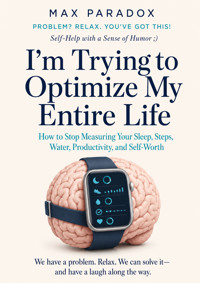
I'm Trying to Optimize My Entire Life - How to Stop Measuring Your Sleep, Steps, Water, Productivity, and Self-Worth ebook
Max Paradox
Uzyskaj dostęp do tej i ponad 240000 książek od 14,99 zł miesięcznie
- Wydawca: ALL-IN Rafał Płonkowski
- Kategoria: Biznes, rozwój, prawo•Biznes, rozwój
- Język: angielski
You slept 7 hours and 14 minutes.
Your watch is disappointed.
You walked 8,931 steps.
Apparently 9,000 would have made you a better person.
You drank water, exercised, worked, answered messages, and completed most of your tasks-but one productivity dashboard still contains an alarming amount of orange.
So naturally, the day feels incomplete.
I'm Trying to Optimize My Entire Life is a practical, funny guide for anyone who has accidentally turned self-improvement into a full-time management position.
Max Paradox takes on the modern obsession with measuring everything: sleep scores, steps, calories, hydration, screen time, deep work, habits, spending, workouts, reading targets, recovery scores, and the increasingly suspicious idea that if enough numbers move in the correct direction, you may finally qualify as a successful human.
The problem is not data itself. Tracking can be useful. Goals can be useful. Productivity systems, fitness apps, budgets, smartwatches, routines, and dashboards can all help.
Until they become judges.
This book shows you how to keep the useful parts without allowing your entire life to become a quarterly performance review.
You will learn how to:
identify which metrics genuinely improve decisions and which ones merely create anxiety;
stop turning ordinary fluctuations into personal failures;
define “enough” before the finish line moves again;
simplify productivity systems that have become more work than the work itself;
use fewer numbers and track the bottleneck instead of everything;
create defaults that eliminate repetitive decisions;
build rules that reduce willpower without turning your life into a prison;
create a minimum viable day for weeks when your energy is approximately potato;
recover when routines collapse without waiting for Monday;
reduce goals when life becomes unusually demanding;
stop hobbies from becoming unpaid second careers;
recognize the early signs that optimization is taking over again;
and learn the deeply advanced skill of leaving something alone because it already works.
This is not a book about giving up on health, ambition, discipline, or progress.
It is about putting them back in proportion.
You can exercise without worshipping your step count.
You can manage money without turning every coffee into a financial ethics hearing.
You can sleep without receiving a morning grade.
You can work well without recording every productive minute.
You can improve your life without inspecting it constantly.
And perhaps most importantly, you can have a perfectly ordinary day without demanding evidence that you performed it correctly.
Practical, direct, and packed with observational humor, I'm Trying to Optimize My Entire Life helps you build systems that support you, simplify them when they become ridiculous, and know when the most productive thing you can do is stop.
Your life does not need another dashboard.
It may just need fewer meetings.
This publication was prepared with the assistance of tools that support the creative process, including artificial intelligence-based solutions. The final concept, structure, and editing belong to the author.
Ebooka przeczytasz w aplikacjach Legimi na:
Liczba stron: 211
Rok wydania: 2026
Odsłuch ebooka (TTS) dostepny w abonamencie „ebooki+audiobooki bez limitu” w aplikacjach Legimi na:
Podobne


















INTRO
At 10:47 p.m., you are standing in your kitchen drinking water you do not particularly want because your app says you are still fourteen ounces behind.
This is not thirst.
This is administration.
Your watch says you have completed 8,742 steps, which would be perfectly respectable if yesterday had not been 10,116. Your sleep score this morning was 78, a number that apparently means you slept acceptably but should still feel vaguely disappointed in yourself. You exercised for thirty-seven minutes, although only twenty-nine counted toward whatever mysterious standard your fitness app has established. You answered twelve emails, finished three important tasks, postponed two moderately important ones, and spent eleven minutes reading about whether sitting for too long is slowly killing you.
You are exhausted.
Fortunately, your device has already noticed.
It recommends recovery.
So naturally, you begin researching how to recover more efficiently.
This is how optimization gets you. It rarely arrives wearing a villain cape and announcing, “Good evening. I am here to destroy your ability to enjoy a sandwich.” It begins as something sensible. You want to sleep better. Exercise more. Drink enough water. Spend less. Focus at work. Stop wasting Sunday afternoon scrolling through videos of people reorganizing refrigerators that are already more organized than your career.
These are reasonable goals.
Then reasonable goals acquire dashboards.
Suddenly, your life has quarterly reporting.
You wake up and immediately receive your first performance review from a rectangle strapped to your wrist. Deep sleep: disappointing. Resting heart rate: acceptable. Readiness: questionable. Stress: apparently high, which is interesting because you were not stressed until a device informed you that you were.
Excellent.
Now you can worry about worrying.
You start treating ordinary human experiences as data problems. A bad night is no longer a bad night. It is a sleep-trend event. A walk is no longer a walk; it is an opportunity to close a ring. Drinking water becomes compliance. Reading becomes a streak. Meditation becomes a score. Exercise becomes a graph. Work becomes a productivity system containing so many categories, tags, filters, reminders, and color codes that doing the actual work begins to feel almost disruptive.
And somewhere in the middle of all this improvement, you stop asking a fairly important question:
Is any of this making my life better?
Not theoretically better. Not more measurable. Not beautifully represented by a green upward arrow.
Actually better.
That question gets surprisingly difficult once optimization becomes part of your identity. Because measuring things can feel like progress even when nothing meaningful is improving. Tracking creates activity. Activity creates a sense of control. Control feels responsible. Responsible feels good.
Until it does not.
You can spend forty-five minutes designing the perfect morning routine and still wake up tomorrow wanting to throw your phone across the room when the alarm goes off. You can buy a premium habit tracker, customize seventeen habits, select tasteful icons, create weekly targets, and spend more time maintaining the system than practicing the habits.
At least your procrastination now has excellent user interface design.
The deeper problem is not that tracking is bad. Tracking can be useful. A step counter can encourage movement. A budget can prevent your bank account from developing an experimental relationship with zero. A sleep log can reveal patterns. A calendar can stop you from discovering at 9:56 that your 10:00 meeting is not, in fact, “sometime later.”
The problem begins when tools quietly become judges.
You stop using numbers to help you make decisions and start using them to decide how you are allowed to feel.
If the watch says you slept well, you feel relieved.
If it says you slept badly, you start examining yourself for symptoms.
“How do I feel?”
A dangerous question. Better check the app.
You can be having a perfectly pleasant morning, see a mediocre recovery score, and suddenly downgrade the entire experience. Apparently the coffee was good, the weather was nice, and you felt fine, but the official data has arrived and would like to correct your testimony.
That is one of the strangest things about modern self-improvement: we have become capable of outsourcing our own judgment to devices that cannot tell whether we just got engaged, lost a job, stayed up comforting a friend, watched a terrible movie until 1:00 a.m., or ate nachos in bed because Wednesday had defeated us.
The device has numbers.
You have context.
Context keeps losing.
Optimization also expands. This is important because no one wakes up one morning and calmly decides, “I would like to convert my entire existence into a spreadsheet.” You usually begin with one area.
Maybe sleep.
Then exercise.
Then nutrition.
Then focus.
Then money.
Then screen time.
Then hydration.
Then reading.
Then morning sunlight because someone online says you should look at the sky within eleven minutes of waking, and now you are standing outside in pajama pants at 6:52 a.m. as if awaiting instructions from a helicopter.
Eventually, you are not improving your life.
You are managing a small corporation called You.
The corporation has ambitious targets.
Employee morale is poor.
The cruelest part is that optimization tends to move the finish line. Once 7,000 steps becomes normal, you want 10,000. Once you sleep seven hours, you start wondering whether seven hours and forty-five minutes would transform you into a radiant genius. Once you finish three important tasks a day, three becomes the baseline and four becomes success.
Yesterday’s victory becomes today’s minimum requirement.
This is why people can objectively improve while feeling increasingly inadequate. The system keeps upgrading the definition of “good enough.” You never arrive because arrival would end the project, and the optimization brain loves projects.
It especially loves projects where the deliverable is you.
This book is not going to tell you to throw away your smartwatch, delete every app, abandon goals, move into a cabin, and measure time by observing moss. Tools are not the enemy. Numbers are not the enemy. Goals are not the enemy.
The problem is the relationship.
We are going to rebuild that relationship so the data works for you instead of you working for the data.
You will learn how to identify which measurements are actually useful, which ones create anxiety without improving decisions, and which ones exist mainly because someone built a dashboard and dashboards get lonely if nobody checks them. You will learn how to choose a few measures that serve a purpose, stop tracking things that do not, and create limits so self-improvement does not become a second unpaid job.
More importantly, we are going to separate performance from worth.
You are not your step count.
You are not your productivity score.
You are not the number of books you read, workouts you completed, hours you slept, ounces of water you drank, emails you answered, calories you burned, habits you maintained, or mornings you successfully behaved like the person in the motivational video.
You can miss a workout without becoming lazy.
You can sleep badly without failing at sleep.
You can have an unproductive day without placing yourself under formal review.
And yes, you can drink water because you are thirsty.
A revolutionary system.
The goal here is not to become less capable, less organized, or less healthy. It is to stop spending so much energy monitoring whether you are being capable, organized, and healthy correctly.
There is a difference between improving your life and constantly inspecting it.
You are allowed to have goals.
You are also allowed to have lunch without collecting evidence.
By the end of this book, you should be able to use tracking when it helps, ignore it when it does not, make decisions without demanding a graph, and recognize the moment when healthy self-improvement starts turning into endless self-surveillance.
You should also be able to go for a walk, come home, and not care whether it was 5,983 steps or 6,014.
The walk still happened.
Your body noticed.
No spreadsheet required.
Chapter 1 - When Everything Becomes a Score
You wake up at 6:38 a.m. and feel surprisingly decent.
Not magnificent. Nobody is filming a commercial in which you leap out of bed wearing white linen and smile at the sunrise. But you feel rested enough. Your back is not protesting, your brain appears to know your name, and you have not yet developed a personal grievance against the day.
Then you check your sleep app.
Score: 63.
Oh.
Apparently you are exhausted.
You inspect the details. Deep sleep: low. REM: below average. Restlessness: elevated. Recovery: “fair,” which is a wonderfully diplomatic way for a machine to say, “You have disappointed us.”
Five minutes earlier, you felt fine. Now you are evaluating whether your eyelids seem unusually heavy.
This is the first mechanism you need to understand: measurement does not merely describe your experience. It can change your experience.
That is not automatically bad. A thermometer can tell you that you have a fever even if you are still insisting you are “probably just tired.” A bank statement can reveal that your vague feeling of spending “a little too much lately” has somehow involved $417 worth of food delivery. Useful measurement corrects bad guesses.
But measurement becomes a problem when the number stops informing you and starts overruling you.
You know this has happened when your first reaction is no longer:
“That is useful information.”
It becomes:
“What does this say about me?”
A step count becomes evidence that you were active enough.
A productivity score becomes evidence that you were disciplined enough.
A calorie total becomes evidence that you ate correctly enough.
A screen-time report becomes evidence that you have once again failed civilization.
The number has acquired moral authority.
Your phone did not ask for this promotion.
Data and judgment are not the same thing
Imagine you walk 6,400 steps on Tuesday. That number is neither good nor bad by itself. Perhaps you normally walk 2,000 and are recovering from a month of sitting through back-to-back meetings. In that case, 6,400 may represent meaningful progress.
Perhaps you normally walk 12,000 and deliberately took an easier day because you ran ten miles yesterday.
Also fine.
Perhaps you were at the airport, your flight was canceled, and those 6,400 steps consisted largely of walking between Gate B17 and a customer-service desk where a very calm employee repeatedly explained that your luggage was enjoying an independent travel experience.
Context decides what the number means.
Yet optimization encourages us to reverse the process. Instead of starting with the purpose and asking whether the data helps, we start with the data and ask whether we measured up.
That distinction sounds small.
It is not.
A useful metric answers a question.
An unhealthy metric creates one.
For example:
“Am I moving more than I was three months ago?” is a useful question.
“Why did I only get 8,913 steps today?” may simply be an invitation to pace around the kitchen at 11:54 p.m. while brushing your teeth.
This happens because precise numbers feel authoritative. “I moved quite a bit today” sounds vague. “9,742 steps” sounds official, as though certified by the International Department of Walking Around.
Precision creates confidence even when the target itself is arbitrary.
That is how people end up serving the metric instead of the goal.
The goal was to move more.
The metric was steps.
Then steps quietly became the goal.
Now taking a swim, lifting weights, gardening, stretching, or carrying twelve grocery bags upstairs may somehow feel less legitimate because the little number did not increase enough.
Congratulations. You have found a way to turn physical activity into accounting.
The question every metric must answer
Before you track anything, ask:
What decision will this number help me make?
That is the filter.
Not:
“Is this interesting?”
Not:
“Can my watch measure it?”
Not:
“Does somebody on YouTube have a color-coded dashboard for it?”
What decision will this number help you make?
Suppose you track sleep for two weeks because you want to know whether caffeine after 3:00 p.m. affects your nights. Excellent. You are collecting information for a decision: perhaps moving your last coffee earlier.
Suppose instead that you check nine sleep variables every morning but never change anything based on them.
You do not have a sleep tool.
You have morning trivia about yourself.
The same applies to work. Tracking how long specific tasks take can help if you routinely underestimate projects and overload your calendar. But if you record every twenty-minute block, calculate a daily efficiency percentage, compare it with last Thursday, and then feel guilty because you spent fourteen minutes talking to a coworker about their sick dog, the system has wandered away from usefulness and joined a cult.
The dog conversation may have mattered more than the spreadsheet.
Not everything valuable produces a metric.
This is difficult for the optimizing mind because metrics make reality look manageable. Relationships are messy. Energy fluctuates. Workdays get interrupted. Motivation disappears for reasons ranging from poor sleep to “someone replied ‘per my previous email’ and now I need an hour.”
Numbers offer a cleaner world.
They say:
Here is the target.
Here is your result.
Here is the gap.
Beautiful.
Except human life contains variables that refuse to sit politely in cells.
Watch for the scoreboard effect
One of the fastest ways to detect over-optimization is to notice whether you are behaving differently because you want a better number rather than a better outcome.
Examples:
You go for a pointless late-night walk because your step goal is unfinished, even though you are tired and need sleep.
You avoid taking a rest day because your workout streak would break.
You choose an easy task over an important difficult one because completing five small items will make your productivity tracker look better.
You finish a book you hate because abandoning it would ruin your reading target.
You drink another enormous bottle of water despite not being thirsty because the hydration app has begun issuing passive-aggressive reminders.
The metric has become a scoreboard.
And once there is a scoreboard, humans become surprisingly creative about winning.
This is why badly designed workplace targets produce bizarre behavior. Tell employees that success means answering customer calls quickly, and some will find efficient ways to help people. Others will discover that hanging up quickly produces excellent call-duration statistics.
The number improved.
The customer is currently shouting at a lamp.
Personal metrics can create the same problem. We optimize what is visible even when it damages what we actually wanted.
You wanted better health.
Now you are anxious about health data.
You wanted better sleep.
Now you lie awake wondering whether lying awake will damage tomorrow’s sleep score.
A particularly elegant system.
Separate observation from evaluation
Here is a simple method.
When you see a number, describe it before you judge it.
Instead of:
“Only 5,600 steps. Terrible.”
Try:
“5,600 steps today. I spent most of the day driving.”
Instead of:
“My productivity was awful.”
Try:
“I finished one planned task because two urgent issues came up.”
Instead of:
“I slept badly again.”
Try:
“I slept six hours and woke twice. I also stayed up until midnight.”
This may sound like a minor language trick. It is more useful than that. Description keeps the number connected to reality. Evaluation often skips directly from measurement to identity.
Data:
“I worked out twice this week.”
Judgment:
“I have no discipline.”
Data:
“My average screen time rose by forty minutes.”
Judgment:
“I am wasting my life.”
Data:
“I missed my reading target.”
Judgment:
“I am becoming one of those people who buys books mainly to construct decorative guilt.”
That last one may be true aesthetically, but it is still not a useful conclusion.
The goal is not to forbid judgment. Sometimes the data genuinely shows a problem. If your spending has exceeded your income for four months, “interesting neutral information” is not enough. Something needs to change.
But you want the sequence to be:
data → context → decision.
Not:
data → shame → elaborate new tracking system.
Use ranges instead of perfect targets
Optimization loves exact numbers because exact numbers create clear victories.
Ten thousand steps.
Eight hours of sleep.
Sixty-four ounces of water.
Four workouts.
Thirty books.
Zero inbox.
Exactness feels tidy. Life is not particularly interested.
A better approach for many behaviors is to use a range.
Maybe your movement target is 6,000–9,000 steps on normal days rather than exactly 8,000.
Maybe your exercise goal is three to four sessions per week.
Maybe your reading target is fifteen to thirty minutes when you have the energy.
Maybe your deep-work goal is one to three focused blocks depending on the day.
Ranges preserve direction without turning normal variation into failure.
They also prevent the absurd situation in which 7,982 steps feels meaningfully different from 8,000.
Your cardiovascular system is not standing at the finish line with a clipboard saying:
“Seventeen steps short. Unfortunately, nothing counts.”
Choose leading indicators carefully
Some measurements help because they track behaviors you control.
You cannot directly command yourself to “be healthier” today. You can take a walk, prepare a reasonable meal, sleep at a sensible time, or attend a medical appointment.
You cannot directly decide to “be successful at work” before lunch. You can complete the proposal, make the call, review the numbers, or protect an hour from interruptions.
The useful measurement is often the smallest behavior connected to the outcome.
But even here, restraint matters.
If you want to write consistently, measuring “days I wrote for twenty minutes” may help.
You probably do not also need:
words per minute,
average sentence length,
time spent revising,
number of creative ideas,
mood before writing,
mood after writing,
coffee consumed while writing,
and a weekly chart comparing productivity with atmospheric pressure.
At some point, you are no longer writing.
You are conducting research on the endangered writer in its natural habitat.
Pick one or two indicators that genuinely influence behavior. Ignore the rest unless a specific problem gives you a reason to investigate further.
Try the two-week test
Choose one thing you currently track obsessively.
For the next two weeks, ask three questions whenever you check it:
Did this number affect a real decision?
Did checking it improve my behavior?
Did checking it improve or worsen how I felt without changing anything useful?
At the end of two weeks, classify the metric.
Keep it if it regularly helps you decide or act.
Reduce it if it is occasionally useful but does not need daily attention.
Remove it if you mostly stare at it, judge yourself, and continue behaving exactly as before.
This is not anti-data.
It is anti-useless-data.
A spreadsheet should have to earn its place in your life just like everything else.
What if stopping makes you anxious?
Some people notice that merely reducing tracking creates discomfort. They worry that without measurement they will lose control, become lazy, stop exercising, gain weight, spend too much, sleep terribly, forget every habit they have ever established, and be found six months later living entirely on cereal.
If that is you, do not delete everything at once.
Reduce frequency.
Check your sleep trend weekly instead of every morning.
Review spending once or twice a week instead of after every purchase.
Look at your average steps every Sunday instead of chasing the number every night.
This keeps the information while removing the constant judgment.
You are not trying to become unaware.
You are trying to become less supervised.
Your practical action for this chapter is simple: pick one metric you currently monitor and write down the decision it is supposed to help you make. If you cannot name the decision, stop checking it for one week and see what actually happens.
You may discover that nothing collapses.
The dashboard will cope.
Chapter 2 - The Finish Line Keeps Moving
You decide you want to become more productive.
Nothing unreasonable.
You make a list of three important tasks for the day and complete all three by 4:00 p.m.
Success.
For approximately seven minutes.
Then something strange happens. Instead of enjoying the fact that you completed the plan, your brain notices there is still time left.
You could answer a few emails.
Clean up tomorrow’s schedule.
Start the next task.
Organize those files.
Maybe make a better system for tracking tasks, because apparently completing your tasks has created an urgent need to redesign how you complete tasks.
By 6:30, you are tired and vaguely dissatisfied.
Three tasks became five.
Five became seven.
The day that initially counted as successful has somehow been demoted.
This is the moving finish line.
It may be the central trick behind chronic optimization: every improvement quickly becomes the new normal, and the new normal stops feeling like an achievement.
You wanted to exercise twice a week.
You manage twice.
Then three would be better.
You reach three.
Someone online exercises five times.
Interesting.
You wanted to save $300 a month.
Then $500.
Then you calculate that if you cut restaurants, vacations, subscriptions, hobbies, and possibly electricity, you could save $1,200.
At that point, financial planning begins to resemble preparation for a siege.
The problem is not ambition. Improving your goals can be reasonable. The problem is upgrading the standard automatically, without noticing that you have done it.
If every achievement immediately raises the requirement, success becomes structurally impossible.
Your brain is very good at turning upgrades into defaults
Humans adapt.
The first time you move into a nicer apartment, buy a faster computer, earn more money, or finally get the job you wanted, the change feels significant. Then life continues.
The new thing becomes ordinary.
This adaptation is useful. Imagine being permanently overwhelmed with gratitude every time your refrigerator kept food cold. You would never get anything done.
“Can you send me the quarterly report?”
“I’m sorry, Diane. I’m emotionally processing refrigeration.”
But adaptation also means improvements stop feeling special quickly. When you apply optimization logic to this process, you can create endless escalation.
Yesterday, eight hours of focused work seemed impressive.
Today, it is expected.
Yesterday, running three miles was progress.
Today, it is the minimum.
Yesterday, cooking dinner four nights a week was a victory.
Today, takeout on Friday feels like evidence of moral decline.
The baseline rises quietly.
Your satisfaction does not.
There are two kinds of goals
It helps to separate achievement goals from maintenance goals.
Achievement goals have a destination.
Pay off a credit card.
Run a 10K.
Finish a course.
Complete a project.
Declutter the garage.
Maintenance goals are ongoing.
Exercise regularly.
Keep spending under control.
Maintain friendships.
Sleep reasonably well.
Keep the house functional enough that visitors do not need safety equipment.
The optimizing mind often treats maintenance goals as though they should have permanent upward progress.
That makes no sense.
If your goal is maintaining your health, you do not need to exercise more every month for the rest of your life. At some point you would require a sponsorship deal and several knees.
If your home is reasonably clean, the next level does not necessarily involve alphabetizing the pantry.
If you drink enough water, drinking increasingly more water is not evidence of personal development.
Many parts of life have a sufficient level.
Find it.
Then stop upgrading.
Define “enough” before you begin
This may be the most useful anti-optimization habit in the entire book:
Decide what enough looks like before you start.
Before the workday:
“Today is successful if I finish the proposal and make the two important calls.”
Before exercising:
“Thirty minutes is enough.”
Before cleaning:
“I will clean the kitchen and bathroom. I am not reorganizing every drawer containing an object whose purpose I cannot immediately identify.”
Before checking email:
“I will process the urgent messages and anything requiring less than five minutes. The rest can wait.”
This prevents your brain from renegotiating the contract after you have already fulfilled it.
Without a definition of enough, there is always more available.
There is always another email.
Another mile.
Another book.
Another improvement.
Another meal you could prepare from organic ingredients arranged beautifully in glass containers.
Another person online who apparently wakes at 5:12 a.m., meditates, runs six miles, reads philosophy, builds a company, spends meaningful time with their children, practices Italian, and somehow has already roasted vegetables before you have located your left sock.
There will always be somebody doing more.
You do not need to enter the competition.
They may not even be telling the truth.
Stop confusing capacity with obligation
Suppose you can work ten hours today.
Does that mean you should?
You can technically stay up until 1:30 a.m. finishing a presentation.
You can spend Saturday handling errands.
You can squeeze another workout into Thursday.
You can answer the email tonight.
You can use every open space.
Optimization often treats unused capacity as waste.
An empty hour becomes “available.”
An evening without plans becomes “an opportunity.”
A quiet weekend becomes “time to catch up.”
This turns your calendar into a storage unit where every empty square must contain something.
But spare capacity has a function.
It absorbs surprises.
It allows recovery.
It gives you room to think.
It makes it possible for your child, partner, friend, dog, dishwasher, car, boss, body, or internet connection to unexpectedly require attention without causing the entire week to fall over.
Efficiency without slack is fragile.
An airport running at 100 percent capacity would become chaos after one delayed flight.