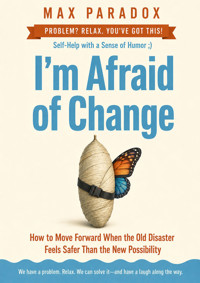
I'm Afraid of Change - How to Move Forward When the Old Disaster Feels Safer Than the New Possibility ebook
Max Paradox
Uzyskaj dostęp do tej i ponad 240000 książek od 14,99 zł miesięcznie
- Wydawca: ALL-IN Rafał Płonkowski
- Kategoria: Biznes, rozwój, prawo•Biznes, rozwój
- Język: angielski
You know something needs to change.
Maybe it’s your job. Your relationship. Your city. Your routine. Your career. Your business. Or simply one part of your life that has been irritating you for so long it has started paying symbolic rent.
Then an alternative appears.
And suddenly the old situation looks strangely comforting.
Welcome to the absurd logic of change: the familiar disaster often feels safer than the uncertain possibility.
In I'm Afraid of Change, Max Paradox explains why your brain can spend months complaining about the present and then defend it passionately the moment you consider doing something different. More importantly, he shows you how to move forward without pretending uncertainty does not exist.
This is not a book about “being fearless,” trusting the universe, resigning dramatically on a Tuesday afternoon, or buying a one-way plane ticket because someone on social media told you to choose yourself.
It is a practical guide to changing intelligently.
You’ll learn how to separate real danger from ordinary discomfort, calculate the hidden cost of staying, stop demanding impossible certainty, recognize when preparation has become procrastination, and break frightening changes into smaller experiments that produce actual information.
You’ll also learn how to:
compare the risks of changing with the risks of doing nothing;
identify what you are really afraid of losing;
stop treating fear as a prediction;
set decision thresholds instead of waiting for certainty;
test career, business, lifestyle, and personal changes before making larger commitments;
build financial and practical exit ramps;
stop reopening decisions without new evidence;
handle setbacks without declaring the entire plan a failure;
keep moving when motivation disappears;
recognize when fear returns in a new disguise;
avoid turning your successful change into the next situation you are afraid to leave.
The methods are designed for normal people with jobs, bills, responsibilities, limited energy, and no desire to meditate beneath a waterfall at 4:30 a.m.
There are no guarantees here. That is rather the point.
A thoughtful change can still go badly. A new job can disappoint you. A move can be difficult. A business can fail. You can make a sensible decision and discover something you could not have known beforehand.
The goal is not to predict your future perfectly.
The goal is to become better at moving, testing, adjusting, recovering, and choosing again.
You do not need to stop being afraid of change.
You need to stop giving fear automatic veto power.
Because familiarity is not evidence that something is good.
Sometimes it only means you have become very efficient at surviving it.
This publication was prepared with the assistance of tools that support the creative process, including artificial intelligence-based solutions. The final concept, structure, and editing belong to the author.
Ebooka przeczytasz w aplikacjach Legimi na:
Liczba stron: 193
Rok wydania: 2026
Odsłuch ebooka (TTS) dostepny w abonamencie „ebooki+audiobooki bez limitu” w aplikacjach Legimi na:
Podobne


















INTRO
You have been complaining about your job for eleven months. The meetings could have been emails, the emails could have been deleted, and your manager has developed the rare ability to say “Let’s circle back” without ever actually circling anywhere. Then a recruiter contacts you with a better role, better pay, and a boss who appears to understand that employees are not houseplants requiring occasional motivational misting.
You stare at the message.
And suddenly your current job does not seem that bad.
This is one of the stranger talents of the human brain: it can spend years building a detailed legal case against your present situation, then become its defense attorney the moment an alternative appears. Yesterday you were ready to leave. Today you are remembering that the coffee machine on the third floor makes a surprisingly decent cappuccino. Apparently this is now a major factor in your long-term career strategy.
Change does that. It turns familiar misery into a sentimental object.
You know the relationship is going nowhere, but at least you know exactly how nowhere works. You know the apartment is too small, the commute is awful, the business idea is stalled, the routine is draining you, or the city has stopped fitting your life. Still, the old situation has one enormous advantage: it has already happened to you. You know the furniture. You know the potholes. You know which argument comes after which sentence. You know how Tuesday feels.
The new possibility has no such courtesy. It contains unanswered questions. Maybe the new job will be worse. Maybe moving will be lonely. Maybe the relationship you leave was secretly the best you will ever get, despite the fact that half your conversations currently sound like negotiations over shared airspace. Maybe you will fail. Maybe you will regret it. Maybe future you will come back in time, slap present you with a rolled-up utility bill, and shout, “What were you thinking?”
Your brain loves certainty so much that it occasionally prefers certain disappointment to uncertain improvement.
That does not make you uniquely bad at life. Familiar situations are easier to predict, and prediction feels like safety. Even unpleasant routines come with instructions. If you stay in the same job, relationship, or town, your brain can roughly estimate what happens next. It may not like the forecast, but at least it has one.
Change replaces the forecast with weather.
Now there are variables. You may have to learn something. You may have to be awkward for a while. You may have to introduce yourself to people who already seem to know where the bathrooms are. You may make a choice without receiving a certificate from the universe confirming that it was correct. Extremely inconsiderate of the universe, but this remains its policy.
So you hesitate. You research. You compare. You think a little more. Then you decide that responsible adults do not make impulsive decisions, which is true, and use this fact to justify another four months of doing absolutely nothing, which is less impressive.
The problem is not that you need to become fearless. Fearlessness is overrated and often just poor risk assessment wearing sunglasses. The goal is to become able to move while some uncertainty is still in the room, eating your snacks and making unhelpful comments.
Many people wait for a feeling that never arrives. They assume confidence comes first and action follows. Often it works the other way around. You take a small step, survive it, collect evidence, and become a little more confident because reality has finally entered the conversation. Before that, your brain is working mostly with imagination, and imagination has an unlimited special-effects budget.
It can turn “I might apply for another job” into a six-season drama involving unemployment, bankruptcy, moving into your cousin’s basement, and somehow being asked to give a presentation without pants.
Meanwhile, the actual first step is updating your résumé.
This book is about closing that gap between imagined catastrophe and useful movement. Not reckless movement. Not motivational-speaker movement where you quit your job at noon, buy a one-way ticket somewhere tropical, and announce that you are “choosing yourself” while your credit card quietly calls a lawyer. Sensible movement: small enough to be survivable, concrete enough to create information, and deliberate enough that you are not just swapping one disaster for a more photogenic disaster.
You will learn how to separate real risk from familiar discomfort, why your mind overvalues what it already knows, and why waiting for perfect certainty is often just avoidance with a spreadsheet. More importantly, you will learn what to do: how to test a change before fully committing, create exit ramps, make decisions with incomplete information, shrink a terrifying leap into a manageable experiment, and recover if the first attempt goes badly.
Because sometimes it will go badly.
Self-help becomes nonsense when it pretends every brave choice is rewarded with better lighting and a successful podcast. You can make a thoughtful change and still encounter disappointment. A new job can be mediocre. A move can be harder than expected. A relationship can end and still be missed. A business can fail despite your color-coded planning document.
The question is not, “Can I guarantee that the new thing will work?”
You cannot.
The better question is, “Can I make the next move intelligently enough that I can handle several possible outcomes?”
That is a skill. And unlike certainty, it can actually be built.
We are also going to deal with a less flattering truth: sometimes the old disaster feels safe because it asks nothing new of you. You already know how to complain about it. You have scripts. You have coping mechanisms. Change may require you to become temporarily incompetent again, which is deeply offensive once you have spent years becoming efficiently competent at your current problems.
There is comfort in knowing exactly how your life disappoints you.
But comfort and safety are not the same thing.
A familiar situation can be emotionally expensive, financially limiting, physically draining, or simply too small for the person you are becoming. Staying is also a decision. Doing nothing also has consequences. The old road does not become neutral just because you have memorized the potholes.
So we are not going to worship change for its own sake. Sometimes staying is correct. Sometimes the boring option is the wise one. Sometimes your fear is giving you useful information, and ignoring it would be foolish. The skill is learning to tell the difference between a warning and a reflex.
That is where we begin.
Not with a dramatic leap.
With a better question, a smaller step, and enough skepticism to stop treating familiarity as evidence.
Your old disaster has excellent branding.
We are going to read the fine print.
Continuing with exactly Chapters 1 and 2, following the supplied series structure and style lock.
Wklejony tekst
Chapter 1 - Familiar Is Not the Same as Safe
You are thinking about leaving your job again.
Not actually leaving it, obviously. That would involve actions. You are doing the safer activity: imagining leaving while scrolling through job listings and becoming irritated that none of them offers better pay, perfect colleagues, zero commuting, meaningful work, unlimited flexibility, and a manager who communicates exclusively through respectful messages sent between 10:00 a.m. and 2:00 p.m.
One position looks promising. You could probably do it. The salary is better. The company seems stable.
Then your brain starts working.
What if the manager is terrible?
What if the company restructures?
What if the commute becomes annoying?
What if the work is boring?
You close the listing and return to your current job, where the manager is definitely terrible, restructuring happens every eight months, the commute is already annoying, and you have described the work as “slow emotional taxation.”
Excellent risk management.
This is the first thing to understand about fear of change: your brain does not compare the old situation and the new situation fairly. It compares known problems with imagined problems.
Known problems receive a discount.
You already know how bad Monday morning feels in your current situation. You know which coworker will schedule a meeting at 4:30 p.m. You know which cabinet door sticks. You know exactly how long your partner can say “nothing’s wrong” before revealing that several things are, in fact, wrong. Familiar problems are irritating, but they are predictable.
The unknown gets no such discount. It arrives without reviews.
That makes the new possibility look riskier than it really is and the old situation look safer than it really is. Not because the old situation is good, but because you have learned how to operate inside it.
You know where the fire exits are.
Even if the building is occasionally on fire.
Your brain is comparing two different products
Suppose you are choosing between your current job and a possible new one.
Your current job comes with data.
You know the salary. You know the boss. You know the politics. You know how exhausted you feel on Thursday. You know exactly which spreadsheet exists solely because somebody senior once asked for it in 2022 and nobody has been brave enough to stop updating it.
The new job comes with uncertainty.
You do not yet know how the boss behaves under pressure. You do not know whether “collaborative culture” means healthy teamwork or eleven people editing the same slide. You do not know whether the generous flexibility policy survives contact with your actual manager.
So your brain makes an unfair comparison:
Current job: Known negatives.
Possible job: Potential negatives plus uncertainty.
Of course the new option feels more dangerous. You have allowed imagination to add unlimited charges.
This happens everywhere.
You think about moving to another city and immediately picture loneliness, bad neighbors, hidden apartment defects, unreliable public transportation, disappointing takeout, and somehow being unable to find a dentist.
You do not apply the same imagination to staying.
You rarely sit down and vividly picture three more years of the current commute, the current rent increase, the current social circle shrinking, and yourself still saying, “I’m thinking about moving.”
Staying gets treated as if nothing happens.
Something always happens.
Doing nothing is still a choice
One of the most expensive mental mistakes is assuming that action carries risk while inaction preserves the current situation.
It does not.
If you stay in a job, the company continues changing. Your skills either develop or stagnate. Your salary changes relative to inflation and the market. Managers leave. Teams reorganize. Your energy changes. Opportunities appear and disappear.
If you stay in a relationship that is not working, time continues passing there too.
If you delay starting the business, somebody else may enter the market, your enthusiasm may decline, your circumstances may become more complicated, or nothing dramatic may happen at all—which is exactly why another two years can disappear so efficiently.
Inaction is not a glass display case.
It is a moving walkway.
You are still going somewhere.
This matters because people frightened of change often calculate the risks of moving but not the risks of staying.
Imagine someone named Daniel. Daniel has been talking about changing careers for four years. He dislikes his industry, sees little room for growth, and spends Sunday evenings developing the facial expression of a man who has just received a parking ticket from existence.
But changing careers feels risky.
He might earn less at first.
He might need training.
He might discover that the new field is not what he expected.
All true.
What Daniel rarely calculates is the alternative: four more years in the same direction. Four more years of limited development. Four more years of declining energy. Four more years of postponing the experiment that could tell him whether another career fits.
Staying is not free simply because nobody sends you an invoice.
Familiar pain becomes background noise
People adapt to surprisingly bad arrangements.
The first month in a chaotic workplace feels outrageous. By month eighteen you have developed systems. You know not to expect an answer from accounting before Tuesday. You save every document in three locations because “the shared drive sometimes has moods.” You have a folder called FINAL, another called FINAL2, and one called FINAL_USE_THIS_ONE.
Civilization has been rebuilt.
This adaptation is useful. Humans need it. If every recurring annoyance remained as emotionally intense as the first time, we would all collapse because the dishwasher beeped unexpectedly.
But adaptation has a downside: recurring problems become normal.
Normal does not mean good.
It means familiar enough that your nervous system has stopped filing daily complaints.
This is why you can stay too long in situations you once considered unacceptable. The rent slowly rises. The relationship slowly deteriorates. The work slowly expands. The commute slowly becomes ridiculous. No single day feels dramatic enough to trigger action.
Your life does not explode.
It drifts.
Drift is dangerous precisely because it lacks dramatic music.
Run the staying test
When you are afraid of change, do not ask only:
“What if I change and regret it?”
Ask:
“What happens if nothing changes?”
Not tomorrow. Tomorrow is usually manageable. That is the problem.
Look at one year.
Then three.
If the situation stayed broadly similar, what would it cost you in:
money;
time;
energy;
health;
relationships;
opportunities;
confidence;
skills;
daily quality of life?
Do not make it philosophical. Make it annoyingly specific.
Instead of:
“I’ll probably feel stuck.”
Write:
“If nothing changes, I will spend about ten hours a week commuting. That is roughly five hundred hours a year.”
Instead of:
“This job drains me.”
Write:
“I currently spend three evenings a week too tired to do anything except watch videos about people renovating kitchens I do not own.”
Specific consequences are harder to romanticize.
Your brain enjoys vague suffering because vague suffering can be negotiated with.
Numbers are less sentimental.
Separate danger from discomfort
Not every uncomfortable change is dangerous.
This sounds obvious until your body votes.
A difficult conversation can feel dangerous. Starting a new role can feel dangerous. Going alone to an event can feel dangerous. Asking for more money can feel dangerous. Saying, “I don’t think this relationship works anymore” can feel as if you have been asked to defuse a device while everyone watches.
Your nervous system is not lying to you. It is doing its job: detecting uncertainty, conflict, social exposure, possible loss, and lack of control.
But feelings are signals, not final verdicts.
When fear appears, ask:
“What exactly is the threat?”
Not:
“Why am I such a coward?”
That question is both unhelpful and unnecessarily rude.
Identify the actual threat.
For example:
“I’m afraid to apply for the position.”
Threat: I may be rejected.
Fine. Rejection hurts.
But what happens after rejection?
Probably an email.
Maybe silence.
Possibly a brief period during which you decide the recruiter has personally evaluated your entire value as a human being despite spending seventeen seconds on your résumé.
Then life continues.
The discomfort is real.
The danger is limited.
This distinction matters because fear speaks in volume, not precision. A loud feeling can be attached to a small practical risk.
Use the two-column reality check
Take the change you are considering and divide a page into two columns:
What I know about staying
and
What I am afraid might happen if I change
The wording matters.
In the first column, include evidence.
In the second, include fears.
For example:
What I know about staying:
My salary has barely increased in two years.
I am regularly working late.
Promotion opportunities are limited.
I feel drained most Sunday evenings.
I have already tried discussing workload twice.
What I fear might happen if I change:
The new manager could be worse.
I might fail during probation.
I might miss my coworkers.
The company could reorganize.
I might regret leaving.
Now look at the page.
One column describes your current reality.
The other describes possible futures.
Both matter, but they do not deserve equal certainty.
This exercise stops your imagination from sneaking into the meeting wearing an “Evidence” badge.
Do not confuse competence with fit
Another reason the old disaster feels safer is that you have become skilled at surviving it.
You know how to handle your boss.
You know how to avoid certain arguments.
You know when traffic gets bad.
You know which tasks can safely be postponed until somebody notices.
You may even be excellent at coping.
That can create a strange attachment.
Leaving means becoming less competent for a while.
At the new job, you may need to ask where things are. You may not understand the acronyms. You may sit in a meeting while everyone nods at the phrase “standard QBR process” and briefly wonder whether QBR is software, a meeting, or a regional species of bird.
This is normal.
Beginnings involve temporary incompetence.
People who fear change often treat that temporary incompetence as evidence that they should stay where they are strong.
But being good at navigating the wrong environment is not proof that the environment is right.
You can become extremely efficient at carrying a chair everywhere.
Buying a table may still be an improvement.
Ask whether you are safe or merely adapted
This is the core question of the chapter.
When you describe your current situation as “safe,” what do you mean?
Do you mean:
“It supports me, meets my important needs, and carries acceptable risks”?
Or do you mean:
“I know how it disappoints me”?
Those are different definitions.
A genuinely safe situation may still be boring. It may not need changing.
A familiar situation may be financially unstable, emotionally draining, professionally limiting, or relationally unhealthy—and still feel easier to remain inside because you already know the script.
Do not leave merely because something is familiar.
Do not stay merely because something is familiar either.
Familiarity is information about exposure.
Not quality.
Make one comparison fair
Today, choose one change you have been postponing.
Do not decide yet.
Your only job is to compare fairly.
Write:
What is genuinely working in the current situation?
What is genuinely not working?
What are the realistic risks of changing?
What are the realistic risks of staying for another year?
Which fears are evidence-based?
Which fears are your brain producing because the outcome is unknown?
If you cannot answer number four, spend extra time there.
People afraid of change are usually experts on the dangers of departure and amateurs on the cost of remaining.
Fix the accounting.
You do not need courage today.
You need two honest columns.
Your old disaster has had years to prepare its marketing campaign.
Chapter 2 - Your Brain Wants a Guarantee
You are considering making a change, but first you would like certainty.
Not complete certainty. You are reasonable.
Ninety-seven percent would probably do.
You would like to know that the new job will work out, the relationship decision will be correct, the move will feel right, the business idea will succeed, nobody important will be disappointed, your finances will remain stable, and future you will someday look back and say, “Excellent decision. Five stars. No notes.”
Unfortunately, major life decisions do not come with that package.
So you wait for more information.
You read reviews.
You compare salaries.
You watch videos.
You ask three friends, two coworkers, your sister, somebody in an online forum named CoffeeWarrior88, and eventually a man on YouTube who appears to record career advice from inside a luxury rental car.
Still no guarantee.
Suspicious.
Uncertainty feels like missing information
One reason change becomes paralyzing is that uncertainty creates the sensation that you have not researched enough.
Sometimes that is true.
If you are considering moving to another country and have not checked whether you can legally work there, please continue researching. This book is not opposed to documents.
But often you already possess enough information to make the next reasonable step.
You just do not possess enough information to eliminate uncertainty.
Those are not the same thing.
Suppose you are thinking about starting freelance work on the side.
Useful research might include:
whether there is demand for your service;
what comparable people charge;
whether your employment contract creates restrictions;
how many hours you can realistically offer;
what basic tax or registration requirements apply.
Good.
After that, you can test.
But fear may ask for more.
Which logo should you use?
What if demand falls next year?
Should your future business have three service tiers?
Which invoicing system will work when you eventually have fifty clients?
You currently have zero clients.
Your future invoicing empire is not the emergency.
This is how reasonable preparation mutates into protective delay.
The certainty trap
The certainty trap has a simple rule:
“I will move when I feel sure.”
That sounds responsible.
It is often impossible.
You can feel sure about small repeatable things because you have enough experience with them. You know roughly what happens when you make pasta, drive to work, or order the same coffee.
Major changes are different because the evidence you want often exists only after you act.
You cannot know what working at the new company feels like before working there.
You cannot know how living alone feels before living alone.
You cannot know whether you enjoy running a business before running some version of one.
You cannot know whether the new city feels like home before Tuesday evening in November when it is raining and you need toothpaste.
Experience produces information that thought cannot.
This is the annoying part.
Thinking feels safer.
Reality has better data.
Your brain hates loss more than it enjoys possible gain
There is a useful concept called loss aversion. In plain English: losing something usually feels more significant than gaining something of similar value.
You can see this in very ordinary situations.
Finding twenty dollars in an old jacket feels nice.
Losing twenty dollars you were certain was in your pocket feels like a minor betrayal by the financial system.
The amount is identical.
The emotion is not.
This matters during change because you already possess the current situation.
Even if you dislike parts of it, it contains things you could lose: routine, status, colleagues, income, familiarity, identity, convenience, a favorite café, the ability to perform your work without Googling basic terms.
The alternative offers possible gains.
Possible gains are mentally weaker than concrete possessions.
Your current desk exists.
Your hypothetical better manager does not.
Therefore the desk has surprisingly strong lobbying power.
Name what you are actually afraid to lose
When people say, “I’m afraid of change,” the fear is often too large and vague to work with.
Change itself is not the unit.
Loss is.
Ask:
“If I make this change, what exactly might I lose?”
Be concrete.
You may fear losing:
stable income;
professional status;
daily contact with coworkers;
a predictable schedule;
family approval;
your identity as “the person who does this”;
proximity to friends;
comfort;
competence;
sunk time or money;
the option to go back.
Now you have something useful.
You cannot solve “change.”
You can solve specific losses.
If the fear is income, build a financial buffer.
If the fear is loneliness, create a social plan.