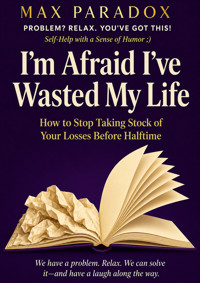
I'm Afraid I've Wasted My Life - How to Stop Taking Stock of Your Losses Before Halftime ebook
Max Paradox
Uzyskaj dostęp do tej i ponad 240000 książek od 14,99 zł miesięcznie
- Wydawca: ALL-IN Rafał Płonkowski
- Kategoria: Biznes, rozwój, prawo•Biznes, rozwój
- Język: angielski
What if the most exhausting thing about your past is not what happened-but the fact that your brain keeps reopening the case?
I'm Afraid I've Wasted My Life: How to Stop Taking Stock of Your Losses Before Halftime is a practical, funny self-help guide for anyone who has looked at their age, career, finances, relationships, missed opportunities, abandoned plans, or somebody else’s suspiciously successful social-media feed and thought:
“Excellent. I have apparently done adulthood incorrectly.”
Max Paradox takes apart the fear of having wasted your life without pretending every mistake was secretly wonderful. Some opportunities really were missed. Some choices were poor. Some years could have gone better. The solution is not fake positivity, motivational slogans, or convincing yourself that every terrible decision was “part of the journey.”
The solution is learning how to review the past accurately, extract what is useful, and stop sacrificing the future to repeated regret.
Inside, you will learn how to:
stop comparing your real life with imaginary alternate timelines where everything went perfectly;
separate genuine loss from hindsight, selective memory, and social comparison;
identify which goals are still available, which need modification, and which should finally be released;
turn regret into concrete decisions, calendar actions, and realistic plans;
recover abandoned friendships, skills, experiences, and goals when recovery still makes sense;
build routines that survive ordinary exhaustion, bad weeks, lost motivation, and actual adult responsibilities;
stop reopening decisions just because uncertainty feels uncomfortable;
create a life that improves normal Tuesdays instead of looking impressive only in theory;
recognize when reflection is useful-and when your brain has simply launched another unnecessary internal investigation.
This is self-help for normal people: people with jobs, bills, families, tired evenings, imperfect histories, and no interest in waking at 4:30 a.m. to meditate beside a waterfall.
You do not need to redeem every previous year.
You do not need to catch up with the imaginary person you were “supposed” to become.
You do not even need to stop regretting everything.
You need to know what still matters, what is still possible, and what to do next.
Because the most effective way to waste more of your life is to spend the next decade thinking about how much of it you already wasted.
The game is still happening.
It may be time to stop reading the scoreboard.
This publication was prepared with the assistance of tools that support the creative process, including artificial intelligence-based solutions. The final concept, structure, and editing belong to the author.
Ebooka przeczytasz w aplikacjach Legimi na:
Liczba stron: 199
Rok wydania: 2026
Odsłuch ebooka (TTS) dostepny w abonamencie „ebooki+audiobooki bez limitu” w aplikacjach Legimi na:
Podobne



















INTRO
It usually starts at an inconvenient hour.
You are brushing your teeth, driving home, scrolling through somebody else’s vacation photos, or standing in the kitchen waiting for the microwave to finish reheating something you were too tired to cook properly the first time. Nothing dramatic is happening. Nobody has called an emergency meeting. Then your brain casually asks, “So… what exactly have we done with our life?”
Excellent question, brain. Fascinating timing.
Within thirty seconds, you are no longer waiting for leftover pasta. You are conducting a full forensic audit of your existence. Career decisions. Relationships. Money. Places you never visited. Things you never learned. That business you thought about starting in 2016. The guitar you bought because apparently owning a guitar and learning to play one are two separate subscription plans. You remember people who seem further ahead, opportunities you missed, years that went suspiciously fast, and at least one decision involving bangs that should never have happened.
The microwave beeps.
Your life review continues.
This is how the fear of having wasted your life often works. It does not arrive carrying a clipboard and a balanced set of evidence. It bursts through the door like an auditor who has already decided you are guilty and is now searching the filing cabinets for supporting documents. It remembers every abandoned plan and conveniently forgets every difficult thing you survived, learned, built, changed, enjoyed, repaired, or simply got through without ending up on the evening news.
And because the phrase “I’ve wasted my life” sounds serious, your brain treats it like a fact instead of what it often is: a very dramatic conclusion based on an extremely selective spreadsheet.
Column A: things I did not achieve.
Column B: apparently deleted.
The trouble becomes worse because life gives us plenty of comparison material. At almost any age, you can find someone younger who has achieved something you have not. A twenty-three-year-old has sold a company. A thirty-one-year-old owns three houses. A forty-year-old runs marathons before breakfast and seems delighted about it, which frankly raises questions. Someone you went to school with has become a vice president of something. Someone else lives in Portugal and makes ceramic bowls while wearing linen shirts. You are currently searching online for “how long is cooked chicken safe in fridge.”
This does not feel like a fair competition.
It is not.
You are comparing your complete internal history—with every doubt, boring Tuesday, mistake, financial setback, bad relationship, stalled project, and evening spent watching six episodes of something you do not even remember—to somebody else’s edited evidence. Their promotion. Their wedding. Their mountain. Their kitchen renovation. Nobody posts a photo captioned, “Here is me at 2:14 a.m. wondering whether I have misunderstood adulthood at a fundamental level.”
If they did, social media would be much more useful.
The deeper problem, however, is not Instagram, your successful cousin, or the person from college who somehow became “an entrepreneur” and now writes posts beginning with “Ten lessons I learned before turning thirty.” The deeper problem is the way we take stock of a life that is still in progress.
We look backward, collect the losses, compare them with an imaginary version of what should have happened, and then announce the final score.
Before halftime.
Imagine doing this with anything else. Your team is losing 1–0 after twenty-five minutes, so everybody leaves the stadium. The chef tastes the soup before adding half the ingredients and throws it away. You watch the first forty minutes of a movie, decide no character has completed a satisfying emotional arc, and demand a refund.
Yet with life we do exactly this.
“I should have figured it out by now.”
According to whom?
There is rarely a serious answer. Usually there is just a vague committee made up of family expectations, cultural milestones, old plans, successful strangers, your younger self, and an imaginary person named Probably Everyone Else.
Probably Everyone Else had a plan.
Probably Everyone Else bought property at the correct time, chose the correct career, invested early, maintained meaningful friendships, learned Spanish, stretched regularly, and never spent four years in a relationship that should have lasted six months.
Probably Everyone Else is exhausting.
The feeling that you have wasted your life is especially convincing because it mixes three things that are real with one thing that is not. Real: time has passed. Real: some opportunities are gone. Real: you have made decisions you would make differently now. Not automatically real: therefore the whole thing has been wasted.
That final leap is where the trouble starts.
A bad decade is not the same as a wasted life. A career that did not work out is not proof that everything leading up to it was pointless. A relationship ending does not erase every good thing that happened inside it. Five years spent caring for children, helping family, surviving financial trouble, rebuilding after burnout, or simply getting through a difficult period may not produce a shiny trophy you can place on LinkedIn, but that does not mean those years were empty.
Even mistakes are rarely pure waste. Some are expensive lessons, which is irritating because nobody asked for the premium package. But they still leave information behind: what you tolerate, what you value, what you are good at, what you absolutely do not want to repeat, and which sentence beginning with “I have an amazing investment opportunity” should cause you to leave the room immediately.
The purpose of this book is not to convince you that every choice you ever made was secretly wonderful.
Some choices were terrible.
Congratulations. You are a person.
Nor are we going to solve regret by hanging inspirational posters over it. You will not be asked to stand in front of a mirror each morning and declare, “Every chapter of my journey was necessary,” while brushing your teeth and wondering why your journey bought that useless exercise machine in 2019.
Some losses are losses. Some years really could have been used better. Some doors close. Some decisions cost time, money, confidence, or opportunity. Pretending otherwise is not optimism. It is accounting fraud with candles.
What we can do is separate useful regret from useless self-punishment. Useful regret says, “I do not want to repeat that.” Useless regret says, “Because I did that, everything is ruined.” One gives you information. The other takes the same information, puts on a black cape, and declares the kingdom doomed.
This book will help you stop doing the second one.
You will learn how to take stock of your life without turning the process into a prosecution. We will look at why your brain gives disproportionate attention to missed chances, why imaginary timelines have so much power, how to stop comparing your real life with alternative lives that never had to survive contact with reality, and how to decide what still matters now.
More importantly, we will move forward.
Because if you are worried that you have wasted too much time, spending the next three years repeatedly thinking about how much time you wasted would be an unusually committed way to continue the tradition.
We will deal with the practical questions. What do you do when you genuinely chose the wrong career? When you stayed too long? Started too late? Never started? When you are not twenty-five anymore and certain options are genuinely different? When you cannot dramatically reinvent your entire life because you have a mortgage, children, responsibilities, a tired back, and approximately eleven minutes of uninterrupted free time on Wednesday?
The answer will not be “follow your passion.”
Your passion does not pay the electric bill merely because it believes in you.
Instead, we will build a more useful way to evaluate the past, choose what deserves attention now, recover abandoned possibilities where possible, replace impossible goals where necessary, and create evidence that your life is still moving rather than waiting for some heroic transformation.
You do not need to repair every previous year.
You need to stop letting previous years consume the next one.
That distinction matters because the goal is not to become a person with no regrets. Such a person either has amnesia or is selling a course. The goal is to become someone who can look backward accurately without permanently facing backward.
Maybe you have wasted some time.
I have bad news.
So has everyone.
We have watched pointless meetings, stayed in stupid arguments, waited for people to change, bought things we did not need, postponed things that mattered, and spent entire evenings choosing what to watch before becoming too tired to watch anything. Human beings are remarkably creative when it comes to converting finite existence into browsing menus.
But wasted minutes do not automatically create a wasted life.
The question is not whether the first half went perfectly.
It did not.
The question is what you are going to do with the ball now.
Chapter 1 - The Trial You Keep Reopening
At 10:17 on a perfectly ordinary Tuesday, you remember a job you did not apply for nine years ago.
This would be harmless if your brain reacted appropriately: “Huh. I wonder what would have happened.”
It does not.
Instead, the Department of Historical Mistakes opens the file.
Perhaps you would have got the job. Perhaps the salary would have been better. Perhaps you would have met different people, moved to another city, bought a house before prices went insane, invested early, become wildly successful, developed excellent posture, and learned to make sourdough before everyone else did.
By 10:21, the imaginary version of you has a beach house.
You have a spreadsheet open and cannot remember why.
This is one of the main reasons the thought “I have wasted my life” becomes so persuasive. You are not comparing your actual life with another actual life. You are comparing it with an edited alternate timeline in which every decision you did not make turns out beautifully.
The imaginary job has no awful manager.
The imaginary relationship never becomes boring.
The imaginary city has good weather, reasonable rent, excellent public transportation, and apparently no plumbing problems.
The imaginary business succeeds.
The imaginary children sleep.
The imaginary stock you almost bought goes up.
The imaginary version of you also has more energy, confidence, discipline, money, courage, and hair.
This competitor is difficult to beat.
The past becomes obvious only after it happens
One reason regret feels intelligent is that hindsight gives you information your previous self did not have.
Today, you know the relationship failed.
You know the company later became successful.
You know the neighborhood became expensive.
You know the investment rose.
You know the degree did not help much.
You know the person you trusted was unreliable.
Your past self knew none of this.
But when you judge old decisions, you often quietly give your younger self access to today’s information and then criticize them for not using it.
This is unfair.
It is like shouting at someone watching a mystery movie for the first time because they have not guessed the killer, while you are sitting beside them after watching it twice and reading the Wikipedia page.
“Come on. It was obvious.”
Yes.
After the reveal.
Many bad decisions really were bad decisions. We do not need to turn every mistake into a sacred learning experience involving candles and acoustic guitar music. Sometimes you ignored warning signs. Sometimes you stayed because leaving was frightening. Sometimes you bought something financially ridiculous because it had leather seats.
Fine.
But a useful review asks:
“What did I know then?”
“What options did I realistically have?”
“What was I afraid of?”
“What did I fail to understand?”
“What would I do differently now?”
A useless review asks:
“Why was I not already the person I became later?”
That question cannot produce anything except guilt.
You were less experienced because experience had not happened yet.
Annoying system.
Your brain counts visible outcomes
Suppose two people spend ten years working.
Person A changes careers three times, learns a great deal, earns reasonably well, helps family members through difficult periods, develops several skills, and eventually discovers work they like.
Person B joins one company, receives regular promotions, buys a large house, and gets a senior title.
Who appears more successful?
Usually Person B.
Their progress comes with labels.
Promotion.
Director.
House.
Salary.
Anniversary.
Person A may have gained judgment, resilience, technical skills, stronger relationships, better boundaries, and a very advanced ability to identify terrible managers within seventeen minutes.
These things are useful.
They are also annoyingly difficult to photograph.
This creates a strange accounting problem. We count what can be displayed and discount what cannot.
Money is easy to count.
Titles are easy to count.
Properties are easy to count.
Marriages, degrees, countries visited, businesses started, books published, kilometers run—countable.
Knowing when to leave?
Harder.
Becoming less afraid?
No certificate.
Learning not to lend money to your cousin Kevin?
Extremely valuable. Tragically absent from LinkedIn.
Your life therefore may feel less successful than it actually has been because many of its gains are not displayed as conventional milestones.
This does not mean milestones are meaningless.
If you wanted financial security and have none, that matters.
If you wanted children and circumstances made that impossible, that can hurt deeply.
If you dreamed of a career and abandoned it, the loss may be real.
We are not going to erase pain by inventing participation trophies for adulthood.
But we do need accurate accounting.
If you record every visible loss and ignore every invisible gain, the final number is nonsense.
Even accountants would object, and they tolerate some very depressing spreadsheets.
Stop using one category to grade your whole life
Another common error is taking disappointment in one area and letting it infect everything else.
Career stalled?
“I have wasted my life.”
Relationship ended?
“I have wasted my life.”
You are forty-five and do not own a house?
“I have wasted my life.”
You are thirty-two and single?
Apparently civilization has collapsed.
A life has multiple categories. Career, money, relationships, family, health, learning, freedom, contribution, fun, creativity, stability, community, experiences, personal development, and whatever category covers learning after age thirty that sleeping badly now requires a recovery plan normally associated with surgery.
You can be disappointed in one area without declaring bankruptcy everywhere.
This sounds obvious until you observe how people actually think.
A man with loving children, stable finances, good health, close friends, and a job he dislikes may say, “I have done nothing with my life.”
Nothing?
Sir, there appear to be several humans in the kitchen calling you Dad.
A woman may build a successful career, support herself, travel widely, maintain strong friendships, and feel that her life has failed because she did not marry.
The pain may be genuine.
The conclusion is still too large.
“I am unhappy with this part” is painful but useful.
“My entire life was wasted” is dramatic and vague.
Vague judgments are difficult to solve.
Specific disappointments can be worked on.
That distinction will matter throughout this book.
Make the accusation specific
The next time your brain announces that you have wasted your life, do not argue with it immediately.
Interrogate it.
Ask:
What exactly do I believe I wasted?
Time?
Money?
Career opportunities?
A relationship?
My twenties?
My thirties?
Creative ability?
Health?
Years spent in the wrong place?
Chances to travel?
Time with family?
Then ask:
What outcome do I believe should have happened instead?
This second question exposes a great deal.
“I wasted my twenties.”
Doing what?
“Well, I worked, had two relationships, traveled a little, changed careers, and spent too much money.”
What should have happened?
“I should have bought a home, found my ideal career, invested more, exercised regularly, and met my future spouse.”
Ah.
So the complaint is not actually “I wasted my twenties.”
It is:
“I did not complete six major life objectives simultaneously while having limited money, limited experience, and the emotional judgment of someone whose idea of conflict resolution was not replying to a text.”
That is a different case.
More importantly, it is a case we can examine.
The Fantasy Replacement Test
Try this simple method whenever regret begins inflating an alternate timeline.
Write down the decision you regret.
Then write what you imagine would have happened if you had chosen differently.
Now add realistic friction.
If you had taken that other job:
What might have been worse?
What new risks would have appeared?
What would you have had to give up?
Which problems would have followed you because you were still you?
What facts were unknowable at the time?
Suppose you regret not moving to New York ten years ago.
Fantasy version:
You move.
You become successful.
You meet fascinating people.
Your career accelerates.
You become the kind of person who says “my place in Brooklyn” without sounding pleased with yourself.
Now add friction.
Rent would have been higher.
You might have hated your job.
You could have felt lonely.
Your relationship might have ended.
You might have moved back after eighteen months.
Perhaps the move would have been wonderful.
Perhaps not.
The point is not to make the alternative look terrible.
The point is to stop giving it a guaranteed happy ending.
Your actual life had uncertainty.
The unlived life had uncertainty too.
Fair competition.
Regret is information, not a residence
Healthy regret has a job.
It tells you something.
“I stayed too long because I was afraid of conflict.”
Useful.
“I ignored money for years because looking at my accounts made me anxious.”
Useful.
“I kept waiting for perfect certainty and missed several chances.”
Useful.
“I have ruined everything forever and should spend Thursday evening proving it again.”
Not useful.
Regret becomes destructive when you stop extracting information and begin repeatedly experiencing the punishment.
You already learned the lesson.
The class is over.
Why are you still sitting in the classroom?
There is no extra credit.
This is particularly common with decisions that cannot be reversed. The brain keeps revisiting them because it dislikes unresolved problems. If an issue cannot be repaired, the mind may continue processing it as though one more hour of thinking will eventually produce a secret door back to 2014.
It will not.
We have excellent phones now.
Time travel remains disappointing.
When a past decision cannot be changed, the useful question is no longer, “How do I undo it?”
It becomes:
“What does this change about what I do next?”
That is where regret becomes practical.
Use the Three-Line Review
For one regret that regularly returns, write exactly three lines.
What happened: State the facts without drama.
What I learned: Name the lesson.
What I will do differently: Choose one future behavior.
Example:
What happened: I stayed in a job I disliked for four years because the salary felt safe.
What I learned: I tolerate dissatisfaction too long when change feels financially uncertain.
What I will do differently: If I am seriously unhappy at work for six months, I will actively explore alternatives instead of waiting for the feeling to disappear.
Done.
Do not turn this into a twelve-page autobiography.
You are extracting the data, not filming the documentary.
If the same regret returns tomorrow, you do not need to reopen the entire trial. Read the three lines.
Case reviewed.
Lesson recorded.
Future instruction issued.
Move on.
But what if I really did waste years?
Maybe you did.
This deserves a serious answer.
You may have spent years addicted, trapped, afraid, passive, ill, grieving, caring for someone, recovering from abuse, stuck in financial chaos, or simply avoiding decisions until avoidance itself became a lifestyle.
Some periods may genuinely look empty from where you stand now.
Calling them wonderful would be insulting.
But even then, two things can be true:
“I wish those years had been different.”
and
“I do not have to sacrifice more years to proving how bad they were.”
The first statement honors reality.
The second protects the future.
If the regret involves trauma, severe depression, addiction, complicated grief, or thoughts that your life is not worth living, this is no longer merely a productivity or perspective problem. Professional mental-health support may be appropriate. A book can help you think differently, but it should not pretend to replace qualified care when the problem is deeper.
For ordinary regret, however, your first job is simpler.
Make it specific.
Remove hindsight.
Stop idealizing the alternative.
Extract the lesson.
Then close the file.
You can reopen it if new evidence appears.
Your brain will be delighted to hear that it has an appeals process.
What to do today
Choose one regret you have been using as evidence that you “wasted your life.”
Write:
What actually happened.
What you imagine should have happened.
What you knew at the time.
What you learned.
One thing you will do differently now.
Do not decide whether your whole life was worthwhile.
That assignment is too large and badly designed.
Just review one case accurately.
A fair trial would be a pleasant change.
Chapter 2 - The Timeline Nobody Signed
You are thirty-seven.
Or forty-six.
Or twenty-nine.
The number is almost irrelevant because whatever it is, your brain has evidence that you should be somewhere else by now.
Maybe you should already own a home.
Maybe you should have children.
Maybe you should have more savings.
Maybe your career should make sense.
Maybe you should be married, divorced, remarried, promoted, retired, financially independent, fluent in Italian, able to touch your toes, and mysteriously enthusiastic about waking up at 5:30 a.m.
There was apparently a schedule.
Nobody gave you a copy.
Still, you are late.
This is the invisible timeline problem: the belief that major life events are supposed to happen by certain ages, in a certain order, with limited deviation and preferably before your parents begin asking questions at dinner.
School.
Job.
Partner.
Marriage.
House.
Children.
Career advancement.
Financial security.
A tasteful kitchen island.
Peace.
The sequence looks very organized from a distance.
Actual lives are less cooperative.
“By now” is one of the most expensive phrases in your head
Listen to the sentence behind many life regrets.
“I should have figured this out by now.”
“I should be earning more by now.”
“I should have met someone by now.”
“I should own something by now.”
“I should feel confident by now.”
By now according to what?
Sometimes the answer is practical. A professional certification has a deadline. Fertility changes with age. Retirement savings benefit from starting earlier. Certain athletic goals become harder. Real time constraints exist, and pretending otherwise is not helpful.
But much of “by now” comes from comparison, family culture, old expectations, or assumptions you absorbed so early that they feel like natural law.
They are not.
Gravity is natural law.
Being a senior manager at forty is not.
Your uncle’s opinion at Christmas is definitely not.
The danger of an invisible timeline is that it converts difference into failure.
Someone else does something at thirty.
You do it at forty.
Nothing about the event itself changes.
But because you expected thirty, the extra decade begins to feel like evidence that you messed up.
This is how people reach goals and still manage to experience them as late fees.
The schedule keeps changing
Life timelines are particularly ridiculous because society cannot agree on them.
In one social group, getting married at twenty-four is normal.
In another, people at thirty-four are still deciding whether the person they have dated for three years is “someone I’m seeing.”
In one family, buying a home is treated as the official beginning of adulthood.
In another, nobody cares until you mention you are renting at fifty and an aunt quietly loses consciousness.
Career expectations are equally inconsistent.
One person is “doing amazingly” because they became a manager at thirty.
Another person changed professions at thirty-eight and is temporarily junior again.
A third built a business at fifty-two.