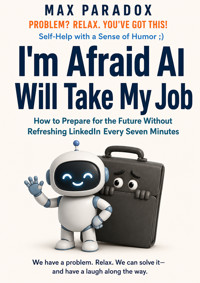
I'm Afraid AI Will Take My Job - How to Prepare for the Future Without Refreshing LinkedIn Every Seven Minutes ebook
Max Paradox
Uzyskaj dostęp do tej i ponad 240000 książek od 14,99 zł miesięcznie
- Wydawca: ALL-IN Rafał Płonkowski
- Kategoria: Biznes, rozwój, prawo•Biznes, rozwój
- Język: angielski
AI can write emails, analyze data, generate code, create presentations, summarize meetings, and apparently give half of LinkedIn a reason to announce that your profession will cease to exist by Thursday.
So… should you panic?
Probably not.
Should you ignore what is happening?
Also probably not.
I'm Afraid AI Will Take My Job: How to Prepare for the Future Without Refreshing LinkedIn Every Seven Minutes is a practical, funny guide for anyone wondering what artificial intelligence actually means for their career-and what they should do about it before anxiety turns professional development into a second full-time job.
Max Paradox cuts through dramatic headlines, vague predictions, and useless advice such as “future-proof yourself” to show you how to prepare in ways that normal people can actually use.
You will learn how to break your job into tasks and identify which parts are most exposed to automation, which parts AI is more likely to accelerate rather than replace, and where human judgment, context, relationships, and expertise still create meaningful value.
You will also learn how to:
choose useful skills instead of collecting random courses;
use AI to improve real workflows;
turn saved time into higher-value work;
build evidence of your professional value;
monitor your company without interpreting every meeting invite as a layoff announcement;
identify realistic adjacent career options;
maintain your résumé and network before you urgently need them;
build financial and professional buffers;
respond calmly if your role genuinely becomes vulnerable;
stop using LinkedIn as a career heart monitor.
This is not a book promising that your job is completely safe. Nobody can honestly promise that.
It is also not a book telling you to quit immediately, learn programming, launch three side businesses, become an AI strategist, and post daily thought leadership beside photographs of yourself staring thoughtfully through office windows.
The goal is simpler: understand what is changing, increase your ability to adapt, and build enough options that uncertainty stops controlling your week.
Because preparation is useful.
Panic with a spreadsheet is still panic.
If you want a realistic plan for working alongside AI, strengthening your career, and worrying considerably less about a future nobody can predict perfectly, this book is for you.
This publication was prepared with the assistance of tools that support the creative process, including artificial intelligence-based solutions. The final concept, structure, and editing belong to the author.
Ebooka przeczytasz w aplikacjach Legimi na:
Liczba stron: 204
Rok wydania: 2026
Odsłuch ebooka (TTS) dostepny w abonamencie „ebooki+audiobooki bez limitu” w aplikacjach Legimi na:
Podobne



















INTRO
It is 9:14 on a Tuesday morning, and you are supposed to be working.
Instead, you are reading an article titled something like 17 Jobs AI Will Destroy Before Lunch. The article was recommended by another article explaining that artificial intelligence will create millions of new opportunities, which was recommended by a video insisting that anyone who does not learn twelve AI tools immediately will soon be living under a bridge selling handcrafted bookmarks.
Your coffee is getting cold.
Your actual job is still waiting.
And somehow the responsible thing feels like opening LinkedIn again.
You tell yourself you are not panicking. You are researching. This is an important distinction because research sounds professional, while panic sounds like something that should come with a paper bag and instructions to breathe slowly. So you refresh the feed. Someone has just announced that they have “future-proofed their career” by completing a forty-three-minute online course. Someone else has become an AI strategist despite appearing to have discovered AI sometime last Thursday. A third person has posted a photograph of themselves staring thoughtfully out a window with the caption: “Adapt or disappear.”
Excellent.
Nothing calms the nervous system like a motivational hostage situation.
You return to work, but now every ordinary task looks suspicious. You write an email and wonder how long before AI writes all emails. You update a spreadsheet and wonder whether spreadsheets will still need humans. You attend a meeting and briefly hope AI will replace meetings first, which would at least prove civilization is moving in the right direction.
Then somebody demonstrates a new tool that can do in twenty seconds something that took you two hours last year.
Your stomach performs a small corporate restructuring.
This fear is not ridiculous. Artificial intelligence is changing work. Some tasks will disappear. Others will become faster, cheaper, or heavily automated. Certain jobs will shrink. New jobs will emerge. Existing roles will be reorganized in ways nobody can predict perfectly, especially the people posting confident predictions next to photographs of rockets.
The problem is not that you are paying attention.
The problem is what happens when paying attention quietly turns into monitoring the future as if you have been appointed head of the Department of Preventing Everything Bad That Might Ever Happen.
You read reports. You watch demonstrations. You compare your skills with strangers. You save courses you may never take. You inspect job listings “just to understand the market,” which somehow results in forty-seven browser tabs and the emotional impression that every employer now wants a data scientist who can sell enterprise software, manage a team, design graphics, speak Mandarin, and repair a helicopter.
Salary: competitive.
Naturally.
Fear makes this behavior feel useful because uncertainty is uncomfortable. Your brain wants certainty, and the job market has unfortunately declined to provide a notarized document guaranteeing that your career will remain unchanged until retirement.
So the brain improvises.
It checks.
And checks.
And checks again.
Maybe the next article will finally contain the sentence you want: “Good news. We have reviewed your specific career, personality, mortgage, manager, industry, skill set, and preferred lunch schedule. You will definitely be fine.”
That article does not exist.
Even if it did, LinkedIn would immediately recommend another one saying the opposite.
This is where people often make one of two mistakes. The first is denial: AI is overhyped, nothing important will change, everyone should calm down, and perhaps we can all return to fax machines. That is comforting but not especially useful. Pretending change is not happening is not a career strategy. It is more like closing your eyes during a home renovation and hoping the kitchen remains where you left it.
The second mistake is turning preparation into permanent emergency mode.
Now everything becomes urgent. You need to learn prompting, coding, automation, analytics, machine learning, video generation, data visualization, cybersecurity, personal branding, public speaking, and possibly pottery because apparently handcrafted objects will survive the robot economy.
You begin six courses.
You finish fourteen percent of each.
Congratulations. You are now professionally overwhelmed in multiple disciplines.
Real preparation looks much less dramatic. It starts by separating three things that anxiety keeps mixing together: what is changing, what you can influence, and what you are imagining without enough evidence.
Those categories matter.
Suppose AI can automate thirty percent of the tasks in your current role. Anxiety translates that into: Thirty percent of my job can disappear, therefore one hundred percent of me is doomed.
But jobs are not usually single tasks. They are bundles of activities, responsibilities, relationships, decisions, judgment calls, coordination, knowledge, exceptions, politics, timing, communication, and the mysterious skill of knowing whom to ask when the official process clearly does not work.
A tool may automate the report.
It may not know that Karen from Finance will reject the numbers unless you send them before 2:00 because after 2:00 she enters a different spiritual dimension.
Understanding the difference between a task and a job is one of the first ways to make this problem smaller and more manageable.
The next is recognizing that your goal is not to predict the exact future. You cannot. Nobody can, despite the impressive confidence with which people put years on charts.
Your goal is to become harder to surprise.
That means understanding which parts of your work are vulnerable to automation, which parts become more valuable when automation increases, which skills travel well between roles, and how to use AI before somebody decides that “using AI” should be added to your performance objectives in a font large enough to feel threatening.
It also means building options before you desperately need them.
Not seventy-three options.
A few good ones.
You do not need to resign tomorrow, reinvent yourself as an AI consultant, post daily thought leadership, or spend Sunday learning Python while your family wonders whether you have joined a very technical cult.
You need a system.
In this book, we are going to build one.
You will learn how to assess your actual career risk without treating every headline like an evacuation alarm. You will identify which tasks in your job are easiest to automate, which human strengths are likely to matter more, and where improving your skills gives you the highest return without turning your evenings into a second unpaid degree.
You will learn how to use AI as leverage instead of viewing it only as competition. We will look at what “future-proofing” can realistically mean, because there is no such thing as a completely future-proof career. If there were, universities would offer a Bachelor of Permanent Relevance and charge a spectacular amount of money for it.
You will also build a practical backup plan: how to keep your résumé current without checking job boards during breakfast, how to strengthen your professional network without becoming the person who suddenly messages former coworkers with “Hey stranger!” followed by a suspiciously enthusiastic coffee invitation, and how to test new directions before making expensive decisions.
Most importantly, you will stop confusing vigilance with preparation.
Refreshing LinkedIn is not a career strategy.
Reading the sixteenth article about the death of your profession is not preparation.
Knowing which three skills you should improve next, practicing them consistently, becoming better at using the tools changing your field, keeping evidence of your value, and maintaining realistic alternatives?
That is preparation.
AI may change your job.
Your job may change even without AI. Companies restructure. Industries shift. Managers leave. Products disappear. Entire departments occasionally discover that they have been “realigned,” which is corporate language for everyone receiving a new org chart and pretending it makes sense.
You cannot control all of that.
But you can become someone who responds to change with options instead of panic.
That is the goal here.
Not certainty.
Not invincibility.
Not becoming the world’s leading expert in every technology released before breakfast.
Just a stronger professional position, a clearer plan, and far fewer moments spent staring at LinkedIn wondering whether a twenty-three-year-old “AI transformation visionary” has somehow already made your career obsolete.
They have not.
Close the tab.
We have work to do.
Chapter 1 - The Headline Is Not Your Career
At 7:42 in the morning, before you have done anything professionally meaningful, the internet informs you that your profession is finished.
This is inconvenient because you were planning to use the profession today.
You click the article while eating breakfast. The headline says AI is “coming for” accountants, marketers, programmers, designers, lawyers, analysts, customer-service workers, consultants, managers, writers, recruiters, and several other occupations that collectively employ what appears to be everyone except lighthouse keepers.
You are not a lighthouse keeper.
Damn.
The article contains impressive language about disruption, transformation, automation, and the future of work. There may also be a photograph of a humanoid robot sitting at a laptop, because apparently the visual shorthand for artificial intelligence remains “silver person who has somehow obtained an office job.”
By the time you finish your coffee, nothing about your actual employment has changed. Your manager has not called. Your company has not deleted your position. Your customers have not gathered outside demanding a chatbot instead.
Yet emotionally, you have already been laid off twice.
This is the first problem we need to solve: you are probably consuming information about AI at the wrong level.
Most AI news operates at the level of industries, professions, technologies, companies, or dramatic future scenarios. Your career operates at the level of one specific person doing one specific combination of tasks for one specific employer in one specific market with one specific set of skills.
Those are not the same thing.
“The marketing industry will be transformed by AI” may be true in a broad sense and still tell you almost nothing about whether your particular role is in immediate danger.
“AI can write sales copy” is information.
“My employer can therefore remove my role next quarter without losing anything important” is a conclusion.
Your brain likes to skip directly from the first sentence to the second because anxiety is an efficient travel agent. It specializes in one-way tickets.
Stop measuring danger by emotional intensity
The more frightening a headline feels, the more important it seems.
Unfortunately, fear is not a risk-assessment system.
If it were, turbulence would be more dangerous than driving while typing a message, because turbulence makes people grip the armrest and driving while typing often makes them say, “It’s fine, I’m just sending one thing.”
Your career deserves better analysis.
A useful way to think about AI risk is to separate three different questions:
Exposure: How much of your current work can AI already perform or substantially accelerate?
Impact: If those tasks become automated, how much does that reduce the need for your role?
Adaptability: How easily can you move toward the tasks, skills, and responsibilities that remain valuable?
These questions produce very different answers.
Imagine two people who both spend thirty percent of their week producing routine reports.
For the first person, those reports are nearly the entire reason the company employs them. The remaining seventy percent is mostly moving information between systems, correcting formatting, and wondering why the printer has once again decided that cyan is a human-rights issue.
For the second person, the reports are just a tool. They use them to identify problems, recommend decisions, explain performance to senior leaders, negotiate priorities, and coordinate people who have incompatible definitions of “urgent.”
Both roles contain report production.
Only one is primarily about report production.
That distinction matters far more than whether a software demo can create a chart.
The internet often shows you capability. You need to evaluate economic usefulness.
A system may technically perform a task without making it practical, trustworthy, cheap, compliant, integrated, or sensible for your employer to automate the entire workflow. On the other hand, a capability does not need to be perfect to change a job. If it turns a five-hour task into a forty-minute task, that can alter staffing even if a human still checks the result.
So neither extreme helps.
“AI can do everything” is useless.
“AI cannot truly replace human beings” is also useless.
Your mortgage does not care which slogan wins.
Build your personal risk picture
Instead of asking, “Will AI take my job?” ask a narrower question:
What evidence exists that my current role is changing?
Now you have something you can actually investigate.
Start with your workplace, not the internet.
Look for evidence such as new automation tools, changing headcount, different hiring profiles, requests to use AI, reduced time allocated to routine work, new expectations around productivity, tasks being centralized, or responsibilities moving between teams.
Notice the difference between evidence and atmosphere.
Evidence: your company has introduced an AI tool for creating first drafts of customer responses.
Atmosphere: a podcast host said ninety percent of customer service will disappear.
Evidence: your manager now expects one analyst to produce work that previously required two.
Atmosphere: somebody on X posted a chart with a red arrow.
Evidence: new job descriptions in your field increasingly ask for AI-assisted workflow skills.
Atmosphere: your cousin said, “Mate, everything is AI now,” while trying to connect his TV to Wi-Fi.
The first category deserves action.
The second category may deserve attention.
It does not deserve immediate emotional evacuation.
For the next month, keep a simple change log. Not a journal. You are not documenting the fall of Rome.
Write down only observable developments affecting your work:
a task that became automated;
a new tool your team adopted;
a skill appearing repeatedly in relevant job postings;
a responsibility becoming more important;
a responsibility becoming less important;
a process that now takes fewer people;
a new type of work your manager values.
After four weeks, read the list.
You may discover something interesting: the future is usually arriving in smaller pieces than the headlines suggest.
That is good news because small pieces can be handled.
Beware of career weather addiction
When people become worried about AI, they often start checking the job market the way anxious vacationers check the weather.
Monday: 20 percent chance of rain.
Tuesday: 40 percent.
Wednesday: thunderstorm icon.
Trip canceled emotionally.
The same thing happens with careers. You open LinkedIn “to keep informed.” Then Indeed. Then a salary website. Then a Reddit thread titled “Is anyone else’s industry completely dead?” which, astonishingly, does not improve your mood.
Twenty minutes later you know that one company froze hiring in Austin, somebody in Toronto has sent 183 applications without receiving an offer, and a person named CodeWolf88 believes civilization ends in 2028.
You still do not know what skill you should learn this month.
Information becomes harmful when it stops changing your decisions.
That gives us a useful rule:
Do not consume career information unless you know what decision it is helping you make.
Before opening another article, ask:
“What will I do differently depending on what I learn?”
If the answer is nothing, you are probably not researching.
You are soothing anxiety with more anxiety.
This is a remarkably popular treatment.
Replace constant monitoring with scheduled monitoring
You do need to watch what is changing. You simply do not need to watch it every twenty-three minutes.
Set a regular career review.
Once every two weeks is enough for most people. Spend thirty to forty-five minutes checking three things: developments in your industry, relevant job postings, and changes in the AI tools affecting your work.
Then stop.
You are creating a radar system, not moving into an airport control tower.
During that review, collect only information that answers practical questions:
What tasks are employers trying to automate?
What new skills are appearing?
What responsibilities still seem difficult to replace?
Where are salaries or hiring patterns moving?
Which AI tools are becoming normal rather than merely fashionable?
At the end, choose one action.
Maybe you test a tool.
Maybe you update one skill.
Maybe you contact someone working in a neighboring role.
Maybe you do absolutely nothing because the information did not justify a change.
Doing nothing after reviewing evidence is not laziness.
It is a decision.
This approach also protects you from the emotional whiplash of AI news. One day a model appears capable of doing something astonishing. The next day people discover that it occasionally invents facts with the confidence of a man giving directions in a city he visited once in 2009.
Capabilities matter.
Reliability matters too.
So does implementation.
So does cost.
So does regulation.
So does whether Brenda in Procurement will approve the contract before the sun burns out.
Do not ask the impossible question
A major source of anxiety is asking questions nobody can answer.
Will my profession exist in ten years?
Will my salary fall?
Will my employer automate my team?
Will AI become capable of doing everything I do?
Maybe.
Maybe not.
That is deeply unsatisfying, but reality has not agreed to become more predictable for customer convenience.
Instead, ask questions that lead to action:
Which part of my role would be easiest to automate today?
Which part requires judgment or context?
Which part creates the most value?
Which neighboring roles use my current strengths?
Which one skill would make me more useful if automation increases?
Those questions are not as dramatic.
They are much more profitable.
Suppose you work in recruiting and AI becomes excellent at screening résumés and generating initial candidate messages. You could spend the next six months arguing online about whether recruiters will still exist in 2035.
Or you could notice that relationship-building, hiring-manager consultation, candidate assessment, negotiation, process design, and understanding difficult hiring markets may become relatively more important as routine sourcing becomes easier.
One path produces opinions.
The other produces a development plan.
Try to guess which one employers pay for.
Use the three-zone test
When you encounter a frightening AI development, place it in one of three zones.
Zone 1: Not relevant yet. Interesting, but it does not materially affect your work today.
Zone 2: Worth watching. It could change your role, but there is no immediate need to act beyond understanding it.
Zone 3: Act now. The technology is already affecting expectations, workflows, hiring, or value in your role.
This prevents every innovation from becoming a personal emergency.
For example, an impressive AI video generator may be fascinating to an accountant but probably belongs in Zone 1 unless accounting departments have suddenly started producing cinematic trailers.
An AI tool that reconciles transactions or drafts financial commentary may belong in Zone 2 or 3.
Context.
The least exciting word in the AI debate.
Also one of the most important.
If you cannot decide which zone something belongs in, use a simple test: Can I name a realistic way this changes my work within the next twelve months?
If no, watch lightly.
If yes, investigate further.
If it is already happening, act.
No bunker required.
What if your anxiety ignores the evidence?
Sometimes you can do all this rationally and still feel nervous.
That is normal. A spreadsheet does not immediately convince the nervous system that everything is fine. If spreadsheets had that power, finance departments would be extremely peaceful places.
Use a smaller rule.
When you catch yourself spiraling into career predictions, write two lines:
What do I know?
What am I predicting?
For example:
What I know: my company has introduced an AI writing tool.
What I am predicting: half the communications team will be gone by Christmas.
Those sentences are not equal.
The first is evidence.
The second is a scenario.
A scenario may become true. But until you have supporting evidence, do not treat it as a calendar appointment.
If your energy is approximately potato, do only this today: stop one unscheduled career-information check.
That is enough.
The goal of this chapter is not to make you stop caring about AI. You should care. Change is happening, and ignoring it would be a strange strategy for a book about preparing for it.
The goal is to stop reacting to every headline as if it has personally reviewed your performance file.
Your first job is not predicting the future.
Your first job is measuring your actual exposure to it.
And preferably doing so after breakfast.
Chapter 2 - Your Job Is a Bundle
Imagine that tomorrow morning an AI tool becomes capable of doing one part of your job perfectly.
Not “pretty well if supervised.”
Perfectly.
It never gets tired. It never needs coffee. It never says, “Sorry, I thought the deadline was next Friday.” It produces flawless results in fifteen seconds and does not spend the remaining seven hours discussing how busy it is.
Should you panic?
Not yet.
The important question is not whether AI can perform a task.
The important question is what happens to the rest of your job when that task becomes cheap.
This is where a huge amount of career anxiety goes wrong. We talk about occupations as if each one were a single activity.
“AI can write.”
Therefore writers disappear.
“AI can code.”
Therefore programmers disappear.
“AI can analyze data.”
Therefore analysts disappear.
“AI can make presentations.”
Therefore consultants disappear, although civilization may require additional evidence before celebrating.
Real jobs are bundles.
A project manager does not merely update timelines. They negotiate priorities, chase people who have ignored three emails, identify risks, translate vague executive ambitions into tasks, resolve conflicts, manage dependencies, explain delays, and occasionally stare at a meeting invitation titled “Quick Sync” while experiencing emotions not approved by Human Resources.
A sales representative does not merely write outreach messages. They identify opportunities, understand customer needs, build trust, handle objections, negotiate, coordinate internal teams, follow up, read situations, and know when “Let me think about it” means maybe and when it means please leave my building.
A designer does not merely create images. A financial analyst does not merely build spreadsheets. A teacher does not merely explain information. A lawyer does not merely produce text.
The bundle matters.
Take your job apart before somebody else does
You cannot prepare intelligently until you know what is actually inside your role.
So we are going to perform a small professional autopsy.
The patient is alive.
Please try to keep it that way.
Take a sheet of paper or open a blank document. Write down the tasks you perform during a normal month.
Do not write your job description.
Job descriptions are aspirational fiction.
According to many job descriptions, employees spend their days “driving strategic alignment,” “unlocking cross-functional synergies,” and “delivering transformational stakeholder outcomes.”
According to reality, Gary cannot find the latest version of the file.
Write what you actually do.
Examples:
prepare weekly sales reports;
respond to customer questions;
review contracts;
create presentations;
run team meetings;
analyze campaign performance;
forecast demand;
write code;
fix bugs;
prepare invoices;
train new employees;
coordinate suppliers;
interview candidates;
write product descriptions;
approve expenses;
handle escalations;
explain complicated things to people who do not have time to understand complicated things.
Aim for fifteen to thirty tasks.
If that sounds exhausting, start with ten. We are analyzing your career, not applying for a government grant.
Now put each task into one of four categories:
Automate. AI or software may be able to perform most of the task with limited human involvement.
Accelerate. AI can make the task much faster, but a human still contributes important judgment, context, checking, or decisions.
Human-heavy. The task depends strongly on trust, negotiation, responsibility, physical presence, relationships, leadership, nuanced judgment, or context.
Unclear. You genuinely do not know yet.
The fourth category matters because adults are allowed to say, “I don’t know.”
The internet has been trying to suppress this ancient tradition.
Do not cheat
People become surprisingly creative during this exercise.
If they are frightened, everything goes into Automate.
If they are defensive, everything goes into Human-heavy.
“My work requires deep strategic judgment.”
Does it?
You copied numbers from three systems into a fourth system and changed the font.
Let us remain calm.
The goal is not to prove that you are irreplaceable. Nobody is irreplaceable. CEOs leave. Presidents leave. Famous chefs leave restaurants. The person who knew the office Wi-Fi password eventually leaves, despite the organization’s best efforts.
The goal is to identify where your value currently comes from and how that value may shift.
For each task, ask three questions:
Could an AI system produce the output?
Could it produce the output reliably enough for this context?
If yes, who still needs to define, check, interpret, approve, communicate, or act on the result?
That third question is where jobs often survive while changing shape.
Suppose AI can create your weekly performance report.
Excellent.