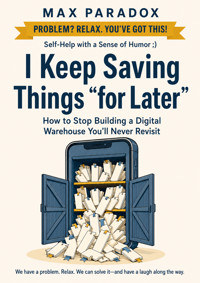
I Keep Saving Things “for Later” - How to Stop Building a Digital Warehouse You'll Never Revisit ebook
Max Paradox
Uzyskaj dostęp do tej i ponad 240000 książek od 14,99 zł miesięcznie
- Wydawca: ALL-IN Rafał Płonkowski
- Kategoria: Biznes, rozwój, prawo•Biznes, rozwój
- Język: angielski
You save an article because it looks useful. Then a video. Then a restaurant. Then a recipe, a product comparison, three travel ideas, seventeen screenshots, and a forty-minute tutorial that Future You is apparently going to watch during one of the many free afternoons that Future You definitely has.
Eventually, “Save for later” stops being useful and becomes a digital warehouse.
I Keep Saving Things “for Later” is a practical, funny guide to escaping the endless cycle of bookmarks, screenshots, open tabs, Watch Later queues, saved posts, unread articles, abandoned product comparisons, and information you were absolutely going to revisit someday.
Max Paradox explains why saving feels productive even when nothing is actually getting done-and how to replace digital accumulation with a system simple enough to survive real life.
Inside, you’ll learn how to:
decide whether something deserves saving at all;
distinguish reference material from temporary information and hidden tasks;
stop using screenshots as a reminder system;
set realistic limits on reading and video queues;
avoid saving information you can easily search for again;
turn endless research into actual decisions;
extract useful conclusions instead of preserving entire articles;
create a small reference system you can genuinely trust;
delete large backlogs without reviewing every item individually;
reduce the information coming in before it becomes clutter;
recover quickly when your system inevitably becomes messy again;
recognize when collecting has become a substitute for action.
This is not a book about becoming an extreme digital minimalist or spending an entire weekend building an elaborate “second brain.” You do not need more folders, more tags, more databases, or a dashboard that looks capable of launching a satellite.
You need fewer unresolved intentions.
The methods in this book are designed for normal people with jobs, messages, tired evenings, busy weeks, and absolutely no desire to conduct a quarterly review of screenshots from 2023.
The goal is simple: save less, find important things faster, use more of what you keep, and stop assigning Future You several hundred hours of optional information processing.
Because your cloud storage may be nearly unlimited.
Your attention is not.
And perhaps that article about “27 Things Successful People Do Before 6 A.M.” can survive without becoming part of your permanent collection.
This publication was prepared with the assistance of tools that support the creative process, including artificial intelligence-based solutions. The final concept, structure, and editing belong to the author.
Ebooka przeczytasz w aplikacjach Legimi na:
Liczba stron: 194
Rok wydania: 2026
Odsłuch ebooka (TTS) dostepny w abonamencie „ebooki+audiobooki bez limitu” w aplikacjach Legimi na:
Podobne


















INTRO
You save an article because it looks useful. Not useful enough to read now, obviously. That would be reckless. No, this is the kind of article Future You will appreciate—Future You being a calm, organized individual who apparently has several free afternoons reserved exclusively for reading things Present You cannot be bothered with.
So you tap Save.
Then you save a video about stretching your hips, a restaurant you might visit, a thread explaining retirement accounts, three recipes involving chickpeas, a hotel in Portugal, a productivity system, a documentary, a pair of shoes, a quote that seemed important at 11:47 p.m., and a detailed guide to choosing olive oil.
You now own information about olive oil.
You will never look at it again.
This is the strange thing about saving things “for later.” Saving feels responsible. It feels like the opposite of forgetting. You have not ignored the useful thing; you have carefully placed it somewhere safe, where it can remain untouched until the end of civilization. The act creates a tiny burst of satisfaction because you have converted a decision into storage. You do not need to read the article, watch the video, book the hotel, cook the recipe, or decide whether you actually want the shoes.
You have saved them.
Administrative excellence achieved.
At some point, however, your digital life starts resembling the warehouse at the end of an action movie. There are browser bookmarks. Screenshots. Saved Instagram posts. Watch Later videos. Notes. Emails starred for mysterious reasons. Tabs kept open because closing them would apparently destroy knowledge itself. Downloads with names like guide_final_FINAL_2.pdf. Photos of restaurant menus, parking signs, book covers, products, receipts, exercises, furniture, and one extremely blurry label you photographed six months ago because it contained information you urgently needed for something you no longer remember.
Nothing is technically lost.
This is somehow worse.
The problem is not that saving is bad. Saving is useful when it leads to retrieval. A boarding pass should be saved. A contract should be saved. The address of the apartment you rented for next weekend should definitely be saved unless you enjoy turning travel into an urban survival exercise.
The problem begins when saving becomes a substitute for deciding.
You see something interesting and your brain faces several possibilities. Read it now? Too busy. Ignore it? That feels wasteful. Decide whether it matters? That requires effort. So the brain discovers a beautiful fourth option: put it somewhere called “Later,” where no decision is required and every possibility remains emotionally alive.
Later is a magnificent place.
Nothing ever happens there.
This is why your collections grow faster than your ability to use them. Every saved item carries a tiny promise: I’ll come back to this. I’ll learn this. I’ll buy this. I’ll try this. I’ll think about this properly. I’ll become the sort of person who makes lentil soup, understands bond yields, stretches every morning, watches thoughtful documentaries, and visits small museums instead of spending forty-five minutes looking for somewhere to get coffee.
The collection gradually becomes less about information and more about identity. You are not merely saving a ten-minute video titled How to Fix Your Posture. You are preserving evidence that one day you may become A Person with Excellent Posture.
Closing the video would feel unnecessarily final.
So you keep it.
The trouble is that saved information still occupies mental space even when it occupies almost no physical space. A basement full of unopened boxes is obviously cluttered. Ten thousand digital items look pleasantly invisible until you need one of them. Then you discover that your carefully preserved knowledge system is actually an archaeological site.
You vaguely remember saving a useful article about sleep.
Was it in bookmarks?
Pocket?
Notes?
Email?
Instagram?
Screenshots?
A browser tab currently living somewhere between “weather tomorrow” and “why does my washing machine smell weird”?
The search begins.
Ten minutes later you have found a recipe for Korean pancakes, a 2023 article about electric cars, and a screenshot of a lamp.
The sleep article has joined the witness protection program.
This book is not going to tell you to delete everything, become a minimalist monk, or maintain one perfectly organized database featuring tags, sub-tags, categories, review dates, color codes, and a dashboard that looks like it belongs in air-traffic control. If your solution to having too much saved stuff requires a forty-five-minute tutorial, we have accidentally created another thing for you to save for later.
The goal is simpler: save less, retrieve more, and stop treating every interesting thing as an obligation to your future self.
You will learn how to decide whether something deserves saving at all, how to separate genuine reference material from digital guilt, how to reduce the number of places where information can hide, and how to create a system simple enough that you will still use it when you are tired, distracted, or operating at what scientists informally call “Tuesday.”
We will also deal with the harder part: deleting things you might theoretically need someday.
“SOMEDAY” is a powerful legal defense in the court of digital clutter.
What if that article becomes useful?
What if you finally take that trip?
What if you suddenly need the screenshot?
What if, in 2029, someone asks whether you still have the comparison chart for cordless vacuums?
First, congratulations on having extremely specific friends.
Second, this book will help you stop confusing possible future usefulness with actual value. Almost anything could theoretically become useful. A brick could become useful. This does not mean you need to carry seventeen bricks in your backpack in case the afternoon develops unexpectedly.
Digital storage makes this confusion easy because keeping something costs almost nothing in the moment. One tap. Done. No shelf gets full. No drawer stops closing. No family member asks why there are 680 articles stacked next to the sofa.
The cost arrives later as search friction, visual noise, unfinished intentions, and the quiet sense that you are behind on material nobody assigned you.
You are not behind.
You do not have to read everything you saved.
You do not have to watch everything in your queue.
You do not have to extract maximum value from every useful thing that crossed your screen.
The internet produces more interesting material before breakfast than you could consume in several lifetimes. Trying to preserve all of it is not knowledge management. It is standing beside a waterfall with a sandwich bag.
The solution is not stronger discipline. It is better rules.
By the end of this book, you will have rules for what gets saved, where it goes, how long it stays, and what happens when you never return to it. You will know how to clear old collections without spending an entire weekend conducting emotional interviews with bookmarks. You will have a minimum version for busy weeks, a fallback for when the system gets messy again, and a way to prevent “Later” from quietly rebuilding itself into a second internet.
Most importantly, you will stop treating saving as progress.
Sometimes progress means reading the thing.
Sometimes it means doing the thing.
And sometimes it means looking at an article titled 27 Habits That Will Transform Your Life, deciding your life has already been transformed enough for one day, and closing the tab.
No ceremony required.
Chapter 1 - Saving Is Not Organizing
You are looking for one screenshot.
Not an important screenshot in the historical sense. Nobody is waiting at the National Archives. It is simply a screenshot containing the name of a restaurant someone recommended three months ago. You remember the recommendation clearly enough to know that the restaurant was “amazing,” “not too expensive,” and possibly Italian.
You open Photos.
There are 8,462 images.
Good start.
You search “restaurant.” Your phone finds photographs of restaurant interiors, menus, plates, receipts, a picture of a restaurant sign taken from a moving car, and one photograph of your own kitchen table because modern image recognition occasionally operates with the confidence of a consultant who has misunderstood the assignment.
You scroll.
There are screenshots of flights you already took, products you did not buy, weather forecasts for days that have already happened, conversations you no longer remember, QR codes that expired during a previous geological era, and a chart explaining something about coffee.
The restaurant is nowhere.
You saved it so you would not lose it.
You have lost it very carefully.
This is the first uncomfortable distinction we need to make: saving something and organizing something are not the same activity.
Saving means transferring an item from the world into your possession.
Organizing means making it reasonably likely that you can find and use that item later.
Those two activities often happen together in the physical world because physical objects force decisions. If you bring home a new frying pan, you eventually have to put it somewhere. A kitchen cabinet has opinions about capacity. At some point it stops cooperating.
Digital storage is much more polite.
It will allow you to save 4,000 articles, 700 videos, 900 screenshots, twelve years of email, seventeen versions of the same PDF, and a folder called IMPORTANT containing three other folders called IMPORTANT NEW, IMPORTANT OLD, and SORT LATER.
No drawer jams.
No shelf collapses.
Your laptop does not call an intervention.
Because nothing physically blocks your path, accumulation can masquerade as organization for a very long time.
The Tiny Reward of “Handled”
Saving something creates a satisfying psychological shortcut.
Imagine you are reading an article about negotiating your salary. It looks useful, but you are standing in line for coffee and the person ahead of you has apparently ordered a beverage requiring civil engineering.
You do not want to read a 2,400-word article right now.
Fair enough.
But if you close it, there is a tiny feeling of loss. What if it contains something brilliant? What if you need it later? What if this is the article that finally teaches you how to ask for more money without sounding as though you are attempting a hostage negotiation?
So you save it.
Immediately, the tension drops.
The information has been “handled.”
Except it has not.
You have merely transferred responsibility from Present You to Future You.
This transfer feels productive because the brain prefers unresolved things to have a visible container. A bookmark, screenshot, star, folder, saved post, or open tab creates the impression that the loop is closed.
In reality, the loop is often just wearing a label.
This is why people can spend an hour creating folders for material they have not read and feel more productive afterward. Something has changed. Items moved. Categories appeared. There may even be icons.
The information itself remains completely unused.
You did not learn the thing.
You organized the possibility of learning the thing.
There is a difference.
A large one.
Your Collection Has Three Different Jobs
Most digital clutter becomes confusing because we store fundamentally different things together.
Consider these four items:
your car insurance policy;
an article about sleep;
a restaurant recommendation;
a funny video you may want to send to your brother.
All four can technically be “saved,” but they have completely different purposes.
The insurance policy is reference material. You may need to retrieve it later.
The sleep article is consumption material. You intend to read it once.
The restaurant is possible future action. You may visit it.
The video is temporary sharing material. Its useful life may be approximately six minutes, depending on your brother’s tolerance for raccoons falling off patio furniture.
When these different categories all go into one giant system called “saved stuff,” retrieval becomes difficult because there is no relationship between the place where you put something and the reason you kept it.
This is the digital equivalent of storing your passport, cereal, winter coat, and electric drill in one large cabinet.
Technically efficient.
Operationally concerning.
The first practical move in this book is therefore not deleting anything.
It is learning to ask a better question.
Instead of:
“Should I save this?”
ask:
“What will I do with this?”
That one question changes everything.
If the answer is “I may need to look this up later,” you are dealing with reference.
If the answer is “I want to read or watch this,” you are dealing with a queue.
If the answer is “I might buy, visit, cook, try, or do this,” you are dealing with a possible action.
If the answer is “I have no idea, but it feels useful,” you are dealing with digital emotional support.
That last category is larger than most people expect.
The Useful-Looking Trap
The internet contains a special type of object that is extremely easy to save: the useful-looking thing.
It has titles like:
“11 Things You Should Know Before Buying a Home”
“The One Setting You Should Change on Your iPhone”
“Seven Foods That Are Surprisingly High in Protein”
“How Successful People Structure Their Mornings”
“Three Travel Hacks Airlines Don’t Want You to Know”
You may have no immediate need for any of this information. You are not buying a home, changing phones, increasing protein, restructuring mornings, or fighting an airline.
But the information looks potentially useful.
Potential usefulness is dangerous because it has no natural limit.
Almost anything can qualify.
A video on knife sharpening?
Useful someday.
A guide to Tokyo subway etiquette?
You might go.
An article on negotiating a car lease?
You may need a car.
A twelve-minute explanation of how to remove red wine from linen?
Anything can happen.
At this rate, your saved collection becomes a preparedness bunker for imaginary versions of your future life.
The problem is not curiosity. Curiosity is excellent.
The problem is confusing curiosity with obligation.
You are allowed to find something interesting without appointing yourself its permanent archivist.
A Saved Item Should Have a Return Path
Here is a very simple test.
Before saving something, ask:
“How would I realistically find this again?”
Not theoretically.
Realistically.
If you save a restaurant recommendation as Screenshot 6,381, the answer may be: “I would scroll through thousands of images while whispering increasingly hostile things about technology.”
That is not a return path.
If you save the restaurant in a short list called “Places to Try,” the return path is obvious.
If you save a tax document in a folder called “Taxes 2026,” good.
If you save it in Downloads between manual.pdf, manual(1).pdf, scan00034.pdf, and a picture of a sofa, we have moved away from civilization.
A good saving system makes retrieval predictable.
You should not need to remember the exact day you encountered something, which app you were using, whether you saved it as a screenshot or link, and what phase of the moon was occurring at the time.
If finding the item requires reconstructing your past behavior, the system is not organized.
It is a crime scene.
Use the Four-Second Test
Do not create a complicated decision tree yet. You do not need laminated flowcharts.
For now, use this four-second test whenever you feel the urge to save something:
1. What is this for?
Reference, consumption, action, or temporary use?
2. When am I likely to use it?
Today, this week, during a specific project, during an upcoming trip—or in the traditional month of “someday”?
3. Where would I look for it?
Name the place before saving.
4. What happens if I do not save it?
This is the most powerful question.
Often the answer is:
“Nothing.”
You will survive without the article about the ten best desk plants.
Your future office will not become botanically ungovernable.
If losing an item would cause no meaningful problem, saving it is optional. Interesting is not the same as necessary.
Do Not Organize the Avalanche Yet
At this point you may feel an urge to open every app you use and begin reorganizing everything.
Please do not.
This is exactly how people turn a clutter problem into a six-hour infrastructure project.
You begin by cleaning bookmarks.
Then you create categories.
Then categories need icons.
Then you research naming conventions.
Then you find an app that promises a “second brain.”
Then you watch three tutorials about the app.
Then you save the tutorials.
We have made progress in the wrong direction.
Your existing backlog will be handled later. First, stop feeding it at the same rate.
Think of a bathtub overflowing onto the floor. There are two possible first moves:
mop with greater passion;
turn off the faucet.
We are starting with the faucet.
For the next seven days, do not try to become digitally pure. Simply interrupt automatic saving.
Every time your finger moves toward Save, Bookmark, Screenshot, Watch Later, Star, or “Open in New Tab,” ask:
What will I do with this?
If you have a clear answer, save it in the place where that action naturally belongs.
If you do not have a clear answer, let it go.
This will feel strangely uncomfortable at first because deleting—or not saving—can feel like losing access to value.
But you are not losing the value.
You are declining to warehouse a possibility.
The Difference Between Storage and a System
A system has rules.
Storage has space.
That distinction matters because digital services market enormous storage as if capacity itself solves the problem. You can store 50,000 photos. Excellent. You can also fit a tremendous number of boxes in a warehouse. That does not mean you know which box contains your passport.
More capacity can actually make poor habits easier because there is no forcing function.
You never have to decide.
This is how someone ends up with 37,000 emails and says, “It’s fine, I can search.”
Can you?
Search for the email from that woman about that document from maybe March.
Go ahead.
I will notify the authorities if you are not back by dinner.
A useful system does not require perfect order. It requires a few predictable destinations and clear reasons for keeping things.
Later in the book, we will simplify those destinations.
For now, your only job is to stop treating the act of saving as proof that something has been managed.
Minimum Viable Version
If your energy level is approximately potato, do this:
For one day, save nothing unless you can finish this sentence:
“I am saving this because I will use it for __.”
Examples:
“I am saving this because I will use it when I file my taxes.”
“I am saving this because I will use it to choose a hotel for my October trip.”
“I am saving this because I will read it during my commute tomorrow.”
“I am saving this because I will cook this recipe on Saturday.”
Notice how specific those are.
Now compare:
“I’m saving this because it seems useful.”
That sentence has built more digital warehouses than any construction company.
Plan B: You Saved It Anyway
You will sometimes save things automatically.
That is normal.
Years of muscle memory do not disappear because Chapter 1 made several reasonable points.
So use a simple backup rule: if you catch yourself saving something without knowing why, reverse the action immediately.
Unsave it.
Delete the screenshot.
Close the tab.
Remove it from Watch Later.
You do not need a discussion.
There will be no retirement ceremony for the bookmark.
The point is not to achieve a perfect save rate. The point is to create a pause between encountering information and adopting it.
That pause is where your system begins.
Your practical action for today is simple: for the next twenty-four hours, do not save anything without naming its future use and destination.
If you cannot say what it is for, let it pass.
The internet has another copy.
Probably twelve thousand.
Chapter 2 - Future You Has Enough to Do
At 10:38 p.m., you discover a forty-minute video titled The Complete Beginner’s Guide to Strength Training.
This seems excellent.
You are not going to watch it now because you are tired. Also, you are currently in bed performing the important nightly ritual of discovering educational material you would never search for at 2:15 in the afternoon.
So you add it to Watch Later.
Future You will watch it.
Future You is incredible.
Future You wakes rested, reads saved articles, watches educational videos, cooks bookmarked recipes, compares insurance policies, processes screenshots, answers old emails, uses discount codes before they expire, finishes online courses, visits saved restaurants, and occasionally has time for basic hygiene.
Present You, meanwhile, would like to sleep.
This arrangement appears fair because Future You has one enormous advantage:
Future You does not exist yet.
You can assign that person anything.
Saving Creates Invisible Commitments
A saved item often feels neutral.
It is just a bookmark.
Just a video.
Just a screenshot.
Just a note.
But emotionally, many saved items are tiny commitments.
“I should read this.”
“I should try this.”
“I should remember this.”
“I should compare these.”
“I should go there.”
“I should learn that.”
One saved item weighs almost nothing.
Five hundred saved items create a quiet background feeling that you are perpetually behind.
Nobody has officially assigned you the work.
You assigned it to yourself.
This is how a collection of interesting material becomes a private syllabus for a university you never enrolled in.
The key problem is not storage capacity.
It is future capacity.
There are only so many hours in your life during which you will willingly consume material you previously saved.
That number is much smaller than the number of things you can save.
Saving takes one second.
Reading takes twelve minutes.
Watching takes twenty-eight.
Comparing takes thirty.
Trying the recipe requires ingredients, a cutting board, and discovering that apparently you do not own cumin.
The economics are terrible.
The Queue That Never Receives a Budget
Imagine a normal work project.
If someone says, “We should do this,” a competent team eventually asks:
Who is doing it?
When?
How long will it take?
What gets deprioritized?
Digital saving skips all four questions.
You see a seventy-minute podcast.
Save.
An article.
Save.
A twenty-five-minute tutorial.
Save.
A list of books.
Save.
A detailed guide to investing.
Save.
Nobody asks whether your future calendar has room for any of this.
Your personal information queue operates like an airport allowing unlimited planes to land without checking whether there is space at the terminal.
Eventually everyone is parked somewhere, nobody is moving, and a man in row 18 is furious about pretzels.
The solution is not to become faster at consuming.
It is to stop admitting unlimited arrivals.
Put a Price Tag on “Later”
Here is a useful exercise.
Look at ten things you recently saved for later.
Estimate the time required to actually use each one.
For example:
article: 8 minutes;
video: 22 minutes;
recipe: 45 minutes including cooking;
product comparison: 20 minutes;
podcast: 58 minutes;
travel guide: 15 minutes;
long social-media thread: 6 minutes;
online course lesson: 35 minutes;
restaurant list: 10 minutes to review;
PDF guide: 25 minutes.
Total: 244 minutes.
A little over four hours.
That is ten saved items.
If you save twenty things a week, you may be casually assigning Future You eight hours of optional information processing.
Eight hours.
A full workday.
For material you encountered while standing in line, sitting on the couch, avoiding another task, or waiting for pasta water to boil.
Future You would like union representation.